
Your phone rings while you're on a ladder installing electrical wiring. You can't answer. The caller needs an emergency repair—$1,200 job. They call the next electrician on Google. Job lost in 30 seconds.
Research shows 62% of calls to home services businesses go unanswered—and 42% of SMBs lose $500 or more per month to missed calls. For contractors, that's not just annoying—it's financially devastating.
At average contractor call volumes, missing 70% of calls means losing $16,800-$252,000 annually in quote requests, appointments, and emergency jobs you never knew about.
The best AI receptionist apps now resolve 90-95% of calls without human intervention, answer in under 5 seconds, and maintain 99% positive caller sentiment — measured across 1,446,980 real business calls. They route emergencies to your phone, book appointments directly into your calendar, and cost less than one employee lunch per day.
In this guide, we compare 9 AI receptionists for small businesses in 2026—honest pros, cons, and pricing for each.
Quick Answer: The Best AI Receptionist App in 2026
Short answer: The best AI receptionist app in 2026 is NextPhone — a flat-rate $199/month AI receptionist solution that picks up in under 5 seconds, resolves 90–95% of calls without human escalation, and maintains 99% positive caller sentiment across 1,446,980+ real business calls answered. It runs 24/7, supports 9 languages, includes spam filtering and emergency routing, and is the only AI receptionist software in this comparison that doesn't meter you per call or per minute.
Best for home services & contractors: NextPhone (flat-rate, emergency keyword routing). Best AI + human hybrid: Smith.ai (AI tier $97.50/mo, human tier $292.50/mo for 30 calls). Best budget AI: Dialzara (from $29/mo) or Upfirst (from $24.95/mo) — limited features. Best for scheduling-heavy practices: My AI Front Desk (from $79/mo).
A production after-hours call answered by NextPhone — greeting, urgency capture, contact details, callback flagged. This is the call a voicemail box would have lost.
What Is an AI Receptionist App?
An AI receptionist app is software that uses artificial intelligence to answer your business phone calls automatically. Instead of hiring a full-time receptionist or letting calls go to voicemail, an AI virtual receptionist handles inquiries 24/7 using natural language processing. The virtual receptionist market has reached $6.26 billion, driven by businesses seeking 24/7 coverage without the cost of human staff.
How AI Receptionist Apps Work
The technology sounds complex, but the process is straightforward. When a call comes in, the AI follows three steps:
First, it converts the caller's voice to text (speech-to-text). Then, it analyzes what the caller wants using natural language processing—the same technology that powers Siri and Alexa. Finally, it either responds with an answer (text-to-speech) or routes the call to the right person.
You train the AI by feeding it information about your business: hours of operation, services offered, pricing, frequently asked questions. The more detail you provide during setup, the better it performs.
What AI Receptionists Can Do
Modern AI receptionist apps handle most routine business calls:
- Answer questions about hours, pricing, and services
- Book appointments directly into your calendar
- Route urgent calls to your phone immediately
- Take detailed messages with caller contact info
- Filter spam and robocalls automatically
- Send confirmation texts after bookings
- Handle multiple calls simultaneously (no busy signals)
Modern AI achieves 85-95% accuracy for routine inquiries when trained on business-specific information. For complex or unusual questions, the best systems route calls to you rather than guessing. The technology is advancing rapidly—85% of customer service leaders plan to pilot conversational generative AI in 2025.
AI vs. Traditional Receptionist
The cost difference is stark. The Bureau of Labor Statistics reports the median receptionist salary is $33,960 per year ($2,830/month). Add benefits—health insurance, payroll taxes, paid time off—and you're looking at $3,750-$4,000 monthly for a full-time receptionist.
That receptionist works 40 hours per week. An AI receptionist costs $199-$500 per month for full-featured solutions and works 168 hours per week (24/7/365). No breaks, no sick days, no vacations.
The math makes sense for small businesses. A traditional receptionist costs $45,000 annually (salary plus benefits). An AI receptionist costs $2,388 annually ($199/month). That's a $42,612 savings—and the AI never sleeps.
Why Small Businesses Need AI Receptionist Apps
Missing calls doesn't feel catastrophic in the moment. You're busy. You'll call them back. But the data tells a different story.
The Hidden Cost of Missed Calls
Industry research shows 60-80% of small business calls go unanswered. That's not an exaggeration—three out of every four potential customers can't reach you.
What happens when someone calls and gets voicemail? Research shows 60-80% call a competitor instead of leaving a message. They don't wait. They move on to the next Google result.
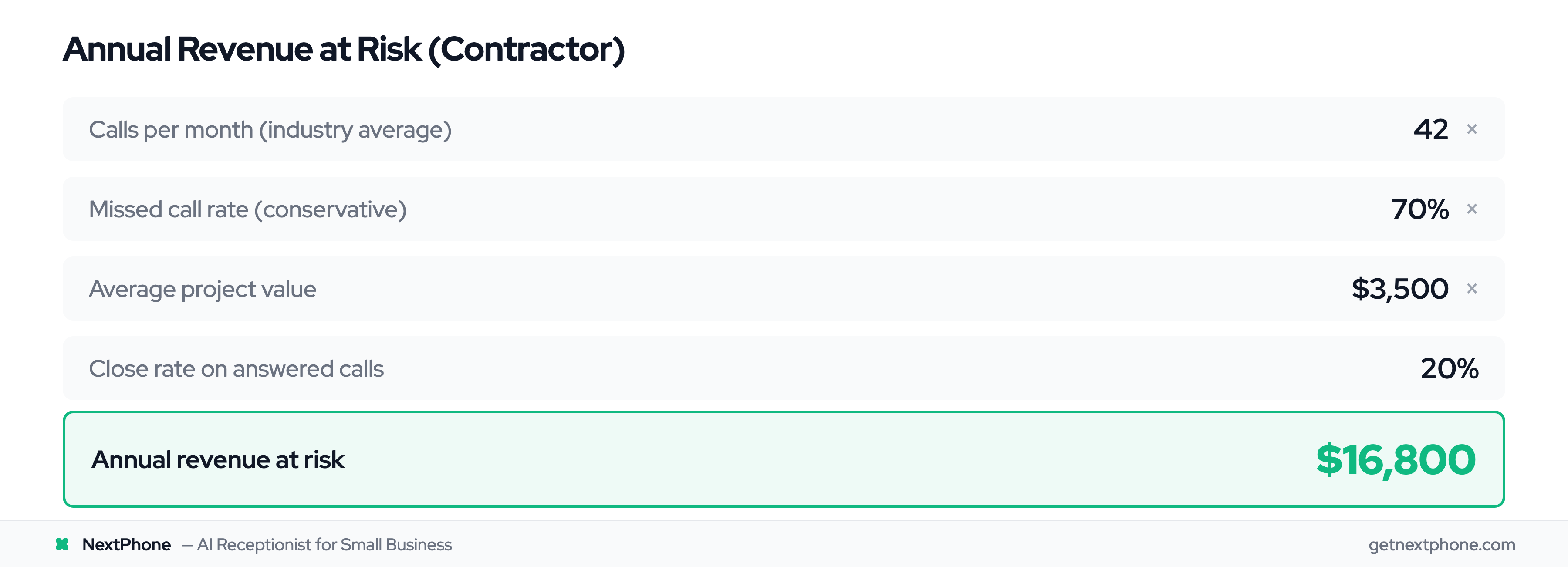
Let's do the math for a general contractor:
42 calls/month (industry average)
× 70% missed (conservative estimate from industry data)
= 29 missed calls monthly

Of those 29 missed calls:
- 6.9% are quote/estimate requests
- That's 2 quotes lost per month

At $3,500 average project value
× 20% close rate
= $1,400/month in lost revenue
= $16,800 lost annually
For roofers, the numbers are even worse. Roofing contractors in industry studies average 87 calls monthly but miss 76.6%. With 10.6% being quote requests for projects averaging $15,000, that's $252,000 in annual lost revenue.
An AI receptionist costs $2,388 per year. If it captures just one additional $3,500 job you would've missed, you're profitable for 17 months.
After-Hours Opportunities You're Missing
Research on customer call patterns found that 15.9% of customer calls contain urgency language like "ASAP," "urgent," "emergency," or "today." Another 6.2% are true emergencies requiring immediate response.
These aren't calls that can wait for a callback tomorrow morning. Real example from industry research data:
"Needs emergency AC repair, no cooling in 95 degree weather."
When someone's AC dies in a heat wave, they're calling 5-10 HVAC contractors. The first one to answer gets a $1,200+ emergency job. The rest get nothing.
After-hours calls represent massive revenue opportunities. Customers don't only have emergencies during business hours. But if you're not answering at 9 PM on a Tuesday, you're sending them straight to your competitor who has an AI receptionist.
Time Wasted on Repetitive Questions and Spam
Research analyzing call patterns shows 6.5% of customer calls ask the same repetitive questions: "What are your hours?" "What's your service area?" "How much do you charge?"
Each interruption costs 15-20 minutes of focus time. You stop what you're doing, answer the phone, explain your hours for the hundredth time, and lose your momentum.
Then there's spam. Industry analysis reveals 7% of all incoming calls are spam or robocalls—that's 35 wasted interruptions monthly for a contractor getting 500 calls yearly. For electricians, it's worse: their numbers get on spam lists more frequently, hitting a 15.5% spam rate.
AI filters spam automatically. It blocks robocalls before your phone even rings.
And here's the kicker: 25.4% of customer calls include an explicit request for a callback. "Have him call me back about the roof estimate." Without a tracking system, studies show 42% of those callback requests never get returned. That's hundreds of lost customers who felt ignored.
AI apps track every callback request with contact info, urgency level, and what they called about. You see it in your dashboard and actually follow up.
9 Best AI Receptionists for Small Business (2026)
We compared each service on pricing transparency, feature depth, integration ecosystem, voice quality, and setup time. Each product was evaluated at the same call volume scenarios to normalize pricing comparisons.
Disclosure: NextPhone is our product. We've included it because it competes directly in this category, but we applied the same evaluation criteria to every service. Where NextPhone falls short—single pricing tier, contractor focus, no human fallback—we say so.
1. NextPhone - Best Overall for Small Business
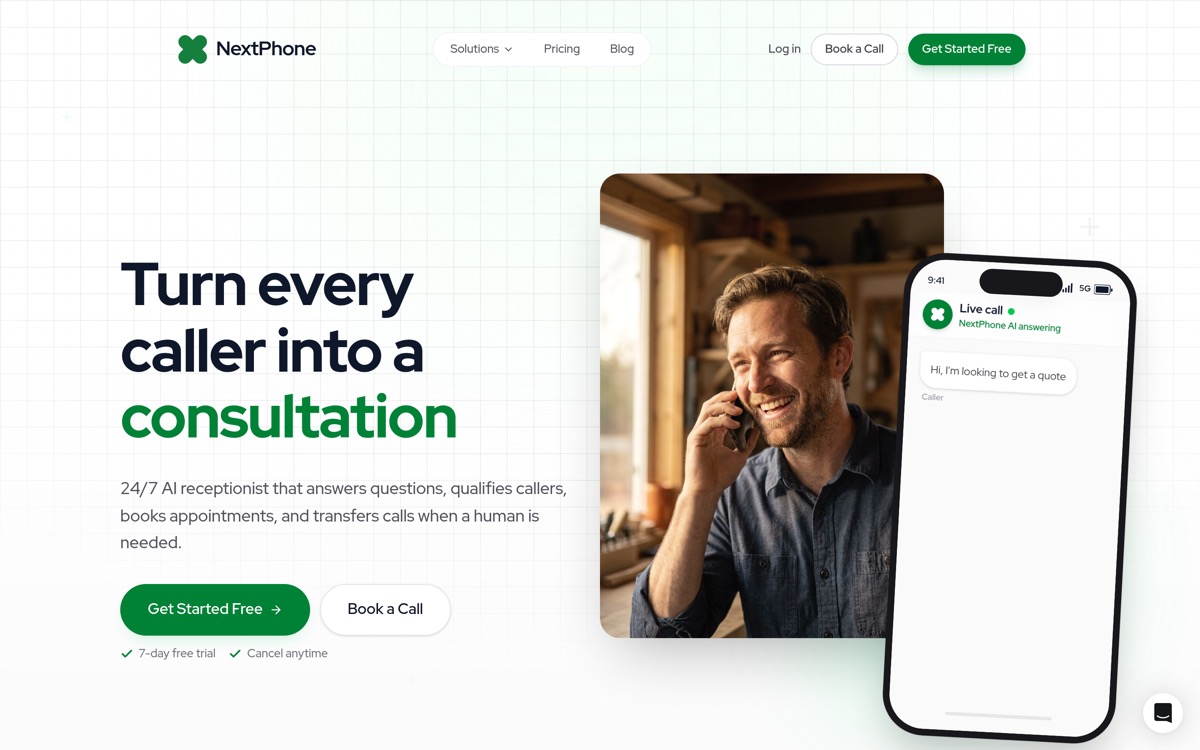
For all contractors: Roofing, HVAC, electrical, plumbing, and general contractors. Unless you're a medical practice requiring complex diagnostic triage, this is the answer.
NextPhone was built specifically for contractors and field service businesses that struggle with high missed call rates. The flat-rate unlimited pricing eliminates surprise bills during busy season.
- 24/7 AI call answering (responds in under 5 seconds)
- Emergency call detection with keyword routing ("urgent," "emergency," "ASAP")
- Automatic spam filtering (blocks 7% of wasted calls)
- Callback request tracking (captures 25.4% of calls requesting follow-up)
- Appointment booking with Google Calendar and Outlook integration
- Call transcripts and analytics dashboard
- Unlimited parallel calls (no busy signals ever)
- Industry-specific training (understands contractor terminology)
- CRM integration (Salesforce, HubSpot, ServiceTitan, Jobber)
Pricing:
- Single tier: $199/month flat rate
- Unlimited incoming calls (no per-minute or per-call charges)
- No setup fees
- 7-day free trial
Pros:
- Flat-rate pricing means no surprise bills during peak season
- Contractor-specific features (emergency routing, spam filtering for trades)
- Fast answer time (under 5 seconds keeps customers on the line)
- Unlimited calls included (scales with your business)
- Completely transparent pricing ($199/mo, period)
Cons:
- Single pricing tier (no cheaper option for very low volume)
- Focused on contractors (may lack features for other industries)
Why contractors choose NextPhone:
Research analyzing home services calls found that 6.2% are emergencies requiring immediate response. NextPhone's AI detects urgency keywords—"emergency," "pipe burst," "no heat," "urgent"—and routes these calls directly to your phone instead of trying to handle them with AI.
Real example from industry data:
"Emergency pipe burst, needs plumber immediately."
When that call comes in at 9 PM, NextPhone's AI detects "emergency" and "immediately," connects the caller to your phone, and you answer a $1,200 after-hours job in 15 seconds.
The spam filtering is calibrated for contractors. Research shows electricians face a 15.5% spam rate—their numbers get on lists more than other trades. NextPhone automatically filters these time-wasters.
And here's the big one: flat-rate unlimited pricing. Most competitors charge per-minute or per-call, which creates sticker shock when you hit busy season. Roofing contractor in May after hailstorms? You might get 200 calls. With per-call pricing at $5/call, that's a $1,000 surprise bill. NextPhone stays $199 whether you get 20 calls or 200.
The result? 99% caller satisfaction. Most callers can't tell they're talking to AI—they just know someone finally answered the phone.
Setup takes a few minutes. No technical skills required.
Try NextPhone free for 7 days
AI answering service that answers, qualifies, and books — 24/7.
Get Started Free2. Smith.ai - Best for AI + Human Hybrid
Best for: Law firms, professional services, and businesses where some calls genuinely require human judgment.
Smith.ai combines AI efficiency with live human receptionists as backup. Over 5,000 businesses use the service, with particularly strong adoption among law firms for client intake.
Pricing: Starting at $255/month for 30 calls. AI-only plans from $97.50/month. Free trial: 14-day money-back guarantee Standout feature: Human receptionists handle calls AI can't—complex intake gets real empathy.
Pros:
- AI handles routine calls, humans handle complex situations
- Extensive CRM integrations (Clio, Salesforce, HubSpot)
- Strong lead qualification and intake workflows
- 4.8+ stars on G2, Capterra, and Clutch
Cons:
- Per-call pricing gets expensive at volume ($8.50+/call overage)
- Starting at $255/month for just 30 calls
- Complex pricing tiers make budgeting harder
- At 100 calls/month, expect $850+ vs flat-rate alternatives
Smith.ai works best for law firms and professional services where sensitive intake calls genuinely require a human voice. The AI-human handoff is smooth. The downside is cost: volume growth punishes you with per-call overages. Choose Smith.ai when call quality matters more than cost predictability.
3. Ruby - Best for Human Receptionists
Best for: Businesses where callers actively expect or prefer a human, and budget isn't the primary concern.
Ruby provides US-based live receptionists, not AI. It's on this list because many "best AI receptionist" searches come from people comparing AI against human alternatives.
Pricing: Starting at $319/month for 50 receptionist minutes Free trial: 21-day money-back guarantee Standout feature: Real human receptionists based in the US, trained on your business.
Pros:
- Genuine human interaction (no AI involved)
- US-based team, professional and consistent
- Strong reputation and established track record
- Excellent for businesses where callers expect a person
Cons:
- Most expensive option on this list ($319+ for just 50 minutes)
- Per-minute overage charges add up fast ($5.19+/min)
- After-hours coverage requires add-on
- No AI automation for routine calls
Ruby is the right choice if your callers actively dislike AI or your calls require empathy a machine can't deliver. For everyone else, the price premium is hard to justify—especially since AI handles routine calls (hours, pricing, scheduling) identically to a human at a fraction of the cost.
4. Dialzara - Best Budget AI Option
Best for: Businesses testing AI reception for the first time without a major commitment.
Dialzara offers pure AI call answering at entry-level pricing, making it accessible for solopreneurs and very small businesses with low call volume.
Pricing: Starting at $29/month (limited calls), up to $199/month for higher tiers Free trial: Available Standout feature: Low entry price lets you test AI reception without financial risk.
Pros:
- Affordable entry point ($29/month to start)
- Pure AI with decent voice quality
- Easy setup process
- Good for testing whether AI reception works for your business
Cons:
- Limited call volume at base tier
- Fewer integrations than established platforms
- Less mature product with smaller feature set
- No emergency routing at lower tiers
Dialzara works for businesses with low call volume (under 30 calls/month) who want to experiment with AI reception before committing to a full-featured platform. If you're getting 50+ calls/month and need emergency routing or deep CRM integration, you'll outgrow the base tier quickly.
5. Upfirst - Best for Solopreneurs
Best for: Solo professionals and very small businesses wanting simple, affordable AI call answering.
Upfirst targets the simplicity end of the market—minimal setup, affordable pricing, basic AI coverage.
Pricing: Starting at $24.95/month Free trial: Available Standout feature: Simplest setup on this list—designed for non-technical users.
Pros:
- Most affordable starting price on this list
- Clean, simple interface
- Quick setup with minimal configuration
- Good for basic call handling
Cons:
- Smaller feature set than full-featured platforms
- Newer product with less proven track record at scale
- Limited integrations
- May not scale for growing businesses
Upfirst is a good starting point if you're a solopreneur getting 10-20 calls/month and want basic AI coverage. Understand the tradeoff: you get affordability at the cost of features like emergency routing, advanced CRM sync, and multi-language support.
6. My AI Front Desk - Best for Scheduling-Heavy Businesses
Best for: Dental offices, salons, therapy practices, and any business where 80%+ of calls are appointment-related.
My AI Front Desk focuses specifically on scheduling workflows—booking, rescheduling, cancellations, and calendar management.
Pricing: From $79/month Free trial: 7-day trial Standout feature: Built specifically around appointment booking and calendar management.
Pros:
- Strong scheduling and calendar integration
- Designed for appointment-heavy workflows
- Handles booking, rescheduling, and cancellations naturally
- Affordable for the feature set
Cons:
- Narrower feature set outside of scheduling
- Less CRM depth than broader platforms
- Limited emergency routing capabilities
- Not ideal for businesses with complex non-scheduling calls
If the vast majority of your calls are about appointments, My AI Front Desk handles that use case well. For businesses where calls also include emergencies, complex quotes, or non-scheduling inquiries, a more general-purpose AI receptionist is a better fit.
7. Rosie - Best for After-Hours Coverage
Best for: Businesses that answer most calls themselves but need backup for after-hours and busy periods.
Rosie focuses on the missed-call problem: catching calls that go to voicemail when you're unavailable, rather than replacing your phone system entirely. (If text acknowledgment on missed calls is all you need right now, the missed call text back guide covers the simpler options before stepping up to a full AI receptionist.)
Pricing: Pay-per-minute starting at $0.25/minute Free trial: Available Standout feature: Purpose-built for after-hours and overflow call handling.
Pros:
- Designed specifically for missed call recovery
- Pay only for what you use
- Good voicemail-to-text transcription
- Works as a supplement to your existing setup
Cons:
- Per-minute pricing gets expensive at higher volume
- Limited as a full-time receptionist replacement
- Fewer integrations than all-in-one platforms
- No emergency routing
Rosie works as a supplement—handling calls when you can't answer rather than replacing your phone system. Good for businesses that answer most calls themselves but lose revenue on after-hours and busy-period calls. At volume, per-minute costs exceed flat-rate alternatives.
8. TTYL - Best iOS Companion App
Best for: iPhone users who want a lightweight AI receptionist managed entirely from their phone.
TTYL is an iOS-only AI receptionist with a 4.9-star App Store rating and 10,000+ businesses using it. It's built as a mobile-first call handler—answer calls, block spam, get summaries.
Key Features:
- Native iOS app (App Store exclusive)
- AI-powered call answering with natural-sounding voices
- Spam call detection and blocking
- Detailed call summaries, transcripts, and recordings
- Customizable greetings and response protocols
- Appointment scheduling
- 24/7 availability
Pricing:
- Not publicly listed (download app to see plans)
Pros:
- Excellent iOS app experience (4.9/5 rating)
- Strong spam filtering
- Natural voice quality
- Simple setup from your phone
Cons:
- iOS only—no Android support
- No public pricing transparency
- Fewer integrations than NextPhone (100+)
- No emergency keyword detection
- No smart forwarding for urgent calls
- Limited to phone-based management (no web dashboard)
How it compares to NextPhone:
TTYL is a solid iOS app for basic call answering and spam filtering. NextPhone offers the full package: flat-rate unlimited at $199/month, emergency detection, smart forwarding, 20+ languages, unlimited simultaneous calls, 100+ CRM integrations, and both mobile and web access. If you need more than basic call screening, NextPhone covers it.
AI Receptionist Comparison Table
Pricing Comparison
| Product | Starting Price | Pricing Model | AI / Human | Best For |
|---|---|---|---|---|
| NextPhone | $199/mo | Flat-rate unlimited | AI | Contractors & SMBs |
| Smith.ai | $255/mo | Per-call (30 included) | AI + Human | Law firms, professional services |
| Ruby | $319/mo | Per-minute (50 min) | Human | Callers who prefer humans |
| Dialzara | $29/mo | Tiered | AI | Budget testing |
| Upfirst | $24.95/mo | Tiered | AI | Solopreneurs |
| My AI Front Desk | $79/mo | Flat-rate | AI | Scheduling-heavy businesses |
| Rosie | $0.25/min | Per-minute | AI | After-hours overflow |
| TTYL | In-app pricing | Subscription | AI | iOS users |
| RingCentral | Platform add-on | Varies | AI | Existing RingCentral users |
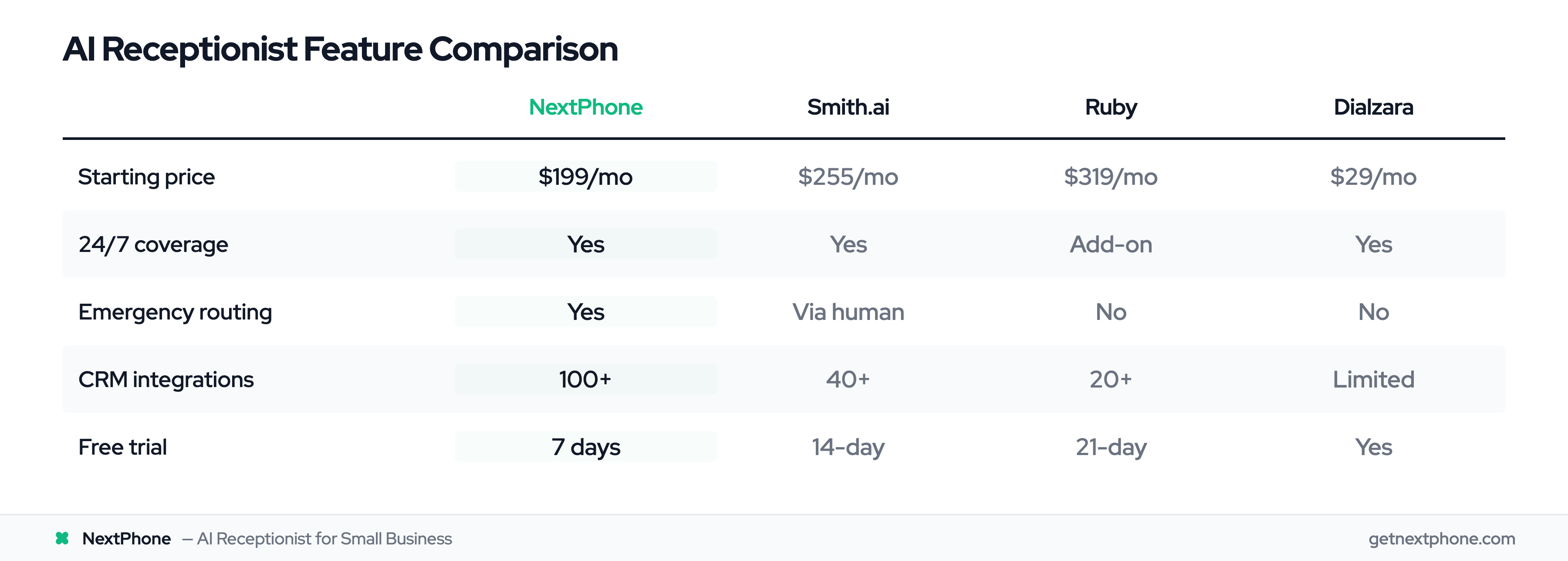
Feature Comparison
| Product | 24/7 | Emergency Routing | CRM Integrations | Free Trial |
|---|---|---|---|---|
| NextPhone | ✅ | ✅ | 100+ | 7 days |
| Smith.ai | ✅ | Via human | 40+ | 14-day guarantee |
| Ruby | Add-on | ❌ | 20+ | 21-day guarantee |
| Dialzara | ✅ | ❌ | Limited | Yes |
| Upfirst | ✅ | ❌ | Limited | Yes |
| My AI Front Desk | ✅ | ❌ | Limited | 7 days |
| Rosie | ✅ | ❌ | Limited | Yes |
| TTYL | ✅ | ❌ | Limited | Yes |
| RingCentral | ✅ | ❌ | Native | With plan |
Best AI Receptionist App by Vertical and Use Case
Different businesses have different call patterns. Here's our pick by industry and scenario, based on the call data we see across 1,446,980+ inbound calls handled by our AI receptionist.
Best AI Receptionist for Small Business
For most small businesses, NextPhone is the best AI receptionist for small business in 2026. The flat-rate $199/month covers unlimited inbound calls — no per-minute meter, no overage anxiety. You get emergency routing, spam filtering, calendar booking, and 100+ Zapier-bridged integrations included.
Which AI virtual receptionist is best for small businesses depends on call volume: under 20 calls/month, Upfirst or Dialzara can work as a cheap entry point; at 30+ calls/month, the per-call metered services (Smith.ai, Ruby) get expensive fast and NextPhone's flat rate wins on both price and feature depth.
Best AI Receptionist for Contractors and Home Services
For contractors — plumbing, HVAC, electrical, roofing, general — NextPhone is purpose-built for the missed-call problem and the seasonal volume spikes. The AI detects urgency keywords ("pipe burst," "no heat," "roof leak," "no AC") and routes those calls to your cell instead of trying to handle them. Most home services alternatives either meter you per call (painful in storm season) or skip emergency routing entirely.
If you're shopping AI receptionist for home services alternatives, the realistic options are: NextPhone (flat-rate, contractor-tuned), Smith.ai (AI+human, expensive at volume), Rosie (after-hours overflow only), and My AI Front Desk (scheduling-only). For full coverage at predictable cost, NextPhone is the answer.
Best AI Receptionist for Roofing Companies
Roofing contractors have the worst missed-call math in home services — Invoca's data shows up to 76.6% of calls go unanswered, and roofing leads are high-ticket ($15,000+ per project). After a hailstorm, call volume can 10x in a week. NextPhone's unlimited flat-rate is the only sensible option at that volume; per-call services bill you $1,000+ in surprise overage. Emergency keyword detection ("storm damage," "leak," "tarp") routes the highest-intent calls straight to you.
Best AI Receptionist for Construction Companies
For construction companies and general contractors, the right AI receptionist needs to: (1) handle subcontractor coordination calls, (2) route emergency jobsite calls, (3) capture estimate requests with project type and budget. NextPhone handles all three with custom intake questions, plus integrates with QuickBooks and ServiceTitan via Zapier.
Best AI Receptionist for Trucking Companies
Trucking companies need an AI receptionist that handles dispatch overflow, after-hours load requests, and driver call-ins around the clock. NextPhone runs 24/7/365 and can route urgent dispatch calls to your on-call number while capturing structured load data (origin, destination, weight, pickup time) for everything else.
Best AI Receptionist for Managed Services Providers (MSPs)
For MSPs, the AI receptionist needs to triage urgent client tickets, route VIP accounts to your on-call engineer, and capture detailed problem descriptions for standard issues. NextPhone's custom intake fields let you collect client name, system affected, error message, and urgency — then push the record into ConnectWise or Autotask via Zapier. Smith.ai's hybrid AI+human model also works here if your clients expect a live person.
Best AI Receptionist for Dental Practices (Voicify Competitors)
For dental practices comparing Voicify alternatives, the realistic competitors are: NextPhone, Smith.ai, My AI Front Desk, and Ruby. NextPhone handles appointment booking, new-patient intake, and insurance verification questions through configurable intake fields. My AI Front Desk is the most narrowly-focused on scheduling. Smith.ai adds human backup for sensitive intake. NextPhone is the flat-rate, full-feature pick.
Most Reliable AI Receptionist Available 24/7
The most reliable AI receptionist available 24/7 is the one that picks up consistently, handles overflow without dropping calls, and degrades gracefully when it doesn't know an answer. NextPhone hits under 5 seconds to pickup, handles unlimited simultaneous calls (no busy signals), and resolves 90–95% of calls without human escalation — the remaining 5–10% get smart-forwarded to your phone with full context. The real comparison isn't AI vs human — it's AI vs voicemail.
Best 24/7 Coverage AI Receptionist
Every AI receptionist on this list runs 24/7 in theory; the meaningful question is what they cost when you actually use them at 2 AM. Per-minute services (Ruby at $5.19/min overage, Rosie at $0.25/min) penalize after-hours volume. Flat-rate AI (NextPhone $199/mo, My AI Front Desk $79/mo for scheduling-only) doesn't. For best 24/7 coverage at predictable cost, NextPhone is the pick.
Cheapest AI Receptionist
The cheapest AI receptionist apps in 2026 are Upfirst ($24.95/mo) and Dialzara (from $29/mo) — both have limited features, low call caps, and minimal integrations. They work for solopreneurs getting 10–20 calls/month. For everyone else, the math flips: the price difference vanishes the moment a $3,500 job slips through the cracks because the cheap service didn't have emergency routing or callback tracking. NextPhone at $199/mo with unlimited calls is cheaper than Ruby ($319), AnswerConnect ($325), and Smith.ai's human tier ($292.50 for just 30 calls).
Free AI Receptionist for Small Business
There is no genuinely free AI receptionist for small business worth recommending — the "free" options are either time-limited trials, demo accounts capped at a handful of calls, or stripped-down free tiers that can't actually answer your business phone. What is widely available is free trials: NextPhone offers a 7-day free trial with the full feature set ($199/mo after), Smith.ai offers a 14-day money-back guarantee, Ruby a 21-day guarantee, and Dialzara/Upfirst free trials. Use the trial period to validate fit before committing.
Best Niches for AI Receptionist (2025–2026)
The best niches for AI receptionist in 2025–2026, based on the verticals where missed-call cost is highest and answering patterns are highly repeatable: (1) home services (plumbing, HVAC, electrical, roofing — emergency-heavy and seasonal), (2) legal practices (high-stakes intake, conflict checks, after-hours consultations), (3) dental and medical offices (appointment-heavy, predictable workflows), (4) MSPs (24/7 triage, structured ticket capture), (5) trucking and logistics (dispatch overflow, driver call-ins), and (6) real estate (showing requests, property inquiries that need instant response). All of these share the same DNA: high missed-call cost, repeatable call patterns, and an after-hours tail.
AI Receptionist Use Cases by Industry
| Industry | Top use cases | Why AI works |
|---|---|---|
| Home services | Emergency triage, after-hours quoting, scheduling | Time-sensitive, voicemail kills the lead |
| Legal | New-client intake, conflict screen, consult booking | Standardized scripts, sensitive but repeatable |
| Dental / medical | Appointment booking, rescheduling, insurance Qs | 80%+ of calls are scheduling — perfect AI fit |
| MSP / IT | Ticket capture, on-call routing, status checks | Structured data collection, 24/7 demand |
| Trucking | Dispatch overflow, load requests, driver call-ins | Round-the-clock, structured intake |
| Real estate | Showing requests, listing inquiries, lead capture | Speed-to-lead wins deals |
| Salons / spas | Booking, rescheduling, cancellations, gift cards | Scheduling-dominated call mix |
When AI Receptionists Fall Short
AI reception isn't perfect. Know the limitations before you commit.
Complex emotional calls. A customer whose basement just flooded or a patient receiving difficult news needs human empathy. AI can detect urgency and route these calls, but the initial interaction lacks warmth. Services like Smith.ai address this with human backup at higher cost.
Caller preference for humans. Some demographics—particularly older callers—dislike talking to AI and may hang up immediately. If your customer base skews 60+, factor this into your expectations and consider a hybrid service.
Noisy environments and accents. Background noise from job sites and heavy accents reduce speech recognition accuracy across all AI platforms. Test with real-world conditions during your free trial—not just quiet office calls.
Compliance requirements. Not all AI receptionists meet industry-specific regulations. If you handle protected health information or sensitive legal data, verify compliance certifications before signing up.
Mid-conversation failures. AI occasionally misunderstands context in longer conversations—answering a follow-up question as if it were a new topic. The best platforms recover gracefully and route to you when confused; weaker ones create frustrated callers.
For most small businesses, these limitations don't outweigh the benefits of 24/7 coverage at a fraction of human receptionist cost. But understanding them helps you choose the right service and set realistic expectations with your team.
Key Features to Look For in an AI Receptionist App
Not all AI receptionist apps are created equal. Here's what matters when you're evaluating options.
24/7 Availability & Fast Answer Times
After-hours calls represent significant revenue. Customers don't schedule emergencies for 9 AM on Tuesday. Your AC breaks at 8 PM. Your pipe bursts on Sunday morning.
AI never sleeps, takes breaks, or goes on vacation. It answers every call, every time.
But speed matters too. If your AI takes 30-45 seconds to answer, customers hang up and call the next contractor. Look for platforms that answer in under 10 seconds. NextPhone answers in under 5 seconds—fast enough that customers don't notice a delay.
Appointment Scheduling & Calendar Integration
Direct calendar integration means customers can book appointments while they're on the phone. No back-and-forth "Let me check my calendar and call you back."
The AI should check your real-time availability in Google Calendar, Outlook, or Calendly, offer available slots, and book the appointment on the spot. Then it sends automatic confirmation texts or emails.
This eliminates the scheduling friction that causes 40% of potential appointments to never happen. Customer calls at 11 PM wanting a Thursday morning slot? AI books it while you're sleeping. You wake up to a confirmed appointment.
Emergency Call Detection & Smart Routing
This feature separates good AI receptionist apps from great ones.
Research shows 15.9% of customer calls contain urgency language. Another 6.2% are true emergencies requiring immediate response. These high-value calls ($1,000-3,000+) can't wait for you to check voicemail tomorrow.
The best AI apps detect urgency keywords—"emergency," "urgent," "ASAP," "today," "right now"—and route those calls directly to your phone.
Example: Customer calls at 9 PM and says, "Emergency AC repair, no cooling in 95 degree weather." The AI hears "emergency" and immediately transfers to your cell. You answer in 15 seconds, book a $1,200 job, while your competitor's call goes to voicemail.
NextPhone's keyword detection is calibrated for contractor emergencies: "pipe burst," "no heat," "roof leak," "power out." The AI knows these can't wait and routes them instantly.
Spam Call Filtering
Industry analysis reveals 7% of all incoming calls are spam or robocalls. For electricians, it's 15.5%—their numbers get on spam lists more frequently than other trades.
At 500 calls per year, that's 35-75 spam interruptions that provide zero value. Each one breaks your focus, wastes 2-3 minutes, and kills productivity.
AI apps can identify spam patterns and block these calls automatically. You never even hear your phone ring. The spam call gets filtered before it reaches you.
This might sound like a minor convenience, but ask any electrician who's answered 10 robocalls in a day how valuable spam filtering is. It's a sanity-saver.
Callback Request Tracking
Research on customer call patterns found 25.4% of callers explicitly request callbacks. "Have him call me back about the roof estimate." "Wants you to call when you get a chance."
Without a tracking system, studies show 42% of callback requests never get returned. You get busy, forget to check voicemail, or lose the sticky note with the number.
AI apps track every callback request with:
- Caller's phone number
- What they called about
- Urgency level
- Time they called
You see it in your dashboard: "Callback request: Roof estimate, medium urgency, called at 2:15 PM, (555) 123-4567."
You call them back within 2 hours, close a $15,000 roofing job. Your competitor who doesn't track callbacks forgets to call back. Guess who gets the job?
Voice Quality & Natural Conversation
Here's the truth: if your AI receptionist sounds like a 1990s GPS system, customers will hang up.
Modern AI voices in 2025 are remarkably natural. In blind tests, 85-95% of people can't distinguish advanced AI voices from human receptionists. They include natural pauses, inflection, and conversational tone.
But quality varies by platform. Always test during a free trial. Call your own AI receptionist and evaluate:
- Does the voice sound natural?
- Are responses conversational or robotic?
- Does it handle interruptions gracefully?
If you cringe when you hear it, your customers will too. Choose a platform with voice quality you'd be proud to have representing your business.
Integration Ecosystem
Your AI receptionist doesn't exist in isolation. It needs to connect with your other business tools:
- CRM integration: Salesforce, HubSpot, or Zoho so call data flows into your customer database
- Calendar integration: Google Calendar, Outlook, or Calendly for appointment booking
- Phone system compatibility: Works with your existing VoIP provider or landline
- Communication tools: Sends notifications via Slack, email, or SMS
- Business tools: Integrates with QuickBooks, Jobber, or industry-specific software
More integrations mean more automation. Instead of manually copying appointment details from AI transcripts into your calendar, the integration does it automatically.
Check whether the platform offers native integrations with tools you already use. If it doesn't integrate, you're stuck with manual data entry—defeating the purpose of automation.
Mobile App Access
If you're a contractor, you run your business from your phone. You're on job sites, in your truck, or at Home Depot—not sitting at a desk checking a web dashboard.
Mobile app access means you can:
- Get push notifications when urgent calls come in
- Review call transcripts on the go
- Update your availability from a job site ("Mark me as unavailable for the next 3 hours")
- Listen to call recordings while driving
- Respond to callback requests immediately
NextPhone offers full mobile access with push notifications and call management for contractors who need to run everything from their phone.
If you rarely sit at a computer, mobile app quality should be a primary decision factor.
How to Choose the Right AI Receptionist App
Here's how to pick the right one for your specific business:
Assess Your Call Volume
Any call volume (30+ calls/month): NextPhone's flat-rate at $199/month is the best value. You get unlimited calls, emergency routing, spam filtering, and CRM integration—all included.
High volume (150+ calls/month): NextPhone's unlimited flat-rate shines here. Per-call or per-minute pricing gets expensive fast at these volumes.
Variable/seasonal volume: If you're a roofer or HVAC contractor with huge swings between slow season (30 calls/month) and busy season (200 calls/month), flat-rate pricing (NextPhone) prevents surprise bills.
Identify Your Must-Have Features
Need mobile app? NextPhone (full iOS/Android with push notifications)
Need complex calls handled? NextPhone forwards urgent/complex calls to your phone instantly with full context
Need emergency routing for after-hours calls? NextPhone's keyword detection is best-in-class
Want predictable pricing with all features included? NextPhone at $199/month includes everything
Contractor-specific features? NextPhone was built for you
iOS-focused lightweight option? TTYL (iOS only, basic call screening)
Make a list of your non-negotiables. "I absolutely need X" vs "It would be nice to have Y." This narrows your options quickly.
Consider Your Budget
Best value ($199/month): NextPhone offers unlimited calls, emergency routing, spam filtering, and CRM integration—all for one flat rate
Other options: TTYL offers iOS-only call screening (pricing not public). For the full feature set—emergency detection, smart forwarding, 20+ languages, 100+ integrations—NextPhone at $199/month is the clear value leader.
ROI perspective: Even the premium option pays for itself if it captures one additional job per month. A roofer losing $252,000 annually to missed calls shouldn't quibble over $200/month—the cost is irrelevant if the platform captures extra jobs.
Focus on value, not just price.
Test During Free Trial
Every platform offers trials—use them. This isn't a decision you should make based solely on website marketing.
Test voice quality: Call your own AI receptionist. Would you want to talk to that voice if you were a customer? Is it natural or obviously robotic?
Test accuracy: Ask various questions your customers actually ask. "What are your hours?" "Do you service [area]?" "How much for a roof inspection?" Does the AI answer correctly?
Test speed: How fast does it answer? Under 10 seconds is acceptable. Under 5 seconds is excellent. Over 15 seconds and customers hang up.
Review transcripts: Are they accurate? Can you understand what the customer wanted? Transcription quality matters for follow-up.
Check the dashboard: Is the interface intuitive? Can you easily see missed calls, callback requests, and appointments? If the dashboard is confusing, you won't use it effectively.
Run the trial for at least 3-5 days to get real usage data, not just one test call.
Decision Matrix
If you're a contractor who needs predictable pricing, emergency routing, and spam filtering → NextPhone
If you want the best mobile experience → NextPhone (full iOS/Android app)
If you need complex calls handled → NextPhone (forwards to your phone with context)
If you want a lightweight iOS-only option → TTYL (basic call screening)
For most small businesses → NextPhone offers the best combination of features and value
Frequently Asked Questions
How accurate are AI receptionist apps?
Modern AI receptionist apps achieve 85-95% accuracy for routine inquiries when properly trained on business-specific information. They excel at common questions like hours, pricing, service areas, and appointment scheduling. The key is providing a comprehensive knowledge base during setup—the more info you give the AI about your business, the better it performs.
For complex or unusual questions, the best AI apps route calls to you rather than attempting to answer and potentially giving wrong information. This hybrid approach (AI handles routine, human handles complex) ensures accuracy while maintaining efficiency.
Can I use my existing business phone number with an AI receptionist app?
Yes, most AI receptionist apps work with your existing phone number. You typically forward your current business number to the AI receptionist's number (call forwarding takes 2 minutes to set up with your phone provider), or the platform can port your existing number directly to their system.
You don't need to print new business cards or update your Google listing—customers call the same number they always have, but now AI answers instead of it going to voicemail.
Do AI receptionist apps sound robotic or obviously AI?
Not anymore. Modern AI voices are remarkably natural—85-95% of people can't distinguish them from human receptionists in blind tests. NextPhone uses advanced text-to-speech technology that includes natural pauses, inflection, and conversational tone. 99% caller satisfaction confirms most callers can't tell.
That said, voice quality varies by platform. Always test during a free trial by calling your own AI receptionist and evaluating whether the voice sounds professional and natural enough for your customers.
What happens if the AI doesn't know how to answer a question?
Good AI receptionist apps have fallback protocols. NextPhone either transfers the call to you directly with context about what the caller asked, or takes a detailed message including the caller's question and contact info. Emergency keyword detection ensures urgent calls always reach you immediately.
The AI should never guess or make up information. If it's not confident in the answer based on its knowledge base, it should gracefully defer to you or offer to have you call the customer back. See how NextPhone works.
How long does it take to set up an AI receptionist app?
Setup time ranges from 30 minutes to 1 hour depending on the platform and how much customization you want:
NextPhone takes 30-60 minutes for detailed training on your business specifics—it learns from your website automatically. TTYL sets up in minutes directly from the iOS app.
Most platforms have you input business hours, services offered, pricing FAQs, and appointment booking preferences. The more detailed your setup, the better the AI performs. You can always refine and improve the knowledge base over time based on call transcripts.
Can AI receptionist apps handle multiple calls at the same time?
Yes—this is a huge advantage over human receptionists. AI can handle unlimited simultaneous calls, meaning you'll never get a busy signal even if 10 customers call at the exact same moment.
This is especially valuable during peak times like Monday mornings, post-storm for roofers, or heat waves for HVAC contractors when call volume spikes 5-10X normal levels. A human receptionist can only talk to one person at a time. AI scales infinitely.
What industries benefit most from AI receptionist apps?
Any business with high call volume benefits, but especially service industries where timing matters:
Home services (plumbing, HVAC, electrical, roofing, general contractors) see the highest ROI. Industry research shows 60-80% missed call rates, time-sensitive emergencies (6.2% of calls), and significant after-hours call volume. AI receptionist for contractors addresses these specific pain points.
Healthcare (dental offices, medical practices) benefit from appointment-heavy call volume and patient inquiry management.
Legal services use AI for consultation scheduling and case intake.
Real estate handles property inquiries and showing requests.
IT/MSP companies handle support ticketing and client scheduling through AI reception.
Field services of any type where staff are on-site and can't answer phones.
Are AI receptionists compliant for healthcare use?
It varies by provider. Compliance posture differs widely, and not every AI receptionist is built for healthcare use. If your practice handles protected health information over the phone, verify compliance directly with any vendor before signing up and sharing data.
Can AI receptionists integrate with PSA and ticketing tools?
Most AI receptionists integrate with popular CRMs (Salesforce, HubSpot, Clio) natively. For PSA tools like ConnectWise or Autotask, check whether the provider offers direct integration or supports Zapier/Make as a bridge. NextPhone supports 100+ integrations including webhook-based connections to custom tools.
What is the best AI receptionist software in 2026?
The best AI receptionist software in 2026 is NextPhone for most small businesses and contractors — flat-rate $199/month, unlimited inbound calls, sub-5-second pickup, 90–95% of calls resolved without human escalation, 99% positive caller sentiment across 1,446,980+ real business calls. Smith.ai is the better pick for businesses that need a live-human fallback (AI tier $97.50/mo, human tier $292.50/mo for 30 calls). My AI Front Desk is the best AI receptionist software for scheduling-dominated practices ($79/mo). For low-volume solopreneurs, Upfirst ($24.95/mo) or Dialzara ($29/mo) work as cheap entry points.
What's the best AI receptionist solution for a small business?
The best AI receptionist solution for a small business depends on call volume and call type. For 30+ inbound calls per month with any mix of emergencies, quotes, scheduling, and FAQs, NextPhone's flat-rate $199/month is the best AI receptionist solution because it bundles unlimited calls, emergency routing, spam filtering, calendar booking, and 100+ integrations — features that per-call competitors charge extra for. For under 30 calls/month and basic call screening only, Upfirst or Dialzara work.
What's the best AI receptionist for contractors?
The best AI receptionist for contractors is NextPhone, built specifically for the contractor missed-call problem: flat-rate unlimited pricing (so storm-season volume spikes don't bankrupt you), emergency keyword detection ("pipe burst," "no heat," "roof leak"), spam filtering tuned for trades (electricians face up to 15.5% spam rates), and integrations with Jobber, ServiceTitan, and QuickBooks via Zapier. Setup takes a few minutes.
What's the best 24/7 coverage AI receptionist?
The best 24/7 coverage AI receptionist is NextPhone, because it combines true round-the-clock availability with flat-rate pricing — so after-hours calls don't trigger per-minute overage. NextPhone picks up in under 5 seconds, handles unlimited simultaneous calls (no busy signals at 3 AM), and routes emergency keywords to your cell. Competitors that meter you per minute or per call get expensive fast on after-hours volume.
What's the most reliable AI receptionist available 24/7?
The most reliable AI receptionist available 24/7 is one that picks up consistently, scales to handle spikes, and degrades gracefully when it doesn't know an answer. NextPhone measures sub-5-second pickup, 90–95% call resolution without human escalation, and 99% positive caller sentiment across 1,446,980+ real business calls. The remaining 5–10% of calls get smart-forwarded to your phone with full context — the caller never hits voicemail.
Are there free AI receptionist options for small business?
There are no genuinely free AI receptionist options for small business worth recommending — "free" tiers are either stripped of essential features (no emergency routing, no integrations), capped at a handful of calls, or trial-only. What's widely available is free trials: NextPhone (7 days, full features), Smith.ai (14-day guarantee), Ruby (21-day guarantee), Dialzara and Upfirst (free trials). Use the trial to validate fit before committing.
What's the cheapest AI receptionist?
The cheapest AI receptionist apps are Upfirst ($24.95/mo) and Dialzara (from $29/mo), both with limited features and low call caps suited to solopreneurs under 20 calls/month. Above that volume, NextPhone at $199/mo flat-rate unlimited becomes cheaper than Ruby ($319/mo), AnswerConnect ($325/mo), and Smith.ai's human tier ($292.50/mo for 30 calls) — and includes features the cheap tiers don't (emergency routing, spam filtering, 100+ integrations).
Start Capturing Every Customer Call
Here's the math: contractors missing 70% of calls lose $16,800-$252,000 annually. That's not a typo. A roofer missing quote requests on $15,000 jobs loses a quarter million dollars a year to voicemail.
An AI receptionist app costs $199/month—$2,388/year. If it captures just ONE additional $3,500 job you would've missed, you're profitable for 17 months.
For most small businesses and contractors, NextPhone's flat-rate unlimited pricing, emergency keyword routing, and 99% caller satisfaction make it the clear winner. Setup takes a few minutes. Complex calls get forwarded to your phone instantly with full context.
Right now, while you're reading this, someone in your service area is calling for a quote. Either an AI answers, or they call your competitor.