The Phone Problem Every Contractor Knows
You're on a roof, hands full of shingles, 30 feet up. Your phone buzzes in your pocket. You can't answer it. An hour later, you check - missed call from a number you don't recognize. No voicemail. That caller already hired the next contractor on their list.
This is the daily reality for every home services professional. Plumbers under houses with hands covered in PVC cement. Electricians inside walls running wire. HVAC techs on ladders swapping out compressors. Painters mid-roll on a ceiling. Your hands are full, the environment is loud or dangerous, and stopping to answer the phone means stopping the job you're already being paid to do.
It's a brutal catch-22. Focus on the job in front of you and you lose the next one. Take every call and your current customer watches you chat on the phone instead of finishing their project.
One plumber using NextPhone put it perfectly: "I didn't even know I was missing that many calls until I saw the data. I just thought business was slow." He was missing 76 calls per month.
You're probably missing more calls than you think. Here's what the data actually shows.
What the Data Actually Shows
The Real Story Behind Missed Calls
We've answered more than 1,446,980 business calls. These aren't hypothetical numbers or industry surveys - this is real call data from real contractors across roofing, electrical, plumbing, HVAC, pool and spa, landscaping, painting, and cleaning businesses.
The headline number from industry research: 74.1% of calls to home services businesses go completely unanswered. For a contractor getting 42 calls per month, that means 31 potential customers never reached a human voice. They got voicemail - or more likely, they hung up and called someone else.
And according to industry research, 85% of callers who reach voicemail won't call back. Your phone rings once, and if nobody answers, that customer is gone.
Call Patterns Across Different Trades
Call patterns vary significantly by trade:
- General Contractors: Steady call volume year-round, heavy on estimate requests
- Roofing: Major spikes after storms, emergency leak calls during rain
- Electrical: Emergency "no power" calls are time-critical and high-value
- Pool/Spa: Seasonal with summer peaks, equipment failure emergencies
- Plumbing: Emergency-heavy (burst pipes, flooding), big holiday spikes
- HVAC: Extreme seasonal swings - summer AC failures, winter heating emergencies
- Landscaping: Spring/summer peak, schedule-heavy
- Painting: Estimate-focused, less emergency-driven
What they all share: the person doing the work is the same person who needs to answer the phone. And when you're doing the work, you can't answer.
The After-Hours Problem
Here's something that surprises most contractors: a large share of calls to home services businesses happen outside traditional 9-5 hours. Homeowners call after work. Tenants call at midnight when a pipe bursts. Weekend warriors call Saturday morning about that deck project.
If you're only reachable during business hours, you're ignoring a big chunk of your potential customers. And those after-hours callers often have the highest intent - they're actively dealing with a problem and ready to hire right now.
The Revenue You're Losing (And Don't Know It)
The Math on Missed Calls
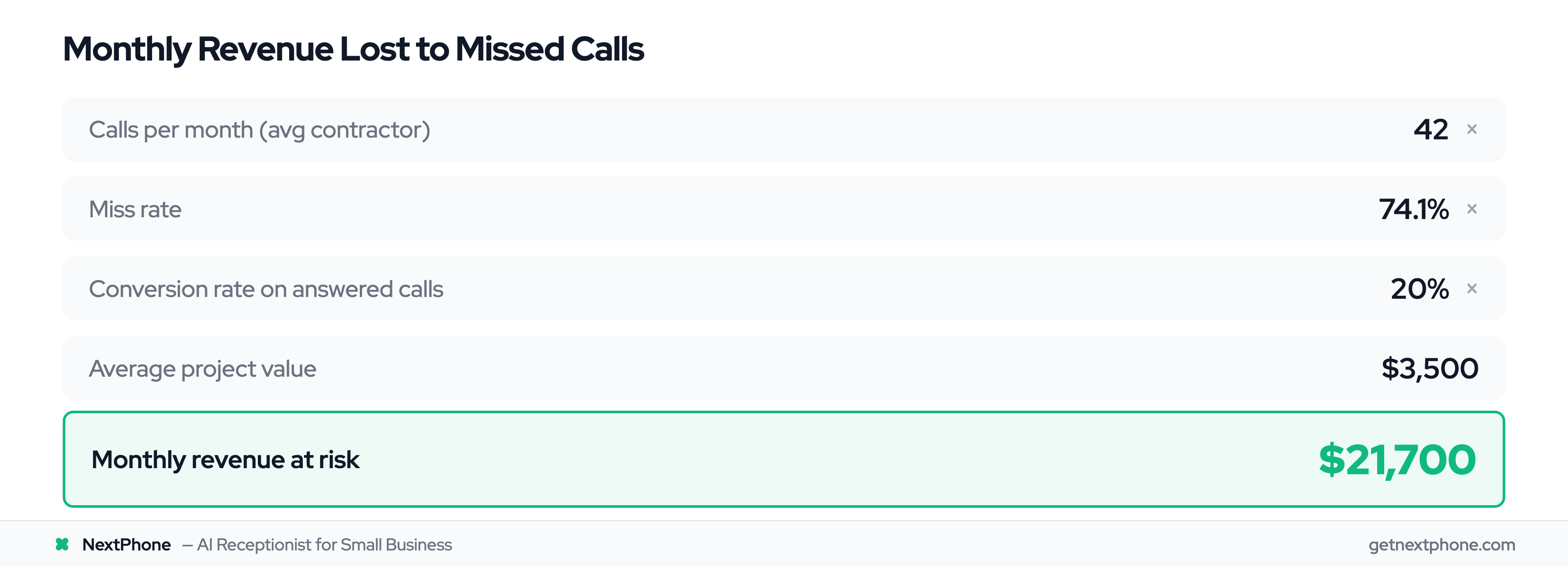
Let's walk through the actual calculation for a typical home services contractor:
- You receive 42 calls per month (a typical volume for a small contractor)
- 74.1% go unanswered = 31 missed calls
- A conservative 20% would have converted to paying jobs
- Average project value: $3,500
- Monthly lost revenue: 31 x 20% x $3,500 = $21,700
- Annual lost revenue: $260,400
That's a quarter-million dollars walking out the door every year because nobody picked up the phone. And Invoca's research on home services confirms the pattern - they estimate the average missed call costs home services businesses $1,200 in lost revenue.
Emergency Call Economics
Emergency calls are worth even more. A typical emergency job comes in around $4,200 against $3,500 for routine work. Makes sense: emergency pricing carries a premium, and the customer isn't shopping around.
With urgent calls ranking among the top reasons people call ("emergency," "urgent," "ASAP," "flooding," "no power"), a 42-call/month contractor gets several urgent calls every month. Miss just one emergency call per week, and you're losing $16,800 per month in high-value work.
The Callback Black Hole
Of all the calls we've answered, approximately one in four included an explicit request for a callback - customers saying "please call me back" or "I need to hear from someone." That's about 11 callback requests per month for a typical contractor.
Without a system to track and follow up on these, most of them never happen. Assume even 80% get forgotten and that's 9 lost leads every month, just because nobody wrote down the message or got around to returning the call.
The InsideSales lead response study found that responding within 5 minutes makes you 8x more likely to convert that lead. Wait 30 minutes and your contact rate drops 10x. Wait 24 hours? You're 60x less likely to close.
Speed wins. And right now, your voicemail isn't fast.
Why Traditional Answering Services Don't Work for Trades
Script-Only Services Can't Handle Trade Calls
You've probably considered a traditional answering service. Maybe you've even tried one. Here's why most contractors cancel within a few months.
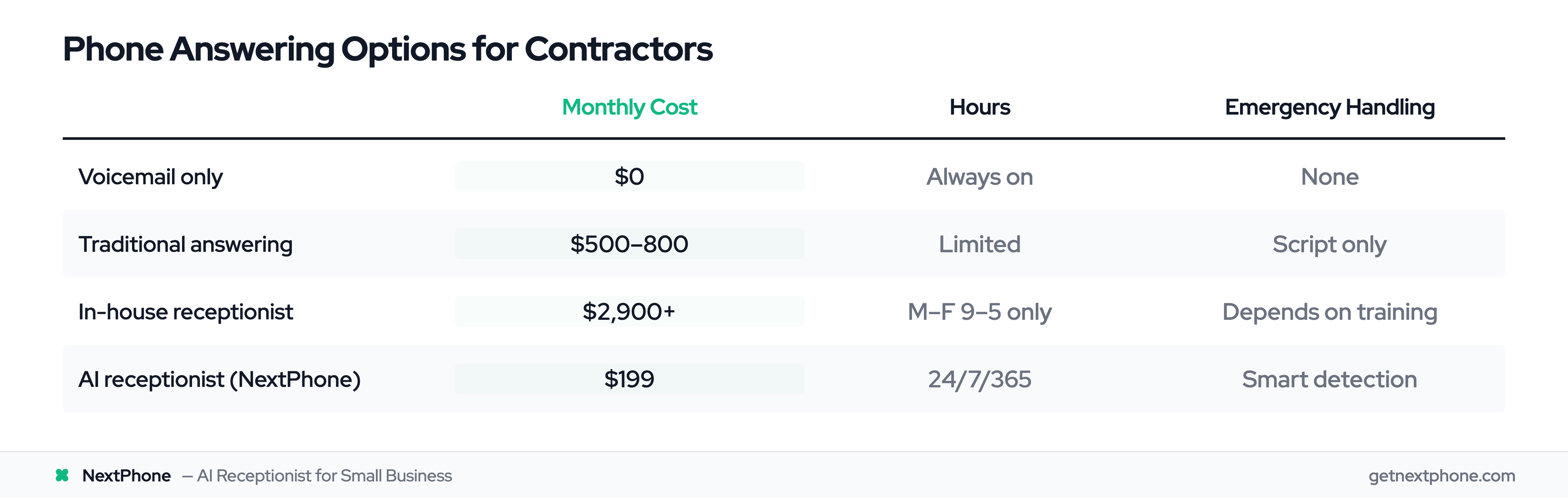
Traditional answering services give you a human operator reading from a script. They answer the phone, take a name and number, and promise someone will call back. That's it.
They can't tell the difference between a customer saying "my basement is flooding, I need someone NOW" and someone saying "I'd like to get a quote on repiping next spring." Both get the same treatment: a message slip that arrives in your email whenever the operator gets to it.
For an AI receptionist built for contractors, that distinction is everything. A flooding basement needs immediate routing to your phone. A quote request for next spring needs a friendly response and a scheduled callback.
The Cost Problem
Traditional live answering services charge $500 to $800 per month - and that's only for about 100 calls. Go over and you're paying overage fees. During storm season, when a roofer might get 200 calls in a week, those overage charges can push costs well above $1,000/month.
And for that money, you get message-taking. Not scheduling. Not emergency detection. Not lead qualification. Just someone writing down a phone number.
What Contractors Actually Need
Home services businesses need something different:
- Emergency detection that can distinguish "my pipe burst" from "I want a quote"
- Intelligent scheduling that can book appointments without bothering you on a job
- Trade-specific knowledge - understanding what services you offer, what you charge, what areas you cover
- Instant response - not 4 rings and a hold queue, but immediate pickup
- After-hours coverage that doesn't cost extra during your busiest seasons
Traditional services can't deliver this. They weren't built for trades.
How AI Receptionist Works for Home Services
Instant Answer, Every Time
An AI receptionist for home services picks up every call in under 5 seconds. No rings, no hold music, no "please wait while I transfer you." The caller immediately hears a professional greeting tailored to your business.
This matters more than you'd think. Research shows conversion drops 10-25% after just 4-5 rings. By the time a traditional service picks up (15-30 seconds), you've already lost some callers. An AI virtual receptionist eliminates that gap entirely.
The AI handles multiple calls simultaneously. When a storm hits and 10 homeowners call your roofing company at once, every single one gets an immediate answer. No busy signals. No hold queues. No lost customers.
Emergency Detection That Actually Works
This is where AI separates itself from everything else available to home services businesses.
The AI listens for urgency signals in every call: "emergency," "burst pipe," "flooding," "no power," "no heat," "no AC," and dozens of other phrases that indicate someone needs help right now. When it detects a true emergency, it routes the call directly to your cell phone - immediately.
In our data, urgent calls rank among the top reasons people call. And true emergencies requiring immediate dispatch are a recurring reason as well. The AI catches every single one and gets them to you within seconds.
For a deeper look at how this technology works, see our guide to emergency call routing.
Smart Scheduling and Quote Capture
For the calls that aren't emergencies - and that's most of them - the AI handles the conversation completely:
- Quote requests (among the top reasons people call): AI captures project details, timeline, address, and contact info. Sends you a complete lead summary via email and push notification.
- Scheduling requests (the single most common reason people call): AI checks availability and books appointments directly on your calendar.
- Common questions: "Do you service my area?" "What are your hours?" "How much do you charge for a furnace tune-up?" AI answers from your business knowledge base.
- Callback requests (roughly one in four calls): AI logs the request, sends you a notification, and can even text the customer to confirm their callback is scheduled.
The Features That Matter for Trades
Every call generates a complete record:
- Email notifications with call summary and caller details
- SMS follow-ups to callers with booking links or confirmation
- CRM webhooks that push lead data to your existing systems (HubSpot, Salesforce, ServiceTitan, Jobber)
- Call recordings and transcripts for training and quality assurance
- Spam filtering - spam and robocalls get filtered out before they ever ring you. AI handles those so you don't have to.