Quick answer (updated September 2026):NextPhone is the best AI receptionist for most small businesses: flat monthly plans from $199 with unlimited inbound calls, answers in under 2 seconds, 90–95% of calls resolved without a human, and native calendar booking from day one. Smith.ai is the only alternative worth considering if you specifically need live human agents on calls (from $300/month for 30 calls). Below: how we compared five platforms (three of them run through the same real-world scenarios), what each actually costs as of our latest pricing read, and the accuracy test you can run yourself during any vendor's trial.
What that looks like in production: NextPhone answers in under 2 seconds: every call, simultaneously, including your busiest hours. It resolves 90–95% of calls without escalating to you, with 99% positive caller sentiment and 99.97% uptime across our production data. Fourteen languages are included on every plan. Emergency keyword routing fires instantly for trades ("pipe burst," "no cooling," "sparks"). And the bill is identical in a record-volume month as it is in a slow one. No overage math required. Compare: Smith.ai's entry plan is $300/month for 30 calls, then $8.50 to $11.50 a call over plan.
Hear it: NextPhone answering a sample small-business call
0:00
0:00
A sample call showing what an AI receptionist sounds like end-to-end. This is the bar to measure every platform below against.
Why NextPhone wins: flat monthly plans from $199 with unlimited calls: no per-minute charges, no call caps, no overage math. Answers in under 2 seconds, resolves 90–95% of calls without a human, 99.97% uptime across 2,000,000+ business calls answered. Every other platform in this comparison meters calls or minutes, or sells AI answering as a per-seat add-on; the bill grows exactly when your AI answering is working hardest. For law firms and professional services practices where each intake call has a direct dollar value, that predictability is the deciding factor.
AI receptionist pricing comparison (October 2026)
Prices checked against each provider's own pricing page on October 5, 2026.
Platform
Starting Price
Billing Model
Busy-Month Overage
NextPhone
$199/month
Flat, unlimited inbound calls
None: bill is identical every month
Smith.ai
AI plan from $150/month (75 calls); free tier 25 calls; human receptionists from $300/month (30 calls)
Per call
$2.17 to $3.00 a call on AI plans; $8.50 to $11.50 a call on receptionist plans
Phonely
$50/month (200 minutes)
By talk-time minutes (free tier: 100 min/mo)
$0.25 to $0.35 a minute
Moneypenny AI
$69/month (25 calls)
Per call (25 to 250 calls/mo plans)
$1.89 to $2.49 a call
RingCentral AI
From $49/month (100 minutes) standalone or $39/month RingEX add-on
By talk-time minutes
$0.50 a minute over the 100 minutes
NextPhone is the only flat-rate unlimited model in this comparison. Every other option charges by the call, by the minute, or by the user seat. The same growth that makes AI answering valuable makes those bills unpredictable.
Try NextPhone free for 7 days
Flat monthly plans from $199, unlimited calls. Set up in about 5 minutes.
Disclosure: NextPhone is our product. The full test methodology is published at the bottom of this page so you can discount our bias and re-run every test during any vendor's trial.
Which one is right for you
You want every call answered at a predictable price → NextPhone. Plans from $199/month, unlimited calls, answers in under 2 seconds, emergency routing, 14 languages. The default answer for service businesses.
Your calls genuinely need a human's judgment, most of the time → Smith.ai. You'll pay about 4.6x as much at 100 calls a month, and for high-stakes intake that can be correct.
You already pay for RingCentral → turn on RingCentral AI, use it until you outgrow it, then re-read this list.
You're not sure AI answering fits your business at all → Phonely's free tier (100 minutes a month) or its Starter plan at $50/month for 200 minutes is a cheap experiment. Just re-check the math the moment your volume grows.
You get a small, steady number of calls every month → Moneypenny AI's per-call plans (from $69/month for 25 calls) fit; avoid them if you're marketing for new callers and expect volume to swing.
Whatever you pick, clear this minimum bar: answers in under 2 seconds, true 24/7 coverage, real-time calendar booking, smart forwarding with an escalation rule you control, emergency keyword routing, spam filtering, and pricing you can predict in your busiest month. Platforms missing any of those don't belong in a 2026 shortlist.
The five platforms at a glance
Platform
Best for
Pricing (read Oct 2026)
24/7
Languages
NextPhone
Flat-rate unlimited for service businesses
From $199/mo, unlimited calls
Yes
14 included
Phonely
Low-volume businesses testing AI
Metered: 100–650 min capped, then $0.25 to $0.35 a minute (read October 5, 2026)
Not stated
"100+ voices & languages" listed
Moneypenny AI
Small, steady call volume
Metered by call: 25–250 calls capped, then $1.89 to $2.49 a call (read October 5, 2026)
Yes (24/7 service listed)
Not stated on the AI plans
Smith.ai
Complex calls needing human backup
$300/month for 30 calls, human-handled
Yes
English/Spanish
RingCentral AI
Existing RingCentral users under ~50 calls/mo
From $49/month (100 minutes) standalone or $39/mo RingEX add-on; $0.50 a minute over (read October 5, 2026)
Yes
Multiple
NextPhone: best flat-rate AI receptionist
Best for: service businesses that want predictable costs and every call answered.
Pricing: flat monthly plans from $199, with unlimited inbound calls and no per-minute charges. The entry plan covers answering, booking, smart forwarding, and spam filtering; the $299 Growth plan adds native CRM sync (Clio and HubSpot, plus 6,000+ tools via Zapier); higher tiers cover multi-location and high-volume operations. Whatever tier you're on, the bill is the same in a busy month as a quiet one.
What impressed us: pickup speed (under 2 seconds, consistently), emergency detection tuned for trades ("no cooling," "pipe burst," "sparks" all routed instantly to the on-call phone in our tests), the flat rate, 99.97% uptime, and 99% positive caller sentiment across our production corpus. A busy month costs the same as a quiet one, which matters most in exactly the months you can least afford surprises. It also handles unlimited simultaneous calls, so a storm-day surge doesn't produce busy signals.
Where it fell short: no outbound calling. And $199 is more than the entry tier of per-minute competitors, so if you get a handful of calls a month and none after hours, the cheaper meter might genuinely be enough.
Honest fit:law firms and professional services first, where a missed intake call is a missed case; then contractors and home-services businesses (plumbing, HVAC, electrical, roofing); and any business where after-hours calls are revenue. If every one of your calls is a bespoke consultation, AI answers and forwards; it won't close for you.
Hear it: NextPhone qualifying an inbound lead end-to-end
0:00
0:00
The AI captures scope, budget, timeline, and address, and books the estimate, before the caller gets a chance to hang up.
Two production voice samples, so "sounds natural" isn't an abstract claim:
Voice sample: Emma, warm-professional female
0:00
0:00
Default pick for client-facing service businesses.
Try NextPhone free for 7 days
AI answering service that answers, qualifies, and books, 24/7.
Best for: low-volume businesses trying AI answering for the first time.
Pricing: metered, not unlimited. Phonely's own pricing page, read on October 5, 2026, lists a Free plan with 100 minutes a month, Starter at $50/month for 200 minutes and Professional at $150/month for 650 minutes, with overage of $0.25 to $0.35 a minute on Starter and $0.30 a minute on Professional. Billed yearly, Starter drops to $33 a month and Professional to $100. Enterprise is quoted by sales from "as low as 5¢/min". The same page's comparison table lists 250 and 750 minutes for Starter and Pro, so confirm the allowance in writing before you sign.
The monthly figure is the floor, not the bill. Phonely's plan cards put 200 minutes at "~100 calls", which assumes two-minute calls. At a 3-minute average, 200 minutes is about 66 calls; call 67 onward is charged by the minute.
What the page lists: 100+ voices and languages and email and SMS notifications from the free plan up; premium voices, transcripts with AI analytics and spam filtering on Starter; conversational SMS, advanced API integrations and CRM integrations on Professional; unlimited concurrent calls on every plan.
Where to look closely: the meter. Per-minute pricing means a busy month produces a bigger bill, and busy months are the point. CRM integrations sit on Professional, not Starter. Phonely was not part of our June-July scenario runs, so treat this entry as a pricing comparison and run the vendor accuracy test on its free tier before you rely on it.
Honest fit: businesses with predictable volume under ~50 calls/month who want to experiment before committing. Not ideal once volume picks up; the overage model punishes growth.
Moneypenny AI: best for a small, steady call count
Best for: businesses that get a modest, predictable number of calls a month and want a person available behind the AI.
Pricing: metered by call. Moneypenny's US AI Answering plans, read on its own pricing page on October 5, 2026, are $69/month for 25 calls, $99/month for 50 calls, $199/month for 100 calls and $435/month for 250 calls, then $1.89 to $2.49 a call past the allowance, depending on the plan. VoiceNation's site now redirects to Moneypenny. Every call counts toward the plan, so each new lead your marketing generates moves you up the meter.
What the page lists: no contract, 24/7 service, a reporting dashboard and human escalation on every AI plan. Moneypenny also sells people-answered plans (from $165/month for 50 minutes) and describes its AI receptionist as having "the option to transfer to real people built in".
Where to look closely: the per-call meter. At 100 calls a month Moneypenny AI costs $199, the same as NextPhone's Pro plan; at 150 calls it costs $308.50, and the bill keeps climbing with every call after that. The AI plans do not list languages or calendar booking, so ask before you sign. Moneypenny AI was not part of our June-July scenario runs; run the accuracy test below during any trial.
Honest fit: steady, low-volume lines where a human fallback matters more than the per-call price. Wrong fit if you're spending money to generate new callers and expect volume to swing.
Smith.ai: best when calls genuinely need humans
Best for: professional services where human judgment on the call is the product.
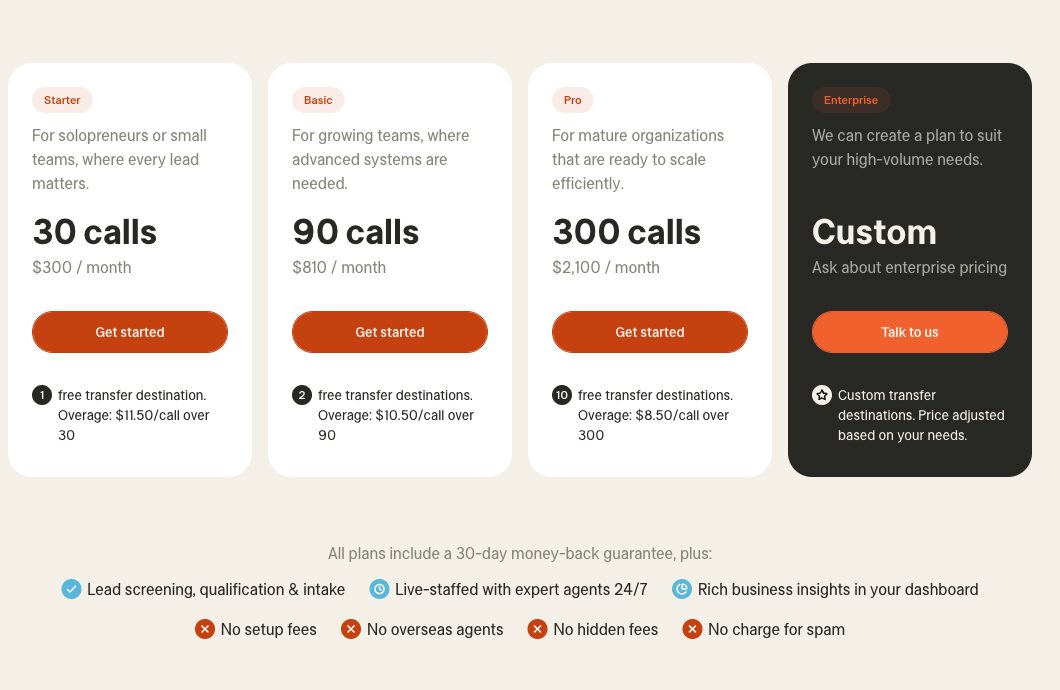
Pricing: $300/month for 30 calls, $810/month for 90 calls, $2,100/month for 300 calls (read October 5, 2026). Over your plan, calls bill at $8.50 to $11.50 a call depending on tier.
Captured from smith.ai/pricing, August 2026.
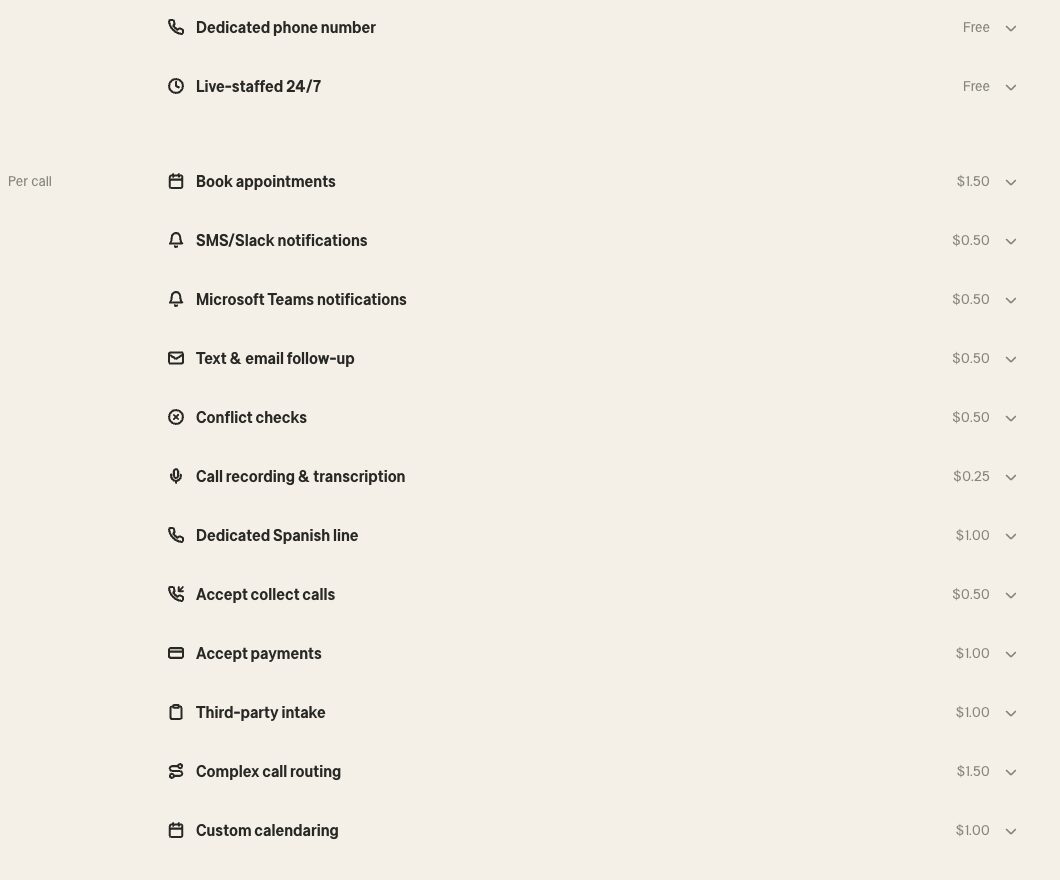
Budget for the add-on menu as well. Several things most people assume are included bill per call on top of the plan:
Captured from smith.ai/pricing, August 2026. Appointment booking is $1.50 per call, call recording $0.25, conflict checks $0.50. On a 90-call plan where every call books an appointment, that's $135/month on top of the 90-call plan.
What impressed us: the humans. Live North-America-based agents handle the calls the AI screens to them, and for sensitive intake (legal, medical) that judgment is real. Longest track record in the category (since 2015), professional setup, outbound calling available, CRM integrations including Clio.
Where it fell short: cost scales with your growth, at about 4.6x NextPhone's price at 100 calls a month. Human routing adds pickup delay compared to instant AI answers, and surge capacity is limited by staffing: the 2am storm-night flood of calls is exactly when a human pool is thinnest.
Honest fit: law firms and professional-services practices with genuinely complex, high-stakes intake on most calls. If 80% of your calls are routine, you're paying human rates for FAQ answers.
RingCentral AI: best if you're on RingCentral and get very few calls
Best for: businesses already on the RingCentral phone system where answering calls isn't a real revenue channel (roughly speaking, under ~50 calls a month). Past that, the gap between a bundled feature and a dedicated platform starts costing you more than the add-on saves.
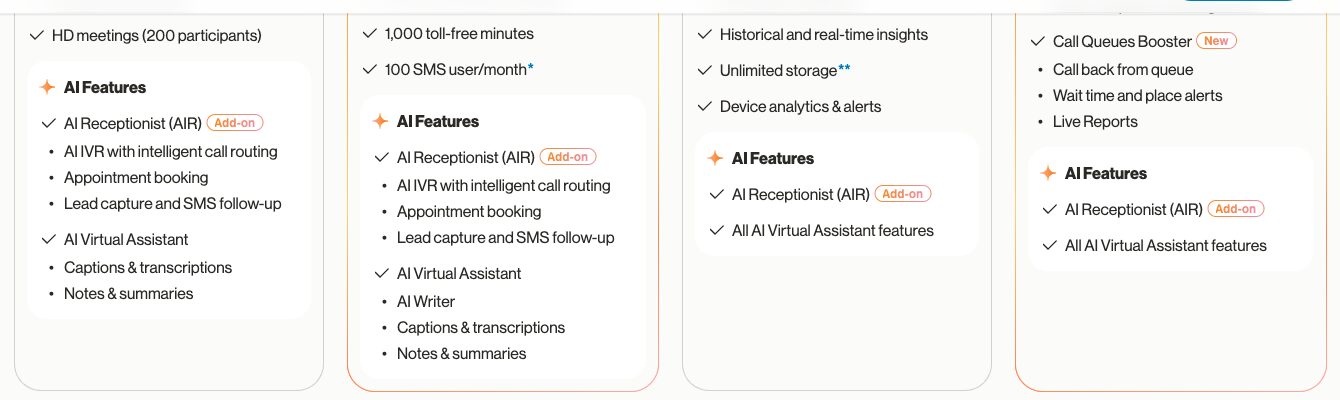
Pricing: from $49/month (100 minutes) standalone, or $39/month as an add-on to a RingEX plan (the bundle lists RingEX Core at $30/month), then $0.50 a minute over the allowance (read on RingCentral's AI Receptionist pricing page, October 5, 2026). It is not an included feature: RingCentral's own plan comparison marks AI Receptionist (AIR) as "Add-on" on all four tiers, including Ultra.
Captured from ringcentral.com/office/plansandpricing.html, August 2026. AIR is badged "Add-on" on Core, Advanced and Ultra alike. Confirm the current add-on rate with RingCentral before budgeting.
What impressed us: the convenience if you're already a customer. No new vendor, and it lives inside the phone system you already administer. Voicemail transcription and basic routing work as advertised.
Where it fell short: it's a feature, not a product. The AI is noticeably less capable than the dedicated platforms in this list: less customization, weaker booking, no trade-tuned urgency handling. And the add-on version requires a RingEX plan.
Honest fit: existing RingCentral shops that want basic after-hours coverage without buying anything. If call answering is actually costing or making you money, a dedicated platform earns its fee.
The honest tiering across the category, read on each vendor's own pricing page on October 5, 2026:
Pure AI, flat-rate: NextPhone from $199/month with unlimited calls (current tiers on the pricing page). This is the only flat-rate unlimited model in the comparison; see the full AI receptionist pricing guide for the tier-by-tier breakdown.
Pure AI, metered: neither of these is unlimited. Phonely caps talk time at 100 to 650 minutes a month and bills $0.25 to $0.35 a minute past it. Moneypenny AI caps calls at 25 to 250 a month and bills $1.89 to $2.49 a call past that, depending on the plan. Both look cheap at low volume and get unpredictable exactly when you get busy.
Hybrid AI + human: Smith.ai from $300/month for 30 calls, up to $2,100/month for 300 calls, plus $8.50 to $11.50 a call over plan and per-call fees for booking, recording and payments. You're paying for staffed agents; the price tracks your call volume.
Per-minute add-on: RingCentral AI Receptionist, from $49/month (100 minutes) standalone or $39/month on top of a RingEX plan you're already paying for, then $0.50 a minute.
The traps to check before signing anything:
Per-minute rounding. Most per-minute plans round every call up to the next 60 seconds. Even rounding to 6-second increments adds ~6.7% to your effective rate. The shorter your typical call, the worse the invisible tax; a 20-second "are you open today?" bills as a full minute.
Overage cliffs. A live answering service at a median of $444/month for 100 calls looks manageable until busy season doubles your volume and the per-call overages kick in. Ask every vendor: "what does my bill look like in my busiest month?"
Setup fees and integration fees. Some platforms charge $100–500 for setup or extra for CRM connections. NextPhone and Smith.ai don't charge setup fees; always verify the integration you need is included in the tier you're buying, not the tier above it.
Is the ROI real? One worked example with third-party numbers: a typical home-services contractor gets about 42 calls a month, and 74.1% of calls to home-services businesses go unanswered (Invoca). That's roughly 31 missed calls monthly. If just 20% of those callers would have hired you at a $3,500 average project, missed calls are costing about $21,700 a month. Against a $199/month plan, capturing even one additional job pays for months of service. Your numbers will differ; run them with your own call volume and ticket size before buying anything.
Why flat-rate pricing matters more for law firms and professional services
For most businesses, per-minute pricing is inconvenient. For law firms and professional services practices, it's a structural problem.
A personal injury or criminal defense firm runs on contingency: the signed client is the unit of value, not a billable hour. When a new intake call goes to voicemail, it's a lost case. The Clio 2024 Legal Trends Report found that only 40% of law firms answered the phone when secret-shopped. Gary Falkowitz, an intake consultant to more than 200 firms, found that 42% of legal consumers hire the first firm that responds, and that 35%+ of legal leads call after hours, while only 25% of firms answer then.
Per-minute pricing punishes exactly this scenario. A firm running a TV or LSA campaign that drives a surge of inbound calls pays more the month the AI actually works. A flat-rate model inverts that: the bill is identical whether the phone rings 100 times or 300 times.
Flat-rate pricing means the bill is predictable before the month starts. NextPhone plans from $199/month cover unlimited inbound calls, the same in a strong advertising month as in a slow one. That predictability matters most in the verticals where each answered call represents a potential case or client relationship:
Personal injury and criminal defense: intake call = potential contingency case; after-hours coverage is table stakes (arrests and accidents don't happen 9–5)
Estate planning and family law: consultation-first model; the intake call is the entire top of funnel
CPA and tax firms: volume can triple in January–April; a per-minute bill triples alongside it
Insurance agencies: quote calls run 5–8 minutes each, and the meter stacks fast at standard talk-time rates
For any of these verticals, the right question before signing with an AI receptionist is "what does it cost in my busiest month?" With flat-rate, those two answers are the same.
How to measure any vendor's accuracy yourself
Vendors quote "95% accurate" the way restaurants quote "fresh ingredients": comforting and unfalsifiable. Here's the test we use internally, compressed so you can run it on any vendor in an afternoon during a trial.
Accuracy is four numbers, not one:
Intent recognition. Did the AI understand what the caller wanted?
Task completion. Was the appointment actually booked, the message actually complete, the transfer actually made?
Escalation accuracy. Did it hand off the calls it should have, and stay on the calls it should have? Both failure directions matter: a missed emergency is worse than a false alarm, but constant false alarms defeat the purpose.
Latency. Time from the caller finishing speaking to the AI responding. Under 1 second is good; over 3 feels broken.
These compound across a conversation. A 95% per-turn accuracy compounds to roughly 70% across a 7-turn call, and real booking calls run long. Per-turn numbers look great in a vendor deck; end-to-end numbers determine whether the caller becomes a customer.
Test against the real call mix. In our analysis of 1,446,980 inbound business calls across 2,074 businesses, the most common reasons people call, in ranked order:
Rank
Why people actually call
1
Booking, confirming, or rescheduling an appointment
2
Asking about a specific service or repair
3
Requesting a quote or estimate
4
Checking status of existing work
5
Hours, location, and directions
6
New-customer inquiries
7
Complaints or problems
8
Billing and payment questions
9
Emergencies and urgent issues
10
Cancellations
Most vendor demos showcase the clean appointment booking, which is one of the easier scenarios. Build your trial test set to mirror the ranked list above, add a few spam calls (they should get filtered, not answered), a couple of non-English calls if your customers need them, and an urgent-call overlay. Then score each call on the four numbers separately. Don't blend them into one score; a blended number hides the failure mode you need to fix.
The satisfaction trap. In our production data, 99% of callers express positive or neutral sentiment. That is not the same thing as accuracy. Callers are satisfied when they're greeted politely and the call ends without friction, even if the AI captured the wrong callback number. They find out three days later, when nobody calls. Judge vendors on operational accuracy (was the number right, was the booking made), not on how pleasant the call felt.
Eight questions that sort vendors fast:
Show me your accuracy broken down by scenario type, not blended.
First-utterance intent accuracy versus final intent accuracy?
Escalation false-positive rate AND false-negative rate, separately?
Word error rate on names and phone numbers specifically, not transcript-level?
Median and p95 response latency from production calls, not a sandbox?
What happens on calls below your confidence threshold?
How do you detect accuracy drift in production?
Can I run my own test set against your system before signing?
If a vendor pushes back on that last one, that's your answer. The willingness to be measured is itself a quality signal.
How we tested (and our conflict of interest)
First, the disclosure: NextPhone is our product. We build it, so we have an obvious horse in this race. We're publishing the exact methodology so you can discount our bias and re-run every test yourself during each platform's trial period.
Test setup. Between June and July 2026 we ran the same set of real-world call scenarios through NextPhone, Smith.ai and RingCentral AI, using live call volume on real small-business lines for a minimum of 7 days per platform. Phonely and Moneypenny AI joined this comparison in October 2026 on pricing only: their figures come from their own pricing pages, read October 5, 2026, and we have not yet run these scenarios on them:
Appointment booking with a real connected calendar, including a reschedule request
After-hours emergency ("my water heater is leaking") to test urgency detection and routing
Routine FAQ (hours, service area, ballpark pricing)
A complex inquiry that should trigger a handoff to a human, to test whether the AI knows its limits
Background noise and strong accents, because job sites and real callers have both
We scored answer speed, voice quality, response accuracy, calendar reliability, and what each platform did when it was out of its depth. Pricing was re-verified against each vendor's own published pricing page on August 3, 2026, and the screenshots above are the captures from that pass; where a vendor quotes custom pricing, we say so instead of guessing.
One thing this test can't fully capture: long-run accuracy on your call mix. For that, run the vendor accuracy test during your trial.
Frequently asked questions
What is the best AI receptionist for law firms?
NextPhone for most practices: flat monthly plans from $199 with unlimited calls and no per-minute charges. The Clio 2024 Legal Trends Report found only 40% of law firms answered when secret-shopped; Gary Falkowitz, an intake consultant to 200+ firms, found 42% of legal consumers hire the first firm to respond. A missed intake call at a contingency firm is a lost case. NextPhone answers in under 2 seconds, asks your intake questions during the call, books consultations directly into your calendar, and transfers urgent matters (arrests, emergencies) to your on-call number immediately. Native Clio sync is included on the Growth plan. Smith.ai is the alternative if you specifically need a live human on every call; expect about 4.6x the cost at 100 calls a month.
What is the best AI receptionist for small businesses in 2026?
NextPhone: flat monthly plans from $199 with unlimited inbound calls, answers in under 2 seconds, 90–95% of calls resolved without human escalation, native Clio and HubSpot sync, and 14 languages. For businesses where calls are revenue and volume varies, it's the default pick. Smith.ai is the only alternative worth paying more for: if the majority of your calls genuinely require live human judgment (high-stakes legal intake, complex medical triage), their hybrid model from $300/month is worth the premium. Every other platform in this comparison charges by the call, by the minute, or by the user seat: costs that scale against you exactly when your AI answering is working.
Which AI virtual receptionist is best for small businesses?
For most small businesses, NextPhone: plans from $199/month flat-rate with unlimited inbound calls, answers in under 2 seconds, 90–95% of calls resolved without human escalation, calendar booking, 14 languages, and emergency keyword routing. Native Clio and HubSpot sync comes with the $299 Growth plan (6,000+ other tools via Zapier). Smith.ai is the alternative if you specifically need live human agents on a hybrid model; expect to pay about 4.6x as much at 100 calls a month.
How accurate are AI receptionists?
Modern platforms achieve 85–95% accuracy on routine inquiries (hours, pricing, scheduling), and the good ones route calls they're uncertain about to you instead of guessing. Accuracy depends heavily on setup: an AI trained on your services, pricing, and terminology performs meaningfully better than a 15-minute rushed configuration. Expect a 2–4 week refinement period, and use the vendor accuracy test above to measure rather than trust.
How much does an AI receptionist cost for a small business?
Pure-AI platforms with full features run $199–299/month; NextPhone's plans are flat monthly, from $199, with unlimited calls and no per-minute charges, so a busy month costs the same as a slow one. Hybrid AI-plus-human services run $300/month and up, scaling with volume. Compare that to a human receptionist at $3,100–4,300/month all-in, or a traditional answering service at a median of $444/month for 100 calls ($170 to $1,160 on published plans), with overage charges on top.
Will customers know they're talking to AI?
For quick questions, most don't notice; modern voices sound natural and answer in seconds. On longer conversations, some callers will realize it's AI, and that's fine: in our production data, 99% of callers express positive or neutral sentiment. The design that matters is smart forwarding, so that the calls where a human genuinely matters reach one immediately.
Can AI receptionists schedule appointments in my calendar?
Yes, and booking or rescheduling an appointment is the single most common reason people call a service business in our call corpus, so this feature does the heaviest lifting. Good platforms connect to Google Calendar, Outlook, or Apple Calendar, check availability in real time, book the slot, and send confirmations to both sides. If a platform can't do this reliably, skip it.
Do I need to replace my existing phone system?
No. Standalone AI receptionists work by call forwarding: you keep your existing number, forward it to the AI, and callers never know the difference. Works with any VoIP provider, traditional landlines, and mobile phones. The exception is RingCentral AI, which only exists inside RingCentral's own system.
The bottom line
Every platform in this list beats voicemail, and voicemail is what most missed calls actually hit. Pick based on your call economics: flat-rate AI (NextPhone) when calls are revenue and volume varies, humans (Smith.ai) when judgment is the product, bundled (RingCentral) when free-and-adequate is the goal. Then verify with your own test set during the trial, because the vendor's demo will always be their best-case call.