
Why This Comparison Matters More Than Ever
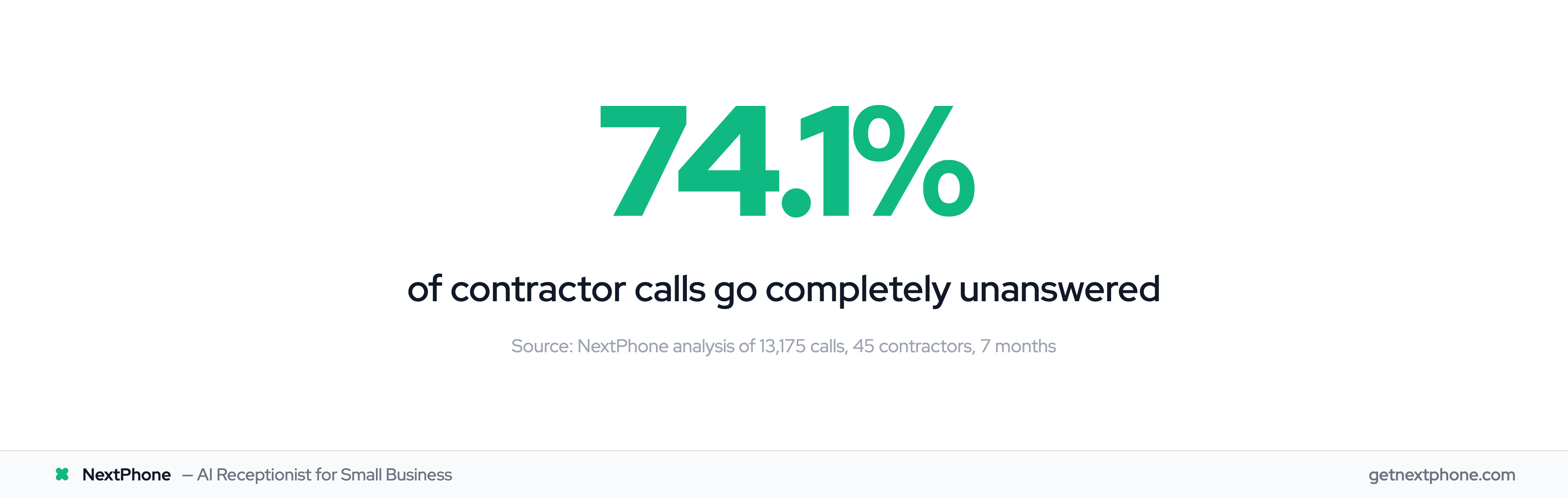
Here's a number that should keep every business owner up at night: 74.1% of calls go unanswered.
Industry research shows 74.1% of calls to home services contractors go unanswered - nearly three out of four calls never reach a human. And approximately one in four callers asks for a callback, a request that too often never gets returned.
The financial damage is staggering. Run that miss rate against typical job values and the average contractor is looking at roughly $189,068 per year in lost work. That's revenue walking out the door while you're on a job, in a meeting, or simply unable to pick up.
For decades, the solution was obvious: hire a live answering service. Research shows consumers and businesses both prefer voice communication over text or email—real humans answering your phones around the clock. Problem solved.
But something changed. AI answering services got good. Really good. Good enough that the decision is no longer "should I get an answering service?" It's "should I pay for live agents or let AI handle it?"
This guide breaks down exactly what each option costs, where each excels, and how to choose the right solution for your business. We're using real data, real pricing, and honest assessments - not marketing fluff.
What Is a Live Answering Service?
Before diving into comparisons, let's establish what we're actually comparing.
How Live Answering Services Work
A live answering service employs trained agents who answer calls on behalf of your business. When a customer calls your number, the call routes to a call center where a human picks up - typically within 3-4 rings.
The agent answers using your business name and follows a script you've provided. They can take messages, transfer calls, schedule appointments, and answer basic questions. Most services offer 24/7 coverage, though after-hours and weekend calls often cost more.
You'll typically work with a team of agents rather than a dedicated individual, though premium services do offer dedicated receptionists at higher price points.
What Live Agents Can Handle
Live answering services shine in several areas:
Complex conversations. When a caller needs to explain a complicated situation, goes off-script, or requires back-and-forth discussion, human agents adapt naturally.
Emotional situations. Frustrated customers, upset callers, or people dealing with emergencies benefit from human empathy. A skilled agent can de-escalate tension in ways that still challenge AI.
Multi-step processes. Detailed intake forms, complex scheduling with multiple variables, or sales conversations requiring objection handling play to human strengths.
Bilingual support. Many live services offer Spanish and other language support through native speakers.
What Is AI Phone Answering?
AI answering services have evolved far beyond the robotic phone trees of the past. Modern AI doesn't just route calls - it holds conversations.
How AI Answering Services Work
When a customer calls, AI answers immediately in a natural-sounding voice. The AI understands what the caller is saying, determines their intent, and responds appropriately.
For a scheduling request, the AI checks your actual calendar availability and books the appointment. For common questions, it provides accurate answers based on information you've provided. For messages, it captures details and routes them according to your preferences.
All of this happens without hold times, without staffing limitations, and without per-minute charges eating into your budget.
What Modern AI Can Handle
Today's AI answering handles far more than people expect:
Appointment scheduling. Real-time calendar integration means AI can book, reschedule, or cancel appointments with actual availability - not just take requests.
FAQ responses. AI provides consistent, accurate answers to common questions about hours, pricing, services, and policies.
Call screening and qualification. AI can ask qualifying questions and route calls based on urgency, value, or type.
Message taking. When AI can't fully resolve a call, it captures detailed messages with transcripts for follow-up.
Emergency identification. Urgent calls rank among the top reasons people call, and emergencies are a recurring one. AI can identify these and route them appropriately.
Live Answering Service Costs: The Complete Breakdown
Let's talk real numbers. Live answering service pricing is notoriously confusing, with multiple models and hidden fees. Here's what you'll actually pay.
Common Pricing Models
Per-minute pricing is the most common model (see our full cost breakdown). You'll pay between $0.75 and $2.00 for every minute an agent spends on your calls. This sounds reasonable until you realize that a 3-minute call at $1.50/minute costs $4.50 - and you might have 200 of those monthly.
Per-call pricing charges a flat rate per call, typically $1.50-$4.00 regardless of length. This works better for businesses with longer average call times.
Monthly packages (flat rate vs per-minute compared) include a set number of minutes or calls for a fixed price. A typical package might offer 100 minutes for $150/month. Go over, and you're back to per-minute rates - often at a premium.
Dedicated receptionist services assign specific agents to your account. Expect to pay $1,000-$3,000 monthly for this premium service.
What the Advertised Price Doesn't Include
Here's where live answering costs get sneaky:
Setup and onboarding fees. Most services charge $50-$200 to get started, create your scripts, and train agents on your business.
Holiday and after-hours premiums. That $1.00/minute rate? It's often $1.50-$2.00 for nights, weekends, and holidays - exactly when you need coverage most.
Overage charges. Exceed your package minutes and you'll pay 1.5x or more the base rate. A 100-minute package at $150/month can easily become $300+ with overages.
Long-call charges. Some services add fees for calls exceeding 2-3 minutes, penalizing the complex calls where human agents add the most value.
Script change fees. Need to update your greeting or add a new service? Some providers charge $25-$50 per change.
Real-World Cost Examples
Low volume (50 calls/month, averaging 2 minutes each):
- Budget service: $150-$200/month
- Mid-tier service: $200-$300/month
- Premium service: $300-$400/month
Medium volume (200 calls/month, averaging 2.5 minutes each):
- Budget service: $400-$500/month
- Mid-tier service: $500-$700/month
- Premium service: $700-$1,000/month
High volume (500 calls/month, averaging 3 minutes each):
- Budget service: $800-$1,000/month
- Mid-tier service: $1,000-$1,300/month
- Premium service: $1,300-$1,800/month
| Provider Type | Base Cost | Per Minute | Typical Monthly Total |
|---|---|---|---|
| Budget | $50-100 | $1.50-2.00 | $200-500 |
| Mid-tier | $100-200 | $1.00-1.50 | $400-900 |
| Premium | $200-500 | $0.75-1.25 | $800-1,800+ |
AI Answering Service Costs: What to Expect
AI answering pricing is refreshingly straightforward compared to live services.
Common AI Pricing Models
Flat monthly fees are the most common approach. You pay $30-$300 per month regardless of how many calls you receive. No counting minutes, no overage surprises.
Per-minute rates exist but are dramatically lower than live services - typically $0.05-$0.15 per minute. Even heavy usage stays affordable.
Hybrid models combine a base fee with usage charges, often capping total costs.
What's Typically Included
Most AI answering services include:
- 24/7 availability with no premium rates
- Unlimited or high-volume call handling
- Calendar integrations for real-time scheduling
- Call transcripts and recordings
- Analytics and reporting
- CRM integrations
- Mobile app access
NextPhone Pricing Example
NextPhone offers a straightforward model: $199 per month, flat rate.
That includes unlimited calls, full 24/7 coverage, all integrations, and every feature. No per-minute charges. No setup fees. No surprises on your bill.
For a contractor receiving 300 calls monthly, that's about $0.66 per call - compared to $3-$6 per call with most live services.
Try NextPhone free for 7 days
AI answering service that answers, qualifies, and books — 24/7.
Head-to-Head: Live vs. AI Answering Comparison
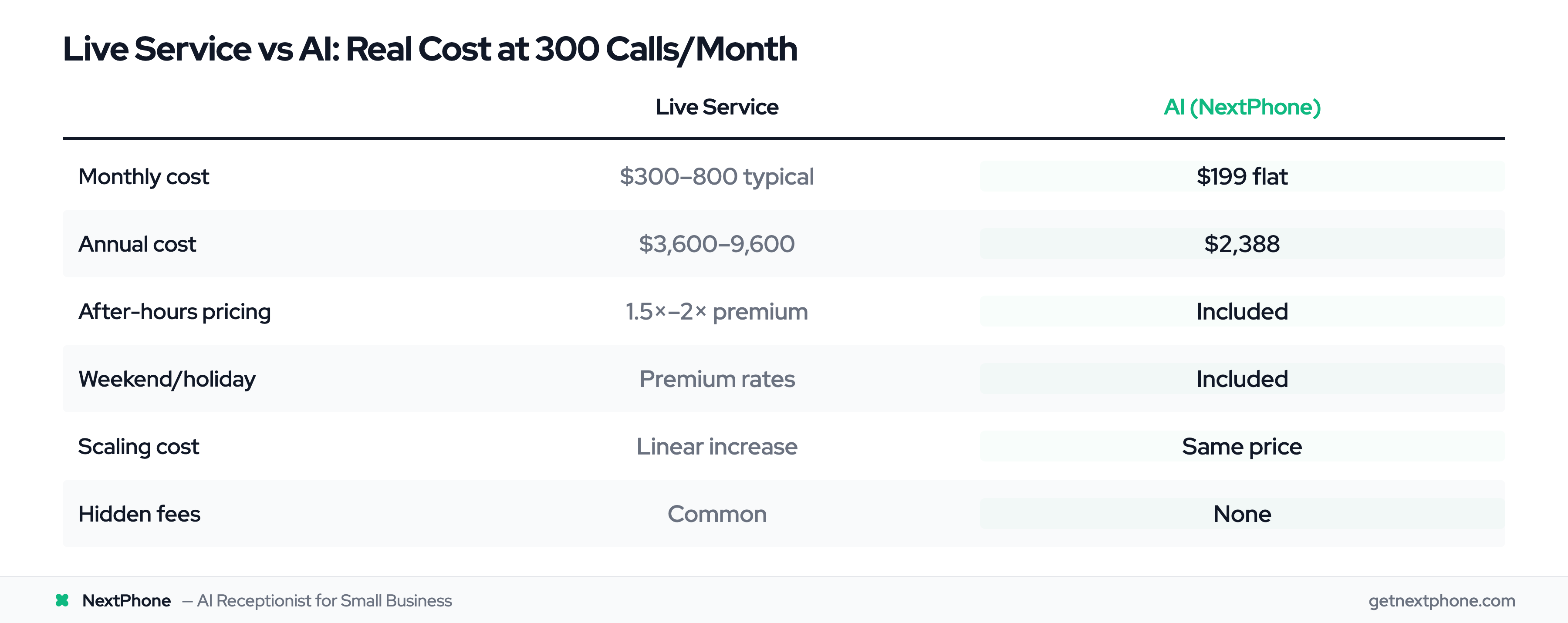
Now for the comparison everyone wants to see. Let's put these solutions side by side across the factors that actually matter.
Cost Comparison
| Factor | Live Service | AI Service (NextPhone) |
|---|---|---|
| Monthly Base | $300-800 typical | $199 flat |
| Annual Cost | $3,600-9,600 | $2,388 |
| Per-Call Cost | $2-5 variable | ~$0.66 at 300 calls |
| After-Hours | 1.5x-2x premium | Included |
| Weekend/Holiday | Premium rates | Included |
| Scaling Cost | Linear increase | Same price |
| Hidden Fees | Common | None |
For most businesses, AI answering costs 50-75% less than equivalent live coverage.
Quality Comparison
This is where things get interesting. The quality gap isn't what most people assume.
Call handling accuracy: Live agents achieve 95%+ accuracy on message taking and call handling. Modern AI hits 90-95% - a gap that continues to narrow with each generation of AI.
Availability: Live services staff call centers, meaning potential hold times during busy periods. AI answers instantly, every time, with zero hold time.
Consistency: Human agents vary. Some are excellent, others less so. You might get different agents each call. AI delivers identical quality on call #1 and call #1,000.
Complex calls: Live agents still hold a clear advantage for genuinely complex conversations requiring judgment, negotiation, or emotional intelligence.
Speed to answer: AI picks up instantly. Live services target 3-4 rings but can have hold times during peak periods or holidays.
Capability Comparison
| Capability | Live Service | AI Service |
|---|---|---|
| Answer speed | 10-30 seconds | Instant |
| 24/7 availability | Extra cost | Included |
| Appointment scheduling | Yes | Yes |
| FAQ responses | Yes | Yes |
| Complex conversations | Excellent | Good |
| Emotional intelligence | Excellent | Limited |
| Consistency | Variable | Excellent |
| Scalability | Limited | Unlimited |
| CRM integration | Some providers | Most providers |
| Call transcripts | Some providers | Standard |
| Multi-location support | Complex setup | Simple |
When Live Answering Services Are Worth It
Despite the cost premium, live answering services genuinely excel in specific scenarios. Here's when paying more makes sense.
Scenarios Where Live Wins
High-stakes sales calls. When a single call might result in a $10,000+ deal, the subtle advantages of human conversation often justify the cost. Skilled agents can build rapport, overcome objections, and close in ways AI can't match.
Medical practices with complex intake. Patient calls often involve sensitive information, symptom descriptions, and triage decisions. While AI can handle scheduling, complex medical conversations benefit from human judgment.
Legal consultations. Initial client calls in legal practices involve emotional situations, confidential information, and nuanced discussions. The empathy and discretion of trained legal receptionists adds genuine value.
Frequent escalations. If most of your calls involve angry customers, service complaints, or emotionally charged situations, human agents de-escalate more effectively.
Complex scheduling. When appointments involve multiple participants, variable durations, special equipment, or complicated availability, humans handle the coordination more smoothly.
Industries That Benefit Most From Live Services
- Healthcare and medical practices
- Law firms and legal services
- Financial advisors and wealth management
- High-end B2B sales organizations
- Crisis hotlines and mental health services
- Luxury services where white-glove experience matters
The threshold question: If your average call value exceeds $1,000 and calls regularly require nuanced human judgment, live answering likely delivers positive ROI despite higher costs.