
The phone rings. You're on a job site with drywall dust on your hands. Or you're in a meeting with your most important client. Maybe you're finally having dinner with your family for the first time this week.
What happens next could cost you thousands of dollars.
Here's a reality that keeps many business owners up at night: industry data shows that contractors and service businesses miss 60-80% of their incoming calls. That's not a typo. For every ten potential customers who call, six to eight of them hear nothing but ringing—or worse, get dumped into voicemail.
Those callers don't wait around. They call your competitor.
This is why AI phone systems have moved from "interesting technology" to "business necessity" for thousands of companies. VoIP and cloud phone statistics show rapid adoption as businesses realize traditional systems can't keep up. The benefits extend far beyond just answering calls. We're talking dramatic cost reduction, round-the-clock availability, rock-solid consistency, seamless scalability, and insights that help you run your business smarter.
Let's break down exactly what an AI phone system can do for your business.
The Hidden Cost of Missed Calls
Before we dig into the benefits of AI phone systems, let's put some numbers around the problem they solve.
How Many Calls Are You Actually Missing?
A study by 411 Locals that monitored phone calls across 85 businesses found that, on average, companies only answer 37.8% of all inbound calls. That means nearly two-thirds of callers get nothing.
For home service businesses specifically, research from Invoca shows they miss around 27% of inbound calls. That's better than average, but still represents more than one in four potential customers slipping away.
Contractors and tradespeople face an even steeper challenge. When you're on a roof, under a sink, or in an attic, answering the phone isn't just inconvenient—it's often impossible. That's why the missed call rate for contractors climbs to 60-80%.
The revenue impact? Research estimates the average business loses approximately $126,000 per year due to unanswered calls. For home service businesses, each missed call represents an average of $1,200 in lost opportunity.
Why Callers Don't Wait

Here's what makes missed calls so devastating: 85% of people whose calls you miss never call back. They're not going to leave a message, either—less than 3% of callers who reach voicemail actually record anything.
What are they doing instead? Calling the next contractor on the list.
Consider this: approximately one in four callers explicitly asks for a callback, which signals how urgently they need to speak with someone. Urgent calls also rank among the top reasons people call—using words like "emergency," "today," "ASAP," or "as soon as possible."
When someone's water heater is flooding their basement or their AC dies in August, they're not going to wait for you to get back to them tomorrow. They need help now.
This is where AI phone system benefits become crystal clear.
Benefit #1: Dramatic Cost Savings
Let's start with the benefit that usually gets business owners' attention first: money.
AI vs. Traditional Receptionist Costs
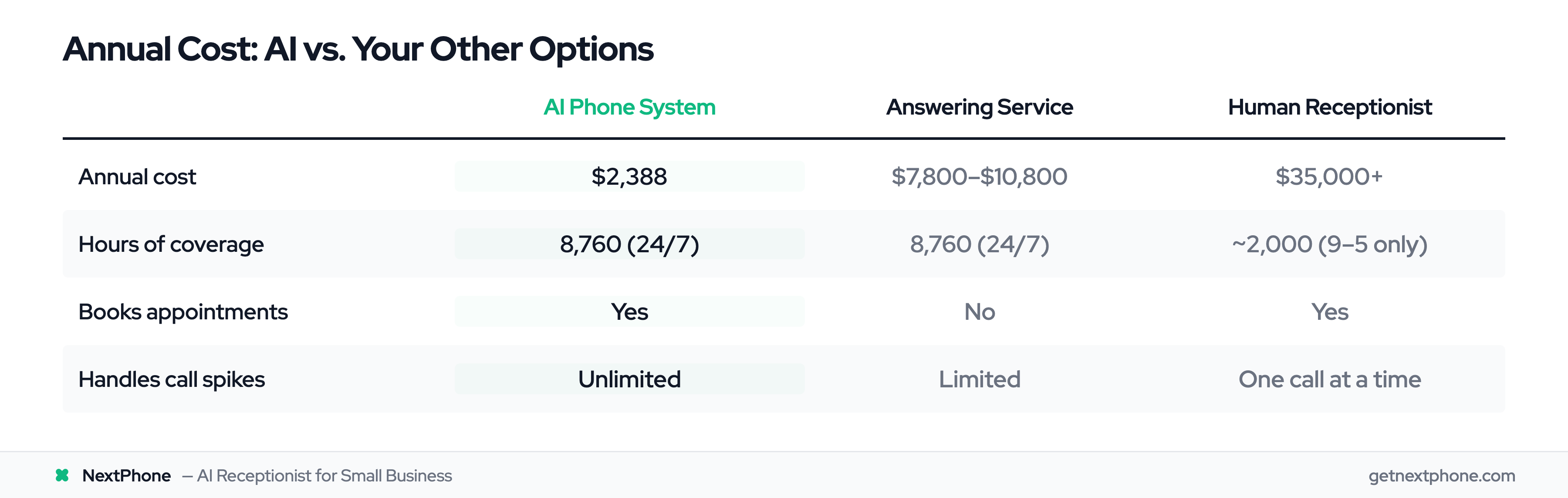
Hiring a full-time receptionist costs $35,000 to $50,000 per year in salary alone. Add benefits, payroll taxes, training, PTO, and you're easily looking at $50,000+ total cost. An AI virtual receptionist changes this equation dramatically.
And that receptionist only works 40 hours a week. Who answers the phone during the other 128 hours?
An AI phone system changes the math entirely. Quality solutions run between $100-$300 per month. At NextPhone, the cost is $199 per month—flat rate, no surprises.
Let's do the comparison:
- Traditional receptionist: $35,000/year minimum
- AI phone system: $2,388/year ($199 x 12)
- Annual savings: $32,612+
That's enough to buy a new work van. Or fund your marketing for the year. Or take a real vacation.
The Real ROI Numbers
The savings go deeper than the headline comparison. Research shows that AI interactions cost $0.25-$0.50 per interaction, compared to $3.00-$6.00 for human agents. That's an 85-90% reduction in cost per call.
McKinsey research confirms that AI technologies can reduce customer service expenses by up to 30% even when used alongside human staff. Businesses implementing AI phone systems report overall savings of 40-60% on communication expenses.
Most companies see full ROI within 3-6 months. After that, the savings flow straight to your bottom line.
Beyond Direct Savings
The cost benefits compound when you consider what you're not paying for:
- No training costs when your AI doesn't quit
- No recruitment fees or hiring delays
- No benefits, health insurance, or retirement contributions
- No sick days, vacation coverage, or family emergencies
- No bad days where a frustrated employee snaps at a customer
Your AI phone system shows up ready to work every single day, delivering identical quality whether it's the first call or the five-hundredth.
Benefit #2: True 24/7 Availability
Your customers don't schedule their emergencies for business hours. Neither should your phone coverage.
Capturing After-Hours Opportunities
Think about when problems happen in homes and businesses. Pipes burst at 2 AM. Air conditioners die on Saturday afternoons. Garage doors refuse to open Sunday morning when someone needs to get to church.
These callers aren't going to wait until Monday at 9 AM. They're calling right now, and they're ready to hire whoever picks up.
Data shows that urgent calls rank among the top reasons people call, with language indicating immediate need. If your phone goes to voicemail at 6 PM, those urgent callers become your competitor's customers.
An AI phone system answers every call, every time. Whether it's 3 PM on Tuesday or 3 AM on Christmas morning, callers get a professional response. They can describe their problem, schedule service, get basic questions answered, and know that someone will follow up.
Never Miss Another Lead
Beyond emergency calls, consider all the leads you're losing during regular off-hours:
- The homeowner researching contractors after the kids go to bed
- The business owner who finally has time to make calls on Saturday
- The customer whose schedule only allows calls during their lunch break (while you're at lunch too)
AI phone systems don't take breaks. They don't eat lunch. They handle multiple calls simultaneously—no busy signals, no hold times, no "please call back later."
Every single inquiry gets captured and routed appropriately.
The Competitive Advantage
According to Gartner research, 85% of customer service leaders are exploring or piloting conversational AI solutions. The UCaaS market is projected to grow from $56B to $176B by 2030 as more businesses adopt cloud-based communication. The businesses that move first gain a significant edge.
Most small businesses simply can't afford to staff phones around the clock. AI levels the playing field, giving a three-person plumbing company the same 24/7 availability as a national chain.
Benefit #3: Consistent Service Quality
Here's something business owners don't like to admit: employees have bad days.
Your best receptionist might be dealing with a personal crisis, feeling under the weather, or just having an off morning. Callers who happen to ring during those moments get a subpar experience through no fault of their own.
Every Call Gets Your Best
An AI phone system delivers identical quality on every single call. The first caller of the day gets the same friendly, professional response as the three-hundredth. There's no variation based on mood, energy level, or what happened in the parking lot that morning.
Your brand voice stays consistent. Your information stays accurate. Your professionalism never wavers.
Professional Image Without the Overhead
Small businesses often worry about sounding "small." A solo contractor answering their own phone while running a table saw doesn't project the same image as a company with dedicated office staff.
AI phone systems give every business a polished, professional presence. Calls are answered promptly with proper greetings. Information is gathered systematically. Callers feel like they're dealing with an established, organized operation. Business phone system statistics show these professional touches matter—first impressions drive customer decisions.
This matters more than you might think. Research shows 70% of customers will stop dealing with a company whose service seems weak or unprofessional. First impressions happen fast, and your phone presence sets the tone.
Standardized Information Capture
Human receptionists, even great ones, sometimes forget to ask key questions. They might miss getting a callback number, forget to ask about the project timeline, or neglect to capture an email address.
AI phone systems collect the same data points on every call. Nothing gets forgotten. Every message is transcribed accurately. The right team member gets notified immediately with complete information.
Benefit #4: Effortless Scalability
What happens when your marketing actually works?
A successful advertising campaign, a great review that goes viral, a busy season that exceeds expectations—these should be causes for celebration. Instead, many businesses panic when call volume spikes because their phone system can't handle the load.
Handle Volume Spikes Without Stress
Seasonal businesses feel this acutely. HVAC companies get crushed when the first heat wave hits. Roofers face call avalanches after major storms. Landscapers see their phones light up every spring.
Traditional solutions require a choice: hire temporary staff (expensive and slow) or accept that you'll miss calls during your busiest, most profitable periods.
AI phone systems scale instantly. Ten calls or ten thousand—the system handles them with the same speed and quality. No hiring. No training. No delays.
Growth Without Growing Pains
Scaling a traditional phone operation means adding headcount. Each new receptionist requires recruiting, interviewing, hiring, training, and managing. That process takes months, and the new hire needs time to get up to speed.
AI scales with a toggle switch. Opening a new location? Add it to the system. Launching in a new market? Your phones are ready immediately. Running a promotion that might triple your normal volume? The AI handles it without breaking a sweat.
You pay for what you use, not for peak capacity that sits idle most of the year. 90% of businesses that switch to VoIP report improved communication—the technology has matured to the point where it simply works better than traditional systems.