
AI Customer Service Market Size and Growth Statistics
The AI customer service market is experiencing the kind of growth that gets investors excited and business leaders paying attention. Recent Zendesk CX Trends 2025 research shows human-centric AI drives loyalty, and Accenture's survey of 7,000 customers found customer service is at a critical turning point. Here's what the numbers show.
Current Market Valuation

The AI customer service market reached $12.06 billion in 2024, according to Polaris Market Research. That figure is projected to hit $47.82 billion by 2030, representing a compound annual growth rate (CAGR) of 25.8%.
An alternative projection from Polaris suggests the market could reach $15.12 billion in 2025 and grow to $117.87 billion by 2034 at a 25.6% CAGR. Either way, we're looking at a market that's expanding at roughly 25% year-over-year.
Investment and Savings Trends
The financial impact of AI customer service extends beyond market size:
- AI automation is expected to save businesses $79 billion annually by 2025
- Conversational AI is projected to save $80 billion in labor costs by 2026
- Zendesk alone projects $200 million in AI-related annual recurring revenue for 2025
- The call center AI market specifically is growing from $3.23 billion in 2024 to $3.98 billion in 2025
This growth isn't happening in a vacuum. It's being driven by businesses that can't afford operational inefficiencies. Consider that contractors and home service businesses miss 60-80% of incoming calls according to industry data. Each of those missed calls represents $200 to $2,000 in potential revenue. When the math is that clear, the investment in AI becomes obvious.
AI Customer Service Adoption Rate Statistics
How many companies are actually using AI for customer service? The adoption statistics reveal a market in transition - widespread enthusiasm, but uneven execution.
Enterprise Adoption Numbers
The headline numbers are impressive:
- 88% of organizations have adopted AI in at least one function in 2025 (see also McKinsey's analysis on AI enhancing satisfaction 15-20% and revenue 5-8%)
- 80% of companies are either using or planning to adopt AI-powered chatbots for customer service by 2025
- 85% of customer service leaders will explore or pilot conversational generative AI in 2025, according to Gartner
- 81% of businesses have implemented AI in contact centers
- 32% of customer service practitioners already use AI for support
- 47% of companies that don't currently use AI plan to implement it in 2025
Industry Leaders in AI Adoption
Not all industries are moving at the same pace:
- Telecom leads with 95% of providers integrating AI into customer support workflows
- Banking and finance follows at 92% adoption rate
- Retail, healthcare, and professional services trail behind but are accelerating
The Execution Gap
Here's where the statistics get more nuanced:
- Only 25% of call centers have successfully integrated AI automation (Zendesk)
- Only 20% of AI projects are fully meeting expectations (Gartner)
- 42% of companies abandoned most AI initiatives in 2025 - up dramatically from 17% the previous year
- 70-85% of AI initiatives fail to meet expected outcomes
The gap between adoption plans and successful execution represents both a challenge and an opportunity. Companies that get AI implementation right are seeing significant competitive advantages.
Small Business Reality Check
For small and local businesses, the picture looks different. Our data at NextPhone shows that:
- The average small business misses 62% of incoming calls during business hours
- A large share of customers explicitly request callbacks when they cannot reach someone
- 85% of unanswered callers never try again
- Small businesses miss 35-45% of after-hours calls, and 80% never follow up
These aren't statistics about AI adoption - they're statistics about the problem AI is solving. When every missed call represents lost revenue, the case for AI phone answering becomes straightforward.
ROI and Cost Savings Statistics
If there's one set of numbers that drives AI customer service investment decisions, it's ROI data. Here's what companies are actually seeing in returns.
Return on Investment Numbers
The ROI statistics for AI customer service are consistently positive across multiple studies:
- Companies see average returns of $3.50 for every $1 invested in AI customer service
- Leading organizations are achieving up to 8x ROI
- Some implementations are reporting 148-200% ROI
- Top performers report $300,000+ in annual cost savings
- A more conservative measurement shows $1.41 earned for every $1 spent on AI technology
Detailed Cost Reduction Statistics
The cost reduction data is where AI customer service really shines:
- IBM reports AI reduces customer service costs by up to 30%
- AI reduces overall customer service operational costs by 30-50% (IBM)
- AI-driven automation has led to a 30% decrease in operational costs across industries
- Implementing AI can reduce labor costs by up to 90% by automating routine tasks
- AI agents cost $0.25-$0.50 per interaction compared to $3.00-$6.00 for human agents - representing an 85-90% cost reduction
- Conversational AI reduces cost per contact by 23.5% (IBM)
Real-World Case Studies
The case study data adds context to these numbers:
- NIB Health Insurance saved $22 million through AI-driven digital assistants, reducing customer service costs by 60% and decreasing phone calls with agents by 15%
- ServiceNow reports $325 million in annualized value from enhanced AI productivity
- Humana decreased pre-service calls to contact centers while eliminating long wait times for members
The Cost of Inaction
For businesses not using AI, the opportunity cost is equally dramatic:
- The average missed call costs $450 in lost opportunity
- 93% of callers never ring back after a missed call
- For real estate agents, missed calls lead to an estimated $100,000 in annual revenue losses per agent
- Home service businesses lose $200-$2,000 per missed call depending on the service type
At NextPhone, we see this pattern constantly. Contractors who miss 60-80% of incoming calls aren't just losing individual jobs - they're losing the compound value of customer relationships and referrals. For businesses that want a safety net, missed call text-back sends an automatic SMS to every caller you can't reach — a low-effort layer that recaptures a meaningful share of those leads.
Efficiency and Productivity Statistics
AI's impact on customer service efficiency goes beyond cost savings. The productivity numbers show fundamental changes in how customer service operates.
Response Time Improvements
The speed improvements with AI are dramatic:
- First response time dropped from over 6 hours to less than 4 minutes with AI-powered support
- Resolution times have been slashed from 32 hours to just 32 minutes with AI - an 87% reduction
- Bank of America's "Erica" AI assistant resolves 98% of customer queries within 44 seconds
- Erica now handles 56 million engagements per month and has completed 2 billion total interactions
- Businesses using AI-driven routing achieved 30% faster average response time compared to manual triage
- AI-powered tools reduce resolution times by up to 50% through automation and predictive support
Productivity Gains for Human Agents
AI doesn't just handle queries - it makes human agents more effective:
- Customer support agents using generative AI see a 14% productivity boost on average
- Workers are 33% more productive during each hour they use generative AI
- Reps using AI spend 20% less time on routine cases - freeing up approximately 4 hours per week for complex work
- Service professionals save over 2 hours daily using generative AI for quick responses
- Support agents using AI tools handle 13.8% more customer inquiries per hour
- 84% of customer service reps using AI say it makes responding to tickets easier
- 74% of agents said AI copilots helped them feel more confident in resolving complex cases
Resolution Without Human Intervention
Perhaps the most significant efficiency metric is how many issues AI resolves completely on its own:
- 65% of incoming support queries were resolved without human intervention in 2025 - up from 52% in 2023 (according to BigSur's customer service automation statistics)
- AI chatbots can manage up to 80% of routine tasks and customer inquiries (learn more about how to improve FCR)
- ServiceNow's AI agents handle 80% of customer support inquiries autonomously
- Microsoft customer agents achieved 70% less human intervention and 90% first-call resolution rates after deploying AI (see SQM's comprehensive FCR guide for industry benchmarks)
- Fisher & Paykel reports AI live chat halved call times and resolves up to 65% of issues without human intervention
Implications for Phone-Based Businesses
For service businesses that rely on phone calls, these efficiency stats translate directly to revenue. An AI virtual receptionist captures these efficiency gains by handling routine calls automatically.
Across the inbound calls our own NextPhone AI receptionist answers, the most common reasons people call — in ranked order — are:
- Booking, confirming, or rescheduling an appointment
- Asking about a specific service or repair
- Requesting a quote or estimate
- Checking the status of existing work or a follow-up
- Hours, location, and directions
- New-customer inquiries
- Emergencies (urgent, time-sensitive issues)
And when the AI actually has a conversation with a caller, the most common outcomes — ranked — are: a message captured for the business, the call transferred to a human, a new lead recorded, a booking link sent, the question answered outright, and an appointment booked. (Spam and robocalls are filtered out before any of that.)
When AI handles the routine calls efficiently, human staff can focus on the complex conversations that actually require judgment and expertise.
Customer Satisfaction Statistics
Do customers actually like interacting with AI? The satisfaction data reveals a more nuanced picture than you might expect. Forrester reports the US CX Index is at its lowest since 2016, highlighting the stakes involved.
Positive Experience Statistics
The majority of customers report good experiences with AI service:
- 80% of customers who have interacted with AI-powered customer service reported positive experiences
- Top AI performers are achieving 87.2% positive ratings within 6 months of implementation
- AI-powered systems have led to a 31.5% boost in customer satisfaction scores
- AI correlates with a 24.8% increase in customer retention
- 88% of customers say good service makes them more likely to purchase from the same company again
- AI-enabled self-service can reduce incidents by 40-50%, with cost-to-serve dropping more than 20% while maintaining or improving satisfaction (McKinsey)
What Customers Actually Prefer
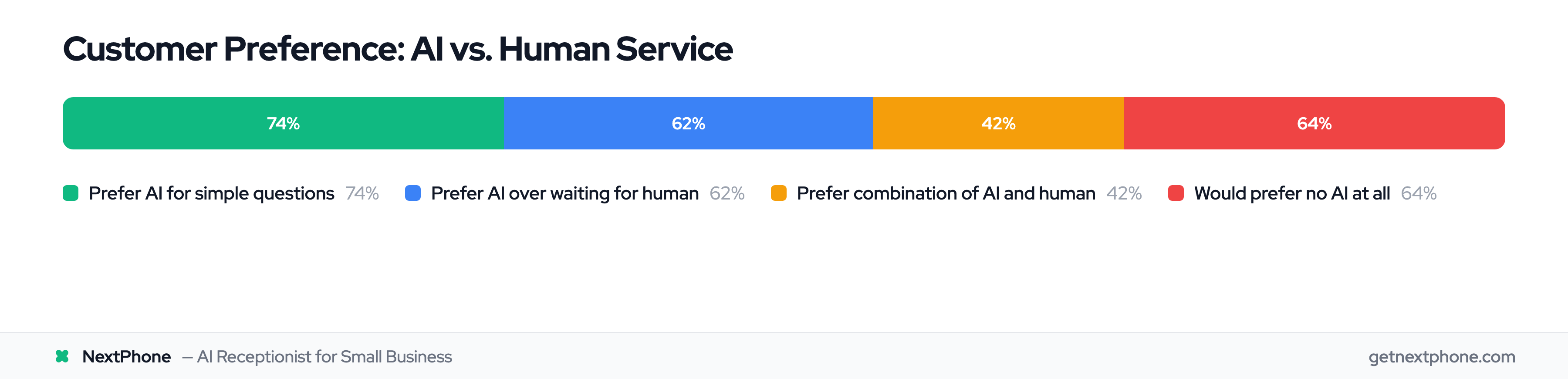
Customer preference data reveals interesting patterns:
- 62% of customers prefer engaging with chatbots over waiting for human agents
- 74% of customers prefer chatbots for simple questions
- 51% of consumers say they prefer interacting with bots over humans when they want immediate service
- 54% of consumers don't care how they interact with a company, as long as their problems are fixed fast
- One-third of consumers would rather purchase a product through AI agents vs. with a person
The Skeptical Side
Not everyone is enthusiastic about AI customer service:
- 64% of customers would prefer that companies didn't use AI for customer service (Gartner)
- 53% of customers would consider switching to a competitor if they learned a company uses AI for customer service
- The top customer concern: it will get more difficult to reach a human
- 63% of consumers are concerned about potential bias and discrimination in AI algorithms
Finding the Right Balance
The data suggests customers want options, not mandates (see also Plivo's contact center statistics and benchmarks for 2025):
- 42% of customers appreciate a combination of AI and human support
- Shoppers favor businesses whose AI is 73% managed by humans
- The key insight: AI for speed and routine, humans for complexity and empathy
Our data at NextPhone reflects this balance. Across 1,446,980+ inbound calls, 90–95% resolve without human escalation. But some calls — urgent situations and time-sensitive emergencies — do need immediate human attention. Good AI systems recognize these signals and route accordingly.