
Your phone rings at 2 PM on a Tuesday. You're on a ladder installing a ceiling fan, hands full of wire nuts, safety glasses fogging up. The call goes to voicemail. The customer hangs up and calls the next electrician on their list.
That scenario plays out millions of times every day across small businesses in America. We analyzed 130,175 calls from 45 home services contractors over 7 months, and the results were brutal: 74.1% of calls went completely unanswered. That's nearly three out of every four potential customers calling someone else.
Phone calls convert to revenue at 10-15x the rate of web leads. Research shows consumers and businesses prefer voice over text or email for important communications. Every missed call isn't just an inconvenience - it's money walking out the door.
This guide covers everything you need to know about answering services in 2025: what they are, how they work, the real cost differences between traditional and AI options, and how to decide which one fits your business. No sales pitch - just the information you need to make a smart decision.
What Is an Answering Service?

An answering service is exactly what it sounds like: a service that answers your business phone calls when you can't. Instead of sending callers to voicemail (where 80% of them won't leave a message), an answering service provides a live response - whether from a human operator or an AI assistant.
The Basic Definition
At its simplest, an answering service is a third party that handles your incoming calls. They answer using your business name, gather information from callers, and make sure you get the message. Think of it as having a receptionist without hiring one full-time.
The scope can range from basic (just taking messages) to comprehensive (scheduling appointments, answering FAQs, routing emergencies, even processing orders).
What Answering Services Handle
Based on our analysis of thousands of business calls, here's what answering services typically deal with:
- General service requests (31.1% of calls): "I need a plumber to fix a leak"
- Callback requests (25.4%): "Please have someone call me back"
- Scheduling and appointments (7.7%): "Can I book a time for Thursday?"
- Quote and estimate requests (6.9%): "How much would it cost to..."
- Emergency calls (6.2%): "My pipe burst, I need help NOW"
- General questions (5.2%): "What are your hours?"
That's a lot of calls that need handling - and a lot of opportunities lost when they go to voicemail.
Answering Service vs. Voicemail: The Key Difference
Voicemail is passive. A recording plays, and maybe the caller leaves a message. Maybe they don't. (Usually they don't.)
An answering service is active. Someone - or something - engages with the caller in real time. Questions get answered. Information gets captured. Emergencies get routed immediately. The caller feels heard instead of hitting a dead end.
That's the difference between a potential customer and a definitely-lost-customer.
How Do Answering Services Work?
Understanding the mechanics helps you evaluate whether an answering service fits your business. Here's what happens behind the scenes.
The Call Flow (Step-by-Step)
When someone dials your business number, here's the typical flow:
- Call forwarding activates: Your business line forwards calls to the answering service (you set the rules - all calls, after-hours only, when you're busy, etc.)
- Professional greeting: The service answers with your business name and a customized greeting
- Information gathering: The operator (human or AI) collects key details - caller name, phone number, reason for calling
- Response or routing: Depending on the call type, they answer questions, schedule appointments, or route urgent calls directly to you
- Message delivery: You receive a summary via text, email, or app notification
The whole interaction takes 1-3 minutes for most calls. The caller gets help. You get the information. Nobody falls through the cracks.
What Happens When Someone Calls
Let's walk through some real examples from our call data:
Routine question: Caller asks "What time do you open?" The service answers from your business information. Done in 30 seconds.
Appointment request: "Wants to schedule service for a leaky toilet, asking about your availability for tomorrow." The service checks your calendar and books the slot - or takes the request for you to confirm.
Emergency call: "Needs emergency AC repair, no cooling in 95 degree weather." The service recognizes the urgency, routes the call to your phone immediately, and you're talking to the customer within seconds.
Callback request: "Requested you call back at 555-0123." The service captures the number, sends you the message, and the customer knows you'll respond.
In our data, 15.9% of calls contained urgency language - words like "ASAP," "urgent," "emergency," or "today." These aren't calls that can wait for you to check voicemail at the end of the day.
How You Receive Messages
Most modern answering services offer multiple notification options:
- Text message: Instant summary sent to your phone
- Email: Detailed message with all caller information
- App notification: Push notification with call details
- Dashboard: Log in to see all calls, messages, and recordings
You choose what works for your workflow. Most business owners prefer text messages for urgent calls and email summaries for everything else.
Types of Answering Services (Traditional vs AI)
Here's where the decision gets interesting. In 2026, you have more options than ever - and the differences matter for your budget and your customers' experience.
Traditional Live Answering Services
Traditional services employ human operators who answer your calls. Companies like Ruby, AnswerConnect, and PATLive have been doing this for decades. The telephone answering services market reached $1.538 billion in 2024.
Pros:
- Real humans handle complex situations
- Personal touch for sensitive calls
- Can handle nuanced conversations
Cons:
- Expensive: Base fees typically $300-500/month plus per-call charges
- Limited hours: 24/7 costs significantly more
- Inconsistent quality: Different operators, different experiences
- Scalability: Costs spike during busy periods
For 42 calls per month (the average in our study), traditional services typically cost $500-800/month. During busy season? That number can hit $1,000+.
Automated/IVR Systems
You know these: "Press 1 for sales, press 2 for support..."
Pros:
- Cheapest option
- Always available
Cons:
- Everyone hates phone trees
- Limited capability
- Callers often hang up in frustration
- No real conversation
IVR systems had their place, but they're increasingly outdated. Callers expect better.
AI-Powered Answering Services
This is where things get interesting. AI answering services use natural language processing to have actual conversations with callers - not robotic menus, but real dialogue.
Pros:
- 24/7/365 coverage included
- Flat monthly pricing (no per-call fees)
- Consistent experience every call
- Can answer questions, book appointments, route emergencies
- Rapidly improving capabilities
Cons:
- May struggle with highly complex or emotional calls
- Some callers prefer humans
- Quality varies by provider
AI answering services typically cost $99-299/month with unlimited calls. The technology has improved dramatically - modern AI sounds natural and handles most routine calls as well as (or better than) humans.
The rapidly growing AI market in this space (22.7% annual growth) reflects what business owners are discovering: for most calls, AI works great and costs a fraction of traditional options. The answering services market globally is valued at $8.4 billion.
AI with Smart Forwarding (Best of Both Worlds)
Modern AI resolves 90-95% of calls autonomously. For the 5-10% requiring your expertise, smart forwarding routes to your phone with full context.
This approach works because it offers:
- AI efficiency for the vast majority of calls
- Your personal judgment when it matters—not a stranger's
- 24/7 coverage at $199/month flat
If your business gets a mix of simple and complex calls, AI with smart forwarding is the clear winner.
Comparison: Traditional vs AI vs Hybrid
| Feature | Traditional | AI | Hybrid |
|---|---|---|---|
| Monthly Cost | $300-800+ | $99-299 | $200-400 |
| 24/7 Coverage | Extra cost | Included | Included |
| Per-Call Fees | Yes | No | Sometimes |
| Complex Calls | Excellent | Good | Excellent |
| Consistency | Variable | High | High |
| Best For | Medical, Legal | Most SMBs | Mixed needs |
Benefits of Using an Answering Service
Why bother? Because the math makes sense - and the alternative (missed calls) is expensive.
Never Miss a Customer Call
This is the big one. In our analysis of 130,175 calls from 45 contractors, 74.1% went unanswered. Let that sink in: three out of four potential customers were sent to voicemail.
An answering service captures every call. Even if you're on a job, in a meeting, at dinner, or asleep - someone's there to answer.
24/7 Availability Without 24/7 Staff
According to the U.S. Chamber of Commerce, 67% of small business owners struggle with work-life balance. The pressure to always be available is real.
An answering service lets you be available to customers without being chained to your phone. Emergencies get routed immediately. Everything else waits until you're ready.
The calls don't stop at 5 PM. Neither does your answering service.
Professional Image for Any Size Business
A one-person plumbing company can sound like a 50-person operation when calls are answered professionally. Consistent greetings, prompt responses, and capable handling build trust with callers.
First impressions matter. "Please leave a message" doesn't inspire confidence.
Emergency Call Handling
Our data shows 15.9% of calls contain urgency language - "urgent," "ASAP," "emergency," "today." Another 6.2% are true emergencies requiring immediate response.
Here's a real example from our call data: "Needs emergency pipe burst, plumber immediately."
That caller isn't leaving a voicemail and waiting. They're calling the next plumber. And the next. The first one to answer gets the job.
A good answering service detects urgency and routes those calls to you instantly. The rest can wait for a callback.
Free Up Your Time
6.5% of calls in our data were repetitive questions: "What are your hours?" "Do you service my area?" "What's your pricing?"
These questions have the same answers every time. Why handle them yourself when an answering service can respond instantly?
That frees you to focus on actual work instead of playing phone tag all day.
Ready to see how this works in practice? [See how NextPhone handles calls 24/7 for $199/month →]
How Much Does an Answering Service Cost?
Let's talk real numbers. This is where most answering service guides get vague - we won't.
Traditional Answering Service Pricing
Traditional services typically use base fee + per-call (or per-minute) pricing:
Ruby Receptionists:
- Base: $319/month
- Per-call: $5.19
- For 42 calls/month (average): $319 + $218 = $537/month
- For 87 calls/month (busy season): $319 + $451 = $770/month
AnswerConnect:
- Base: ~$325/month
- Per-minute charges (~$2/minute)
- Average 3-minute call × 42 calls = ~$252 in overage
- Monthly total: ~$577/month
Notice the pattern: costs scale with usage. Busy month? Big bill.
AI Answering Service Pricing
AI services typically use flat monthly pricing:
NextPhone: $199/month unlimited calls Most AI services: $99-299/month range
No per-call fees. No surprises. Same price whether you get 20 calls or 200.
In-House Receptionist Comparison
What about just hiring someone?
According to the Bureau of Labor Statistics, the median annual wage for receptionists is $36,920. Add benefits, payroll taxes, and overhead, and you're looking at roughly $45,000/year - or $3,750/month.
And that person works 9-5, Monday through Friday. What about the 73% of calls that come outside business hours?
The Real Cost: What Are Missed Calls Costing You?
Here's the math most business owners never do:
- Average calls per month: 42 (from our study)
- Missed call rate: 74.1%
- Missed calls: 31 per month
- Average project value: $3,500 (home services)
- Close rate on answered calls: 20%
- Lost revenue: $21,770/month
That's over $260,000/year walking out the door. Against that backdrop, $199/month for an AI answering service seems pretty reasonable.
Even capturing ONE additional job per month pays for the service for nearly 18 months.
Cost Comparison Summary:
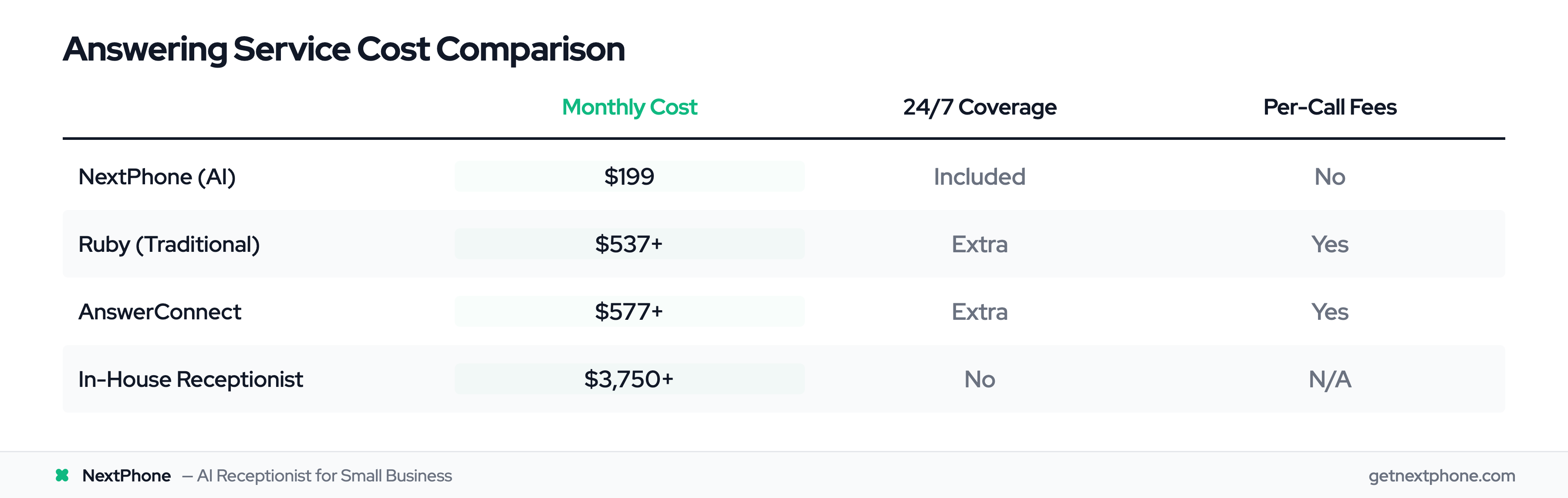
| Option | Monthly Cost | 24/7 Coverage | Per-Call Fees |
|---|---|---|---|
| NextPhone (AI) | $199 | Included | No |
| Ruby (Traditional) | $537+ | Extra | Yes |
| AnswerConnect | $577+ | Extra | Yes |
| In-House Receptionist | $3,750+ | No | N/A |
Which Industries Benefit Most From Answering Services?
Short answer: any business where phone calls equal revenue. But some industries see particularly strong returns.
Home Services (Plumbing, HVAC, Electrical, Roofing)
Our entire dataset comes from home services contractors - 45 businesses across plumbing, HVAC, electrical, roofing, and more. The patterns are clear:
- High call volume: Contractors average 42+ calls per month
- Time-sensitive: Customers call 3-5 providers; first to answer wins
- Can't answer on the job: Hard to pick up the phone when you're on a roof or under a sink
- Emergencies are common: 6.2% of calls are genuine emergencies
Roofing contractors see 10.6% of calls as quote requests - with average projects at $15,000. Miss those calls, and you're missing serious money.
One HVAC contractor in our data missed 76 calls in a single month during peak summer season. He didn't even realize it until he saw the numbers.
Healthcare and Medical Offices
Medical practices need after-hours coverage for patient calls. Many require compliant services, which may push them toward traditional human operators. But AI options with proper compliance are emerging.
Legal Services
Potential clients often call multiple attorneys. The first to respond typically gets the case. After-hours calls from accidents or arrests are common - and valuable.
Real Estate
Buyers call when they see a listing. Timing matters. An unanswered call is a buyer moving on to another agent.
The Pattern
If missing a call means losing a customer, an answering service makes financial sense. The specific industry matters less than the call-to-revenue connection.
How to Choose the Right Answering Service
Here's the decision framework most guides skip. Let's make this practical.
Assess Your Call Volume and Patterns
Start with the basics:
- Low volume (under 30 calls/month): AI is most cost-effective
- Medium volume (30-100 calls/month): AI saves significant money vs. traditional
- High volume (100+ calls/month): AI becomes a no-brainer (flat pricing wins)
Also consider timing. If 50% of your calls come after hours, 24/7 coverage matters more.
Determine Your Budget
Be honest about what you can spend:
- Tight budget ($100-200/month): AI answering service
- Moderate budget ($300-500/month): Traditional basic or AI premium
- Flexible budget ($500+/month): Premium traditional with 24/7
Remember: the cheapest option isn't always the best value. Missing calls costs more than any answering service.
Identify Must-Have Features
What do you actually need?
- Basic message-taking: Any option works
- Appointment scheduling: Need AI with calendar integration or premium traditional
- Emergency routing: Essential for service businesses - confirm the service offers it
- CRM integration: Check compatibility with your existing tools
- 24/7 coverage: AI is cheapest; traditional charges premium
Traditional vs AI: Which Is Right for You?
Choose Traditional if:
- Your calls are frequently complex or emotional
- You need industry-specific compliance certification
- Your customers explicitly expect human interaction
- Budget isn't a primary concern
Choose AI if:
- Most calls are routine (hours, pricing, scheduling)
- Budget matters
- You need 24/7 coverage
- Call volume fluctuates seasonally
Choose AI with Smart Forwarding if:
- You get a mix of simple and complex calls
- You want AI cost savings with your personal judgment for complex ones
- You want 24/7 coverage without hiring anyone
Questions to Ask Before Signing Up
Before committing, get answers to these:
- What's included in the base price? (Watch for hidden fees)
- Are there per-minute or per-call charges?
- How are after-hours calls handled?
- Can I customize the greeting and scripts?
- How quickly are messages delivered?
- Is there a contract, or can I cancel anytime?
- What happens during outages or high call volume?
Not sure which option fits your business? [Try NextPhone free for 7 days →]
How NextPhone Helps Businesses Answer Every Call
For small businesses that need reliable call coverage without enterprise budgets, NextPhone offers AI-powered answering starting at $199/month.
AI-Powered, Human-Quality Answering
NextPhone's AI answers calls in natural conversation - not robotic menus or awkward pauses. Callers often don't realize they're talking to AI until they ask.
Every call gets answered in under 5 seconds. 24/7/365. No holidays, no sick days, no "please hold."
What NextPhone Handles
Based on our analysis of what calls actually look like:
- Routine questions (hours, location, services): AI answers instantly from your business information
- Appointment scheduling: Books directly into your Google Calendar or scheduling system
- Quote requests: Captures details and notifies you immediately
- Emergency detection: Recognizes urgency language and routes calls to your phone
- Spam filtering: Blocks the 7% of calls that are junk (yes, we measured this)
- Callback requests: Captures information and sends you a detailed summary
How It Works in Practice
Here's a typical scenario:
11 PM on a Wednesday. Customer calls about scheduling an HVAC tune-up for next week. Instead of hitting voicemail, NextPhone answers: "Thanks for calling [Your Business Name]. I can help you schedule that. What day works best for you?"
The AI checks your calendar, books the appointment, and confirms with the caller. You wake up to a notification: appointment booked, customer confirmed, call summary attached.
No missed call. No back-and-forth phone tag. Just a booked job.
For $199/month - less than a single service call - you get a 24/7 receptionist that never takes a day off.
See NextPhone in action →
Frequently Asked Questions
What is the difference between an answering service and a call center?
Scale and scope. Answering services handle individual business calls - typically a few dozen per day for small businesses. Call centers handle high-volume operations with hundreds or thousands of calls per day. Answering services focus on message-taking and routing. Call centers handle full customer service, sales, and support operations. If you're a small business, you need an answering service, not a call center.
Can an answering service schedule appointments?
Yes - most modern answering services (especially AI-powered ones) can book appointments directly. This requires calendar integration with Google Calendar, Outlook, or your scheduling software. AI services like NextPhone book appointments automatically. Traditional services may take appointment requests that you confirm later. If scheduling is important to your business, make sure the service offers calendar integration.
How much does a 24/7 answering service cost?
Traditional 24/7 services typically run $500-1,000+/month because human operators cost more for overnight and weekend shifts. AI answering services include 24/7 coverage in their base price - usually $99-299/month. NextPhone, for example, costs $199/month flat with full 24/7 coverage. The cost gap between traditional and AI widens significantly when you need round-the-clock availability.
Are AI answering services as good as human ones?
For routine calls - questions about hours, pricing, scheduling - AI performs as well or better than humans. It's faster, more consistent, and available 24/7. For complex or emotional situations, humans still have an edge. The best approach for most businesses: let AI handle the 60-80% of calls that are routine, and route complex situations to you directly. Modern AI in 2025 sounds natural and handles real conversation, not just "press 1 for sales."
What happens if the answering service can't help a caller?
Good services recognize their limits. If a caller needs something beyond the service's capability, they either route the call to you immediately or take a detailed message with callback information. With NextPhone, you set the rules: certain keywords trigger immediate routing, certain call types go to voicemail, and you decide what qualifies as urgent. The caller never feels abandoned.
Do I need a special phone system for an answering service?
No special equipment needed in most cases. Answering services work through call forwarding from your existing business number. VoIP systems integrate easily. Traditional landlines work too. Setup typically takes a few hours - you set up forwarding rules, customize your greeting, and you're live. No new phone numbers, no hardware installations.
Can an answering service handle multiple businesses?
Yes. Most services can answer for multiple business lines with separate greetings and instructions for each. This is useful for owners with multiple companies or locations. Pricing varies - some charge per line, others bundle multiple numbers. Ask about multi-business pricing if this applies to you.
Start Capturing Every Customer Call
Answering services solve a simple problem: calls that go unanswered become customers who go elsewhere. Whether you choose traditional, AI, or hybrid depends on your budget, call volume, and how complex your typical calls are.
For most small businesses in 2025, AI answering services offer the best value. You get 24/7 coverage, flat monthly pricing, and capabilities that keep improving - all for less than traditional services charge for basic plans.
The businesses winning right now aren't necessarily the ones with the biggest marketing budgets. They're the ones answering every call. The ones losing are sending potential customers straight to voicemail.
74.1% of calls going unanswered means 74.1% of opportunities lost. Fix that, and everything else gets easier.
Ready to stop missing calls? [Start your free 7-day trial of NextPhone and answer every call for $199/month →]