
Key Takeaways
- Prioritize transparent pricing - Understand exactly what's included and how overages work before signing
- Match features to your needs - 24/7 availability, CRM integration, and customizable scripts are table stakes for most businesses
- Know your call volume first - Track your calls for 2-4 weeks before shopping to get accurate quotes
- Ask about contract terms upfront - Look for flexibility and reasonable cancellation policies
- Watch for red flags - Vague pricing, outdated technology, and poor reviews are dealbreakers
- Test before you commit - Request a trial period to evaluate real-world performance
- Budget expectation - Quality services typically run $175-$500/month depending on volume and features
Why Your Business Might Need an Answering Service
Let's start with the basics. An answering service handles your incoming calls when you can't, whether that's after hours, during busy periods, or simply because you'd rather focus on your actual work instead of playing receptionist.
The signs you might need one are pretty obvious: you're missing calls, customers are complaining about reaching voicemail, or you're losing sleep over what opportunities might be slipping through the cracks.
Research shows 62% of business calls go unanswered, costing home services businesses significant revenue. Studies estimate that small and mid-sized businesses lose approximately $120,000 per year due to missed calls. Meanwhile, a quality answering service runs somewhere between $175-$500 per month—far less than the BLS median wage for receptionists of $17.90/hour or $37,230 annually. Even if the service helps you capture just a handful of deals you would have otherwise missed, it pays for itself many times over.
The businesses that benefit most tend to be service providers, healthcare practices, legal firms, real estate agents, and anyone else whose customers expect to reach a human when they call. If your callers regularly need to schedule appointments, ask questions, or get urgent help, you're probably a good candidate.
The 7 Essential Features to Look For
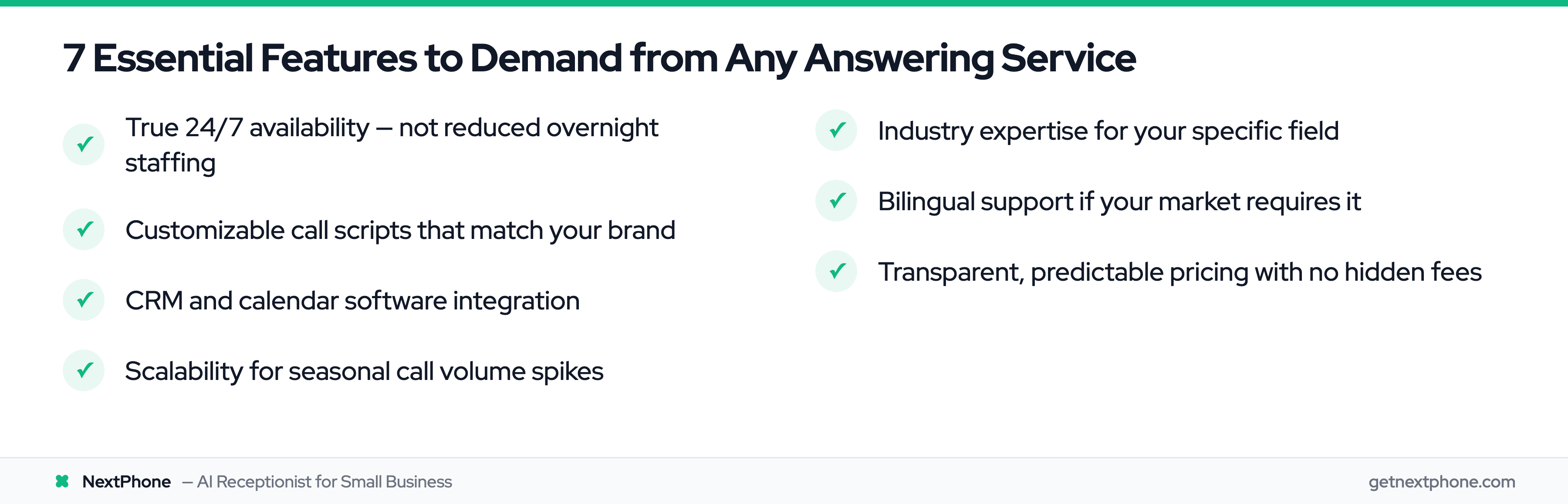
The virtual receptionist market has reached $6.26 billion, but not all answering services are created equal. Here's what separates the good ones from the ones that will frustrate you and your customers.
1. 24/7 Availability
This might seem obvious, but dig into the details. Some services advertise "24/7" but actually have reduced staffing overnight, leading to longer hold times. Others charge premium rates for weekends and holidays.
Why does around-the-clock coverage matter? Because 82% of consumers expect an immediate response when they reach out to businesses, and they don't care what time it is. If someone's calling your plumbing company at 2 AM with a burst pipe, that's exactly when you need a live person answering.
2. Customizable Call Scripts
Your answering service represents your brand. The way they greet callers, handle questions, and take messages should feel like an extension of your team, not a generic call center.
Look for services that let you customize scripts and update them as your business evolves. The best providers will work with you to develop call flows that match your specific processes and brand voice.
3. CRM and Software Integration
Every customer interaction should be logged and accessible. If your answering service can't push data directly into your existing CRM, you're creating manual work and risking dropped balls.
Integration with scheduling software is equally valuable. Our data shows that approximately one in four callers explicitly asks for a callback, and having that request automatically appear in your system means nothing falls through the cracks.
4. Scalability
Your call volume will fluctuate, seasonally and as your business grows. The service you choose should accommodate that without making you jump through hoops or pay excessive fees.
Ask potential providers: How easy is it to adjust my plan? What happens if I suddenly get twice as many calls as expected? Can I scale down during slow periods without penalty?
5. Industry Expertise
A service that specializes in your industry understands the terminology, common questions, and specific needs of your callers. This is especially critical for healthcare (where regulatory compliance is non-negotiable), legal services, and technical fields.
General answering services can work fine for straightforward call handling, but if your callers have complex needs, industry expertise becomes a major differentiator.
6. Bilingual Support
Depending on your market, Spanish-language support may be essential rather than optional. Some services offer bilingual agents as standard; others charge extra or don't offer it at all.
Consider your customer base and make this a requirement if relevant. There's nothing more frustrating for a caller than not being able to communicate effectively.
7. Transparent Pricing
This one deserves special emphasis because it's where many businesses get burned. You should be able to understand exactly what you're paying for, what's included, and what will trigger additional charges before you sign anything.
We'll dive deeper into pricing models in the next section, but for now, know that transparency itself is a feature, and one that not every provider offers.
Understanding Answering Service Pricing Models
Pricing is where things get complicated, and where many businesses end up surprised by their bills. Here's how the main models work.
Per-Minute Pricing
With per-minute billing, you pay for the actual time agents spend on your calls. Rates typically range from $0.65 to $1.75 per minute.
The upside is you only pay for what you use. The downside is unpredictability. You never quite know what your monthly bill will be, and there's an uncomfortable incentive for agents to keep callers on the line longer than necessary. Some Reddit users have reported this exact concern, noting that certain services seem to prolong calls to inflate charges.
Per-Call Pricing
Per-call pricing charges a flat fee for each call, regardless of duration. This sounds simpler, but watch out: "calls" often include wrong numbers, hang-ups, and quick questions that take 10 seconds. They all count the same.
For example, Ruby Receptionists charges $319/month plus $5.19 per call. If you get 100 calls a month, that's $838 total. If half those "calls" are wrong numbers or 15-second questions, you might feel differently about that math.
Monthly Plans with Included Minutes
Many services offer tiered monthly plans with a set number of included minutes. Typical pricing:
- 100-150 minutes: $175-$300/month
- 200-250 minutes: $295-$500/month
- 500 minutes: $549-$1,050/month
The catch is overage rates. Once you exceed your included minutes, you're often paying significantly more per minute than if you'd chosen a higher tier. AnswerConnect, for instance, charges $325/month for their base plan plus per-minute charges for additional usage.
Flat-Rate Unlimited Pricing
Some providers, including NextPhone, offer flat-rate pricing with unlimited calls. At $199/month for unlimited calls, you get complete budget predictability. There's no mental math about whether you can "afford" for someone to call, and no surprise bill at the end of the month.
This model works especially well for businesses with high or variable call volumes. If you're already close to the threshold where per-minute or per-call billing gets expensive, flat-rate often makes more sense.
Quick Pricing Comparison
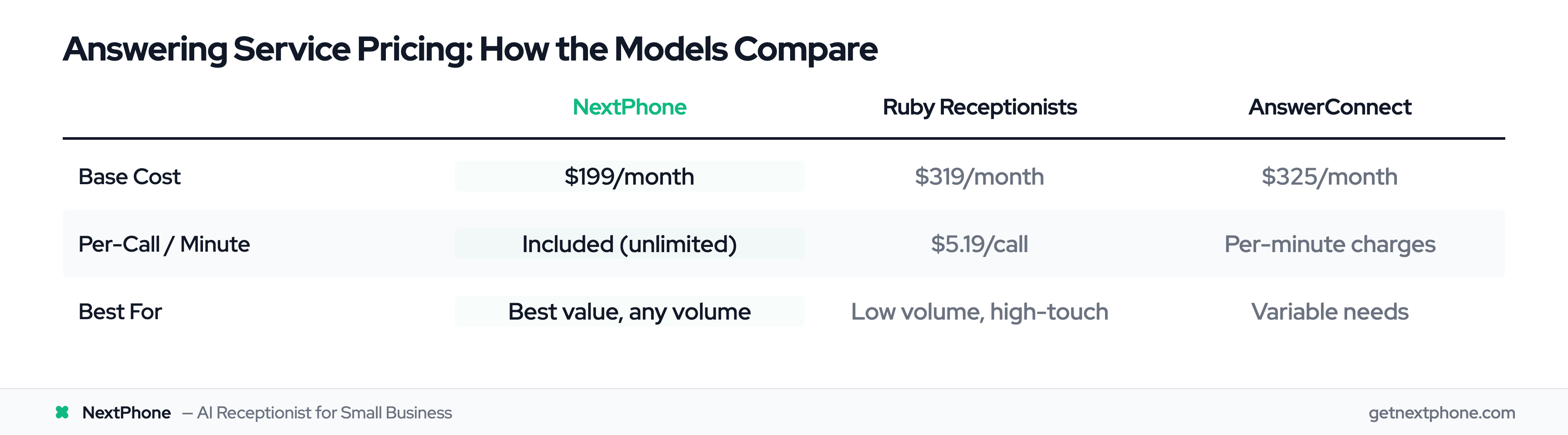
| Provider | Base Cost | Per-Call/Minute | Best For |
|---|---|---|---|
| NextPhone | $199/month | Included (unlimited) | Best value, any volume |
| Ruby Receptionists | $319/month | $5.19/call | Low volume, high-touch |
| AnswerConnect | $325/month | Per-minute charges | Variable needs |
10 Questions to Ask Before Signing a Contract
Before you commit to any answering service, get clear answers to these questions:
1. What exactly is included in your base price? Some providers bundle everything; others nickel-and-dime you for call recording, after-hours coverage, or integrations. Get a complete list.
2. How do you calculate and bill overages? If they use minute-based billing, do they round to the nearest 15 seconds or 30 seconds? That difference adds up.
3. What is your average hold time and response rate? If callers regularly wait two minutes to speak with someone, that reflects on your business, not theirs.
4. What training do your agents receive? Generic training is fine for basic call answering. If you have specific needs, ask how they'll prepare agents for your account.
5. Can I customize and update my call scripts? And how quickly can changes be implemented? Some services are flexible; others make you wait weeks for simple updates.
6. What integrations do you offer? Specifically, does it connect with your CRM, calendar, or ticketing system? API access can be valuable for custom needs.
7. What is your uptime guarantee? Look for 99.9% or higher. Anything less means your calls might go unanswered during outages.
8. What are your contract terms and cancellation policy? Avoid long lock-in periods with steep penalties. Month-to-month or short-term contracts give you an exit if things don't work out.
9. Can I listen to call recordings? This is essential for quality control. Some services make this easy; others charge extra or make it difficult.
10. Do you have experience in my industry? Ask for references from similar businesses. If they can't provide any, that's telling.