Emergency Plumbing Dispatch: 24/7 Call Triage & Routing Workflow

18 min read
Yanis Mellata
Guides

NextPhone AI Receptionist

Answer every call, book appointments, 24/7.

It's 2 AM. Your phone buzzes on the nightstand. A homeowner three miles away just discovered water pouring through their kitchen ceiling from a burst pipe upstairs. They're panicking. The water is pooling around electrical outlets. They need someone now.

Your phone goes to voicemail.

The homeowner hangs up without leaving a message and dials the next plumber on Google. That plumber answers—or rather, that plumber's AI does—and has a technician en route within 12 minutes. The job? $1,800 for emergency pipe repair, water extraction, and drywall coordination.

You wake up the next morning with no idea this call even happened.

This scenario repeats thousands of times every night across the country. In our analysis of thousands of customer service calls from home services businesses over 7 months, 6.2% were true emergencies—pipe bursts, power outages, system failures requiring immediate response. For plumbing companies, those emergency calls are the highest-value work you'll ever do. And most of them happen when you're least able to answer.

Here's the complete workflow for triaging and routing emergency plumbing calls so you never lose another midnight burst pipe to voicemail again.

Why Plumbing Emergency Call Triage Costs You More Than You Think

The Emergency Revenue Gap

Emergency plumbing jobs command premium pricing. A standard burst pipe repair runs $500-$2,500. After-hours emergency rates add 1.5x to 2x your normal hourly charge. These are your most profitable calls—and they're the ones you're most likely to miss.

Here's why: 68% of plumbing emergencies happen outside regular business hours. Cold snaps hit at midnight. Pipes freeze before dawn. Sewage backs up during Thanksgiving dinner. These calls don't respect your schedule.

Our data backs this up. Across thousands of calls we analyzed, 73% of calls to home services businesses came outside the standard 9-5 window. For plumbing specifically, the after-hours percentage is likely higher given the emergency-driven nature of the work.

What Happens When Emergency Calls Go Unanswered

The math is brutal:

  • A typical plumbing company receives about 42 calls per month
  • 6.2% are true emergencies = roughly 2-3 emergency calls per month
  • Each emergency job averages $450-$2,500 in revenue
  • 85% of callers who reach voicemail won't call back—they call your competitor

Missing just one emergency call per week adds up to approximately $16,800 per month in lost revenue. That's over $200,000 per year walking straight to whoever answers their phone first.

One plumber we analyzed had 76 missed calls in a single month and told us: "I didn't even know I was missing that many calls until I saw the data. I just thought business was slow."

The Two-Sided Triage Problem

Without a proper triage system, plumbing companies face problems on both ends:

  • Over-dispatching: Sending a $150/hour emergency crew at 2 AM for a dripping faucet that could wait until Monday burns resources and exhausts your team
  • Under-responding: Treating a burst pipe hitting electrical systems as a "we'll get back to you in the morning" message loses the job and risks the customer's safety

Good triage separates true emergencies from urgent-but-manageable situations and routine requests. That distinction alone can save you $50,000+ per year in wasted dispatches while capturing every high-value emergency.

The Three-Tier Plumbing Call Priority System
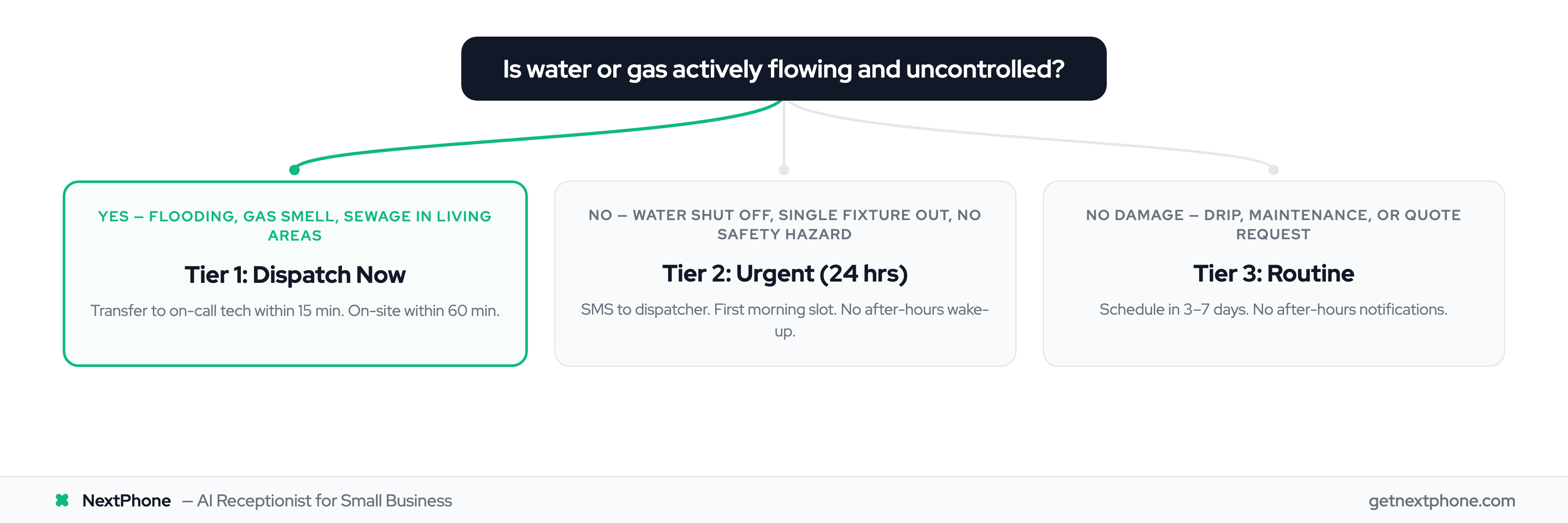
Every incoming call should be classified into one of three tiers. Each tier has specific trigger criteria, response targets, and routing actions.

Tier 1: Immediate Emergency (Dispatch Now)

Trigger criteria: Active property damage, safety hazards, or complete loss of essential services.

Examples:

  • Burst pipe actively flooding (water not shut off or can't be shut off)
  • Gas smell or suspected gas leak
  • Sewage backing up into living areas
  • Water contacting electrical panels, outlets, or appliances
  • Complete water loss to entire home (sudden, not gradual)
  • Frozen pipes that have already burst

Response target: Technician dispatched within 15 minutes. On-site within 60 minutes.

Revenue range: $450-$2,500+ per job

Tier 2: Urgent (Next 24 Hours)

Trigger criteria: Confirmed problem that the customer has temporarily contained, but can't wait for regular scheduling.

Examples:

  • Pipe leak with water successfully shut off
  • Single toilet/sink out of service (but other bathrooms available)
  • Water heater failure (no hot water, but no leaking/gas smell)
  • Slow drain backing up but not yet into living spaces
  • Sump pump making unusual noises during rain

Response target: First available slot within 24 hours. Morning appointment if call comes after hours.

Revenue range: $200-$800 per job

Tier 3: Routine (Schedule at Convenience)

Trigger criteria: Non-urgent maintenance, upgrades, or minor issues with no active damage.

Examples:

  • Dripping faucet
  • Fixture replacement requests
  • Water heater flushing or maintenance
  • Drain cleaning (preventive)
  • New fixture installation
  • Water pressure concerns (gradual, ongoing)

Response target: Schedule within 3-7 business days at customer's convenience.

Revenue range: $150-$500 per job

The key distinction between Tier 1 and Tier 2: can the customer stop the damage themselves? If they've successfully shut off the water valve and the flooding has stopped, it's Tier 2. If water is still flowing, the valve is inaccessible, or there's a safety hazard (gas, electrical contact, sewage), it's Tier 1.

Triage Question Scripts for 5 Common Plumbing Emergencies

Generic "what's your problem?" questions don't cut it for emergency triage. You need specific diagnostic questions that quickly determine severity and priority level. Here are the scripts for the five most common plumbing emergency call types.

Burst or Leaking Pipes

  1. Can you see where the water is coming from?
  2. Have you located and shut off the main water valve? (If not, guide them: "It's usually where the water line enters your home, often in the basement or garage.")
  3. Is water actively spraying, or is it a steady drip/flow?
  4. How much water is there right now? (Small puddle, covering the floor, or actively rising?)
  5. Is water touching any electrical outlets, panels, or appliances?
  6. How long has it been leaking?

Priority logic: If water is contacting electrical systems OR the main valve can't be shut off OR water is actively rising = Tier 1. If valve is off and flooding has stopped = Tier 2.

Gas Leak or Gas Smell

  1. Do you currently smell gas? (Rotten egg or sulfur smell?)
  2. Have you and everyone in the home evacuated the building?
  3. Have all flames and pilot lights been extinguished?
  4. Can you hear a hissing sound near any gas appliances?
  5. Is anyone experiencing dizziness, nausea, or headaches?
  6. Have you called your gas utility company?

Priority logic: Any confirmed gas smell = Tier 1, always. Instruct immediate evacuation. Do not have them flip light switches, use phones near the leak, or create any spark sources. This is a life-safety emergency—dispatch immediately and advise calling the gas utility.

Sewage Backup

  1. Is sewage or waste water visible in your living areas (floors, tubs, sinks)?
  2. How many drains are affected? (One fixture, or multiple throughout the home?)
  3. Is this the only bathroom in your home?
  4. Has anyone come in direct contact with the sewage?
  5. Can you smell sewage? How strong? (Faint odor vs overwhelming?)
  6. Are you on city sewer or a septic system?

Priority logic: Sewage in living areas OR only bathroom affected OR health exposure = Tier 1. Single drain backing up with alternative bathroom available = Tier 2. Slow drain with no backup = Tier 3.

Water Heater Failure

  1. Do you see water pooling around the unit?
  2. Is it a gas or electric water heater?
  3. If gas: Do you smell gas near the unit? (Any rotten egg smell?)
  4. Is water hot anywhere in the house, or completely cold everywhere?
  5. Are there any unusual sounds? (Popping, banging, hissing?)
  6. How old is the unit? (Manufacturers typically recommend replacement after 8-12 years.)

Priority logic: Gas smell near water heater = Tier 1 (treat as gas leak). Active flooding from tank = Tier 1. No hot water but no leak or gas smell = Tier 2. Unit is old and customer wants to discuss replacement = Tier 3.

Complete Water Loss

  1. Did water pressure drop gradually or stop suddenly?
  2. Have you checked the main shut-off valve? (Is it fully open?)
  3. Are your neighbors also experiencing water loss? (Could be a city issue.)
  4. Was any plumbing work done recently?
  5. Can you see water running anywhere unexpected—in the yard, walls, or ceiling?
  6. Do you hear water running even though all fixtures are off?

Priority logic: Sudden loss with visible water elsewhere (yard, walls) = Tier 1 (likely broken main line). Gradual loss with no visible leaks = Tier 2. Neighbors also affected = city issue, not your dispatch.

Building Your Emergency Dispatch Decision Tree

Once triage classifies the call, routing should be automatic. Here's the decision flow:

The Decision Flow: Call → Triage → Route → Dispatch

Before routing any call, collect these basics:

  • Caller name and phone number
  • Property address
  • Nature of the problem (brief description)
  • Whether water/gas has been shut off
  • Whether anyone is in immediate danger

Then apply the routing rules based on priority classification.

Routing Rules by Priority Level

Tier 1 (Immediate Emergency):

  • Transfer call directly to on-call technician's cell phone
  • If no answer in 60 seconds: auto-escalate to backup technician
  • If backup doesn't answer in 60 seconds: escalate to business owner
  • Simultaneously send SMS + push notification with job details
  • Auto-create emergency work order in dispatch system
  • Send customer SMS: "Our emergency technician [Name] has been notified. Expected callback within 5 minutes."

Tier 2 (Urgent):

  • Do NOT wake up on-call technician (unless it's a safety concern)
  • Send SMS + email notification to dispatch manager
  • Book first-available morning appointment
  • Send customer SMS: "Your issue has been logged as urgent. Our team will contact you by [time] to schedule service."
  • Create work order with priority flag

Tier 3 (Routine):

  • Book appointment during standard business hours
  • Send customer confirmation SMS with date and time
  • Add to CRM for standard follow-up
  • No after-hours notifications to team

Research shows that responding within 5 minutes makes you 8x more likely to convert the lead compared to waiting even 30 minutes. For emergency plumbing, that 5-minute window is the difference between winning a $1,500 job and losing it to whoever answers next.

Escalation Protocols

Every emergency dispatch system needs a clear escalation ladder:

  1. Primary on-call technician (first 60 seconds)
  2. Backup technician (next 60 seconds)
  3. Business owner/manager (final escalation)
  4. Partner company (if all internal resources exhausted—rare but critical during surges)

If you're a solo operator, your escalation might be: your cell → your cell again (second attempt) → trusted subcontractor. The point is never letting an emergency call die in voicemail.

After-Hours Dispatch: Capturing the 68% That Happen Off-Clock

The majority of plumbing emergencies don't happen during business hours. Your after-hours protocol determines whether those high-value calls become revenue or competitor wins.

On-Call Rotation Setup

For teams with multiple technicians:

  • Weekly rotation: Each tech takes one week of on-call duty
  • Compensation: Flat weekly on-call fee ($200-$400) plus per-emergency bonus
  • Coverage hours: 5 PM to 7 AM weekdays, full weekends and holidays
  • Requirements: Must answer within 5 minutes of notification, must be within 30-minute drive of service area

For solo operators, you ARE the on-call rotation. The key isn't having a team—it's having a system that wakes you up for real emergencies and lets you sleep through routine inquiries.

After-Hours Triage Differences

After-hours triage should be stricter than during business hours:

  • Only Tier 1 gets immediate dispatch at 2 AM. No one needs to wake up a plumber for a dripping faucet.
  • Tier 2 gets first-morning priority with a customer notification that help is coming at 7 AM.
  • Tier 3 gets scheduled for the next available regular slot.

This protects your team's rest while ensuring genuine emergencies always get a response. Technicians who get woken up for non-emergencies burn out fast. Technicians who only get called for real emergencies stay sharp.

Customer Communication During Off-Hours

After-hours callers are anxious. They're dealing with flooding, no water, or a gas smell in the dark. Communication matters:

  • Immediate confirmation: "Your call has been received. Our emergency team has been notified."
  • Response ETA: "A technician will contact you within [X] minutes."
  • Interim guidance: "While you wait, please [shut off the main water valve / evacuate the area / avoid electrical switches]."
  • Follow-up if delayed: If the technician hasn't responded within the promised window, auto-send an update.

These automated messages keep the customer from calling your competitor while waiting. Our data shows that 85% of callers who reach voicemail won't call back. But a customer who gets immediate confirmation and an ETA will wait.

Storm Season Protocols: When Call Volume Spikes 300-500%

Cold snaps, severe storms, and holiday weekends create call surges that overwhelm even well-staffed plumbing companies. Without surge protocols, you'll either burn out your team on non-emergencies or miss the real ones.

Common Surge Triggers for Plumbers

  • Cold snaps: Frozen and burst pipes, water heater failures (call volume increase: 300-500%)
  • Heavy storms: Flooding, sump pump failures, water intrusion
  • Holiday weekends: Stressed systems (garbage disposals, toilets, water heaters) from heavy use
  • Spring thaw: Hidden winter damage reveals itself, water line breaks

Surge Triage: Stricter Priority During High Volume

During a cold snap with 50 calls instead of your usual 10, tighten your Tier 1 criteria:

  • Tier 1 during surge: Only active flooding with water contact to electrical, gas leaks, or sewage exposure
  • Move to Tier 2 during surge: Burst pipes where water is shut off (normally might dispatch immediately, but during a surge, these can wait 4-6 hours)
  • Batch Tier 3: All routine calls get scheduled for after the surge passes

This prevents dispatching your only available technician to a contained leak while someone else has an active gas leak.

Overflow and Partner Routing

When all technicians are dispatched:

  • Route new Tier 1 calls to pre-arranged partner plumbers (establish these relationships before storm season)
  • Add wait-time estimates to Tier 2 notifications: "High call volume due to weather. Current wait for non-emergency service: 6-8 hours."
  • Consider temporary surge pricing communication: many customers expect and accept emergency rates during extreme weather

One AI answering service reported triaging 83 calls during a single cold snap: 41 immediate emergencies, 28 urgent, and 14 routine. Without triage, a solo plumber would have been paralyzed by volume. With it, emergencies got dispatched in order of severity, and routine calls were booked for the following week.

After the Dispatch: Follow-Up Workflow That Captures Every Dollar

Emergency triage doesn't end when the technician gets the call. The post-dispatch workflow determines whether you capture the full value of every emergency or leave money on the table.

Immediate Notifications

The moment a call is classified and routed:

  • SMS to customer: Technician name, ETA, and any preparation instructions
  • Email to office manager: Full call details, priority level, customer contact info, triage answers
  • Push notification to dispatch app: Job assignment with GPS coordinates
  • CRM entry: Auto-created job record with all collected information

CRM Logging and Job Tracking

Every emergency call should automatically create a structured record:

  • Customer name, phone, address
  • Problem description (from triage)
  • Priority classification
  • Triage answers (water shut off? gas evacuated?)
  • Technician assigned and dispatch time
  • Resolution notes (added post-service)

This data feeds your reporting. Over time, you'll see patterns: which neighborhoods have aging pipes, which customers become repeat emergencies, which types of calls convert highest.

Post-Service Follow-Up

After the emergency is resolved:

  • Same-day SMS: "How did the service go? Reply with any concerns."
  • 24-hour email: Request a Google review (emergency customers who got fast service leave great reviews)
  • Quote for additional work: Emergencies often reveal larger issues—send a quote for preventive repairs discovered during the call
  • Schedule preventive maintenance: "We fixed the burst pipe. Want us to inspect the rest of your plumbing to prevent future emergencies?"

In our study, 25.4% of calls included explicit callback requests. Without a tracking system, 80% of those callbacks never happen. Automated post-dispatch follow-up ensures nothing falls through the cracks.

How NextPhone Automates Plumbing Emergency Triage

Everything in this workflow—the triage questions, priority classification, routing logic, notifications, and follow-up—can run on autopilot.

NextPhone's AI receptionist answers every call in under 5 seconds, 24/7/365. For plumbing companies, it's trained on the exact triage scripts covered in this guide: burst pipe questions, gas leak protocols, sewage assessment, water heater diagnostics, and complete water loss evaluation.

Based on the caller's answers, the AI automatically classifies the call's priority:

  • Tier 1 emergencies trigger an immediate call transfer to your on-call technician
  • Tier 2 urgent calls generate SMS and email notifications with a first-morning appointment
  • Tier 3 routine requests get scheduled during business hours with a confirmation sent to the customer

The system integrates with your existing tools via HTTP webhooks—pushing job details to your CRM, triggering SMS follow-ups through Twilio, and sending email notifications to your dispatch team. No tool switching, no workflow changes.

During surge events, the AI handles unlimited concurrent calls. While a human answering service can manage one caller at a time (and charges $400-800/month for the privilege), NextPhone handles 50 simultaneous callers during a cold snap for a flat $199/month.

For plumbers who are solo operators or running small crews, this means you stop losing $200K+ per year to voicemail—without hiring staff or paying premium answering service rates.

Frequently Asked Questions

What qualifies as a plumbing emergency vs a routine call?

Emergencies involve active property damage (uncontrolled flooding, burst pipes), safety hazards (gas leaks, sewage in living areas), or complete loss of essential services (no water to the home). If the customer can safely shut off the water and the damage has stopped, it's urgent but not an emergency. If it's a dripping faucet or fixture replacement, it's routine.

How fast should a plumber respond to an emergency call?

Industry standard for true emergencies is on-site within 60 minutes. For life-safety issues like gas leaks or sewage exposure, aim for 30 minutes or less. But the first response matters most—responding to the initial call within 5 minutes makes you 8x more likely to convert compared to waiting 30 minutes.

Can AI really triage plumbing emergencies accurately?

Yes. Modern AI trained on plumbing-specific scripts asks the same diagnostic questions a trained dispatcher would: Is water touching electrical systems? Do you smell gas? Is sewage in living areas? Is your main valve shut off? Based on answers, it classifies priority and routes the call. It doesn't guess—it follows the same decision tree a human dispatcher would, just faster and 24/7.

How much does a missed emergency plumbing call actually cost?

Emergency plumbing jobs range from $450 to $2,500+, with after-hours calls commanding 1.5x-2x premium rates. Missing one emergency call per week translates to roughly $16,800/month or $201,600/year in lost revenue. And that's just the immediate job—it doesn't account for the customer's lifetime value or referrals you'll never receive.

How do I set up after-hours on-call routing for a small plumbing team?

Define your rotation schedule (weekly works for most small teams), set a flat on-call fee plus per-call bonus, configure your triage criteria to be stricter after hours (only true emergencies get dispatched at 2 AM), and ensure your system sends immediate notifications when an emergency call comes in. Solo operators need a system that filters real emergencies from routine calls so they only get woken up when it matters.

What information should be collected before routing an emergency plumbing call?

At minimum: caller name, phone number, property address, nature of the emergency, whether water or gas has been shut off, whether anyone is in immediate danger, and approximately how long the issue has been going on. This gives your responding technician everything needed to prepare the right equipment and approach the job efficiently.

Stop Losing Emergency Revenue to Voicemail

Emergency plumbing calls are your highest-value work—and they happen when you're least able to answer. Pipes don't burst during business hours. Gas leaks don't wait for Monday.

The workflow is simple: Triage → Classify → Route → Dispatch → Follow Up. Every step can be automated. Every emergency call can be captured.

The plumbers winning right now aren't the ones with the biggest trucks or the most Google ads. They're the ones answering every call—including the 2 AM burst pipe that's worth $1,800.

Try NextPhone AI answering service

AI receptionist that answers, qualifies, and books — 24/7.

Try NextPhone AI answering service

AI receptionist that answers, qualifies, and books — 24/7.

Related Articles

Yanis Mellata

About NextPhone

NextPhone helps small businesses implement AI-powered phone answering so they never miss another customer call. Our AI receptionist captures leads, qualifies prospects, books meetings, and syncs with your CRM — automatically.

Try NextPhone