
First heatwave hits. Your phone explodes. Three trucks are out on emergency calls, two techs are running installs, and your office manager is drowning in a queue of ringing lines. Voicemails pile up. Callers hang up and dial the next AC company in their search results.
This isn't a hypothetical scenario. It's what happens to AC companies every June, July, and August. One HVAC contractor described peak season this way: "All eight phone lines in our office are lit up at the same time, all day long."
The summer rush is predictable. What most AC company owners don't realize is exactly how much those missed calls are costing them. We've answered 1,446,980+ business calls for home services contractors and others, and the numbers tell a brutal story.
This guide breaks down what an answering service for AC companies actually does, what features matter, how much it costs compared to alternatives, and how to capture every summer call before your competitors do.
Why Summer Is Brutal for AC Companies (And What It's Costing You)

The Call Volume Spike
Summer call volume for AC companies typically increases 30-40% compared to the rest of the year. According to local technicians, the busy season starts almost like clockwork around April 15th. From there, the workload climbs steadily, peaking through May, June, July, and into mid-August.
During peak season when temps hit the 90s, customers can wait up to ten days for a sales appointment. Ten days. In 95-degree heat with no working AC.
Here's the problem: when your crews are on job sites - on roofs, in attics, hands covered in refrigerant - they can't answer phones. And according to a ServiceTitan/ACCA survey-companies-take-on-the-busy-season), 65% of HVAC companies handle this increased demand by simply having existing teams work longer hours. No additional staffing. No call handling solution. Just grinding through and hoping for the best.
That approach leaves money on the table.
The Missed Call Math
Industry research shows 74.1% of calls to home services contractors go completely unanswered. That's three out of every four potential customers hearing a voicemail greeting - and then calling your competitor.
Other industry research backs this up: 62% of calls to contractors go unanswered when crews are on job sites. And here's the kicker: 78% of those callers won't leave a voicemail. They immediately dial the next number.
Let's do the math for a typical AC company:
- Average monthly calls: 42
- Missed at 74.1%: 31 calls
- Assume 20% would convert
- Average job value: $3,500
- Monthly lost revenue: $21,700
Over the three to four summer months alone, that's $65,100 to $86,800 in lost revenue. From calls that rang through to voicemail.
Emergency Call Economics
The numbers get worse when you factor in emergencies. In our data, calls containing urgency language - words like "emergency," "urgent," or "ASAP" - rank among the top reasons people call. Emergencies are a recurring reason people call too: AC completely out in extreme heat, system failures, urgent situations that couldn't wait.
Emergency jobs average $4,200 in revenue, significantly higher than routine maintenance or installations. They also command premium pricing - 1.5x to 2x standard rates for after-hours service.
Miss just one emergency call per week, and you're losing $16,800 per month. That's $201,600 per year walking straight to your competitors.
One plumber we work with pulled his call log and found 76 missed calls in a single month. His reaction? "I didn't even know I was missing that many calls until I saw the data. I just thought business was slow."
Business wasn't slow. The phone was ringing. Nobody was answering.
What an Answering Service Actually Does for AC Companies
An answering service for AC companies handles incoming calls when you and your team can't. But it goes far beyond just picking up the phone.
Call Handling Basics
When a customer calls, the answering service picks up immediately - typically within a few rings. They answer using your company name, following scripts you've approved. To the caller, it sounds like they've reached your office.
The service captures essential information: caller name, phone number, address, what type of service they need, how urgent the situation is. That information gets sent to you immediately via text, email, or pushed directly into your CRM.
Beyond Just Answering
Modern answering services do much more than take messages. They can:
- Schedule appointments: Book directly into your calendar or scheduling software like ServiceTitan or Housecall Pro
- Qualify leads: Ask screening questions to separate price-shoppers from ready-to-buy customers
- Handle FAQ: Answer common questions about your hours, service area, and basic pricing
- Process payments: Some services can take deposits or collect payment information
- Dispatch emergencies: Route urgent calls directly to your on-call technician immediately
The Difference for Customers
From the customer's perspective, a good answering service is indistinguishable from your actual office. They call, a professional answers, their problem gets acknowledged, and they leave the call feeling taken care of.
Compare that to hitting voicemail at 9 PM when their AC just died. Which experience leads to a booked job?
6 Must-Have Features for HVAC Answering Services
Not all answering services are created equal. Here's what to look for when evaluating options for your AC company.
1. True 24/7 Live Coverage
This seems obvious, but many services have gaps. A large share of calls to home services businesses arrive outside standard 9-5 hours. Evenings, weekends, and holidays are when AC emergencies spike - and when most offices are closed.
Make sure "24/7" means actual live coverage, not an after-hours voicemail system. Verify they staff weekends and major holidays without premium charges.
2. Emergency Call Routing
When a customer's AC dies at 2 AM in July, they need immediate help. Your answering service should have emergency dispatch protocols that route urgent calls directly to your on-call technician.
The best services let you define what counts as an emergency. For AC companies, that might include: complete system failure, refrigerant leaks, electrical issues, or any call where indoor temperature exceeds a certain threshold.
3. Appointment Scheduling Integration
Taking a message and scheduling an appointment are different things. Look for services that integrate directly with your scheduling software - ServiceTitan, Housecall Pro, Google Calendar, or whatever system you use.
The goal: a customer calls, the service books them into an available slot, and the appointment appears in your system automatically. No playing phone tag later to actually get them scheduled.
4. Industry-Trained Staff or AI
Generic answering services might fumble HVAC-specific questions. Look for services that either train their staff on industry terminology or use AI that's been programmed for home services.
Your service should understand the difference between "routine maintenance" and "my compressor is making a grinding noise." They should know that "no cold air" in July is more urgent than "annual tune-up request."
5. Bilingual Support
Depending on your market, Spanish-English bilingual support may be essential. Some regions see 20-30% of calls in Spanish. If your answering service can't handle these callers, you're losing that business.
6. Transparent Pricing
Watch out for hidden fees. Many traditional services charge:
- Per-minute rates that spike during long calls
- Holiday and weekend premiums (exactly when AC emergencies happen)
- Overage fees when you exceed your call limit
- Setup fees and long-term contracts
Ask for complete pricing upfront. The cheapest monthly rate means nothing if you're hit with overage charges every time you have a busy week.
How Much Does an AC Company Answering Service Cost?
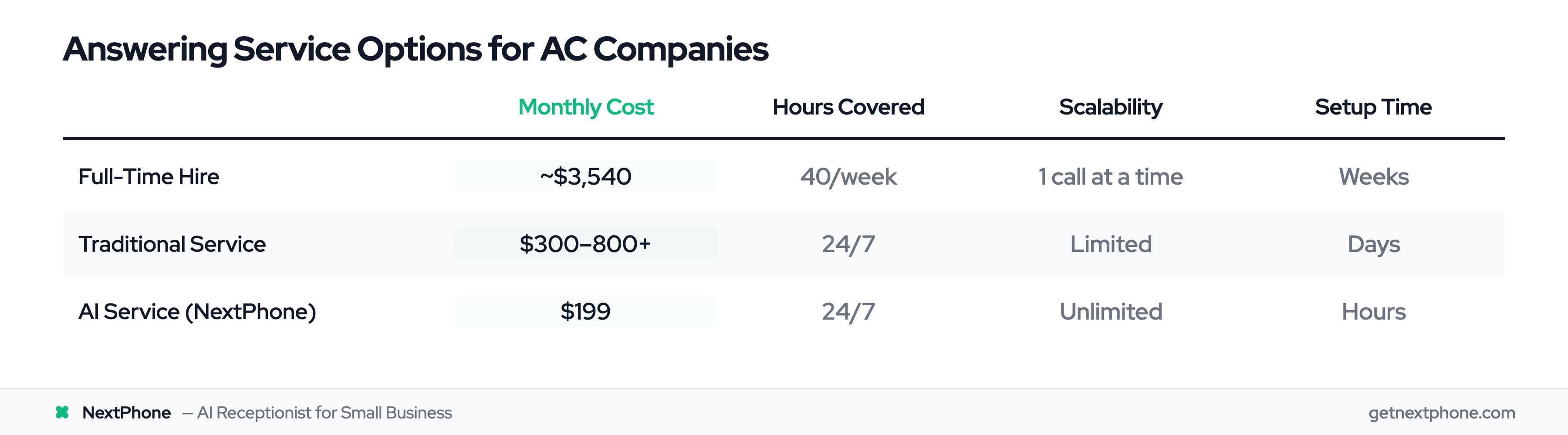
Let's break down your options and what each one actually costs.
Traditional Answering Service Pricing
Traditional live answering services typically charge $300-800 per month for packages of 100-200 calls. Go over your limit, and you're looking at $1-2 per additional call - which adds up fast during a summer heat wave.
Holiday and weekend calls often cost extra. Setup fees range from $50-200. Most require month-to-month or annual contracts.
For an AC company during peak season, a traditional service might run $500-1,000 per month once you factor in overages.
What You'd Pay for an In-House Hire
The alternative many owners consider is hiring a dedicated receptionist. Here's that math:
- Average salary: $33,960/year (customer service representative)
- Benefits (health, PTO, etc.): ~$8,490/year
Total: approximately $42,450/year, or $3,540/month
But here's the catch: that hire only covers 40 hours per week. You're still sending after-hours calls to voicemail. You're still missing calls during lunch breaks, sick days, and vacation time. And when summer hits and call volume spikes 40%, one person still can't answer multiple calls simultaneously.
AI Answering Service Pricing
AI-powered answering services have changed the economics. Services like NextPhone charge a flat monthly rate - typically $99-299 per month - for unlimited calls.
No per-call fees. No overage charges. No weekend premiums. One price, unlimited coverage.
| Factor | Full-Time Hire | Traditional Service | AI Service |
|---|---|---|---|
| Monthly Cost | ~$3,540 | $300-800+ | $199 |
| Hours Covered | 40/week | 24/7 | 24/7 |
| Sick Days/Vacation | Yes | No | No |
| Scalability | 1 call at a time | Limited | Unlimited |
| Setup Time | Weeks | Days | Hours |
The ROI Calculation
At $199 per month, your answering service needs to capture just one extra job every two months to pay for itself. Given that the average AC job is $3,500 and the average emergency runs $4,200, the ROI math is straightforward.
If you're currently missing 31 calls per month and even 10% of those would have converted, that's 3 jobs per month. At $3,500 average, you're capturing $10,500 in monthly revenue for a $199 investment.
That's a 53x return.