It's April 8th. You're reviewing a client's Schedule C when the phone rings. A potential new client, maybe. But you've got Mrs. Patterson sitting across your desk, confused about her K-1 forms, and two more clients waiting in the lobby.
The call goes to voicemail. The caller hangs up and dials the next CPA on Google.
This scenario plays out thousands of times every tax season at accounting firms across the country. Industry research puts the missed-call rate for home services at 74.1% of calls going completely unanswered. That's three out of every four potential clients calling someone else.
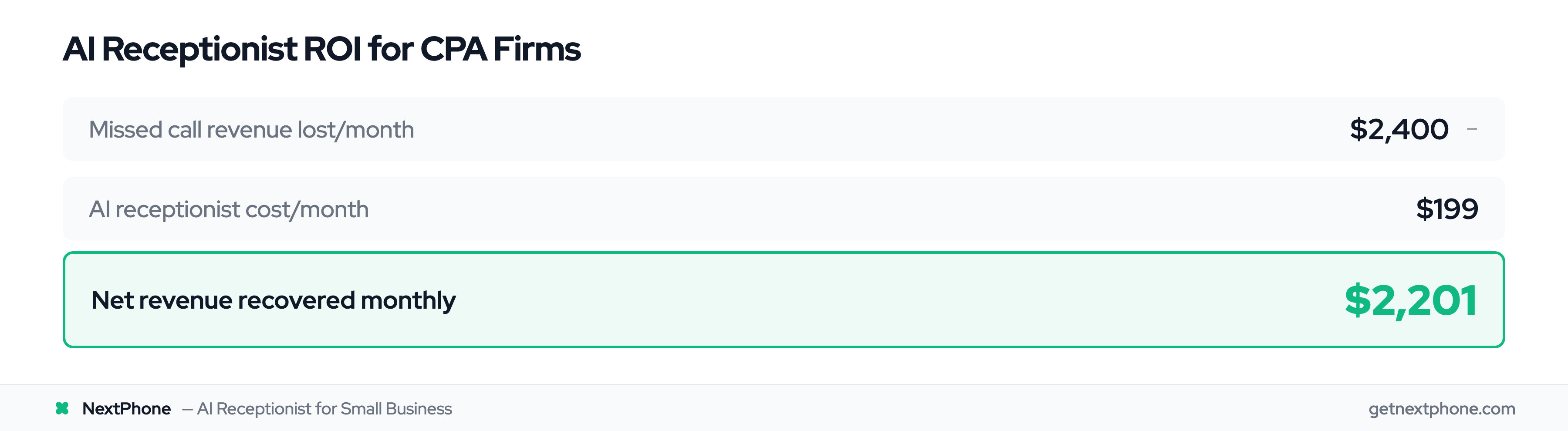
For small CPA practices, these missed calls add up to roughly $2,400 in lost revenue every month. During tax season? That number triples.
An accounting answering service solves this problem. But which type makes sense for your practice, and what does it actually cost? This guide breaks down your options, compares real costs, and helps you decide what works for your firm.
Why Every Missed Call Costs Your Accounting Firm Money
The Missed Call Problem in Professional Services
Accounting isn't like retail. When a potential client calls your firm, they're not browsing. They need help with their taxes, their bookkeeping, or a financial question that's keeping them up at night. That single call often represents $2,000-$5,000 in annual revenue if they become a client.
According to research from Invoca, 62% of calls to small businesses go unanswered during normal hours. For accounting firms during tax season, that number climbs even higher as staff scramble to manage client work and incoming calls simultaneously.
But here's what makes this particularly painful: the caller isn't going to wait.
Why Clients Don't Leave Voicemails
Research from BIA/Kelsey shows that 80% of people who reach voicemail never call back. They don't leave a message. They don't try again later. They just call the next firm on the list.
Think about it from the client's perspective. They're stressed about taxes, they finally carved out time to make the call, and they hit a recording. Why wait for a callback when three other CPAs are a Google search away?
The data gets worse: 85% of callers whose first attempt goes unanswered won't try again. Your one chance to capture that client just vanished.
The Speed Factor: Why Response Time Matters
The MIT Lead Response Management Study found something remarkable about response speed. Companies that responded to inquiries within five minutes were 100 times more likely to reach the prospect compared to those who waited just 30 minutes.
One hundred times. For more on why speed to lead is the single biggest factor in closing new clients, see our breakdown of the research.
And 78% of customers end up buying from whichever company responds first. Not the cheapest. Not the best reviewed. The first one to pick up the phone.
For accounting firms, this creates an impossible situation. You can't answer every call while you're working on returns. But every unanswered call costs you real money. Our guide on reducing missed calls covers the mechanics of how businesses solve this.
What Is an Accounting Answering Service?
An accounting answering service handles incoming calls on behalf of your firm. Whether you run a CPA practice, bookkeeping firm, tax advisory, enrolled agent office, financial planning practice, or wealth management firm, the concept is the same: when a client or prospect dials your number, the service answers professionally, collects information, and routes the call according to your preferences.
These services come in three main types, each with different strengths and price points.
Types of Answering Services for Accountants
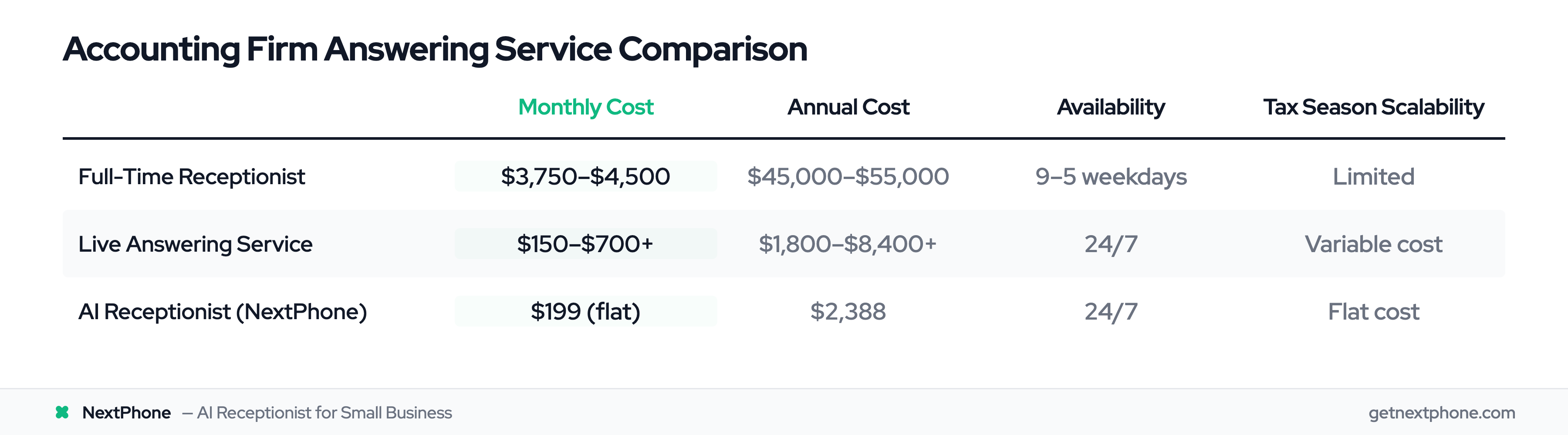
Traditional Live Answering Services employ human receptionists who answer calls from multiple businesses. They follow scripts you provide, take messages, and forward urgent calls. Companies like AnswerConnect and MAP Communications fall into this category.
Virtual Receptionist Services offer dedicated or semi-dedicated human receptionists who become more familiar with your practice over time. Smith.ai and Ruby are examples. These typically cost more but provide more personalized service.
AI Receptionist Services use conversational artificial intelligence to answer calls, collect information, schedule appointments, and route urgent matters to you. NextPhone, Dialzara, and similar platforms offer this approach. They cost less than human options and scale without per-call fees. See our AI receptionist cost breakdown for a detailed comparison of what each type costs, or read our answering service comparison for a side-by-side evaluation.
What Tasks They Handle
Modern accounting answering services do more than take messages. They can:
- Answer basic questions about your services and hours
- Schedule appointments directly in your calendar
- Collect information from new client inquiries
- Route urgent calls to your cell phone based on criteria you set
- Filter spam and robocalls before they reach you
- Provide after-hours coverage when you're not in the office
The best services integrate with your existing calendar and CRM systems, so information flows automatically without manual data entry.
Key Integrations for Accounting Firms
Look for answering services that connect with the tools your firm already uses:
- Accounting software: Xero — so new client data flows directly into your books
- Calendar tools: Google Calendar, Outlook, Calendly — for real-time appointment scheduling
- CRM platforms: HubSpot, Salesforce — to track leads and client interactions automatically
These integrations eliminate double data entry and ensure nothing slips through the cracks during tax season.
The Tax Season Problem: When Call Volume Triples
Tax Season Call Volume Spikes
Every CPA knows the feeling. January hits, and suddenly your phone rings constantly. Existing clients have questions about documents. New clients want to get on your calendar before the deadline. The IRS sends letters that trigger panicked calls.
According to a CPA Practice Advisor survey, accountants spend an average of 9.3 hours per week on client communication. The target? Just 7.2 hours. That's two extra hours weekly lost to phone calls and follow-ups.
During tax season, CPA firms experience 2-3 times their normal call volume. If you normally get 20 calls per week, you're suddenly fielding 40-60. Something has to give. Our guide on seasonal surge management covers how businesses handle these spikes without breaking.
The Staffing Dilemma
You have a few options, and none of them are great.
Option A: Answer everything yourself. You're constantly interrupted, your focus suffers, and you work late into the night to finish returns.
Option B: Hire seasonal help. Training takes time you don't have. Quality is inconsistent. And the math rarely works out for the 3-4 month busy season.
Option C: Let calls go to voicemail. You've already seen the stats on how that turns out.
One forum post from an accountant on Alignable captured it perfectly: "I hired a part-time person just to answer phones during tax season, but she called in sick the week of April 15th. Worst timing imaginable."
What Happens When You Miss Calls During Tax Season
Industry data suggests CPA firms lose 20-30% of incoming calls to voicemail during their busiest periods. For a firm that typically converts new client calls at a reasonable rate, this adds up fast.
The baseline estimate is that small CPA practices lose roughly $2,400 per month from missed calls. During tax season, when call volume triples and each new client represents immediate revenue, that figure can reach $7,200 per month.
And there's a compounding effect. A dissatisfied client doesn't just leave. Research shows 72% of small business owners have switched CPAs because their firm "did not give proactive advice, only reactive service." Missed calls feel reactive. Clients notice.
6 Benefits of an Answering Service for Accountants
Never Miss a Client Call Again
The most obvious benefit: every call gets answered. No more voicemails, no more "sorry I missed you" callbacks. When clients call, they reach someone immediately.
For existing clients, this builds trust. For new prospects, it captures revenue you'd otherwise lose to competitors.
24/7 Availability Without Overnight Staff
Clients don't limit their financial anxiety to business hours. They worry about taxes at 9 PM when they're reviewing bank statements. They have questions Saturday morning when they find a misplaced 1099.
A large share of calls to home services businesses arrive outside standard 9-5 hours. While accounting skews more toward business hours, after-hours calls still represent significant opportunities, especially during tax season when clients squeeze in calls whenever they can.
An answering service provides round-the-clock coverage without you paying overtime or working weekends.
Professional First Impressions
There's a difference between answering the phone while distracted by a tax return and having a dedicated receptionist greet callers with full attention. Clients can tell.
A professional greeting sets the tone for the entire relationship. It signals that your firm is organized, responsive, and takes client communication seriously. For potential clients comparing options, this first impression often determines who gets the business.
More Time for Billable Work
Every phone interruption breaks your concentration. Studies on knowledge workers suggest it takes an average of 23 minutes to fully regain focus after an interruption.
If you're interrupted by phone calls six times per day during tax season, that's potentially hours of productive time lost. An answering service acts as a buffer, filtering calls so you can batch your callbacks at designated times instead of constantly switching contexts.
Seamless Appointment Scheduling
Modern answering services integrate with Google Calendar, Outlook, Calendly, and other scheduling tools. When a client wants to book a meeting, the service can check your availability and schedule it directly, no back-and-forth required.
For accounting firms, this alone can save several hours per week during busy periods.
Scale During Busy Seasons Without Hiring
This is where answering services really shine for accountants. Your call volume isn't consistent. It spikes dramatically for a few months and drops off the rest of the year.
Traditional hiring doesn't make sense for this pattern. But an answering service scales automatically. Handle 20 calls or 200 calls, the service adjusts without you scrambling to hire temps or paying overtime.