
Your phone rings. You're elbow-deep in a refrigerator compressor replacement, hands covered in dust and refrigerant residue. By the time you could even think about answering, the call has already gone to voicemail.
Here's the uncomfortable truth: you probably think you answer almost every call. Research shows appliance repair business owners believe they pick up 97% of the time. The actual number? Just 66%. That 31-percentage-point gap represents thousands of dollars in lost same-day repair jobs every month.
When a customer's refrigerator dies on a Saturday afternoon with a fridge full of groceries, they're not leaving voicemails and patiently waiting for callbacks. They're dialing until someone answers. And whoever picks up first books the job.
This guide breaks down how appliance repair answering services work, what they cost, and how they help you book same-day appointments around the clock—even when you're stuck under someone's washing machine.
Why Appliance Repair Businesses Lose Same-Day Jobs
The appliance repair industry faces a communication problem that most business owners don't even realize exists. Understanding the gap between perception and reality is the first step toward fixing it.
The Perception Gap: What You Think vs. Reality
Ask any appliance repair business owner how many calls they answer, and most will confidently say "nearly all of them." Industry research tells a different story.
Studies show that while appliance repair owners believe they answer 97% of incoming calls, they actually pick up only 66% of the time. That's a 31-point blind spot—and every call in that gap represents a potential same-day job walking out the door.
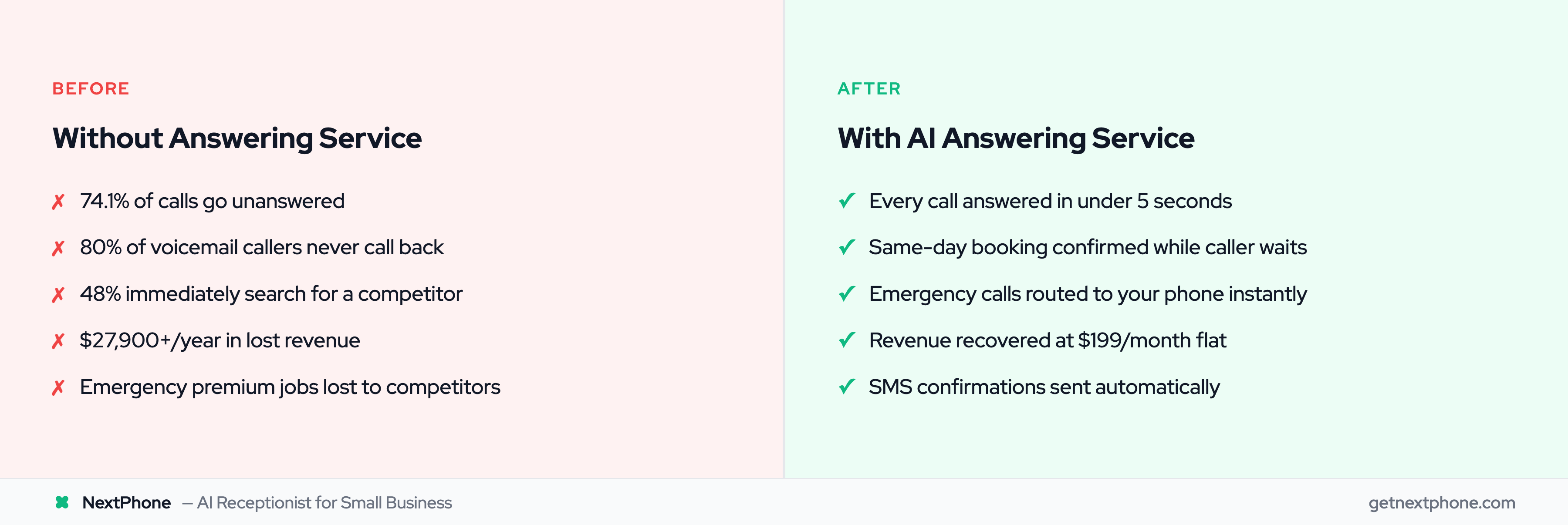
Our analysis of thousands of customer service calls from home services contractors over seven months revealed an even starker picture: 74.1% of calls went completely unanswered. For a typical contractor receiving 42 calls per month, that's 31 missed opportunities every single month.
Where Your Calls Actually Go
When you can't answer, several things happen—and none of them are good for your business:
- 80% of callers who reach voicemail never call back. They don't want to wait. They want their broken appliance fixed today.
- 85% won't even leave a message. They just hang up and dial the next number on their Google search results.
- 48% immediately search for a competitor. Your marketing dollars just drove a lead straight to someone else.
The average appliance repair company takes about 25 minutes to respond to missed calls. By that point, the customer has often already booked with whoever answered first. This is the same speed-to-lead dynamic that punishes every service business that can't pick up immediately.
The First-Responder Advantage
Speed matters more than almost anything else in appliance repair. According to the Lead Response Management Study conducted by MIT and InsideSales.com, 78% of customers buy from whichever company responds first. Not the cheapest. Not the highest-rated. The first one to pick up the phone.
Calling a lead back within five minutes makes you 100x more likely to reach them and 21x more likely to qualify them compared to waiting just 30 minutes. Wait an hour, and your odds drop dramatically. Wait 24 hours, and you might as well not bother.
For appliance repair, this urgency is amplified. Someone with a broken refrigerator full of Thanksgiving groceries or a washing machine flooding their laundry room isn't price shopping. They're booking whoever can get there today.
What Every Missed Call Actually Costs Your Business
Missed calls aren't just inconvenient—they represent real money walking out the door. Let's break down the actual economics of what happens when your phone goes unanswered.
Emergency Call Economics
Appliance emergencies create the highest-value calls in the repair business. Consider what triggers these urgent calls:
- Dead refrigerator: Food spoiling, health concerns, immediate need
- Flooding washing machine: Water damage escalating by the minute
- Sparking oven: Fire hazard requiring immediate attention
- AC failure in summer: Health risk in extreme heat
These customers aren't comparing three quotes and thinking it over. They're calling until someone answers and booking that first available slot.
According to appliance repair industry statistics, the average appliance repair costs between $171 for simple fixes and $400 or more for complex repairs. Refrigerator repairs run $150-$600. Washer repairs cost $150-$300. And here's what most owners miss: emergency and same-day service typically commands a 1.5x to 2x premium.
That "simple" $200 repair becomes a $300-$400 same-day emergency call. When you miss it, you're not just losing a routine job—you're losing the premium revenue that keeps margins healthy.
The Revenue Math
Let's run the actual numbers for a typical appliance repair business:
Monthly call volume: 42 calls (industry average for small-medium shops) Missed call rate: 74.1% = 31 missed calls/month Average job value: $300 (accounting for emergency premiums) Conversion rate: 25% of answered calls book service
Monthly calculation: 31 missed calls × $300 average × 25% conversion = $2,325/month lost
Annual impact: $2,325 × 12 = $27,900/year minimum
And that's conservative. Data from Invoca suggests home service businesses miss out on an average of $1,200 per missed call. Research from CallBird AI found contractors lose $45,000 to $120,000 annually from unanswered calls.
Our analysis of thousands of calls found that 15.9% contained urgency language—words like "emergency," "urgent," or "ASAP." For a business receiving 42 calls monthly, that's roughly 7 urgent calls. Missing just one emergency call per week at $400+ average value adds another $1,600-$2,400 per month in lost revenue.
Seasonal Spikes Make It Worse
Appliance repair follows predictable seasonal patterns that amplify the missed call problem:
- Thanksgiving/Christmas: Oven and refrigerator emergencies spike as families prepare holiday meals
- Summer months: Air conditioning calls surge, with AC repairs running $150-$600
- Post-holiday January: Garbage disposals and dishwashers fail after heavy holiday use
During these peak periods, call volume can double or triple. If you're already missing 74% of calls during normal times, peak season becomes a revenue hemorrhage.
How an Answering Service Books Same-Day Appointments
An appliance repair answering service does more than just pick up the phone. Modern services—especially AI-powered ones—handle the entire customer interaction from initial inquiry to booked appointment.
24/7 Call Answering Explained
Traditional business hours don't match when customers need appliance repair. Our call data shows 73% of home services calls come outside standard 9-5 hours. Evening calls from people who just got home to a broken dishwasher. Weekend calls when the washing machine floods. Middle-of-the-night emergencies when the refrigerator dies.
An after-hours answering service ensures every one of these calls gets answered, regardless of when they come in. AI-powered services answer in under 5 seconds—faster than most humans can physically get to the phone.
The difference between AI and old-school "press 1 for sales, press 2 for service" IVR systems is significant. Modern conversational AI sounds natural, not robotic. It can handle unexpected questions, gather the information you need, and route calls appropriately without forcing customers through frustrating menu trees.
Emergency Detection and Routing
Not all calls are created equal. A good answering service distinguishes between:
- True emergencies: Flooding, fire hazards, complete system failures
- Urgent needs: Same-day service requests for major inconveniences
- Routine inquiries: Scheduling, pricing questions, general information
AI-powered services detect urgency through keyword recognition. When a caller says "flooding," "sparking," "no cooling," or "emergency," the system flags the call for immediate escalation.
For true emergencies, the answering service can route directly to your cell phone or on-call technician. The customer reaches a human for critical situations while routine calls get handled automatically.
Same-Day Booking Workflow
Here's how a modern answering service handles a typical same-day booking:
- Customer calls: "My refrigerator stopped cooling and I have groceries that are going to spoil."
- AI answers in seconds: Greets the caller, confirms they've reached your business.
- Information gathering: Collects name, phone, address, appliance details, and urgency level.
- Availability check: Accesses your real-time calendar to find same-day slots.
- Appointment booking: "I have a technician available at 2 PM today. Would that work?"
- Confirmation: Sends SMS confirmation to customer with appointment details.
- Notification: Alerts you via app notification, email, or text with full call summary.
The entire interaction takes 2-3 minutes. The customer hangs up with a confirmed appointment. You get all the details you need without playing phone tag.
Comparing Your Answering Service Options
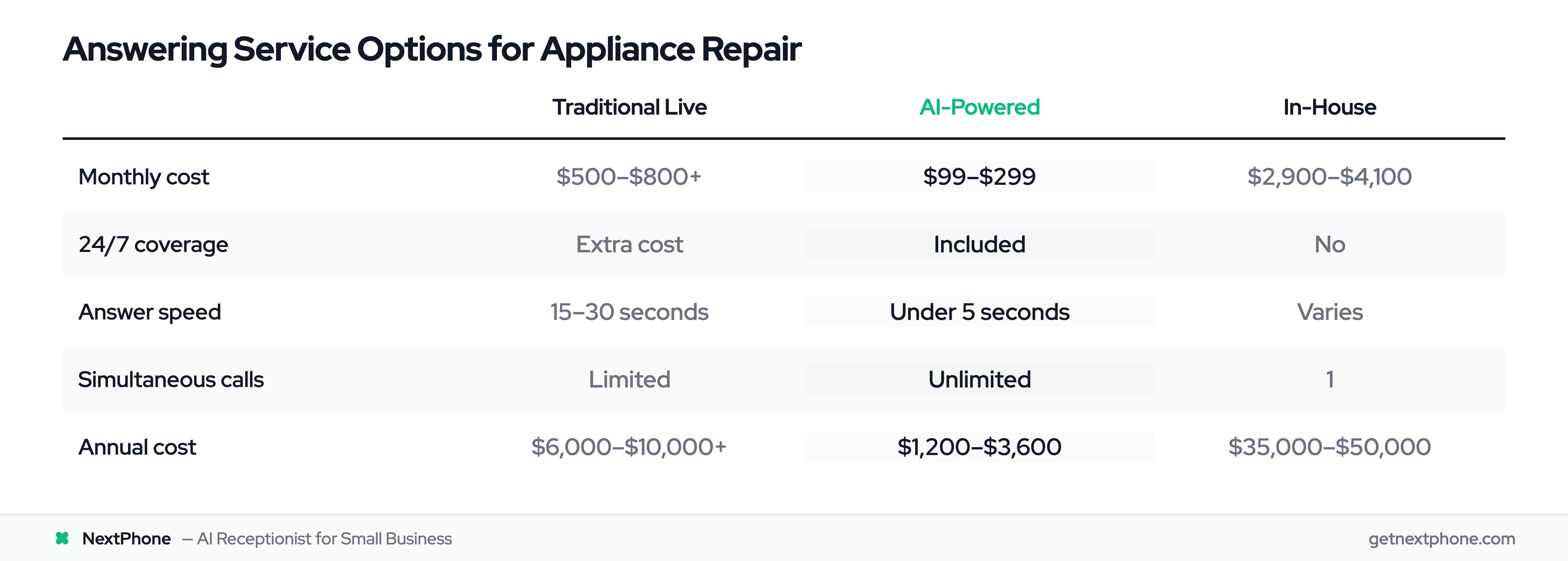
Appliance repair businesses have three main options for handling calls: traditional live answering services, AI-powered answering services, or hiring in-house. Each has distinct advantages and costs.
Traditional Live Answering Services
Traditional services employ real humans to answer calls on your behalf. They follow scripts, take messages, and can handle basic scheduling.
Pros:
- Human touch for sensitive situations
- Familiar interaction style
- Can handle complex conversations
Cons:
- Per-minute or per-call pricing adds up quickly
- Rates typically run $0.75-$1.95 per minute or $2.50-$7 per call
- 24/7 coverage significantly increases costs
- Limited knowledge of your specific business
- Hold times during busy periods
Monthly costs for traditional services typically range from $500-$800 for basic coverage with call limits. Go over your allotted minutes, and overage fees add up fast. Full 24/7 coverage with scheduling capabilities can run $1,000+ monthly.
AI-Powered Answering Services
AI answering services use conversational artificial intelligence to handle calls. They've advanced significantly from the frustrating automated menus of the past.
Pros:
- Answers every call in under 5 seconds
- Flat monthly fee with unlimited calls typically
- 24/7/365 coverage included
- Learns your business specifics over time
- Handles multiple simultaneous calls
- Integrates with scheduling and CRM software
Cons:
- Some callers prefer humans
- Complex emotional situations may need escalation
- Requires initial setup and configuration
AI services typically cost $99-$299 per month with unlimited calls. That's 85-95% less than traditional live services and a fraction of what you'd pay an employee. If you're weighing flat-rate vs per-minute answering service pricing, flat-rate almost always wins for trade businesses with unpredictable call volume.
In-House Receptionist
Hiring your own receptionist gives you maximum control and a dedicated team member who knows your business inside and out.
Pros:
- Complete control over training and processes
- Deep knowledge of your business
- Personal relationships with repeat customers
Cons:
- Salary: $33,000-$50,000 per year based on receptionist wages
- Benefits add 20-30% to total cost of hiring
- Only covers 40 hours per week
- Sick days, vacations, turnover
- Can only handle one call at a time
Total cost for an in-house receptionist runs $2,900-$4,100 per month when you factor in salary, benefits, and overhead. And they're still only available during business hours—missing the 73% of calls that come outside 9-5.
Which Option Fits Your Business?
| Factor | Traditional Live | AI-Powered | In-House |
|---|---|---|---|
| Monthly Cost | $500-$800+ | $99-$299 | $2,900-$4,100 |
| 24/7 Coverage | Extra cost | Included | No |
| Answer Speed | 15-30 seconds | Under 5 seconds | Varies |
| Simultaneous Calls | Limited | Unlimited | 1 |
| Scheduling | Basic | Full integration | Manual |
| Annual Cost | $6,000-$10,000+ | $1,200-$3,600 | $35,000-$50,000 |
For most appliance repair businesses, AI-powered services offer the best combination of cost, capability, and coverage. You get 24/7 availability, instant answer times, and full scheduling integration at a price point that's actually sustainable for small operations. Our answering service comparison covers the full breakdown across provider types if you want to dig deeper.
What to Look for in an Appliance Repair Answering Service
Not all answering services are built for home services businesses. When evaluating options, prioritize features that directly impact your ability to book same-day appointments.
Emergency Call Prioritization
Your answering service needs to distinguish between someone asking about pricing and someone whose washing machine is actively flooding their basement. Look for:
- Urgency keyword detection: Automatic flagging of words like "emergency," "flooding," "fire," "won't cool"
- Immediate escalation protocols: True emergencies get routed to you instantly
- Priority queuing: Urgent calls jump ahead of routine inquiries
Same-Day Scheduling Capabilities
Booking same-day service requires real-time calendar access. The answering service should:
- See your live availability: Know which technicians have open slots
- Book directly: Not just take messages, but actually schedule appointments
- Send confirmations: Automatic SMS or email to customers with appointment details
- Handle reschedules: Manage changes without requiring your involvement
CRM and Software Integration
Your answering service should connect with the tools you already use:
- Field service software: ServiceTitan, Housecall Pro, Jobber
- CRM platforms: HubSpot, Salesforce, Zoho
- Calendar apps: Google Calendar, Outlook
- Payment systems: For collecting deposits on emergency calls
Integration means customer information flows automatically into your systems. No manual data entry. No lost details.
Bilingual Support
Depending on your service area, Spanish-speaking customers may represent a significant portion of your market. Look for:
- Automatic language detection: Switches seamlessly based on caller preference
- Native-level fluency: Not translation software, but actual bilingual capability
How NextPhone Captures Every Appliance Repair Lead
NextPhone is an AI-powered answering service built specifically for home services businesses like appliance repair companies. Here's how it addresses the challenges covered throughout this guide.
Built for Home Services Businesses
NextPhone's AI is trained on thousands of home services conversations. It understands the urgency of a dead refrigerator, knows to ask about appliance brand and model number, and can explain your service area without missing a beat.
The system answers every call in under 5 seconds—faster than you could physically reach your phone even if you weren't in the middle of a repair. No hold music. No "your call is important to us" messages. Just an immediate, professional response.
Key Capabilities
- 24/7/365 coverage: Every call answered, nights, weekends, and holidays
- Emergency detection and routing: Urgent calls go straight to your phone
- Same-day booking: AI accesses your calendar and books appointments directly
- SMS confirmations: Customers get automatic confirmation with appointment details
- Email notifications: You receive full call summaries and transcripts
- CRM integration: Data flows automatically to HubSpot, Salesforce, or custom systems via webhooks
- Call transfers: AI can connect callers to you mid-conversation when needed
Pricing That Makes Sense
NextPhone costs $199 per month with unlimited calls. Compare that to:
- Traditional answering service: $500-$800/month for limited calls
- In-house receptionist: $35,000+/year
That's a 93% savings compared to hiring, and you get round-the-clock coverage instead of just 40 hours per week.
Frequently Asked Questions
How much does an appliance repair answering service cost?
AI-powered services typically run $99-$299 per month with unlimited calls included. Traditional live answering services charge $500-$800 monthly for basic coverage, with per-minute overage fees that can push costs higher during busy periods. NextPhone specifically costs $199/month flat rate. Compare any of these to hiring a receptionist at $35,000+ annually, and the math strongly favors an answering service.
Can an AI answering service handle emergency appliance calls?
Yes. Modern AI answering services detect urgency through keyword recognition—terms like "flooding," "sparking," "emergency," and "won't cool" trigger immediate escalation. For true emergencies, the AI routes calls directly to your cell phone or on-call technician. This is actually more reliable than voicemail, where 80% of callers hang up without leaving a message and call your competitor instead.
Will customers know they're talking to an AI?
Most AI services are transparent about being AI-powered, and this matters less than you might think. Research shows 60-70% of customers are comfortable interacting with AI for straightforward tasks like scheduling and information gathering. Today's conversational AI sounds natural—nothing like the robotic phone menus of the past. And for situations that need a human touch, the AI can transfer to you mid-call.
How quickly does an AI answering service answer calls?
Under 5 seconds typically. Compare that to 15-30+ seconds for traditional live services (while they route to an available operator) or however long it takes you to get to your phone while you're under a washing machine. When 80% of callers hang up after reaching voicemail, those seconds matter. Every ring you miss is a customer reconsidering their options.
Can the answering service integrate with my scheduling software?
Yes. Most modern answering services integrate with popular field service platforms like ServiceTitan, Housecall Pro, and Jobber. They also connect with CRMs like HubSpot and Salesforce, and calendar apps like Google Calendar and Outlook. NextPhone specifically uses HTTP webhooks that can push data to virtually any system. This means customer information flows automatically—no manual entry, no details lost.
What happens after hours with an AI answering service?
The AI answers 24/7/365—there's no "after hours" distinction from the caller's perspective. Emergency calls get routed to your phone immediately, regardless of time. Routine calls get booked for your next available slot. This matters because our data shows 73% of home services calls come outside standard 9-5 hours. Those evening and weekend callers are often the highest-intent customers with urgent needs.
How do I get started with an appliance repair answering service?
Setup typically takes hours, not weeks. You'll configure your business hours, service offerings, and common FAQs. Most services can pull information directly from your website to accelerate training. You'll either forward your existing number or get a new dedicated line. AI learns and improves from every conversation, getting more tailored to your specific business over time.
Start Booking Same-Day Appliance Repairs Around the Clock
The gap between how many calls you think you answer and how many you actually answer costs real money. For a typical appliance repair business, that gap translates to $27,900 or more in lost revenue every year—and that's before counting the premium pricing you're missing on emergency calls.
Your competitors are picking up those calls. When someone's refrigerator dies at 7 PM on a Saturday, whoever answers first books the job. Not the cheapest option. Not the highest-rated. The first one to pick up the phone.
AI answering services have made 24/7 call coverage affordable for businesses of any size. For $199 per month—less than a single missed emergency repair job—you can answer every call, book same-day appointments automatically, and capture the leads you're currently losing to voicemail.
The phone is going to ring while you're in the middle of a repair. The question is whether that call goes to your competitor or gets booked in your calendar.