
Quick answer: For most small businesses, the best RingCentral alternative isn't another VoIP platform — it's NextPhone AI (flat monthly plans from $199, unlimited inbound calls answered 24/7). Switching to Nextiva or Zoom Phone saves $60–120/month but doesn't fix the real problem: calls going to voicemail while you're busy. NextPhone answers every inbound call for you — 24/7, no per-user fees, no missed revenue — and it learns your business from every call, so it gets sharper over time instead of staying static. And for a 1–3 person business, it's no longer just the answering layer: you can call out and text from the NextPhone app on your business number, and have the app ring you first before the AI picks up. This guide covers both categories with verified pricing and honest trade-offs.
Switching from RingCentral? Try NextPhone free → — flat monthly plans, no per-user fees, every inbound call answered 24/7.
Last updated: August 2026. Pricing verified at time of writing. Confirm current pricing on each vendor's site.
The short list of RingCentral alternatives for small business in 2026: Microsoft Teams Phone ($15/user, best for M365 customers), Nextiva ($18.95/user, best support), Zoom Phone ($10/user, cheapest VoIP), Ooma Office ($19.95/user, no contracts), Grasshopper ($14–55/mo flat, solopreneurs), OpenPhone ($19/user, remote teams), Dialpad ($15/user, AI sales), Google Voice (free–$10), 8x8 ($15/user, international), and NextPhone AI ($199/mo flat, unlimited AI answering — and for 1–3 person teams, a full phone-line replacement: it answers, texts, and makes calls from your business number).
When you signed up for RingCentral, it seemed like the professional choice. A real business phone system with all the features. Then the bill came.
Five users at $25 each. Monthly. Plus the features you added. Plus the overage charges. Plus the "administrative fees" nobody mentioned during the sales call.
You're not alone. Thousands of small business owners are searching for a RingCentral alternative right now - looking for something simpler, cheaper, or just better suited to how they actually run their business.
This guide covers the 10 best RingCentral alternatives for 2026. RingCentral holds 20% of the global UCaaS market share, but that doesn't mean it's right for you. We'll compare traditional VoIP options, introduce a category most comparison articles completely ignore (AI answering), and help you figure out which solution actually matches your needs. For a broader overview of business phone options, start there if you're still deciding what type of system you need.
Below: the quick comparison, what RingCentral really costs in 2026, and the question most articles skip — do you actually need a full UCaaS platform at all?
Disclosure: NextPhone is our product. We built it as an AI-powered alternative to traditional phone systems for small businesses. We've included it alongside VoIP alternatives so you can compare on the same terms.
Best RingCentral Alternatives: Quick Comparison
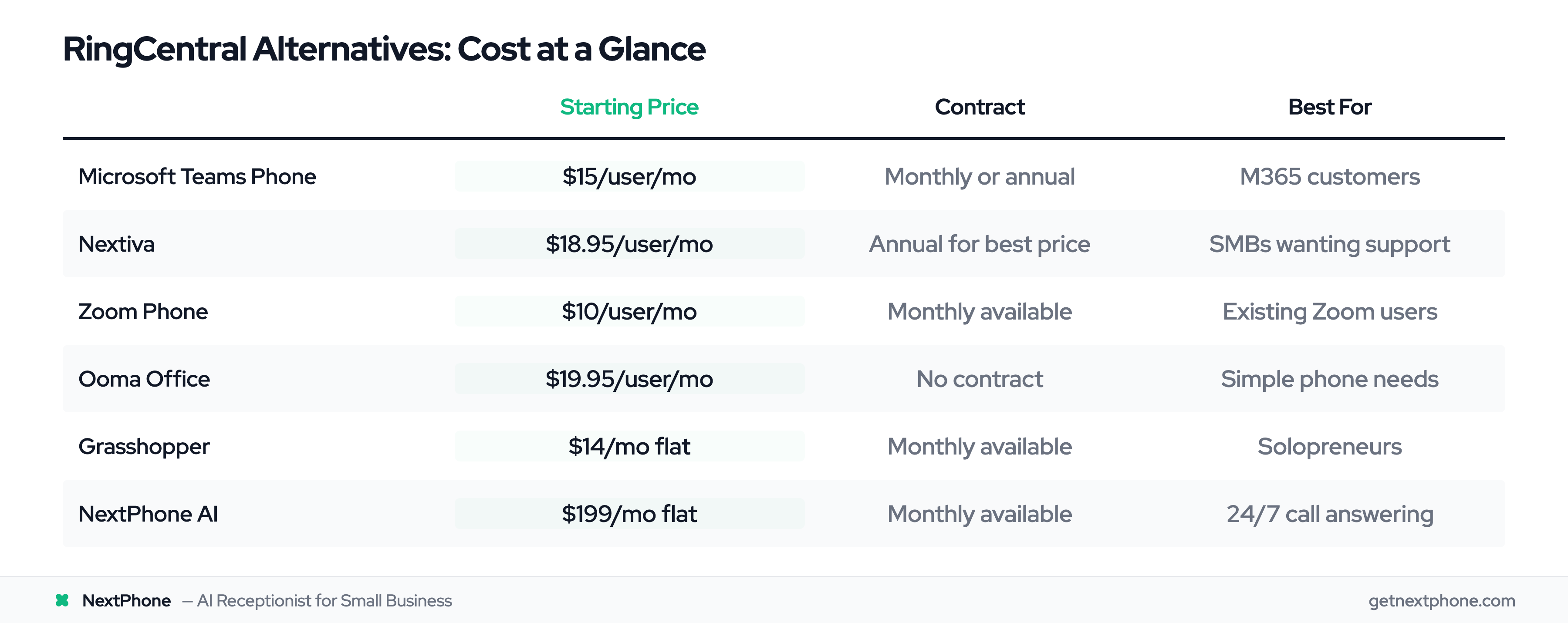
If you're scanning for options, here's the overview. For a deeper dive, see this 13 best RingCentral alternatives comparison:
| Alternative | Starting Price | Best For | Key Advantage |
|---|---|---|---|
| Microsoft Teams Phone | $15/user/mo | M365 customers | Native Teams integration |
| Nextiva | $18.95/user/mo | SMBs wanting better support | Top-rated customer service (G2: 9.0) |
| Zoom Phone | $10/user/mo | Teams already using Zoom | Familiar interface, lowest cost |
| Ooma Office | $19.95/user/mo | Budget-conscious basics | No contracts, simple setup |
| Grasshopper | $14-55/mo | Solopreneurs, small teams | No per-user fees (some plans) |
| OpenPhone | $19/user/mo | Remote teams | Modern interface, shared inboxes |
| Dialpad | $15/user/mo | AI-powered sales teams | Built-in AI transcription |
| Google Voice | Free-$10/user/mo | Solopreneurs on a budget | Free tier available |
| 8x8 | $15/user/mo | International calling | Unlimited calling to 48 countries |
| NextPhone AI | from $199/mo | 24/7 call answering | Answers, texts, and calls — no per-user fees |
Each serves different needs. Traditional VoIP alternatives give you another phone system. AI answering solves a different problem entirely. Let's break down both categories.
RingCentral Competitors: Side-by-Side Comparison (2026)
The most-searched RingCentral comparison in 2026 isn't 1-vs-1 — it's RingCentral vs the four platforms small businesses actually shortlist next: Zoom Phone, Microsoft Teams Phone, 8x8, and Nextiva. Here's the head-to-head on the dimensions that decide the switch.
| Platform | Starting price | Contract | Best fit | Where it beats RingCentral |
|---|---|---|---|---|
| RingCentral | $20/user/mo | Annual recommended | Mid-market UCaaS | Baseline — broad feature set, 300+ integrations |
| Zoom Phone | $10/user/mo | Monthly available | Teams already on Zoom | ~50% cheaper, one-click call-to-video escalation |
| Microsoft Teams Phone | $15/user/mo (add-on) | Monthly or annual | M365 shops | No new app, pooled minutes, native Outlook/Teams integration |
| 8x8 | $15/user/mo | Annual for best price | International calling | Unlimited calling to 14–48 countries included |
| Nextiva | $18.95/user/mo | Annual for best price | SMBs that want hand-holding | G2 support 9.0 vs RingCentral 7.9; slightly lower price for similar features |
Quick verdict for small business in 2026: If you already pay for Microsoft 365, Teams Phone is the cheapest path because the seat license is largely paid for. If your team lives in Zoom, Zoom Phone is the cheapest standalone VoIP at $10/user. If you want a like-for-like RingCentral replacement with better support, pick Nextiva. If you make a lot of international calls, pick 8x8. None of these answer the phone for you when nobody's at the desk — that's where flat-rate AI answering (NextPhone, $199/mo unlimited) comes in alongside whichever VoIP you pick.
Alternatives to RingCentral, ranked by use case (2026)
A direct ranking so you don't have to re-read the table:
- Best for answering inbound calls (replaces a receptionist): NextPhone AI at $199/mo flat — unlimited calls answered 24/7, no per-user fees. For most small businesses, this is the switch that moves revenue, not just saves on the monthly phone bill.
- Best overall VoIP alternative to RingCentral: Nextiva ($18.95/user) — closest feature parity with materially better support (G2: 9.0 vs 7.9).
- Best cheap VoIP alternative to RingCentral: Zoom Phone at $10/user/mo.
- Best alternative for M365 customers: Microsoft Teams Phone at $15/user/mo add-on.
- Best alternative for solopreneurs: Grasshopper at $14/mo flat (no per-user fees).
- Best alternative for international calling: 8x8 at $15/user/mo.
That last one is the category most 2026 comparison guides skip: across our analysis of 1,446,980 inbound calls, the most common reasons people call — in ranked order — are booking or rescheduling an appointment, asking about a specific service, requesting a quote, checking status, hours and location, new-customer inquiries, and emergencies. Almost every one is billable work walking in the door. Swapping VoIP providers doesn't capture any of it if nobody picks up.
RingCentral Alternative for Small Business: Phone System vs. Call Answering
Most comparison guides answer this question with another VoIP platform. For small businesses, that's often the wrong answer. The right RingCentral alternative depends on which problem you're actually solving.
The phone-system problem: you need outbound calling, extensions, or team collaboration. Any VoIP on the ranked list above handles this — Nextiva and Zoom Phone are the practical picks for most teams.
The missed-call problem: calls go to voicemail when nobody's at the desk — during jobs, after hours, on weekends. No VoIP switch fixes this. RingCentral routes calls to phones your team needs to answer; it doesn't answer for you. An AI answering service does.
For most small businesses, the second problem costs more in lost revenue than the first saves on the monthly bill. One missed quote request or new client inquiry can be worth more than a full year of VoIP savings.
For a 1–3 person business, that's the whole switch: NextPhone covers inbound answering, outbound calls, and business texting on one flat monthly plan. For larger teams, the hybrid setup — simpler VoIP for extensions, AI answering for the main line — typically costs less than a full RingCentral plan and does more.
RingCentral Pricing in 2026 — What You'll Really Pay
RingCentral's advertised pricing starts at $20/user/month on annual plans, but the invoice that arrives rarely matches the brochure. Here's what a small team actually pays across the three standard tiers, with NextPhone's flat rate alongside for comparison:
| Plan | Per User (Annual) | 5-User Team/mo | 10-User Team/mo |
|---|---|---|---|
| RingCentral Core | $20/mo | $100 | $200 |
| RingCentral Advanced | $25/mo | $125 | $250 |
| RingCentral Ultra | $35/mo | $175 | $350 |
| NextPhone AI | Flat rate | $199 | $199 |
Note: All RingCentral plans require a human to answer each inbound call — no AI receptionist or 24/7 answering is included at any tier. NextPhone's flat monthly plans from $199 cover unlimited inbound AI answering with no per-minute charges.
Those base numbers grow before you hit "pay invoice." SMS plans cap monthly messages and charge overages beyond the allotment. Toll-free minutes have their own cap with per-minute billing past it. Administrative fees (not government-mandated — just extra charges) add another line item. AI features that are included at higher tiers cost extra on Core and Advanced.
The realistic cost for a 5-person team on RingCentral Advanced: $125/mo base, plus overages and fees, lands closer to $150–185 in most months. And after all that, calls still go to voicemail whenever your team is busy, on a job, or after hours.
NextPhone's $199/month is a flat rate covering unlimited inbound calls answered 24/7 — no per-user math, no overage surprises, no per-minute meter. RingCentral is a phone system you make outbound calls through; NextPhone answers inbound calls so no caller ever reaches voicemail. Larger teams run both — though for a 1–3 person business, NextPhone now covers both sides: outbound calls and texting from the app on your business number, with the AI answering everything you don't pick up.
Why Small Businesses Leave RingCentral
If you're still weighing whether the switch is justified, it helps to understand why RingCentral - despite being a solid enterprise platform - often isn't the right fit for small businesses.
Per-User Pricing Pain
RingCentral's pricing model works great for enterprises. For small businesses, it creates headaches.
The math is straightforward but frustrating:
- 5 users at $25/month = $125/month
- 10 users at $25/month = $250/month
- 20 users at $25/month = $500/month
Every new hire increases your phone bill. That part-time employee who needs occasional access? Same per-user fee. The seasonal worker? Full price. Annual contracts lock you in, and monthly pricing runs 30-50% higher if you don't commit.
For businesses with tight margins, watching phone costs scale linearly with headcount gets old fast.
Feature Overload
RingCentral offers 300+ integrations. Video meetings for 200+ participants. Enterprise analytics. Team messaging that rivals Slack. Advanced call routing. AI transcription. Device management.
Impressive capabilities - if you use them.
Most small businesses need to make calls, receive calls, and maybe check voicemail. They're paying for a Ferrari when they need a pickup truck.
The admin interface reflects this enterprise focus. Setting up call flows, managing integrations, configuring advanced features - it requires training and time most small business owners don't have. When you just want your phone to ring and someone to answer, RingCentral can feel like overkill.
Hidden Costs Add Up
The advertised RingCentral packages run $20-$35/user/month on annual plans. But those prices come with asterisks:
- SMS limits: Exceed your monthly quota and overage charges apply
- Toll-free minutes: Capped on most plans, with per-minute overages
- AI features: Premium add-ons at additional cost
- Administrative fees: Not government-mandated, just extra charges
- Setup fees: For custom configurations
- International calling: Not included in domestic plans
That "affordable" plan gets expensive when the bill arrives.
The Real Question Nobody Asks
Here's what most "RingCentral alternatives" articles miss entirely:
Do you need a phone SYSTEM or just answered CALLS?
These are two different problems. A phone system lets you make and receive calls. Having calls answered means someone (or something) picks up when customers call.
RingCentral - and every VoIP alternative - solves the first problem. But modern businesses need CRM integration and analytics, plus someone to actually answer. If your real issue is calls going to voicemail because nobody's available to answer, switching VoIP providers won't help.
Keep this distinction in mind as we explore alternatives.
Traditional VoIP Alternatives to RingCentral
If you genuinely need a phone system - outbound calling, team messaging, video conferencing, complex call routing - these are your best options.
Microsoft Teams Phone - Best for Existing Microsoft 365 Customers
Pricing: $15 per user per month (Calling Plan add-on)
If your team already runs on Microsoft 365, Teams Phone is the path of least resistance. It adds full PSTN calling to the Teams app your team already uses for chat and meetings — no new software to install.
The Calling Plan uses pooled minutes across your organization rather than per-user allotments, which works well for teams where some people make many calls and others barely touch the phone. The softphone-first approach means no desk phones required, though you can add them if needed.
Practitioners in enterprise IT communities report 50-60% cost savings compared to RingCentral when the business already pays for M365 licenses. The integration with Outlook, SharePoint, and the rest of the Microsoft stack is seamless — call scheduling, contact sync, and voicemail transcription all work natively.
For more on how Teams Phone connects with other tools, see our Microsoft Teams integration guide.
Best for: Businesses already paying for Microsoft 365 who want calling without another vendor Limitation: Weak contact center capabilities and limited call reporting compared to dedicated UCaaS platforms
| Feature | Microsoft Teams Phone | RingCentral |
|---|---|---|
| Starting Price | $15/user/mo (add-on) | $20/user/mo |
| Contract Required | Monthly or annual | Annual recommended |
| Best For | M365 customers | Enterprise UCaaS |
| Key Limitation | Limited reporting | Complex, expensive |
Nextiva - Best for Customer Support
Pricing: $18.95-32.95 per user per month
Nextiva consistently ranks as the top RingCentral alternative for good reason. The feature set is comparable, the pricing is slightly lower, and the customer support is significantly better.
G2 rates Nextiva's customer support at 9.0 out of 10, compared to RingCentral's 7.9. When you're a small business without an IT department, responsive support matters.
The interface feels more intuitive than RingCentral's enterprise-focused design. Setup takes hours instead of days. And the mobile app actually works reliably - a common complaint about RingCentral among users. For a detailed comparison, see our Nextiva alternative breakdown.
Best for: Small businesses who want RingCentral-level features with better support Limitation: Still uses per-user pricing, so costs scale with team size
| Feature | Nextiva | RingCentral |
|---|---|---|
| Starting Price | $18.95/user/mo | $20/user/mo |
| Contract Required | Annual for best price | Annual recommended |
| Best For | SMBs wanting strong support | Enterprise UCaaS |
| Key Limitation | Per-user pricing scales up | Complex admin, hidden fees |
Zoom Phone - Best Budget Option
Pricing: $10-20 per user per month
If your team already lives in Zoom, their phone system makes sense. The interface is familiar, the integration is seamless, and the price undercuts everyone.
At $10 per user for the basic plan, Zoom Phone costs half what RingCentral charges. You get domestic calling, voicemail, SMS, and the ability to escalate any call to a video meeting with one click.
The transition from call to video - something that feels clunky on other platforms - happens naturally in Zoom. For teams doing sales calls or customer support, that fluid experience matters.
Best for: Teams already using Zoom for video meetings Limitation: Analytics and advanced features less robust than RingCentral
| Feature | Zoom Phone | RingCentral |
|---|---|---|
| Starting Price | $10/user/mo | $20/user/mo |
| Contract Required | Monthly available | Annual recommended |
| Best For | Existing Zoom users | Enterprise UCaaS |
| Key Limitation | Weaker analytics | Complex, expensive |
Ooma Office - Best for Simplicity
Pricing: $19.95-29.95 per user per month
Ooma doesn't try to compete with RingCentral's feature list. Instead, it focuses on doing the basics well.
No contracts. Setup in 15 minutes. Call, text, voicemail, basic routing. That's mostly it - and for many small businesses, that's exactly enough.
The pricing stays predictable. No surprise fees. No complexity tax. Just a phone system that works. Learn more in our Ooma integration overview.
Best for: Small businesses with basic phone needs who value simplicity Limitation: Fewer integrations and advanced features
| Feature | Ooma Office | RingCentral |
|---|---|---|
| Starting Price | $19.95/user/mo | $20/user/mo |
| Contract Required | No contract | Annual recommended |
| Best For | Simple phone needs | Enterprise UCaaS |
| Key Limitation | Fewer integrations | Complex, expensive |
Grasshopper - Best for Solopreneurs
Pricing: $14/month (True Solo) to $55/month (Small Business)
Grasshopper takes a different approach: flat monthly pricing instead of per-user fees.
The True Solo plan gives one person a business phone number, voicemail, and basic features for $14/month. The Small Business plan covers unlimited users for $55/month. No per-seat math required.
It's designed for separating business from personal calls without the complexity of enterprise VoIP. Virtual phone system, not full UCaaS platform. See how Grasshopper compares with AI features in our Grasshopper AI receptionist comparison.
Best for: Solo businesses, freelancers, 1-3 person teams Limitation: Limited advanced features compared to full VoIP platforms
| Feature | Grasshopper | RingCentral |
|---|---|---|
| Starting Price | $14/mo flat | $20/user/mo |
| Contract Required | Monthly available | Annual recommended |
| Best For | Solopreneurs, tiny teams | Enterprise UCaaS |
| Key Limitation | No advanced VoIP features | Complex, expensive |
OpenPhone - Best for Remote Teams
Pricing: $19 per user per month
OpenPhone built their platform around how modern remote teams actually communicate: lots of texting, shared inboxes, and asynchronous collaboration.
The interface feels more like a messaging app than a phone system. Shared numbers let multiple team members handle the same conversations. The design is clean and modern - a stark contrast to the cluttered dashboards of enterprise VoIP.
For teams where texting matters as much as calling, OpenPhone offers a genuinely different experience. For integration details, see our OpenPhone integration guide.
Best for: Remote teams, text-heavy communication, small teams collaborating on customer conversations Limitation: No video conferencing, limited analytics
| Feature | OpenPhone | RingCentral |
|---|---|---|
| Starting Price | $19/user/mo | $20/user/mo |
| Contract Required | Monthly available | Annual recommended |
| Best For | Remote, text-heavy teams | Enterprise UCaaS |
| Key Limitation | No video, limited analytics | Complex, expensive |
Dialpad - Best for AI-Powered Sales Teams
Pricing: $15 per user per month
Dialpad leans hard into AI. Every call gets real-time transcription, automated post-call summaries, and sentiment analysis. For sales teams, the AI coaching features flag objection-handling moments and track talk-to-listen ratios across reps.
At $15/user/month for the base plan, it undercuts RingCentral while delivering AI features that RingCentral charges extra for. The interface is clean and modern, and the mobile app is solid.
Where Dialpad gets expensive is the upper tiers. AI Sales Center and AI Contact Center plans jump significantly in price. And if your team just needs basic calling without the AI layer, the extra intelligence adds complexity you may not want. See our Dialpad AI alternative comparison for more detail.
Best for: Sales-focused teams that want AI transcription, coaching, and call intelligence built in Limitation: Higher tiers get expensive fast; overkill for teams with basic phone needs
| Feature | Dialpad | RingCentral |
|---|---|---|
| Starting Price | $15/user/mo | $20/user/mo |
| Contract Required | Monthly available | Annual recommended |
| Best For | AI-powered sales teams | Enterprise UCaaS |
| Key Limitation | Expensive upper tiers | AI features cost extra |
Google Voice - Best Free Option for Solopreneurs
Pricing: Free (personal) / $10 per user per month (Business Starter)
Google Voice is the simplest entry point. The free personal tier gives you a US phone number, voicemail, and basic call forwarding — enough for a solopreneur who needs a separate business number without spending anything.
The Business Starter plan at $10/user/month adds Google Workspace integration, multi-user support, and SLA guarantees. If your business already runs on Gmail and Google Calendar, the integration is seamless.
The trade-offs are real: no toll-free numbers, limited to US users, no advanced call routing, and the feature set is bare-bones compared to any dedicated VoIP platform. For anything beyond basic inbound/outbound calling, you'll outgrow it quickly. Read our Google Voice alternative guide for a full comparison.
Best for: Solopreneurs and freelancers who want a free or near-free business number Limitation: No toll-free numbers, US-only, minimal features for growing teams
| Feature | Google Voice | RingCentral |
|---|---|---|
| Starting Price | Free (personal) | $20/user/mo |
| Contract Required | No | Annual recommended |
| Best For | Solopreneurs, freelancers | Enterprise UCaaS |
| Key Limitation | US-only, no toll-free | Complex, expensive |
8x8 - Best for International Calling
Pricing: $15 per user per month
8x8 positions itself as the international business communications platform — and delivers on it. The base plan includes unlimited calling to 14 countries, and higher tiers extend that to 48 countries. For businesses with international clients or distributed teams, this alone justifies the switch from RingCentral.
The platform covers the full UCaaS stack: voice, video, chat, and contact center. Pricing undercuts RingCentral at the lower tiers while matching features for most SMB needs. The admin console is straightforward, and porting numbers from RingCentral is well-documented.
Where 8x8 falls short: the interface feels dated compared to newer competitors like OpenPhone or Dialpad, and support response times can be inconsistent according to G2 reviews. Check our 8x8 integration guide for setup details.
Best for: Businesses with significant international calling needs Limitation: Interface less modern than newer competitors; inconsistent support
| Feature | 8x8 | RingCentral |
|---|---|---|
| Starting Price | $15/user/mo | $20/user/mo |
| Contract Required | Annual for best price | Annual recommended |
| Best For | International calling | Enterprise UCaaS |
| Key Limitation | Dated interface | International costs extra |
Honorable Mentions
- GoTo Connect ($27/user): Unlimited calling to 50+ countries included - ideal for international businesses
- MightyCall ($20/user): Intuitive dashboard with call recording and analytics
- Unitel Voice ($9.99/month): The budget champion for absolute basics
The Problem Traditional Alternatives Don't Solve
Here's the uncomfortable truth: switching from RingCentral to Nextiva won't help if nobody's there to answer.
Every VoIP platform we've discussed is a phone system. They route calls. They provide numbers. They offer voicemail. But they don't answer phones.
The Missed Call Reality
Industry research shows small businesses miss 60-80% of incoming calls. When nobody's available - lunch breaks, job sites, after hours, busy periods - calls go to voicemail. We break down the full cost of this problem in our guide on how to reduce missed calls.
And 67% of callers don't leave voicemails. They just call the next business on their list.
Think about your own customer calls:
- Quote requests (requesting a quote is among the top 3 most common call types): Customer calls for an estimate. No answer. They call your competitor.
- Emergencies (urgency and emergency calls rank among the top reasons people call): Burst pipe, broken AC, urgent situation. Can't wait for a callback. First contractor to answer wins.
- New customers (first impression): No answer on the first call? Many never call back.
The Cost of Switching VoIP
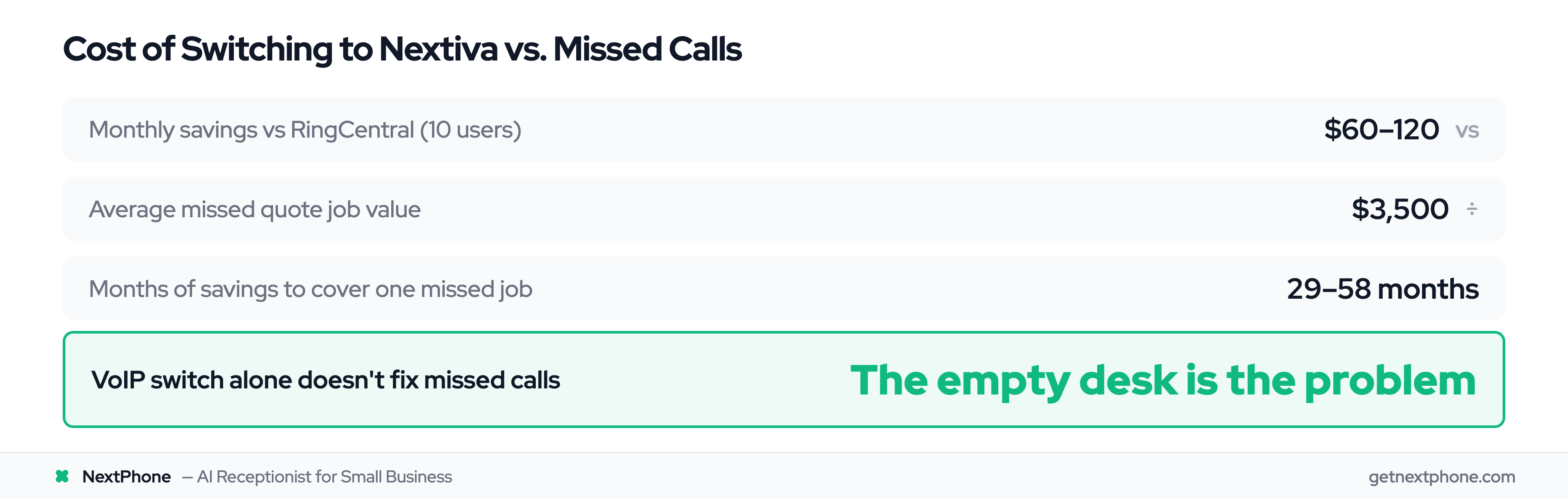
Let's say you switch from RingCentral to Nextiva:
- RingCentral (10 users): $250-350/month
- Nextiva (10 users): $189-330/month
- Monthly savings: $60-120
That's real money. But if calls still go to voicemail, you're still losing revenue. One missed $3,500 quote request costs more than a year of those savings.
The VoIP platform isn't the problem. The empty desk is.