
Key Takeaways
- 42% of callback requests never get returned - nearly half of customers who ask for callbacks are left waiting forever
- One in four customer calls (25.4%) explicitly request callbacks, making callback request tracking essential for capturing this revenue
- The capture problem: You cannot track callbacks that never get recorded - voicemail abandonment creates invisible lost opportunities
- Speed matters: 78% of customers hire whoever responds first, so returning callbacks within 30 minutes is critical
- AI-powered systems can capture 100% of callback requests automatically, eliminating the sticky-note chaos most businesses rely on
Introduction
Here's an uncomfortable truth about your business: 42% of callback requests never get returned.
Not "sometimes delayed." Not "occasionally forgotten." Nearly half of customers who ask to be called back never hear from the business again. They wait. They wonder. Then they call someone else.
If you've ever found a crumpled sticky note with a phone number and no context, or scrolled through voicemails trying to remember who you promised to call back, you know exactly how this happens. The intention is always there. The system isn't.
This guide breaks down exactly how many callbacks your business is handling, why they fall through the cracks, what those missed callbacks cost in real dollars, and how to implement tracking that ensures every callback gets returned. Whether you're a solo operator juggling callbacks between job sites or managing a small team, there's a solution here that fits.
Let's fix the callback problem.
The Callback Problem - 42% Never Get Returned

The callback failure rate isn't a minor operational hiccup. It's a revenue hemorrhage hiding in plain sight.
The Numbers Are Brutal
Industry research on customer service response rates reveals a sobering statistic: 42% of callback requests never get returned. That's not the failure rate for bad businesses with terrible service. That's the average across normal businesses with good intentions.
Think about what that means. If ten customers ask you to call them back this week, four of them will never hear from you. They'll wait a day, maybe two, then call someone who actually picks up.
The downstream effect is devastating. Research shows that 78% of customers hire whoever responds first. It doesn't matter if you're cheaper, more experienced, or have better reviews. The business that calls back first gets the job. The one that calls back second gets nothing.
And here's the kicker: 85% of customers whose calls aren't answered won't call back. They don't send polite follow-up emails asking if you received their message. They move on. You never even know the opportunity existed.
Why This Happens to Good Businesses
This isn't about lazy business owners who don't care. It's about the structural impossibility of reliable callbacks without a system.
You're on a job site. Phone rings. You think, "I'll call them back at lunch." Except by lunch, you've had three more calls, a supply issue, and a customer question. That callback? Forgotten.
Or you check voicemail at 5 PM and find six messages. You return two before dinner. The other four get pushed to "tomorrow." Tomorrow brings new calls. Those four become eight. The pile grows.
The gap between intention and execution is where callbacks go to die. And without tracking, you don't even know how many you're losing.
How Many Callbacks You're Actually Getting
Before you can fix callback tracking, you need to understand the volume you're dealing with.
One in Four Calls Requests a Callback
Analysis of 2,487 real customer interactions revealed a critical data point: 25.4% explicitly request callbacks. That's one in four customers saying some version of "please call me back."
For the average contractor receiving 42 calls per month, that translates to approximately 11 callback requests. Every month. Consistently.
For busier operations:
- 50 calls/month (typical plumber): 13 callback requests
- 87 calls/month (high-volume roofing: 22 callback requests
- 100+ calls/month (growing service company): 25+ callback requests
These numbers represent just explicit requests - customers who specifically said "call me back." They don't include the implicit callbacks from unanswered calls where customers didn't leave voicemails but expected you to return the missed call. 60% of local searchers prefer calling businesses over filling out forms or using chat.
What This Means for Your Business
Ten to twenty callback requests per month might sound manageable. It's not.
Each callback isn't a simple task. It's a mental note to make, information to remember, a number to find, context to recall, a time to call, and follow-through to execute. Multiply that cognitive load by 11-22 pending callbacks at any given time, and the system breaks down.
This is why paper-based tracking fails. This is why "I'll remember" fails. The volume alone overwhelms any memory-based approach.
Why Callbacks Fall Through the Cracks
Understanding why callbacks fail helps explain why simple solutions don't work.
The Capture Problem
You cannot track callbacks you don't capture.
When a call comes in and you don't answer, one of two things happens. The caller leaves a voicemail (which you might check), or they hang up (which creates no record at all). Industry data shows that over 80% of callers hang up when reaching voicemail rather than leaving a message. Gong's research on voicemails confirms that voicemail response rates vary dramatically based on context.
That means 80% of unanswered calls create "invisible" callbacks. The customer expected you to return the missed call. You didn't know they called. That callback request vanished into thin air.
Your tracking system can't help you if there's nothing to track.
Memory-Based Systems Fail
"I'll call them back" is not a system. It's a hope.
You're twenty feet up on a ladder when the phone rings. You make a mental note. Four hours, two job sites, and fifteen distractions later, that mental note is gone. It was never written down, never logged, never tracked.
Sticky notes are marginally better - at least there's a physical artifact. But sticky notes get lost, have incomplete information, lack prioritization, and often can't be read by the time you find them. "John - roof - call back" means nothing when you have three customers named John.
The Voicemail Trap
Voicemail creates a false sense of security.
You think: "The message is saved. I can get to it later." But later never comes cleanly. Voicemails pile up. New ones arrive before old ones are processed. Some get returned, others don't. There's no visual indicator of which callbacks are complete and which are pending.
After three days of voicemail accumulation, you're looking at a queue with no organization, no priority, and no accountability. Some of those callers have already hired competitors. You just don't know which ones.
Speed Requirements You Can't Meet
Modern customers don't wait.
Research shows customers expect callbacks within 30 minutes. The average business takes over four hours. That gap is where jobs are lost.
The customer who requested a callback at 10 AM has already called two other contractors by 10:30. When you call back at 2 PM, they've already scheduled with someone else. Your callback was too late to matter.
Speed of response is everything. And manual tracking systems are inherently slow.
The Real Cost of Missed Callbacks
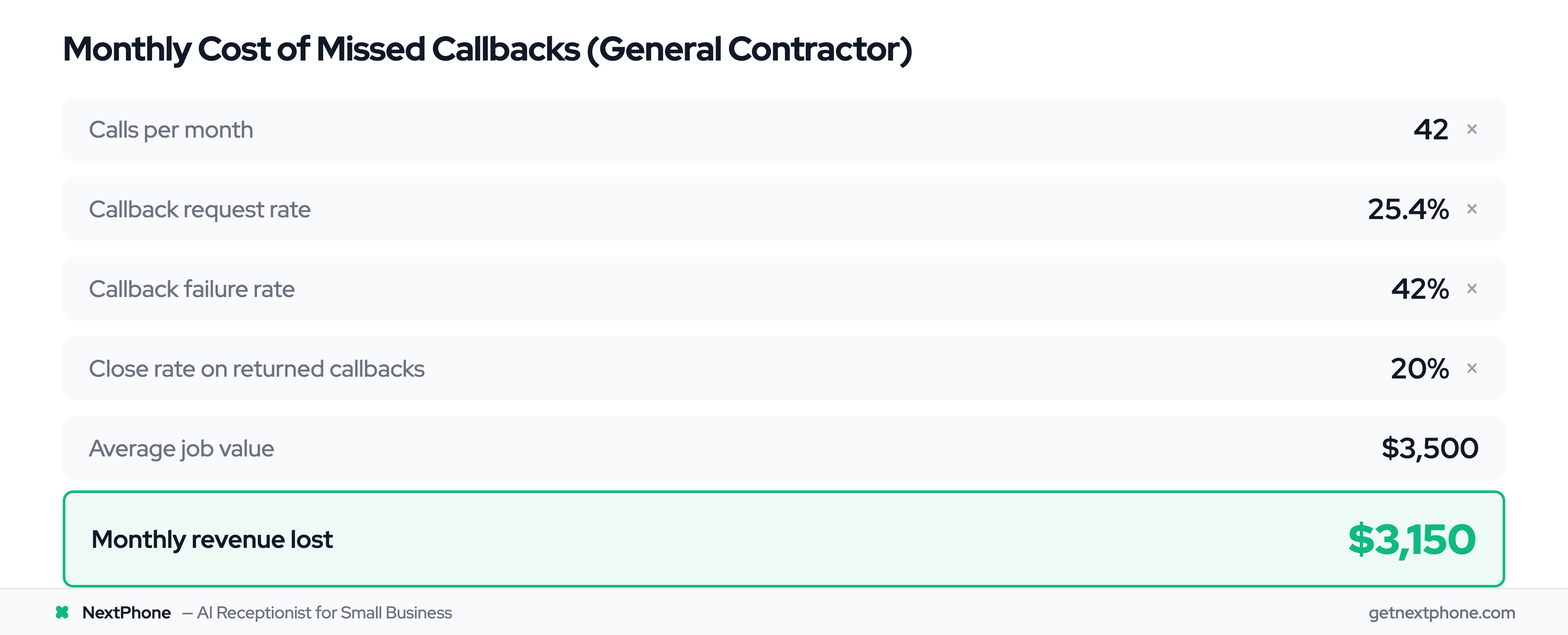
Let's quantify what 42% callback failure actually costs.
The Math on Missed Callbacks
Here's the formula:
Monthly callback requests x Failure rate x Close rate x Average job value = Lost revenue
-
Example: General Contractor
-
42 calls/month x 25.4% = 11 callback requests
-
11 x 42% failure = 4.6 lost callbacks
-
4.6 x 20% would have hired = 0.9 jobs
-
0.9 x $3,500 average job = $3,150/month lost
-
Annual impact: $37,800/year
-
Example: Plumber
-
50 calls/month x 25.4% = 13 callback requests
-
13 x 42% failure = 5.5 lost callbacks
-
5.5 x 30% would have hired = 1.6 jobs
-
1.6 x $500 average = $800/month lost
-
Annual impact: $9,600/year
-
Example: HVAC Contractor
-
60 calls/month x 25.4% = 15 callback requests
-
15 x 42% failure = 6.3 lost callbacks
-
6.3 x 25% would have hired = 1.6 jobs
-
1.6 x $1,200 average = $1,920/month lost
-
Annual impact: $23,040/year
These aren't worst-case scenarios. This is standard math applied to average callback failure rates.
Speed Determines Who Wins
The 78% first-responder advantage applies directly to callbacks.
The homeowner who left a callback request at 10 AM is motivated. They want to hire someone. That motivation fades with time. By noon, they've probably called other businesses. By 3 PM, they may have already scheduled with someone else.
Your callback at 4 PM arrives after the decision is made.
Every hour of delay reduces your chance of winning the job. The businesses that return callbacks within 30 minutes capture the work. The ones that take four hours get "sorry, we already hired someone."
Callback Tracking Systems That Actually Work
Not all tracking methods are equal. Here's what works, ranked by effectiveness.
Method 1: Paper and Memory (What You're Probably Doing)
Effectiveness: 30% Cost: Free Best for: Nobody, but most common approach
This is the sticky-note-on-the-dashboard method. Callbacks get scribbled down (maybe), stuck somewhere visible (hopefully), and returned (eventually). Reality: 70% of callbacks in this system never happen.
The problem isn't laziness. It's that paper systems have no prioritization, no reminders, no accountability, and no way to know what's pending versus complete.
Method 2: Spreadsheet or Simple List (Better Than Nothing)
Effectiveness: 50% Cost: Free Best for: Solo operators, low volume (under 10 callbacks/month)
A single spreadsheet or notebook dedicated to callbacks beats scattered sticky notes. Columns for name, number, reason, date, and status. Check off completed callbacks. Review daily.
The limitation: This only works if you manually log every callback. Miss logging one, and it's gone. And manual logging requires you to be available when calls come in - which is the original problem.
Method 3: CRM or Task Management Software (Good for Teams)
Effectiveness: 65% Cost: $25-100/month Best for: Teams that already use CRM, office-based operations
Systems like HubSpot, Jobber, or Asana can track callbacks as tasks. Assign them to team members. Set due dates. Get reminders. Asana reports $716-722M in FY2025 revenue, demonstrating the scale of task management adoption.
The limitation: These systems still require manual entry. Someone needs to input each callback request. If calls go to voicemail and nobody logs them, the CRM can't help. 70% of marketers use CRM to track lead data, but manual entry remains the weak link.
Method 4: Modern Phone System Features (VoIP with Visual Voicemail)
Effectiveness: 70% Cost: $30-75/month Best for: Office-based businesses with consistent voicemail checking
Modern VoIP systems offer visual voicemail, callback queues, and transcription. You can see all pending voicemails at a glance, mark them complete, and track what's outstanding.
The limitation: This only captures callers who leave voicemails. With 80% of callers hanging up instead, you're still missing the majority of callback opportunities.
Method 5: AI-Powered Callback Capture (Best Solution)
Effectiveness: 95%+ Cost: $199/month Best for: Any business serious about callback completion
AI virtual receptionists like NextPhone solve the capture problem at the source. The AI answers every call - no voicemail, no missed opportunities. It engages with the caller, captures their name, number, reason for calling, and urgency level, then sends you an instant notification.
The result: 100% of callback requests captured automatically. No manual entry. No sticky notes. No forgotten voicemails. Every caller who wants a callback gets logged, prioritized, and pushed to you immediately via email notifications after calls.
The AI can distinguish urgent callbacks ("my pipe is leaking right now") from routine ones ("I want a quote sometime this week"), helping you prioritize responses. Emergency callbacks get flagged. Routine ones queue up. Nothing disappears.
For a business losing $3,000+ per month to callback failures, a $199 solution pays for itself fifteen times over.
How to Implement Callback Tracking Today
You don't need perfect systems to improve. Start with quick wins.
Quick Wins for Today (Free)
Implement these in the next hour:
-
Consolidate your callback list - One place for all callbacks. Not sticky notes, not mental notes, not scattered voicemails. One list.
-
Check voicemails immediately - Every voicemail gets logged the moment you hear it. Name, number, reason, time received.
-
Set three daily callback windows - Morning (8:00 AM), lunch (12:00 PM), end of day (4:30 PM). Protect these 15-minute windows for returning callbacks.
-
Keep callbacks visible - Your callback list should be the first thing you see when you open your phone or sit at your desk.
-
Process before adding - Return at least one callback before listening to the next voicemail. Prevents pile-up.
These steps alone can improve callback completion by 30-40%. 70% of businesses struggle to act on attribution insights, and lead scoring accuracy improves 32% with proper attribution.
Essential Callback Information to Capture
For every callback request, record:
- Name and number (obviously)
- What they're calling about (so you're prepared when you call)
- When they called (older callbacks need faster response)
- Urgency level (emergency vs routine)
- Best time to reach them (if mentioned)
This takes 30 seconds per callback. It saves minutes of confusion later.
The 5-Minute Callback Rule
If you can return a callback within 5 minutes, do it immediately.
Don't wait for a "better" time. Don't plan to call back after lunch. Don't add it to your list for later. Just call.
The 78% first-responder advantage means speed beats perfection. A quick callback with limited information beats a prepared callback that happens two hours late.
When to Upgrade to Automated Systems
Consider AI-powered callback capture if:
- You're missing more than 30% of callbacks (most businesses are)
- Callback volume exceeds 10 per month
- You physically can't answer calls during work hours
- Team members handle calls without accountability
- One missed callback costs more than the monthly solution
For most service businesses, the math is simple. If missing one $500 job per month costs more than $199/month for complete callback capture, the ROI is obvious. Businesses see a 12% average improvement in lead quality with attribution software.
Frequently Asked Questions
What percentage of callback requests never get returned?
Industry research shows 42% of callback requests never get returned. This isn't limited to poorly-run businesses - it happens across normal companies without proper tracking systems. The combination of high call volume, manual processes, and competing priorities means nearly half of promised callbacks simply don't happen.
How many callback requests does a typical small business get?
Analysis of customer interactions shows 25.4% of calls explicitly request callbacks - roughly one in four. For a typical contractor receiving 42 calls per month, that's about 11 callback requests. Higher-volume businesses can see 20+ callback requests monthly, making systematic tracking essential.
How quickly should I return a callback request?
Customers expect callbacks within 30 minutes, and 78% of customers hire whoever responds first. The ideal target is under 5 minutes for urgent requests. After an hour, your chances of reaching the customer and winning the job drop significantly as they've likely already connected with a competitor.
Can I track callbacks without expensive software?
Yes, but with trade-offs. A simple spreadsheet or notebook can work for low-volume businesses (under 10 callbacks/month) if you're disciplined about logging every request immediately. However, this approach typically achieves only 50% completion rates versus 95%+ with automated capture systems.
Why don't customers leave voicemails for callback requests?
Over 80% of callers hang up when reaching voicemail rather than leaving messages. Customer expectations have changed - they want immediate engagement or they move on to the next business. This creates "invisible" callback requests that never get captured in any tracking system unless you're using AI that answers every call.
How does AI capture callback requests automatically?
AI-powered answering service systems like NextPhone answer every call, engage with the caller, and capture their name, number, reason for calling, and urgency level. You receive an instant notification with all callback details. There's no voicemail to check, no sticky notes to manage, and no callback requests that slip through because you didn't answer. Every caller who wants a callback gets logged automatically.
Conclusion
Callback request tracking isn't a nice-to-have organizational tool. It's the difference between capturing revenue and watching it walk to your competitors.
The numbers are clear: 25.4% of your calls request callbacks. 42% of those callbacks never happen. Each missed callback represents a potential job - sometimes worth hundreds, sometimes thousands of dollars - going to whoever returns the call first.
Start with the basics. Consolidate your callback list. Set dedicated callback windows. Return requests within 30 minutes, or 5 minutes when possible. These free changes can cut your callback failure rate significantly.
For complete capture - every caller, every request, zero slippage - AI-powered systems ensure that 100% of callback requests get logged, prioritized, and pushed to you automatically. No voicemail abandonment. No sticky-note chaos. No "I forgot to call them back."
Every callback you miss today is a job someone else quotes tomorrow. The question isn't whether you can afford callback tracking. It's whether you can afford to keep losing 42% of your callbacks.
Ready to capture every callback request? See how NextPhone answers every call and tracks every callback for just $199/month. No setup fees. No per-minute charges. No callbacks left behind.