
It's 2 AM. A homeowner just discovered water pouring from a burst pipe in their basement. They grab their phone and call the first plumber on Google.
That plumber could be you. But only if someone answers.
Here's the reality most business owners don't want to face: if your phone goes to voicemail at 2 AM, that panicked homeowner is already dialing your competitor. And they're probably not calling back.
Most businesses only answer calls 8 hours a day. That leaves 16 hours - two-thirds of every day - when potential customers reach nothing but a recorded message. Research shows that 27% of leads call outside normal 9-5 business hours. Even worse, 85% of callers who don't reach a live person won't bother calling back.
82% of customers expect immediate responses to their inquiries, and more than 40% of small businesses lose money due to phone issues. This is where a 24/7 virtual receptionist changes everything.
The market reflects this demand: the virtual receptionist market is growing from $3.85B to $9B by 2033, and 85% of customer service leaders plan to pilot conversational GenAI in 2025.
Whether you're a plumber, lawyer, property manager, or any business that receives phone calls, this guide covers what you need to know about round-the-clock phone coverage: what it is, how it works, what it costs, and whether it's right for your business.
How the Main Options Compare
Before going deep, here's how leading services stack up on price and call volume:
| Service | Price | Model | Type |
|---|---|---|---|
| Smith.ai | $300/mo for 30 calls (human tier) | Per-call | Human + AI hybrid |
| Ruby | $250/mo for 50 minutes | Per-minute | Human |
| Nexa | custom pricing | Per-minute | Human |
| VoiceNation | from $30/mo | Per-minute | Human |
| PATLive | $250/mo for 75 minutes | Per-minute | Human |
| NextPhone — start free → | $199/mo unlimited calls (flat monthly, no per-minute charges) | Flat monthly | AI-first with smart forwarding |
NextPhone — $199/month flat, unlimited calls, no per-minute charges. Answers in under 2 seconds, resolves 90–95% of calls without a human, 99% positive caller sentiment, 99.97% uptime — across 2,000,000+ business calls answered.
(Pricing verified June 2026.)
Unlike live virtual receptionists who work shifts, NextPhone's AI answers in under 2 seconds — every call, every hour, 365 days a year. $199/month flat means your busiest month and your slowest month cost exactly the same. No per-minute charges. No holiday surcharges.
What Is a 24/7 Virtual Receptionist?
A 24/7 virtual receptionist is a service that answers your business calls around the clock - nights, weekends, and holidays included. Unlike a traditional receptionist who works fixed hours, a virtual receptionist operates remotely and can handle calls whenever they come in.
The core functions typically include:
- Call answering with a custom greeting for your business
- Message taking and delivery via text, email, or app
- Appointment scheduling integrated with your calendar
- Call routing to transfer urgent matters to the right person
- Basic intake to qualify leads and gather information
Virtual receptionists come in two main flavors: human-staffed services with live operators working in shifts, and AI-powered systems that use natural language processing to handle conversations automatically.
The "virtual" part simply means the receptionist isn't sitting in your office. To your callers, it appears seamless - they dial your number and reach someone who sounds like they're part of your team.
True 24/7 Coverage vs. Extended Hours
Here's something that trips up many business owners: not all "24/7" services deliver actual 24/7 coverage.
Some answering services advertise round-the-clock availability but actually have gaps. Maybe they're short-staffed on holidays. Maybe overnight calls get routed to voicemail. Maybe "24/7" really means "extended hours."
True 24/7 coverage means no exceptions. The phone gets answered at 3 AM on a Tuesday. It gets answered on Christmas morning. It gets answered during your vacation.
Before signing up for any service, ask directly: "What happens if someone calls at 3 AM on Christmas Day?" If the answer involves voicemail or callbacks, that's not true 24/7 coverage.
Why 24/7 Coverage Actually Matters (The Data)
Let's look at what the research actually says about missed calls and after-hours availability.
The Real Cost of Missed Calls
Research from Invoca found that home services businesses miss around 27% of their inbound calls, with each missed call potentially costing $1,200 or more in lost revenue. Across multiple missed calls during evenings, weekends, and holidays, those numbers add up fast.
Research from Invoca shows small to mid-size businesses miss approximately 62% of their calls on average. Even large businesses with dedicated phone staff miss about 22% of inbound calls. Calculate that across a year, and potential losses can reach $126,360 or more.
What makes this worse is caller behavior. Research shows:
- 85% of callers whose calls aren't answered won't call back, according to CallRail
- 85% of callers whose calls aren't answered won't call back
- 76% will stop doing business with a company after a single bad experience
Voicemail isn't a safety net. It's a trapdoor.
What's Actually Happening After Hours
The assumption that "nobody calls after 5 PM" doesn't hold up to scrutiny.
Data shows that 27% of leads call outside normal 9-5 business hours. For many service businesses, evenings and weekends are when customers actually have time to make calls about non-emergency needs.
But let's talk about the calls that genuinely can't wait.
Across the 1,446,980+ calls answered by NextPhone's AI, emergencies and urgent situations rank among the most common after-hours call types — situations that callers cannot defer until the next business day.
Think about what those calls look like for different businesses:
- Plumber: Burst pipe flooding a basement at midnight
- Criminal defense lawyer: Client arrested on a Saturday night
- Property manager: Heating system fails in January
- HVAC contractor: Air conditioning dies during a heat wave
- Dentist: Patient with severe tooth pain on Sunday
These callers aren't browsing. They're buying. Right now. From whoever answers.
The Competitive Advantage
Research from the Aberdeen Group shows that businesses with comprehensive after-hours service strategies experience 28% higher annual revenue growth compared to industry averages.
There's also evidence that after-hours inquiries often come with higher purchase intent. People calling in the evening have usually done their research during the day. They're ready to move forward.
Additionally, customers who are acquired through after-hours availability tend to show higher retention rates and greater long-term spending. The relationship starts on a positive note - you were there when they needed you.
Here's the simple competitive math: when a potential customer calls three businesses at 9 PM and only one answers, that business gets the job.
How 24/7 Virtual Receptionists Work
There are two primary approaches to 24/7 phone coverage, each with distinct advantages.
Human-Staffed Services
Traditional 24/7 answering services employ teams of live receptionists working in rotating shifts. Some operate from centralized call centers; others use distributed networks of remote agents.
Many larger services use a "follow the sun" model - routing calls to teams in different time zones so someone is always working normal daytime hours somewhere in the world.
When a call comes in, the receptionist:
- Answers with your customized business greeting
- Follows a script you've provided
- Takes messages, schedules appointments, or gathers intake information
- Transfers urgent calls based on your escalation rules
- Delivers message summaries via your preferred method
The main advantage is the human touch. Live receptionists can handle nuanced conversations, pick up on emotional cues, and navigate unexpected situations with natural flexibility.
The downsides are cost and consistency. Human services typically charge per minute, which can lead to unpredictable bills. Quality can also vary depending on which receptionist answers - some will be excellent, others less so.
AI-Powered Virtual Receptionists
AI virtual receptionists use natural language processing and machine learning to handle phone conversations automatically. Modern AI systems can understand context, respond naturally, and handle most routine call scenarios without human intervention.
When a call comes in, the AI:
- Answers immediately - no hold time, no waiting for an available agent
- Engages in natural conversation using your business's voice and style
- Handles common questions, schedules appointments, captures lead information
- Routes urgent calls or escalates according to your rules
- Logs complete transcripts and delivers summaries instantly
The consistency advantage is significant. An AI receptionist performs identically at 3 AM as it does at 3 PM. There are no bad days, no training variations, no turnover issues. Every caller gets the same professional experience.
Cost structure is also different. Most AI services charge flat monthly rates regardless of call volume. You won't get surprised by a $2,000 bill because you had a busy month.
The trade-off is that AI may struggle with highly emotional situations or extremely complex scenarios that require human judgment. For most routine business calls, though, modern AI handles the job remarkably well.
Hybrid Approaches
Some services combine AI and human elements. AI handles the initial greeting and routine calls, while complex situations get transferred to live operators.
This can work well for businesses with high call volumes where most calls are straightforward but some require human sensitivity. The economics work because AI handles the volume while humans handle the exceptions.
For most small to medium businesses, though, a pure AI approach often delivers better value - especially when the AI can escalate urgent matters to you directly.
The True Cost of 24/7 Phone Coverage
Let's break down what each option actually costs.
Option 1: Hire In-House Staff
Having your own employee answer phones 24/7 seems straightforward until you do the math.
A receptionist salary runs $30,000-$40,000 per year. Add payroll taxes, health insurance, retirement contributions, and other benefits (which typically add 25-40%), and that $35,000 salary becomes $45,000-$50,000 in actual cost.
But one employee doesn't give you 24/7 coverage. For true round-the-clock staffing, you need at minimum three to four full-time employees working in shifts.
Annual cost for true 24/7 in-house coverage: $150,000-$200,000+
That's before accounting for training costs ($4,000-$7,000 per employee), turnover (receptionists have high turnover rates), management overhead, and coverage gaps during vacations and sick days.
For most small businesses, this simply isn't realistic.
Option 2: Traditional Answering Services
Human-staffed virtual receptionist services typically structure pricing as a monthly base fee plus per-minute charges.
Monthly bases range from $100-$500, with per-minute rates of $0.75-$1.50. After-hours and holiday calls often carry premium rates.
Let's calculate a realistic scenario: 500 minutes of call time per month at $1.00/minute:
- Base fee: $200
- Per-minute charges: $500
- Monthly total: $700+
Popular services like Ruby Receptionists charge $319/month for just 100 minutes, scaling to $859/month for 500 minutes. That works out to $1.70-$3.19 per minute.
The unpredictability is the real issue. A busy month can blow up your budget. You might end up watching call duration to manage costs - exactly the opposite of the customer experience you're trying to create.
Option 3: AI-Powered 24/7 Receptionists
AI receptionist services have fundamentally different economics. Most charge flat monthly rates with no per-minute fees.
Pricing typically ranges from $50-$300 per month for unlimited calls. No matter how many calls you receive or how long they last, the bill stays the same.
For example, NextPhone offers unlimited 24/7 coverage for $199/month. No per-minute charges, no holiday surcharges, no surprise bills.
The savings are substantial:
- Compared to in-house staff: 85-95% reduction
- Compared to traditional services: 70-90% reduction
- Potential savings over 5 years vs. full-time staff: $250,000+
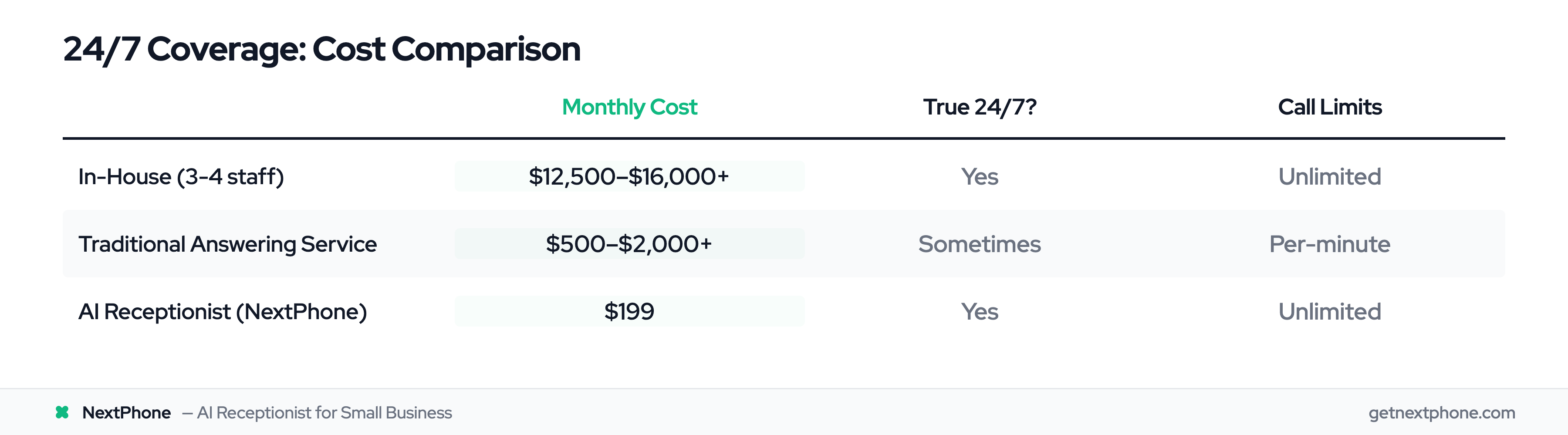
Cost Comparison Summary
| Coverage Option | Monthly Cost | True 24/7? | Call Limits |
|---|---|---|---|
| In-House (3-4 staff) | $12,500-$16,000+ | Yes | Unlimited |
| Traditional Answering Service | $500-$2,000+ | Sometimes | Per-minute |
| AI Receptionist (NextPhone) | $199 | Yes | Unlimited |
Who Needs a 24/7 Virtual Receptionist?
While every business can benefit from never missing a call, some industries see particularly strong ROI from round-the-clock coverage.
Service Businesses with Emergencies
Plumbers, HVAC technicians, electricians, and other trade professionals deal with genuine emergencies that can't wait for business hours.
For a service business receiving 100 calls per month, even a handful of after-hours emergencies represent serious revenue. If your average emergency job is worth $1,500, a few missed after-hours calls can easily cost $5,000–$10,000 per month.
Emergency calls also typically command premium rates. The customer with a flooded basement at midnight isn't price shopping - they're hiring whoever answers.
Professional Services
Lawyers, doctors, accountants, and consultants often serve clients who face urgent situations outside business hours.
Criminal defense attorneys know that arrests don't follow a 9-5 schedule. Medical practices field concerns that feel urgent to patients even when they're not clinical emergencies. Real estate agents compete for buyers who browse listings in the evenings and want to schedule showings immediately.
Being available when competitors aren't creates a meaningful advantage in professional services.
E-Commerce and Online Businesses
If your customers shop online around the clock, their questions don't stop at 5 PM either.
National and international businesses face the additional challenge of time zones. When it's midnight in New York, it's working hours in California, Tokyo, or London. A 24/7 receptionist ensures coverage regardless of where your customers are located.
Property Management
Tenant emergencies are almost defined by inconvenient timing. Water leaks, lockouts, heating failures, and security concerns tend to happen evenings and weekends.
Property managers who respond quickly build stronger tenant relationships and protect their properties from escalating damage. A 24/7 receptionist can triage calls, dispatch emergency maintenance, and handle routine after-hours requests without waking you up.