
Introduction
You've set up your AI receptionist. The system is ready. But you're staring at a blank "greeting" field, wondering: what do I actually say?
A generic "Thanks for calling, how can I help you?" sounds robotic. But writing custom greeting copy from scratch feels daunting. You're a business owner trying to answer phones more effectively.
This guide gives you a proven framework and 10 ready-to-use templates. Pick the one closest to your industry, customize it in 5 minutes, and launch with confidence.
Why Your AI Greeting Matters More Than You Think
Your greeting does real work. Research shows personalization improves response rate by 50%, and small script tweaks can double response rates. Your voice AI receptionist greeting is doing three critical jobs: making a first impression, establishing credibility, and routing calls to the right place.
First Impressions Happen in 7 Seconds
Your greeting is the first (and sometimes only) impression callers get of your business. Research shows that people form judgments about credibility within the first seven seconds of an interaction. For phone calls, the greeting IS that moment.
A professional, well-crafted greeting builds trust instantly. A generic or poorly written one makes callers question whether they've reached a legitimate business.
The Hidden Cost of Generic Greetings
Generic greetings sound unprofessional and fail to route calls effectively. Across the 1,446,980 business calls in our analysis, calls containing urgency language like "emergency," "urgent," or "ASAP" rank among the top reasons people call. True emergencies requiring immediate attention are a recurring reason people call.
Without proper routing built into your greeting, emergency calls get treated like routine inquiries. The result? Frustrated customers who expected immediate help and lost revenue from high-value emergency jobs that average $4,200, significantly higher than routine work.
Your greeting should triage calls the moment they start, not after 30 seconds of conversation.
The 3-Part AI Greeting Framework
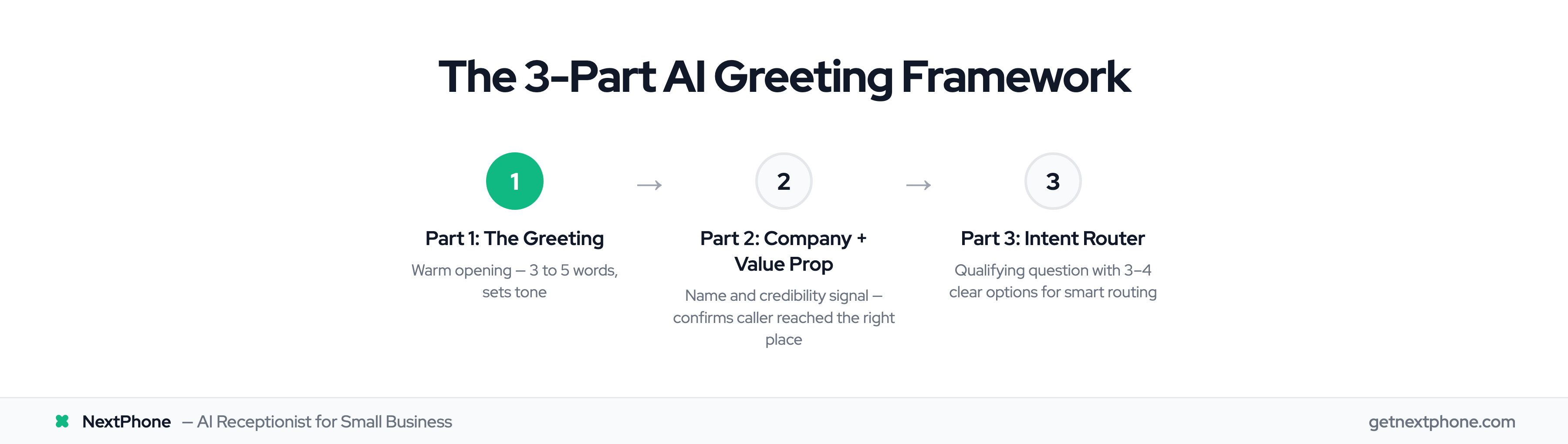
Every effective AI receptionist greeting follows the same three-part structure. Here's the framework that works across industries.
Part 1: The Greeting (Warmth + Professionalism)
Start with a simple, welcoming phrase that sets the tone:
- "Thank you for calling"
- "Thanks for reaching out to"
- "You've reached"
Keep it brief: just 3-5 words. This opening sets your tone (professional vs friendly) without wasting time.
Avoid "Hello" alone (too casual for most businesses) and time-specific greetings like "Good morning" or "Good afternoon." Your AI doesn't know what time it is, and these phrases can sound awkward on recordings.
Part 2: Company + Value Proposition (Credibility)
State your company name clearly, followed by a brief value proposition or expertise signal:
- "[Company Name], your trusted HVAC experts"
- "[Law Firm], serving clients since 1985"
- "[Agent Name], your local real estate specialist"
This accomplishes two things: it confirms the caller reached the right business, and it establishes credibility immediately. The value proposition doesn't need to be elaborate, just a quick signal of what you do or why you're qualified.
Part 3: The Intent Router (Action + Qualification)
This is where AI greetings shine compared to human receptionists. Ask a qualifying question that routes the call based on intent:
- "Are you calling about heating, cooling, or maintenance?"
- "Are you a current client or new client?"
- "Are you looking to buy, sell, or get a market analysis?"
Give callers 3-4 clear options maximum. This enables smart routing while capturing caller intent immediately. In our call data, requesting a quote is among the top reasons people call and booking or rescheduling an appointment is the single most common one. Having these as routing options captures common intents right away.
Framework Summary
Here's how it looks together:
[GREETING] + [COMPANY/VALUE PROP] + [INTENT ROUTER]
Example: "Thank you for calling ABC Plumbing, your 24/7 emergency plumbing experts. Are you experiencing an emergency, scheduling a service, or requesting a quote?"
This 25-word greeting accomplishes everything: it's warm, establishes credibility, and routes calls intelligently.
10 Industry-Specific Greeting Templates (Copy & Customize)
Here are 10 proven greeting templates for different industries. Copy the one closest to your business, replace the placeholders in brackets, and you're ready to launch.
1. HVAC Companies
Template: "Thank you for calling [Company Name], your trusted HVAC experts serving [City/Region]. Are you calling about heating, cooling, or maintenance?"
Why it works: Routes immediately by service type, which helps with technician scheduling and parts preparation. Mentions location for local credibility. Emergency callers will typically say "emergency" instead of a service type, allowing you to fast-track those calls.
2. Plumbing Services
Template: "You've reached [Company Name], available 24/7 for emergency plumbing. Are you experiencing an emergency, scheduling a service, or requesting a quote?"
Why it works: Leads with emergency availability, which is critical for plumbing. Three clear routing options capture the vast majority of plumbing call intents without overwhelming callers with choices.
3. Electrical Contractors
Template: "Thank you for calling [Company Name], licensed electricians serving [Area]. Is this an emergency, or are you calling to schedule service?"
Why it works: Simple two-option routing keeps it brief. "Licensed" builds credibility (important for electrical work). Emergency-first positioning ensures urgent calls get handled appropriately.
4. Roofing Companies
Template: "Thanks for calling [Company Name], your local roofing specialists. Are you calling about a leak, need a roof inspection, or want a quote for a new roof?"
Why it works: Three specific service types cover most roofing calls. "Leak" captures urgency without explicitly using the word "emergency," which can feel alarmist for a roofing company.
5. Law Firms
Template: "Thank you for calling [Law Firm Name], serving clients in [practice areas]. Are you a current client or a new client?"
Why it works: This distinction is critical for legal practices. Current clients need different routing (case updates, billing questions) than new prospects (consultations, intake). Some firms prefer separate phone lines, but this works well for single-line setups.
Alternative for specific practice areas: "Thank you for calling [Law Firm Name], specializing in personal injury law. How can we help you today?"
6. Real Estate Agents
Template: "You've reached [Agent Name] with [Brokerage], your [City] real estate specialist. Are you looking to buy, sell, or get a market analysis?"
Why it works: Three core real estate intents right upfront. Establishes local expertise and brokerage affiliation. Opens the qualification path immediately: buyers and sellers need different follow-up.
7. General Contractors
Template: "Thank you for calling [Company Name], general contractors specializing in [residential/commercial] projects. Are you calling about a new project, an existing project, or requesting an estimate?"
Why it works: Separates new prospects from existing clients. "Estimate" captures quote-seekers, which our data shows are among the top reasons people call. Mentioning residential vs commercial sets expectations.
8. Auto Repair Shops
Template: "Thanks for calling [Shop Name], your trusted auto repair specialists. Are you calling to schedule service, check on a repair, or ask about our services?"
Why it works: Three routing options cover appointment booking (the single most common reason people call), status checks (common for repair shops), and general inquiries. Natural and conversational tone works well for auto repair.
9. Towing Services
Template: "You've reached [Company Name], 24-hour towing and roadside assistance. Do you need immediate towing, roadside help, or vehicle storage?"
Why it works: Emergency-first positioning is essential for towing. Separates urgent towing from less urgent roadside assistance and storage inquiries. 24-hour availability stated upfront sets expectations.
10. Medical/Dental Offices
Template: "Thank you for calling [Practice Name]. Are you calling to schedule an appointment, speak with a current patient, or ask about our services?"
Why it works: Routes by intent while maintaining privacy-appropriate language. "Current patient" enables proper handling of protected health information. Professional, welcoming tone fits medical settings.
How to Adjust Tone (Professional vs Friendly vs Urgent)
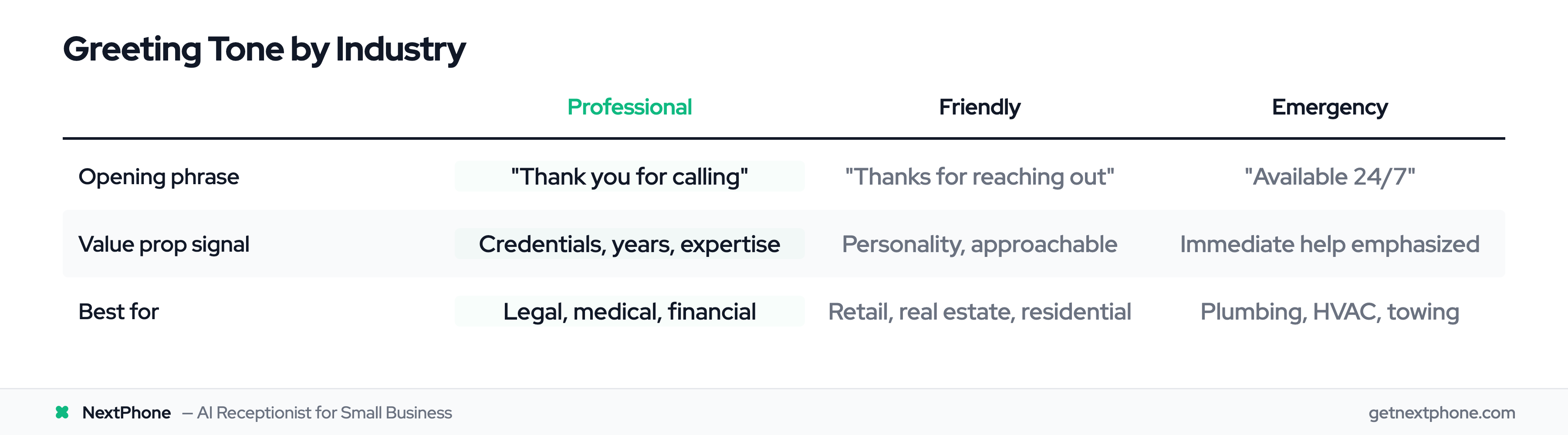
The same greeting structure works across tone variations. Here's how to adjust for your brand personality.
Professional Tone
Use "Thank you for calling" (not "Thanks"). Include credentials, years in business, or formal language. This tone works best for law firms, medical offices, financial services, and B2B companies.
Example: "Thank you for calling Smith & Associates Law Firm, serving clients since 1985. Are you a current client or prospective client?"
Friendly Tone
Use "Thanks for reaching out to" or "You've reached." Include personality and approachable language. This works well for retail, real estate, home services with strong personal brands, and businesses targeting residential customers.
Example: "Thanks for calling Joe's Plumbing! We're here to help with all your plumbing needs. Are you experiencing an emergency, or can we schedule a service call?"
Emergency-Optimized Tone
Lead with availability: "24/7" or "Emergency service available." Front-load urgency handling to reassure callers they've reached the right place for immediate help.
Example: "You've reached ABC Emergency HVAC, available 24/7. If this is an emergency, say 'emergency' now. Otherwise, are you calling about heating, cooling, or maintenance?"
Tone Comparison
| Tone | Greeting Start | Value Prop | Best For |
|---|---|---|---|
| Professional | "Thank you for calling" | Credentials, years, expertise | Legal, medical, financial, B2B |
| Friendly | "Thanks for reaching out" | Personality, approachable | Retail, real estate, residential services |
| Emergency | "Available 24/7" | Immediate help emphasized | Plumbing, HVAC, towing, emergency services |
Match the tone to your industry norms and brand personality. When in doubt, test both professional and friendly versions with a few callers and see which feels right.