
It's 2 AM. A homeowner's pipe just burst. Water is flooding their basement. They grab their phone and call your number.
It rings. And rings. Voicemail.
They don't leave a message. Why would they? Water is pouring across their floor right now. They call the next plumber in Google. That plumber answers. You just lost a $600+ emergency job while you were sleeping.
Here's the thing: this happens more than most plumbers realize. Research from Invoca shows that 27% of calls to home services businesses go unanswered. Other studies put the number even higher, with some plumbing businesses missing up to 40% of calls. Each missed call represents $500-$1,200 in potential work walking out the door.
A plumbing answering service solves this problem by ensuring someone - or something - always picks up. This guide covers how these services work, what they cost, and how to choose the right one for your business.
The Missed Call Problem for Plumbers
Most plumbers don't set out to ignore customers. The problem is the nature of the work itself.
Why Plumbers Miss So Many Calls
You're under a house fixing a drain line. Your phone rings in the truck. By the time you crawl out, brush off, and check your phone, the caller already tried two other plumbers.
Or you're on a ladder installing a water heater. Hands are wet. Tools are everywhere. The phone buzzes in your pocket. You can't answer safely. The customer moves on.
This is the reality of plumbing work. You can't answer the phone when you're:
- Under a crawlspace or inside a wall
- Handling tools or equipment
- Working with water or in unsafe conditions
- Focused on a tricky repair
- Driving between job sites
The One-Man Shop Dilemma
For solo plumbers and small shops, the problem is even worse. There's no receptionist. There's no office staff. It's just you.
One plumber on the Plumbing Zone forum put it perfectly: "As a one man shop, plumbers have a hard time juggling answering the phone and working. When they can't answer the phone and let it go to voicemail, customers don't always leave a message, resulting in lost money."
This isn't laziness. It's physics. You can't answer a phone while your hands are covered in PVC cement.
Answering Services for Plumbing Companies with Multiple Technicians
If you run a plumbing company with two or more trucks on the road, the problem scales differently. You may have some daytime coverage, but evenings, weekends, and surge periods — a cold snap that floods you with burst pipe calls — still fall through.
An answering service for plumbing companies also needs to handle dispatch coordination: routing emergency calls to the right on-call technician, creating jobs directly in ServiceTitan or Housecall Pro, and passing callers off with full context — not just a name and number. Message-taking alone leaves you playing phone tag when every minute costs you a job.
When a caller reports flooding or a burst pipe, the AI collects the issue, address, and urgency, then transfers directly to your on-call number with a live summary. The next morning, the call record and job details are already waiting in your dispatch system. See how to evaluate an answering service for your size of operation →
What the Data Actually Shows

The numbers are brutal.
According to Invoca's research across home services businesses, 74.1% of calls go completely unanswered. That's nearly three out of every four potential customers calling someone else.
One plumber who tracked his inbound calls found he'd missed 76 calls in a single month. His reaction? "I didn't even know I was missing that many calls until I saw the data. I just thought business was slow."
According to industry analysis from CallBird AI-lose-money-missed-calls), the average small contracting business loses $45,000-$120,000 per year to unanswered phone calls. For plumbers specifically, estimates put the annual loss at $50,000-$60,000.
What Callers Actually Want When They Reach You
Across the inbound calls our own AI receptionist answers for service businesses, the most common reasons people call — in ranked order — are:
- Booking, confirming, or rescheduling an appointment — the single largest bucket
- Asking about a specific service or repair — "my water heater's leaking, can someone come out today?"
- Requesting a quote or estimate
- Checking the status of a job already on the books
- Hours, location, and directions
- New-customer inquiries
- Emergencies — burst pipes, flooding, no hot water
For a plumber, almost every one of those is billable work walking in the door. A voicemail box converts close to none of them — the caller has already dialed the next plumber on Google before the beep finishes.
A production after-hours call — the AI greets with the business name, captures the emergency and contact details, and flags it for immediate callback. This is the call a voicemail box loses.
The Cost of Missed Emergency Calls
Not all missed calls are equal. Missing a routine call about a dripping faucet hurts. Missing an emergency call about a burst pipe is devastating.
Why Emergency Calls Are Worth More
Emergency plumbing jobs command premium pricing. We're talking 1.5-2x standard rates. A routine service call might bring in $200-300. An after-hours burst pipe? That's $450-$600 minimum, often reaching $2,000+ for complex repairs.
The math is simple: emergency calls are your highest-margin work.
But here's the catch. Emergency callers are also the least patient. When water is flooding a basement or sewage is backing up, nobody leaves a voicemail and hopes you call back tomorrow.
The Voicemail Trap
This is where most plumbing businesses hemorrhage money without realizing it.
Research from Suzee AI found that with traditional voicemail systems, only 5% of callers leave a message and wait for a callback. The remaining 95% immediately move on to the next plumber who answers.
Think about that. For every 100 after-hours emergency calls, 95 of them call your competitor instead of leaving a message.
The typical plumbing business receives 8-12 after-hours emergency calls per week. That's roughly 520 potential emergencies per year. If voicemail captures only 5%, you're connecting with about 26 of those callers. The other 494? Gone.
Seasonal Emergency Patterns
Plumbing emergencies follow predictable patterns, and these patterns create massive revenue opportunities - if you're answering the phone.
Winter is brutal. Frozen pipe emergencies in January can generate 40% of annual emergency revenue in cold climates. A single cold snap can trigger dozens of burst pipe calls in one night.
Spring brings a different surge. The freeze-thaw cycle exposes winter damage. Basement flooding picks up. Homeowners discover problems that developed over the cold months.
Summer means sewer line issues, sprinkler problems, and water heater failures during peak usage.
These seasonal spikes can double or triple normal call volume. If your only after-hours solution is voicemail, you're leaving tens of thousands of dollars on the table during your busiest periods.
Calculating Your Annual Loss
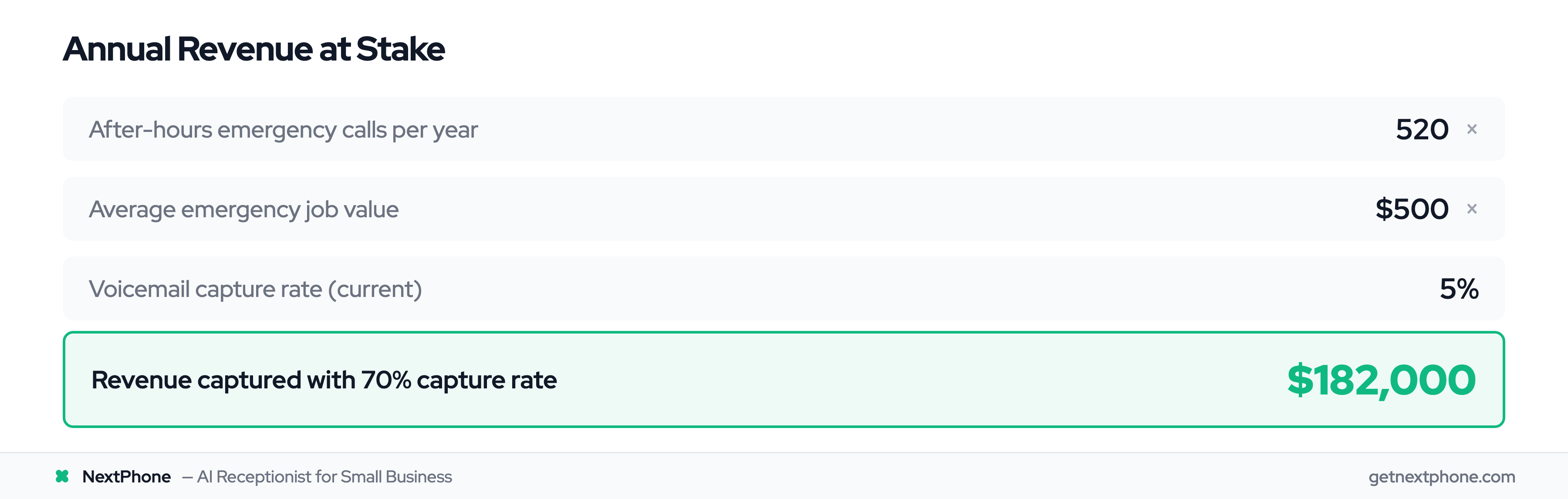
Let's run the numbers for a typical plumbing business:
- After-hours emergency calls: 10 per week (520 per year)
- Average emergency job value: $500
- Voicemail capture rate: 5%
- Calls you actually connect with: 26
- Revenue captured: $13,000
Now imagine capturing 70% of those calls instead of 5%:
- Calls captured: 364
- Revenue captured: $182,000
- Additional revenue: $169,000
Even at a conservative 50% capture rate, you'd add over $100,000 in annual revenue. That's the difference an answering service makes.
Types of Plumbing Answering Services
You have three main options: live human answering, AI-powered answering, or AI-first with smart forwarding. Each has trade-offs.
Live Answering Services
Traditional answering services employ human operators to answer your calls 24/7. When a customer calls after hours, a real person picks up, takes information, and either sends you a message or transfers emergency calls to your cell.
Pros:
- Human judgment for complex situations
- Empathy for upset customers
- Flexible conversation handling
Cons:
- Per-minute billing adds up fast
- Staff turnover means inconsistent quality
- Operators may not understand plumbing terminology
- Limited by human availability during volume spikes
One plumber on a trade forum noted a common frustration: "I hate getting answering services when I call other contractors. I end up calling listings until I get a live employee." Some customers feel the same way about your business.
AI-Powered Answering Services
Modern AI answering services use conversational AI to handle calls. The AI answers immediately, understands natural language, and can book appointments, screen calls, and route emergencies.
Pros:
- Instant response (under 5 seconds)
- Consistent quality every call
- Flat monthly pricing (no surprise bills)
- Scales infinitely during high-volume periods
- Never sick, never on vacation
Cons:
- Can struggle with unusual requests
- Some callers prefer human interaction
- Requires initial setup and training
One case study showed a company switch from live answering to AI: after-hours bookings jumped from 58 to 208. Another user reported that switching to AI cut their monthly service cost from $400 to $50.
AI-First with Smart Forwarding
AI-first services handle routine calls - hours, pricing, appointment booking - while smart forwarding routes complex situations or upset customers directly to your phone.
This approach gives you:
- Speed of AI for straightforward calls
- Direct access to you when it matters
- Cost savings on routine interactions
- Flexibility for unusual situations
Many plumbing businesses find AI-first with smart forwarding works best. The AI handles 80% of calls instantly, and the 20% that need your judgment reach you directly.
Which Type Fits Your Business?
Consider these factors:
- Call volume: Higher volume favors AI (per-minute billing gets expensive)
- Emergency frequency: Emergency-heavy businesses need instant response (AI wins)
- Budget: AI typically costs less at scale
- Customer base: Older customers may prefer humans; busy homeowners often prefer fast AI
For most plumbing businesses, AI-first with smart forwarding makes the most financial sense. The math simply favors solutions that don't bill by the minute when you're handling dozens of calls per week. Compare the top answering service companies side by side →
Answering Service for Plumbing Companies
Solo plumbers and plumbing companies need different things from an answering service. When you have multiple technicians on the road, a basic message-taking service leaves too many gaps — callers want a job booked and a technician confirmed, not a callback promise.
Multi-Tech Dispatch and Coordination
For plumbing companies running two or more trucks, the critical capabilities are:
On-call routing. Emergency calls should reach whoever is actually on tonight's rotation — not a static forwarding number that changes weekly. When a flooding emergency comes in at 11 PM, the AI transfers immediately with a live summary (address, issue, urgency) so your on-call tech arrives prepared, not scrambling for details.
Field software integration. New jobs should flow directly into ServiceTitan or Housecall Pro (via Zapier) after each call, and into Jobber directly, where the call becomes a client and a request you can quote. Your dispatcher starts the morning with jobs already logged — no sticky notes from the answering service, no manual entry, no information gaps.
Surge handling. A hard freeze can push call volume 3-5x in a single day. AI scales without adding cost — whether you field 30 calls or 300 during a burst-pipe wave, each call gets the same response time. Per-minute live services get expensive exactly when you're busiest.
Predictable Pricing for Higher Call Volume
Per-minute billing is a trap for high-volume operations. At 80 calls/month averaging 3 minutes each, a $0.79–$1.50/min contract runs $190–360/month in usage charges before the base fee — and a winter surge that doubles your volume doubles that bill too.
Flat-rate AI pricing absorbs the spikes: a month where you handle 200 calls costs the same as one where you handle 50. For a plumbing company evaluating options, the right question is what does this cost when we're slammed — not what does it cost in a quiet month.
How home services businesses compare their answering service options →