
Key Takeaways
- 6.2% of business calls are true emergencies - the highest-value calls you receive
- 15.9% of all calls contain urgency language indicating time-sensitive needs
- Emergency keywords like "flooding," "no heat," "burst pipe," and "ASAP" signal calls that need immediate routing
- AI can detect urgency language in real-time and route emergency calls before you even answer
- Proper emergency call routing means never missing a high-value job while you're on another call
Introduction
You're knee-deep in a flooded basement when your phone buzzes. By the time you can call back, that customer with the burst pipe across town has already hired your competitor.
This is the emergency call routing problem that costs service businesses thousands in lost revenue every month. When every call looks the same on caller ID, you have no way to prioritize the true emergencies that need immediate attention.
This guide shows you how to set up emergency call routing that catches the 6.2% of calls that are true emergencies - even when you're unavailable. You'll learn the specific keywords that indicate emergencies and how AI technology can detect and route urgent calls automatically.
No more missing the calls that matter most.
The True Cost of Missing Emergency Calls
Emergency calls aren't just any calls. They're typically the highest-value opportunities a service business receives.
Emergency Calls: High Value, High Urgency
When a customer calls with a burst pipe, a furnace that stopped working in January, or a sewage backup, they're not price shopping. They need help now, and they'll pay premium rates to get it.
Average emergency job values tell the story:
- HVAC emergency: $800-1,500
- Plumbing emergency: $600-1,200
- Electrical emergency: $500-1,000
These aren't quote requests where the customer will call five companies and pick the cheapest. Emergency callers hire the first responder. Research shows 78% of customers go with whoever answers first.
And here's what makes this brutal: 80% of emergency callers won't leave a voicemail. They'll hang up and call the next company on the list. Your missed call becomes your competitor's completed job.
The Domino Effect of Missed Emergencies
Missing one emergency call starts a cascade of losses.
First, you lose the immediate job - potentially $1,000 or more in revenue. But that's just the beginning.
That customer who couldn't reach you? They hired your competitor. They had a good experience. Now they have a new "go-to" provider for all their future needs. You didn't just lose one emergency job. You lost a customer relationship worth thousands over the coming years.
Worse, if they leave a review mentioning they couldn't reach you during an emergency, that reputation damage affects every future customer who reads it.
The "on another job" problem makes this especially painful for service businesses. You're already handling an emergency when another one comes in. You can't physically answer the phone with your hands on a pipe or in an electrical panel. Without emergency call routing, you're forced to choose between the customer in front of you and the one calling in.
Understanding Emergency Calls: The 6.2% That Matter Most
Not all calls are created equal. And knowing exactly how many of your calls are true emergencies changes how you think about call routing.
The Emergency Call Reality: 6.2% of All Calls
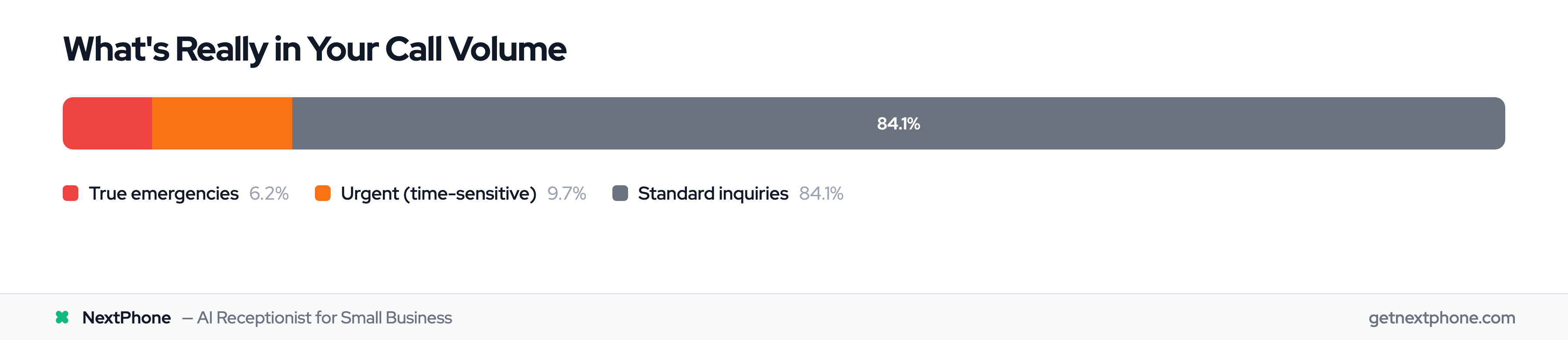
When we analyzed over 13,000 calls to service businesses, we discovered something that surprised even us: exactly 6.2% of incoming calls are true emergencies.
True emergencies are "drop everything" situations. Water flooding a basement. No heat during a cold snap. A gas leak smell. Sewage backing up into the house. These aren't "I'd like a quote" calls - they're "I need someone right now" calls.
6.2% might sound small. But for a business getting 50 calls per month, that's 3 emergency calls. At $800-1,500 per emergency job, that's $2,400-4,500 in monthly revenue that's extremely time-sensitive. Miss those calls, and that money goes to whoever answers instead.
Urgency Language: 15.9% Need Priority Attention
Beyond the 6.2% true emergencies, another 9.7% of calls contain urgency language. Combined, that's 15.9% of all calls - nearly one in six - that signal time-sensitive needs.
These urgent calls might not be flooding-basement emergencies, but they're customers who need help soon:
- "I need someone today"
- "Can you come out ASAP?"
- "The inspector is coming tomorrow"
- "My tenant is moving in this weekend"
Urgent callers are ready to book. They're not in the early research phase. They've already decided they need the service - they just need someone who can do it quickly.
Emergency vs Urgent: A Clear Framework
The concept of call triage has been proven in healthcare settings. Studies show nurse telephone triage is safe in 97% of cases, with 89% safety for high-urgency calls. These healthcare triage principles translate directly to business emergency routing.
Understanding the difference helps you route appropriately:
Emergency (6.2% of calls): Immediate response required. Safety risk, active damage, or complete system failure. Route directly to an available person.
Urgent (9.7% of calls): Same-day or next-day response expected. Time-sensitive but not actively dangerous. Priority callback within 1 hour.
Standard (remaining calls): Quote requests, general inquiries, scheduling for future dates. Callback within 4-24 hours acceptable.
Without emergency routing, all three types get treated the same. The flooded basement call sits in voicemail next to the "I'd like a quote for next month" call. By the time you check messages, the emergency has hired someone else.
How to Detect Emergency Calls: Keywords and AI
The good news: emergency calls aren't random. Customers use predictable language when they're facing a crisis. Knowing these keywords - and having a system that can detect them - is the foundation of emergency call routing.
Emergency Keywords: The Words That Signal Crisis
Through our analysis, we've identified the specific words and phrases that indicate true emergencies:
Water emergencies:
- "Flooding" / "Water everywhere"
- "Burst pipe" / "Pipe burst"
- "Leak" (when combined with "major" or "can't stop")
- "Water coming through the ceiling"
- "Sewage" / "Sewage backup"
HVAC emergencies:
- "No heat" / "Heat isn't working" (in cold weather)
- "No AC" / "Air conditioning stopped" (in hot weather)
- "Furnace out" / "Furnace won't start"
Electrical emergencies:
- "No power" / "Power out"
- "Sparking" / "Electrical sparks"
- "Burning smell"
- "Electrical fire"
General emergency signals:
- "Emergency"
- "Gas leak" / "Smell gas"
When a caller uses any of these words, it signals an immediate need that warrants priority routing.
Urgency Keywords: Time-Sensitive Language
The additional 9.7% of urgent calls use different language - words that signal time pressure without active crisis:
- "ASAP"
- "Right away"
- "Today" / "This morning" / "This afternoon"
- "Immediately"
- "Can't wait"
- "As soon as possible"
- "Before [specific deadline]"
- "The inspector is coming..."
- "My tenant is..."
- "Moving in tomorrow"
For property managers specifically, 39% spend 20+ hours per month on maintenance requests, and 61% of landlords say maintenance is the worst aspect of property ownership. Emergency routing helps manage this burden by ensuring urgent tenant calls get immediate attention.
These calls deserve priority callback even if they don't warrant immediate ring-through.
How AI Detects Emergencies in Real-Time
Modern AI receptionist technology has changed emergency detection from a manual process to an automatic one.
Here's how it works: When a call comes in, the AI answers and listens to what the caller says. Within the first few seconds, the AI identifies keywords that indicate emergency or urgency.
If the AI hears "flooding," "burst pipe," "no heat," or other emergency triggers, it can immediately route the call to ring through to your cell phone. You get a call that bypasses message-taking because the AI knows this caller needs immediate attention.
If the AI hears urgency keywords like "ASAP" or "today," it can flag the call for priority callback while still taking a message.
And if the call is a standard quote request or general inquiry, the AI handles it normally - taking a message and sending you the details when you're ready.
This happens automatically, 24/7, without you needing to answer every call to determine if it's urgent. The AI does the triage for you.
5 Emergency Call Routing Strategies That Work
There are multiple approaches to emergency call routing. The right strategy depends on your business size, call volume, and how you want emergencies handled.
Strategy 1: Keyword-Based Priority Routing
Research shows priority routing keeps 28% more top-tier clients in financial services, and follow-the-sun routing reduces abandoned calls by 45% during off-hours. The same principles apply to service businesses.
The most effective approach uses specific keywords to trigger routing actions.
When a caller mentions "flooding," "no heat," or other emergency keywords, the system automatically takes action. This might mean:
- Immediately ringing through to your cell
- Sending a high-priority text alert
- Starting an escalation chain
The key advantage: callers don't need to press buttons or navigate menus. The system listens to natural speech and makes routing decisions based on what it hears.
This strategy works best with AI receptionist technology that can process natural language in real-time.
Strategy 2: Time-Based Emergency Routing
Different routing rules for different times ensures emergencies get handled 24/7.
During business hours: Emergencies ring to the main line first, then escalate to cell phones if not answered within 3 rings.
After hours (evenings): All calls route to AI answering. Emergencies trigger immediate cell phone notification. Urgent calls get flagged for early morning callback.
Weekends/holidays: Designated on-call person receives emergency routing. Or use AI to handle initial response and escalate true emergencies.
This ensures that a burst pipe call at 11 PM Saturday gets the same priority treatment as one at 2 PM Tuesday.
Strategy 3: Direct-to-Cell Emergency Forwarding
For true emergencies, nothing beats a direct phone call.
When the system detects emergency keywords, it can immediately forward the call to ring on your cell phone. You see it's an emergency before you answer - or you can let it go to AI if you truly can't pick up.
The caller gets connected to a real person (or an AI that can help immediately). You don't have to check voicemail to discover you missed a $1,500 emergency job.
This strategy works particularly well for solo operators who want emergencies to reach them but standard calls to go to message.
Strategy 4: Escalation Routing Chains
What if you're unavailable when an emergency comes in?
Escalation routing solves this by creating a chain of contacts:
- First ring: Primary on-call person (you)
- No answer after 15 seconds: Second person in chain (partner, backup tech)
- No answer after 15 seconds: Third option (answering service, office manager)
- No answer: AI takes message with urgent flag for immediate callback
The call cascades through your team until someone answers. Emergencies don't fall through the cracks because one person is unavailable.
This strategy is essential for businesses with multiple technicians or partners who share emergency duty.
Strategy 5: AI-Powered Detection and Routing
This combines all the above strategies into an intelligent, automated system.
AI answers every call. It assesses urgency based on keywords and caller language. Based on what it detects:
- Emergency calls: Route immediately (ring-through, text alert, escalation chain)
- Urgent calls: Flag for priority callback, take detailed message
- Standard calls: Handle normally, take message, no special routing
The AI operates 24/7 without coffee breaks, sick days, or moments of distraction. It catches every emergency regardless of when the call comes in.
For most service businesses, this strategy provides the best combination of coverage and cost-effectiveness.
AI-Powered Emergency Routing: The Modern Solution
Let's be direct about why AI solves the emergency routing problem better than traditional approaches.
Why AI Solves the Emergency Routing Problem
Traditional emergency routing has a fatal flaw: someone needs to answer the phone to determine if it's an emergency.
If you miss the call, you don't know it was urgent until you check voicemail. By then, it's too late. The caller has moved on.
AI flips this equation. The AI answers immediately and determines urgency in the first few seconds of conversation. Emergency detection happens before a human needs to be involved.
This means:
- You can stay focused on the job in front of you
- Emergencies get detected whether you're available or not
- Standard calls don't interrupt your work unnecessarily
- After-hours emergencies get the same attention as business-hours emergencies
How AI Emergency Routing Works
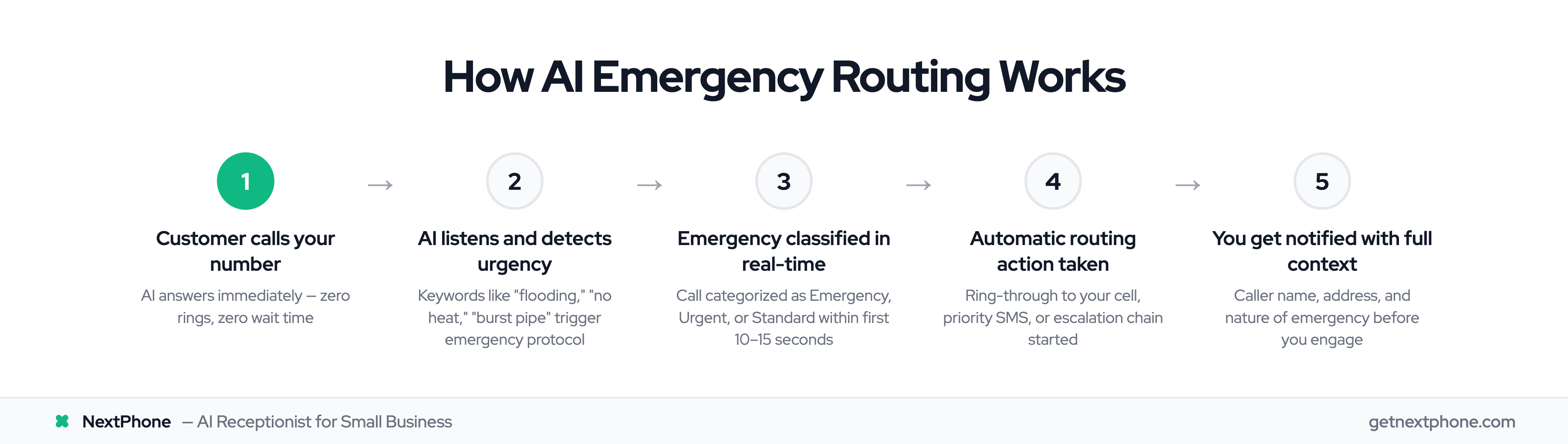
Here's the practical flow:
-
Customer calls your business number. The AI answers immediately - zero rings, zero wait time.
-
AI greets and listens. "Hi, thanks for calling [Your Business]. How can I help you today?"
-
Customer explains their situation. "I have water flooding my basement right now."
-
AI detects emergency keyword. The word "flooding" triggers emergency protocol.
-
AI takes immediate action. Depending on your settings, this might mean:
- Immediately ringing through to your cell
- Sending a high-priority text with caller details
- Starting your escalation chain
- All of the above
-
You get notified with context. You know it's an emergency before you engage. You can prioritize appropriately.
For non-emergency calls, the AI simply takes a message and sends it to you normally. You don't get interrupted for a quote request that can wait.
NextPhone: Emergency Detection Built In
NextPhone provides AI receptionist service with emergency detection included at $199/month.
The system automatically detects urgency language in 15.9% of calls and routes the 6.2% true emergencies for immediate attention. You define your emergency keywords based on your specific business - HVAC, plumbing, electrical, or any service type.
Setup takes minutes, not days. Tell the AI what emergencies sound like for your business, and it starts detecting them immediately.
At $199/month for unlimited calls with 24/7 coverage, the math is straightforward: catching one emergency per month that would have gone to a competitor more than pays for the service.
Implementing Emergency Routing for Your Business
Ready to set up emergency call routing? Here's the practical implementation process.
Step 1: Identify Your Emergency Keywords
Start by listing the words that indicate a true emergency for your specific business.
For HVAC businesses:
- No heat, no AC, furnace out, AC not working
- Frozen pipes, system down, carbon monoxide
For plumbing businesses:
- Flooding, burst pipe, no water, sewage backup
- Water heater explosion, major leak, sewer line
For electrical businesses:
- No power, sparking, burning smell, electrical fire
- Panel failure, exposed wires
Then add your urgency keywords: ASAP, today, immediately, emergency, right away.
This becomes your trigger list for priority routing.
Step 2: Define Your Routing Rules
Decide what happens when each type of call comes in:
Emergency detected: Ring through to cell + send text + start escalation chain
Urgent detected: Take message + send priority text + flag for callback within 1 hour
Standard call: Take message + send normal notification
Write these rules down. They'll configure your AI or phone system.
Step 3: Set Up After-Hours Coverage
Emergency routing is most valuable when you're not available. Define your after-hours plan:
- Who handles emergencies after 6 PM?
- What about weekends?
- Is there a backup if the primary is unavailable?
- At what point does escalation stop and go to voicemail?
With AI, the after-hours coverage is automatic. The AI answers 24/7 and applies your emergency detection rules regardless of the time.
Step 4: Test Your System
Before going live, test every scenario:
- Call your number and say "I have a flooding basement" - does emergency routing trigger?
- Call after hours with urgency language - does the right person get notified?
- Call with a standard quote request - does it route to normal message-taking?
Test from different phones so you're not just seeing internal behavior. Make sure the customer experience works as expected.
Frequently Asked Questions
What is emergency call routing?
Emergency call routing is a phone system feature that detects and prioritizes urgent calls, routing them differently than standard inquiries. Instead of all calls going to voicemail or waiting in queue, emergency calls are identified by keywords or caller input and immediately forwarded to the appropriate person. This ensures time-sensitive situations get immediate attention while routine calls are handled normally.
What percentage of business calls are emergencies?
Analysis of over 13,000 calls to service businesses shows that 6.2% are true emergencies requiring immediate response. An additional 9.7% contain urgency language indicating time-sensitive needs, bringing the total priority call percentage to 15.9%. These emergency and urgent calls often represent the highest-value jobs a business receives.
How does AI detect emergency calls?
AI systems listen for specific keywords and phrases that indicate urgency, such as "flooding," "burst pipe," "no heat," or "emergency." When the AI detects these trigger words within the first few seconds of a call, it can immediately route the call to the appropriate person or escalation chain. This detection happens in real-time without requiring the caller to press buttons or navigate menus.
Can I set up emergency routing as a small business?
Yes, modern AI answering service solutions make emergency routing accessible to businesses of any size. Services like NextPhone provide keyword-based emergency detection and routing for $199/month, with no complex setup required. You don't need a call center or technical expertise - the AI handles detection and routing automatically 24/7.
What happens to emergency calls after hours?
With proper emergency routing, after-hours emergency calls can be handled the same as business-hour emergencies. Options include routing to an on-call person's cell phone, sending immediate text alerts, or using AI to answer and forward urgent calls. The key is ensuring emergencies never go to standard voicemail where they might sit unaddressed until morning.
How quickly should emergency calls be answered?
Emergency callers expect an answer within 15-20 seconds - about 4 rings. Research shows 75% of callers hang up after 6 rings, and 80% won't leave a voicemail. For true emergencies, the goal should be immediate answer or ring-through, with callback for any missed emergency within 5-10 minutes maximum.
Conclusion
Emergency calls represent just 6.2% of your call volume - but they're often your highest-value opportunities. A $1,200 emergency plumbing job. A $1,500 HVAC repair during a cold snap. These aren't calls you can afford to miss.
With 15.9% of calls containing urgency language, having a system to detect and route these calls is the difference between winning emergency work and losing it to competitors. The keywords that signal emergencies are predictable - "flooding," "no heat," "burst pipe," "ASAP" - and AI technology can detect them automatically.
Every emergency you miss is revenue your competitor earns. The first responder wins 78% of emergency jobs.
NextPhone's AI receptionist detects emergency keywords and routes urgent calls 24/7, for $199/month. Your emergency callers get immediate response. You get notified instantly. And you never miss another high-value job while you're handling the one in front of you.