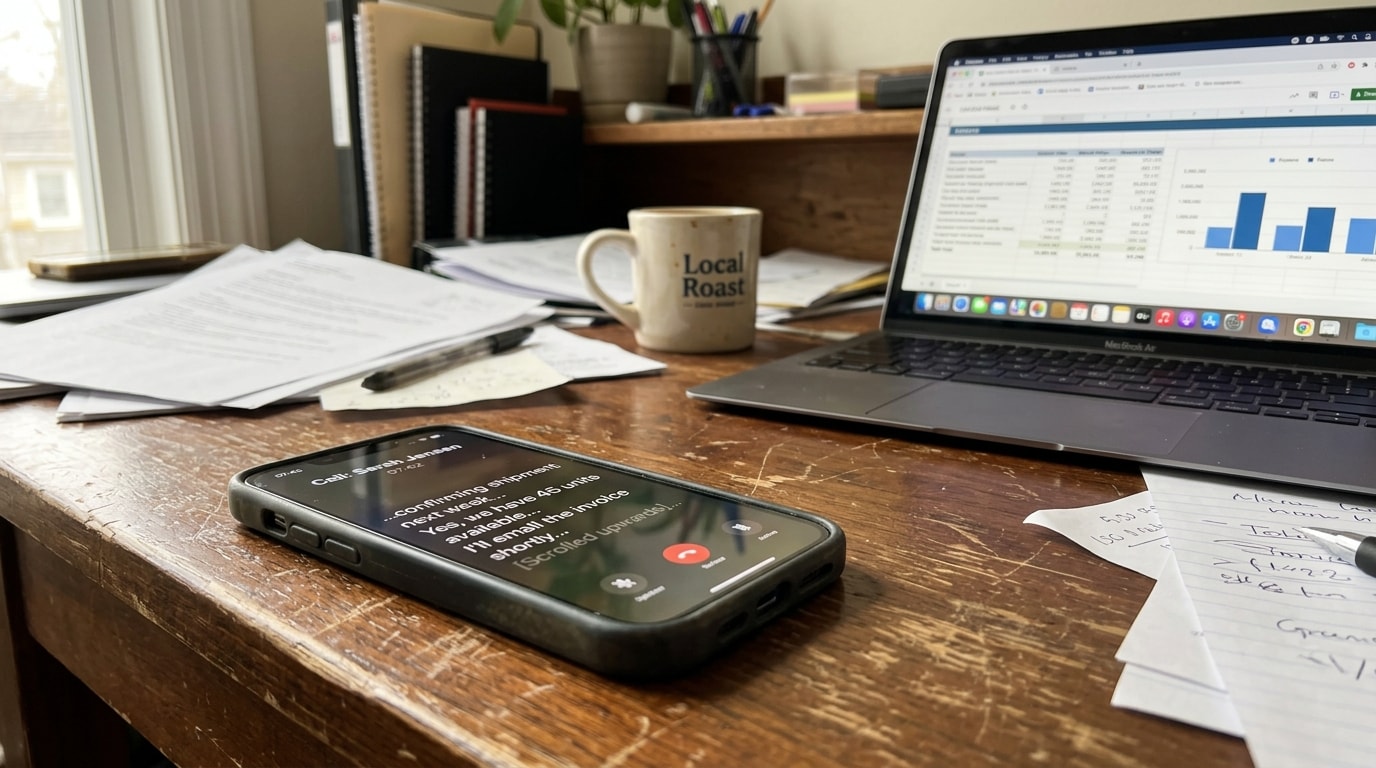
Quick answer: Yes, but the honest version of that answer is more interesting than the marketing version. AI receptionist complex call handling works reliably across four of the five "complexity axes" (multi-intent, multi-turn, ambiguous-request, emotional-load) and kicks the fifth (out-of-distribution) up to a human with the transcript attached. Across 2,000,000+ real business calls in NextPhone's corpus, 90–95% resolve without human escalation. The rest don't hit voicemail. They reach a human with the transcript, the caller's contact, and the suspected intent. The two sample recordings below show what that sounds like.
You're three vendor demos into evaluating AI receptionists. Every one of them showed you a happy-path call ("book me an appointment for Tuesday") and waved at the rest with "yes, our AI handles complex calls too." None let you hear what a complex call actually sounds like, and not a single vendor published a corpus number you could defend in a board meeting.
Below: two sample recordings, the 5-axis taxonomy buyers and operators actually use, the escalation diagram, and the six failure modes most vendors won't publish.
What "complex" actually means on a real call
"Complex" is a buyer word, not a builder word. Vendors use it to mean "anything our demo didn't show." That's not useful. After listening to a representative slice of our 1,446,980-call corpus, the calls that buyers and operators agree are "complex" split cleanly along five axes, and each axis behaves differently inside an AI receptionist.
A complex call is a call that exhibits at least one of: multi-intent (the caller has more than one reason on the line), multi-turn (the conversation needs sustained memory across many exchanges), ambiguous-request (the caller doesn't know exactly what they need), emotional-load (the caller is angry, frustrated, or in crisis), or out-of-distribution (the question is outside the agent's training and knowledge base). Most "complex" production calls are 2- or 3-axis combinations.
The reason the taxonomy matters: the AI's behavior (and its failure mode) depends on the axis, not on some abstract "difficulty score."
Multi-intent calls
A multi-intent call is one where the caller has two or more unrelated reasons on the same line. "I want to book a quote for the deck repair and also check on the invoice from last month." Most legacy phone trees and many older chatbots single-thread. They handle one intent, drop the other. A modern conversational AI acknowledges both, handles them in sequence, and confirms each before closing.
Multi-turn calls
Multi-turn means the call needs sustained memory across many exchanges. Legal intake is the canonical example: incident date, location, parties involved, injuries, fault, insurance contact, eight to twelve fields of structured capture, often with caller backtracks and clarifications. In our corpus, multi-turn is where the AI performs best. Most billable business calls are multi-turn by default.
Ambiguous-request calls
The caller doesn't know exactly what they need. "Something's wrong with my AC." "I'm not sure if this is a plumbing thing or an HVAC thing." "My elderly mom needs help and I don't know what to ask for." What should it do? Ask one clarifying question. Vendors fail ambiguous-request by dead-ending the call instead of cycling once on a follow-up.
Emotional-load calls
Annoyed, frustrated, distressed, or hostile. The AI's job here is to register tone without escalating it, capture the operational facts, and pass the call to a human when the emotional intensity crosses a threshold. Calm, de-escalating language stays in the AI's lane; active hostility or crisis-level distress hands off with the transcript attached. For the script-level deep dive, see our de-escalation protocol for angry callers.
Out-of-distribution calls
Left-field questions outside the knowledge base. "Do you accept Bitcoin?" when the business has no payment integration. "Can you talk to my insurance adjuster on a three-way call?" These should never trigger an invented answer. Capture verbatim. Hand off to the owner. Don't invent policy. It's also the bucket where mishearing fails, which is its own diagnostic frame; see AI receptionist troubleshooting misunderstandings for the operator-side playbook.
Hear it for yourself: a sample multi-turn intake call
Most AI-receptionist pages describe what their product sounds like. This one lets you hear it. The clip below is a sample call: a multi-turn intake with structured field capture, a service-area check before anything is booked, and a clean close with a confirmed next step.
A sample intake call (kitchen-remodel inquiry): multi-turn capture across scope, budget, timeline, and address. Listen for how the AI moves from a quote request to a service-area check and ends with a single concrete next step: an estimate booked with the project lead. Same flow runs across service-business verticals.
What to listen for:
- 0:00–0:05: the greeting (business name and assistant name, no IVR menu, no hold music)
- Mid-call: the caller gives scope, budget, and timeline in their own words, and the AI moves to the next field without restarting the form
- End: an estimate booked with the project lead, a text promised with the details, conversation closed without bot-feel
This is multi-turn + structured-intake complexity. Not the hardest shape on the taxonomy, but the single most common shape of complex call in any business that books work (legal, accounting, home services, professional services). For how this maps to the percentage-resolution scorecard, see our companion AI receptionist resolution rate benchmarks.
Hear it for yourself: an after-hours call with multi-step capture
The second recording is a different shape. It is calm, not an emergency: an after-hours caller wants a partnership agreement reviewed before signing. What makes it complex is multi-step capture (the AI has to get the caller's name, get matter context, confirm the callback number, and set a callback for the morning, all without making the caller repeat themselves or sit through a menu).
A sample after-hours call. The AI greets, takes the caller's name and the matter (a partnership agreement review), confirms the callback number, and promises a callback first thing in the morning. This is a calm, multi-step call: the after-hours shape that otherwise ends in a voicemail nobody returns until the next afternoon.
What to listen for:
- Matter capture: the caller describes the matter in their own words, the AI asks one follow-up question, and then it moves on to the callback
- Calm pacing: the AI doesn't escalate by getting fast or clipped; it slows and confirms
- Callback set: by the end, the AI has captured enough context for a human to call back cold and pick up where the AI left off
This is the kind of call that, without an AI, hits voicemail at 10:47pm on a Saturday. A live answering service might answer it in 30–90 seconds (assuming you're on a tier with after-hours coverage and you're not capped on volume that month). The AI answers it in under 2 seconds.
How the AI decides: the complex-call decision flow
The decision logic the AI runs every few seconds inside a complex call isn't magic. It's a small set of branches that, taken together, route every call to one of three outcomes: handled, clarified, or escalated with context. Here's the actual flow:
For readers who skim diagrams, the same flow in six numbered steps:
- Pickup in under 2 seconds. Speed itself reduces complexity, because frustrated callers in a phone queue are harder than the same caller answered immediately. The MIT/InsideSales research on speed-to-lead response timing sets the foundation here: time-to-first-response is a multiplier on every downstream outcome.
- Intent capture. The first real decision point. Single clear intent goes to the standard path. Multi-intent, ambiguous, or emotional triggers branch-specific handling.
- Complexity detection. The AI classifies which kind of complex call this is, usually within the first two exchanges.
- Branch-specific handling. Multi-intent gets sequenced. Ambiguous gets a clarifying question. Emotional gets calm, de-escalating cadence (or smart-forward if it crosses the threshold). For the full configuration surface, see call transfer & escalation protocol.
- Escalation gate. If a clarification fails to resolve within two cycles, or if emotional load crosses the threshold, the call smart-forwards to a human with full transcript and context.
- Loop closure. Every call ends with a structured CRM push and a next-action note, whether the AI resolved it or escalated it.
The pattern across all of this: no branch dead-ends. Every one closes the loop or hands off with context, the opposite of an IVR.
What the 1,446,980-call corpus actually shows
Time for the receipts. Most vendor blogs cite a vague "AI handles 80% of calls" with no methodology. We publish the corpus number directly.
Across 2,000,000+ real business calls answered, NextPhone resolves 90–95% of calls without human escalation, picks up in under 2 seconds, and maintains 99% positive caller sentiment. Live answering services answer in 30–90 seconds, and cap your volume.
Here's how the five complexity axes distribute in real call data, with ranked categorical framing rather than precise volatile percentages:
| Axis | Frequency in corpus | AI resolution behavior |
|---|---|---|
| Multi-turn | Most common (default shape of billable calls) | Strongest axis, very high resolution rate |
| Multi-intent | Second (callers stack questions naturally) | High resolution, occasional sequencing repair |
| Ambiguous-request | Third (common in home services and emergency calls) | Moderate. Clarifying questions usually resolve |
| Emotional-load | Less common but high-stakes | Moderate. Smart-forwarded above threshold |
| Out-of-distribution | Rarest but most diagnostic | Lowest. Smart-forwarded with full context by design |
The headline pattern: frequency and resolution rate are inversely correlated with how exotic the call shape is. The most common complex calls are the ones the AI handles best. The rarest are the ones we deliberately route to humans. That's the design intent.
For the per-call-type resolution percentages (general questions, callback requests, bookings, transfers, spam), the resolution rate benchmarks post has the numerical scorecard.
Across the inbound calls our AI receptionist answers, the most common reasons people call, in ranked order, are:
- Booking or rescheduling an appointment
- Asking about a specific service or repair
- Requesting a quote or estimate
- Checking status of existing work
- Hours and location
- New-customer inquiries
- Emergencies and urgent issues
Almost every one is billable work walking in the door. A voicemail box converts close to none of them.
The ranked list above is the call distribution that "complex" sits inside. A typical business doesn't get a pure stream of complexity. They get a mix where roughly the top three buckets (bookings, service questions, quotes) carry the multi-turn and multi-intent load, and the bottom buckets (emergencies, complaints) carry the emotional load.
Where AI receptionists actually fail: the 6 named failure modes
Most vendor pages skip this section. We publish it because hiding it is the surest way to lose the trust of a buyer who has already heard three pitches. Here are the six failure modes we've named in production, with what the AI does in each.
1. Truly out-of-distribution questions. The caller asks something not in the knowledge base and not reasonably inferrable. Example: "Do you offer fixed-fee billing on probate cases?" at a firm that has never set a probate fee schedule. The AI captures the question verbatim, records the caller's contact, and smart-forwards with the transcript and an "answer needed" flag. It does not invent a policy.
2. Background-noise saturation. Caller on a job site with power tools running, or in a moving vehicle on a highway. The AI politely asks the caller to repeat once, asks again if needed, then hands off to a human. The detailed operator playbook is in our AI receptionist troubleshooting misunderstandings guide.
3. Heavy accent or dialect mismatch. When the caller's speech doesn't match the model's training distribution well, accuracy degrades. The AI asks for clarification, confirms back what it heard ("just to make sure, you said…"), and routes up on a repeat failure. NextPhone's AI receptionist supports 14 languages out of the box, which covers the common cases, but dialect within a supported language can still be a confounder.
4. Emotionally extreme calls. Beyond annoyed into actively distressed or hostile. The AI does not attempt to de-escalate a true crisis alone; that's a human's job. It captures the operational details, marks the call URGENT, and escalates immediately with the transcript attached. See our separate guide on angry callers and complaint handling for the protocol detail.
5. Caller explicitly demands a human. Even when the AI could resolve the question, an explicit demand is the right reason to transfer. The AI transfers immediately, transcript and intent attached. Never argues, never tries to handle it. The script-level handling is in handling live-agent demands and escalation.
6. Calls requiring policy or legal judgment. Refund requests outside SOP, contract amendments, anything that should require human authority. Capture verbatim. Forward. Don't invent policy. The cautionary case here is Air Canada's chatbot, which fabricated a bereavement refund policy. A tribunal ordered Air Canada to honor it, costing them roughly C$812. (BBC News coverage on the ruling.) A small dollar amount in absolute terms; a precedent-setting outcome for any business operating AI that talks to customers.
The common pattern across all six failure modes: the failure is always graceful: hand-off, not hang-up. That's the difference between an AI built for production and a chatbot demo running in front of real customers.