
The Fear Is Real (and Valid)
Your phone rings. It's the customer whose AC repair was scheduled for yesterday. You hear it in their voice immediately: they're furious. The technician never showed. It's 95 degrees. They took time off work.
You think: "What if my AI receptionist makes this worse? Says the wrong thing? Traps them in some automated loop while they're already at a breaking point?"
This fear isn't paranoid. Research shows that 86% of customers still prefer to interact with a human agent when dealing with a complaint or complex issue. A national survey found 93% of US consumers prefer human agents over AI, with 78% saying humans resolve problems faster and 84% more accurately. Seven in ten people would switch brands after just one poor AI support interaction.
But here's the reality: across the 1,446,980 business calls in our analysis (including for HVAC companies and plumbers), urgent calls with language like "emergency," "urgent," or "ASAP" rank among the top reasons people call. These aren't calm customers requesting quotes. They're stressed, frustrated, or angry before anyone even picks up.
The question isn't whether AI will encounter angry customers. It's whether your AI has the right protocols to handle them, and more importantly, when to immediately hand them off to you.
How AI Detects Angry Customers
Before AI can de-escalate a situation, it has to recognize that one exists. Modern AI receptionists use three primary methods to detect customer frustration in real-time.
Tone and Voice Analysis
AI analyzes vocal cues that humans instinctively recognize but can't always articulate. Rising pitch, increased volume, faster speech rate: these physiological markers of stress are quantifiable. The AI assigns numerical values to these patterns, creating an emotion score that updates throughout the conversation.
When a customer's voice pitch jumps 20% mid-sentence or their speech accelerates from 140 words per minute to 200, the AI flags this as escalating frustration.
Sentiment Keywords and Phrases
Certain words and phrases reliably indicate negative emotions. AI systems maintain databases of sentiment-coded language, from mild frustration ("this is frustrating") to severe anger ("this is unacceptable" or "I want my money back").
The global emotion detection market is projected to grow from $42.83 billion in 2024 to $113.32 billion by 2032, driven largely by businesses that need to identify unhappy customers before situations escalate.
Our data shows that calls with urgency indicators (words like "emergency," "urgent," "ASAP," or "immediately") rank among the top reasons people call. These linguistic cues give AI an early warning system.
Speech Pattern Recognition
Sometimes what matters isn't what the customer says, but how they say it, and how many times. AI tracks patterns that signal growing frustration:
- Asking the same question three or more times
- Long pauses (customer considering giving up)
- Interrupting the AI mid-response
- Repeating "I just want to talk to someone"
Studies show that escalation rates drop by 40% when AI can detect and respond to frustration early, before it becomes full-blown anger.
AI De-Escalation Techniques That Actually Work
Once AI detects an upset customer, it needs a playbook. These techniques mirror what human customer service professionals learn, with the advantage that AI never gets defensive or takes things personally.
Acknowledgment and Validation
The first 10 seconds determine whether the situation improves or deteriorates. AI-powered systems are programmed to immediately acknowledge the customer's emotion:
- "I can hear that you're upset, and I want to help you resolve this right away."
- "That does sound frustrating. Let me see what we can do to fix this."
- "You're absolutely right to be concerned about this. Here's what I can do..."
Notice what these phrases do: they validate the emotion without agreeing the company was wrong. There's a critical difference between "I understand you're frustrated" (validation) and "You're right, we messed up" (admission of fault that AI shouldn't make without details).
Active Listening Cues
Humans know they're being heard when someone repeats back their concern. AI does the same:
"Let me make sure I understand: your appointment was scheduled for 2 PM yesterday, the technician didn't arrive, and you weren't called about the delay. Is that correct?"
This serves dual purposes: it confirms the AI captured the issue accurately, and it demonstrates attention. The customer feels heard, which psychologically reduces anger.
Problem-Solving Language
Upset customers want solutions, not explanations. Effective AI scripts pivot quickly from acknowledgment to action:
- "Let's get this resolved for you right now."
- "Here's what I can do to help..."
- "I'm going to connect you with someone who can fix this immediately."
What AI should never say: "Please calm down," "There's no need to be upset," or "You should have called earlier." These phrases are dismissive and escalate situations.
Tone Matching and Pacing
Advanced AI systems adjust their pacing based on the customer's state. If someone is speaking quickly and urgently, the AI doesn't respond in a slow, overly-calm cadence that feels condescending. Instead, it matches urgency with efficiency: acknowledging quickly, asking concise questions, and moving to resolution.
Companies using emotional AI report a 25% increase in positive reviews because the interaction feels appropriately responsive, not robotically scripted.
Empathy Programming: Can AI Sound Human?
Here's the uncomfortable truth: AI empathy is scripted. But before you dismiss that as inadequate, consider this: so is the empathy training human receptionists receive. They're taught specific phrases, coached on tone, drilled on de-escalation techniques.
The difference isn't that humans have a script and AI doesn't. The difference is in flexibility and genuine emotional understanding.
Scripted Empathy vs. Genuine Connection
AI excels at routine empathy situations:
- "I'm sorry your appointment was rescheduled. That's inconvenient, and I apologize for the disruption to your day."
- "I understand waiting on hold is frustrating. Let me help you right away."
Where AI consistency becomes a feature: it never gets tired, never has a bad day, never takes customer frustration personally. That said, AI receptionists can still make mistakes; consistency doesn't mean infallibility. A human receptionist who's been yelled at three times already might sound less empathetic on call four. AI maintains the same calm, helpful tone on call 100.
But research shows that 63% of customers fear chatbots won't manage complicated issues, and they're not entirely wrong.
What AI Can and Can't Do
AI can respond appropriately to frustration. It cannot truly understand grief, read sarcasm reliably, or pick up on cultural nuances in conflict communication.
Example where AI works: Customer is annoyed their service call got delayed two hours. AI acknowledges, apologizes, offers to reschedule or connect them with dispatch.
Example where AI struggles: Customer makes a sarcastic comment ("Oh, this is just great") and AI might take it literally, responding with "I'm glad I could help" instead of recognizing the frustration. We cover more edge cases like this in what happens when an AI receptionist gets confused.
This is why the hybrid model exists. AI handles the filtering and first-response de-escalation. Humans handle the situations that require judgment, nuance, or genuine emotional connection.
When AI Should Immediately Escalate to a Human
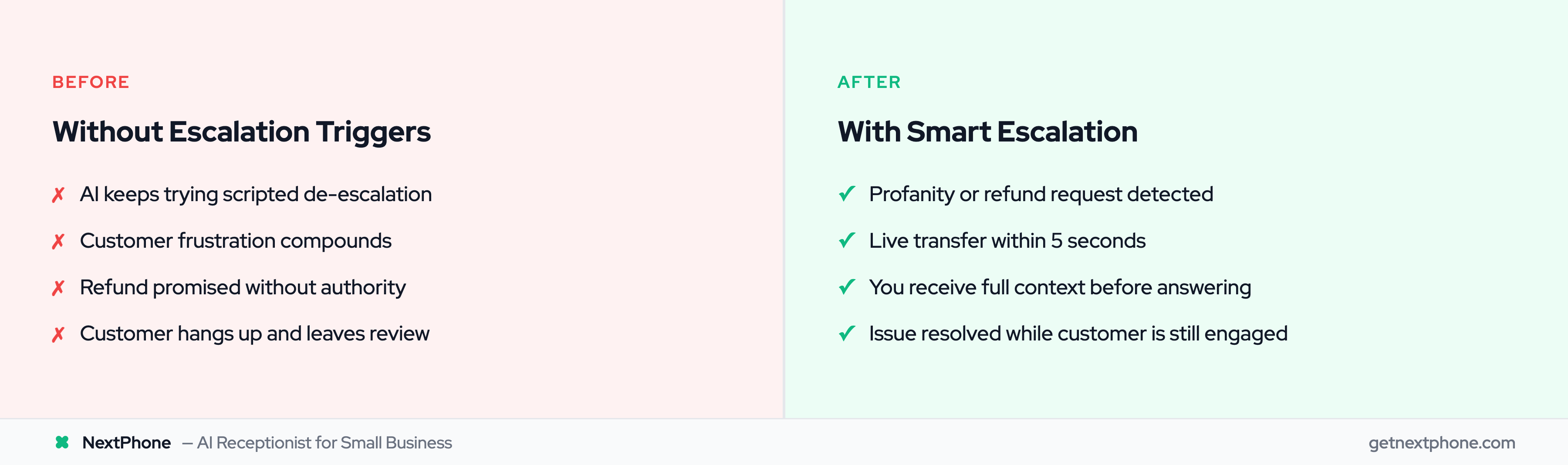
Smart AI design isn't about handling everything. It's about knowing when to hand off.
The Hybrid Model: AI First, Human Backup
Think of an AI virtual receptionist as a first responder, not a replacement. It answers every call in under 5 seconds, handles routine questions about hours and pricing, books appointments, and yes, de-escalates mild to moderate frustration.
But when a situation exceeds its capability, escalation should be immediate and seamless. Not "someone will call you back in 24 hours." Not routing to a ticketing system. Live transfer, right now, while the customer is still on the line.
Speed Matters: Live Transfer vs. Callbacks
Here's what typically happens with chatbot-style systems: Customer gets frustrated, requests a human, gets told "a representative will call you back," and now they're even angrier because they have to wait.
Live call transfer means the AI says, "I'm connecting you with our service manager right now," and within 5-10 seconds, you're on the line. The customer doesn't hang up, doesn't wait, doesn't have to call back.
This is critical for angry customers. Research from SQM Group shows that escalated calls cost 2X more to resolve than standard ones. Every minute of additional wait time compounds frustration and increases resolution cost.
Context Preservation During Handoff
Nothing frustrates an upset customer more than having to repeat their complaint. Good AI systems pass complete context during transfer:
"Hi John, I have a customer on the line. Their name is Dana Reyes, calling about appointment #4782 scheduled yesterday at 2 PM. The technician didn't arrive, and she didn't receive a notification. She's been holding for about 45 seconds. Transferring now."
You pick up already knowing the situation. Sarah doesn't have to say "I've been calling about this for three days" for the third time. The de-escalation advantage is enormous.
Specific Escalation Triggers You Should Set
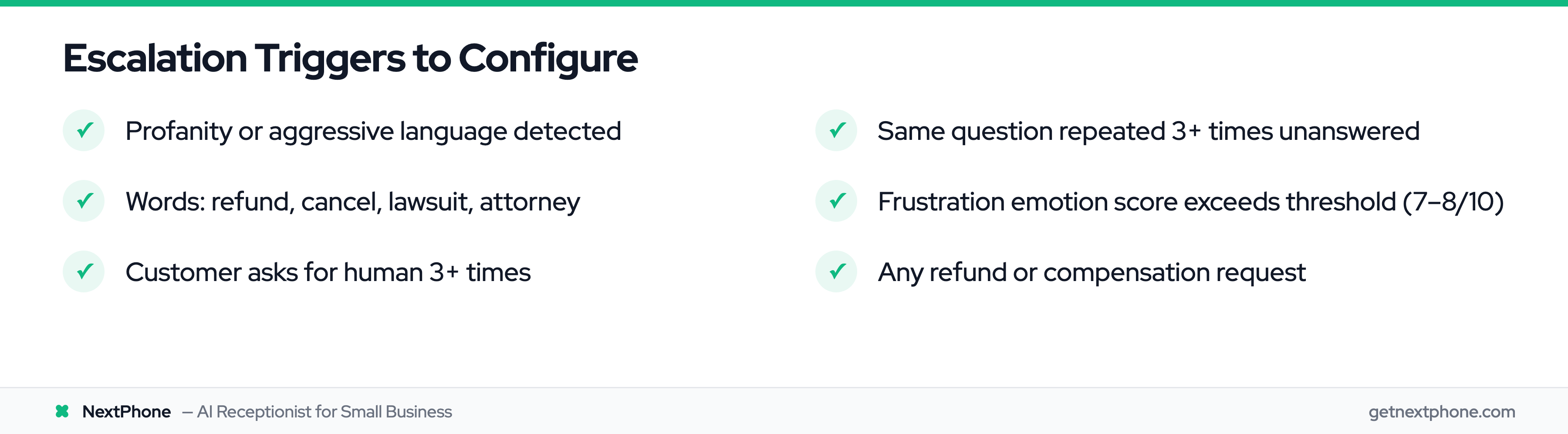
Vague policies like "escalate when the customer seems upset" don't work. AI needs specific, measurable triggers.
Keyword Triggers
Configure your AI to immediately transfer when it detects:
- Profanity or aggressive language - Even if the customer isn't swearing at the AI, profanity indicates high emotion
- Refund, cancel, lawsuit, attorney, corporate - These words signal the customer is past the point of routine resolution
- Competitive mentions - "I'm calling XYZ Company instead" means they're one step from hanging up
Behavioral Triggers
Actions speak louder than words:
- Customer asks for a human 3+ times - If they're insisting, give them what they want (see our guide on handling live agent demands and escalation)
- Repeats the same question 3+ times without getting a satisfactory answer - AI isn't understanding or can't help
- Long pauses after AI responses - Customer is considering giving up
- Voice volume or pitch escalation detected by tone analysis
Emotion Threshold Triggers
If your AI assigns emotion scores (0-10 scale for frustration), set a transfer threshold. Once frustration hits 7 or 8, route to human immediately. Don't let it reach 10.
Request-Type Triggers
Some requests should automatically route to humans regardless of tone:
- Any refund or compensation request - AI should not have authority to approve these
- Policy exception requests - "Can you make an exception just this once?"
- Emergency situations - In our data, true emergencies are a recurring reason people call. These need immediate human attention, especially during after-hours coverage
- Complex technical issues - Multi-step troubleshooting beyond AI capability
Example scenario: Customer calls saying "I want my money back for this service." AI responds: "I understand you'd like to discuss a refund. Let me connect you immediately with someone who can help you with that." Transfer happens within 5 seconds.