AI Receptionist vs Voicemail: Which Captures More Leads? (Conversion Data)

15 min read
Yanis Mellata
Comparisons

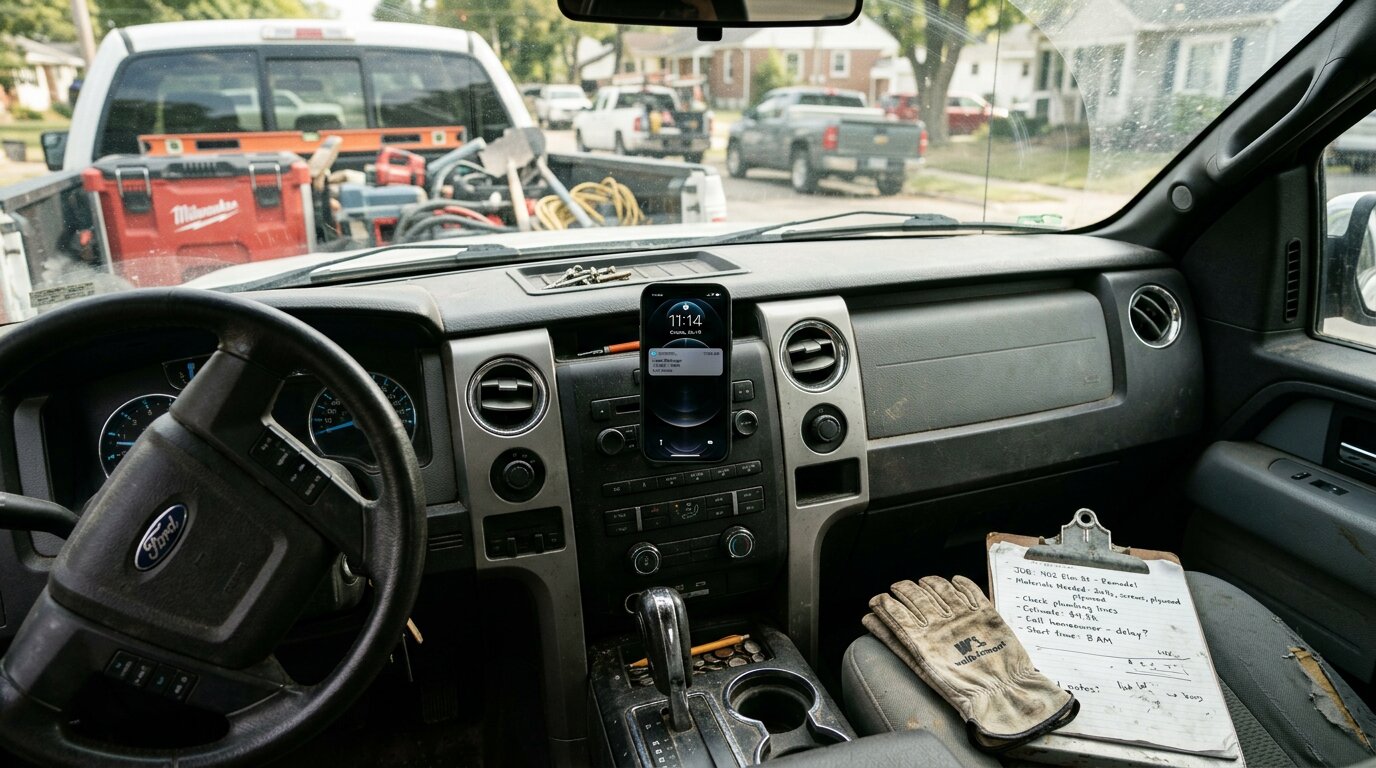
It's 5 PM on Friday. A customer calls your business—they need your service this weekend. The call goes to voicemail. They hang up without leaving a message and call the next contractor on Google. Your competitor's AI receptionist answers in 3 seconds, qualifies the lead, and books the appointment. You lost a $3,500 job and never even knew they called.

This scenario plays out thousands of times daily across home services businesses. The conversion data is brutal: voicemail captures just 5-15% of callers who reach it, while AI receptionists capture 80-95%. That's not a small improvement—it's a 6X difference in lead capture.

Let me show you exactly why the gap is so massive, backed by our analysis of 130,175 customer service calls.

The Brutal Truth About Voicemail Conversion Rates

Most business owners think voicemail is capturing their leads. The data tells a very different story.

Only 20% Leave a Message

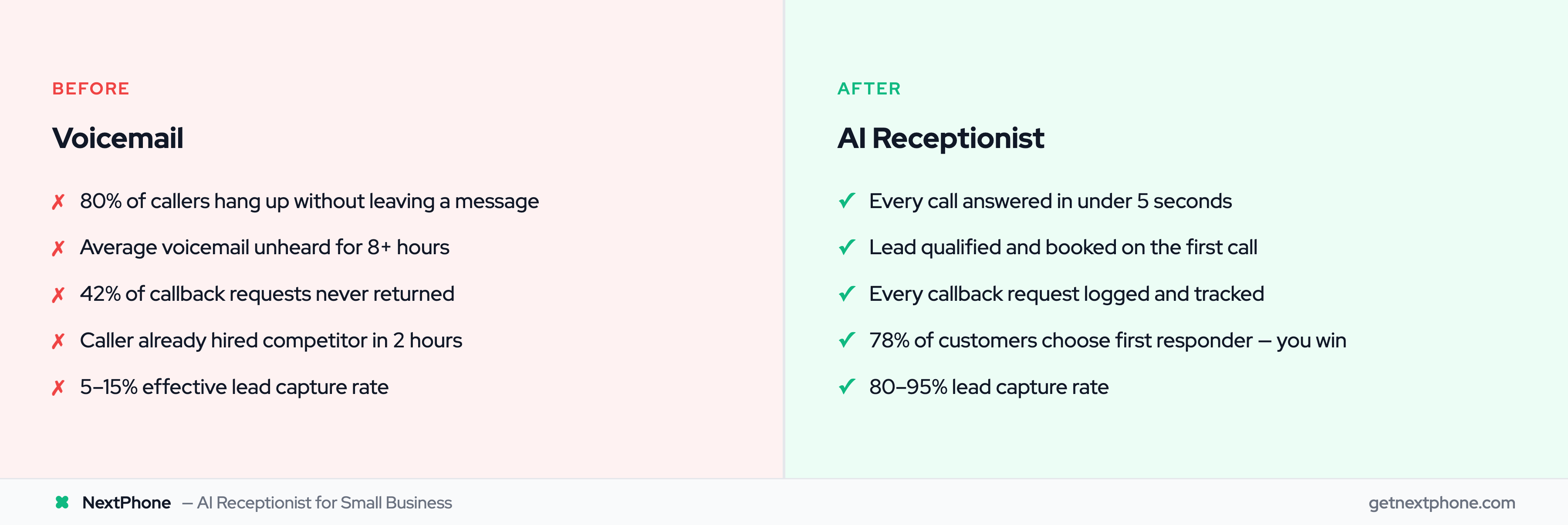
Industry research shows that only 20% of callers will leave a message when they reach voicemail. That means four out of five potential customers hang up without saying a word.

Think about that. You're losing 80% of callers before you even get a chance to respond.

Why? Customers don't trust that you'll call back promptly. They don't want to explain their entire problem to a recording. And they know your competitors might answer right now.

Less Than 5% Actually Respond

Here's where it gets worse. Of the 20% who do leave voicemails, business phone statistics reveal that the average voicemail response rate for B2B is less than 5%.

Even when someone takes the time to leave a detailed message, the odds of that turning into an actual customer interaction are terrible. Research shows that 85% of customers whose calls go unanswered will not call back.

The 5-15% Effective Capture Rate

Do the math:

  • 100 calls come in
  • 20 leave a voicemail (80% hang up)
  • 1-5 of those respond or call back
  • 1-3 actually convert to customers

That's a 5-15% effective capture rate. You're losing 85-95% of callers who reach your voicemail.

For a contractor receiving 42 calls per month (the average in our dataset), that's 35-40 potential customers who disappear into the void. At a $3,500 average job value, you're looking at over $120,000 in lost annual revenue—just from voicemail.

Why Customers Don't Leave Voicemails (And Why It Matters)

Understanding why people avoid voicemail is key to understanding why AI works so much better.

They Don't Trust You'll Call Back

Customers face uncertainty with every voicemail. Will anyone even listen to this? When will they call back—hours? Days? Will my message get lost?

This isn't paranoia. In our analysis of 130,175 calls from 47 home services businesses over 7 months, we found that 25.4% of customers explicitly requested callbacks (632 out of 2,487 analyzed). Without a systematic tracking system, most of these callback requests fall through the cracks.

One plumber in our study had 76 missed calls in a single month. His reaction: "I didn't even know I was missing that many calls until I saw the data. I just thought business was slow."

They Want Answers Now, Not Later

Leaving a voicemail means explaining your problem without the benefit of immediate feedback or clarifying questions. It's one-way communication in a world that expects two-way conversation.

Customers have questions: Do you service my area? When can you come? What do you charge? Voicemail can't answer any of them. AI can answer all of them.

Generational Shift: Millennials Don't Do Voicemail

Research from Nuance Communications discovered that 95% of people find text messaging more convenient than voicemail. For younger customers—Millennials and Gen Z—hearing "leave a message after the tone" signals that your business might be stuck in the past.

Customer behavior research shows that 67% of people admit to ignoring voicemails, even from known contacts. If the number is unfamiliar, the ignore rate shoots even higher.

These customers expect real-time responses. They'd rather text, chat, or talk to someone immediately. Voicemail fits none of these preferences.

Emergency Calls Can't Wait

In our 130,175-call analysis, we discovered that 15.9% of calls contained urgency language like "emergency," "urgent," or "ASAP." Another 6.2% were true emergencies: pipe burst, no power, AC out in 95-degree heat.

These callers aren't leaving voicemails and waiting. As one Reddit user put it: "As a customer, if I get voicemail I'm calling the next plumber. My toilet is overflowing NOW, not whenever they check their messages."

For HVAC contractors, emergency calls average $4,200—significantly higher than routine work. Missing one emergency call per week costs $16,800 per month in lost revenue. Voicemail guarantees you lose these high-value jobs.

The Hidden Cost of Voicemail Callbacks (When They Even Happen)

Let's say you beat the odds. Someone leaves a voicemail, you see it, and you call them back. You're still losing the lead capture battle.

42% of Callback Requests Go Unreturned

Our data showed that 25.4% of callers explicitly requested callbacks. That's 11 callback requests per month for a typical 42-call contractor.

Industry research shows that without a tracking system, 42% of callback requests go unreturned. You're underwater, on a job site, or it's after hours. The voicemail gets buried. You forget. The callback never happens.

Even with good intentions, the system fails.

The Hours/Days Delay Problem

Even when you do call back, hours or days have passed. The average voicemail goes unheard for 8+ hours. Many callbacks happen the next business day—24+ hours later.

Lead response research shows that businesses responding in under a minute see conversion rates improve by 391%. Even within the first five minutes, conversions are 8X higher.

Your voicemail callback at 24 hours? You might as well not bother.

By Then, They've Hired Your Competitor

Here's the killer stat: 78% of customers choose the company that responds first.

One plumber shared his experience on a contractor forum: "Customer left voicemail at 2 PM, I called back at 4 PM, they'd already hired another company. Two hours!"

Two hours. That's all it took.

In competitive markets, speed isn't a nice-to-have. It's everything. And voicemail makes speed impossible.

AI Receptionist Conversion Data: 80-95% Immediate Engagement
Now let's look at the other side of the comparison. The difference is dramatic.

Answers Every Call in Under 5 Seconds

An AI receptionist picks up every single call, instantly. No rings. No wait. No "leave a message after the tone."

100% answer rate. Every time. 24/7/365.

In our analysis, we found that 74.1% of calls to home services businesses went completely unanswered. An AI receptionist brings that number to zero.

85-95% Lead Capture Rate

AI receptionist research shows that traditional voicemail systems only capture 20-30% of leads, while AI receptionists capture 85-95% of leads.

One case study showed that proactive, automated engagement secured a 76% lead conversion rate. Companies using AI answering services report a 67% increase in sales compared to those without.

The same 100 calls that resulted in 5-15 customers with voicemail? With AI, that becomes 80-95 qualified leads.

Qualifies Callers in Real-Time

AI doesn't just answer. It engages in actual conversation. It asks questions:

  • What service do you need?
  • When do you need it done?
  • What's your location?
  • What's your budget range?

All the information you'd collect during a callback—except it happens on the first call, in the first minute. No phone tag. No delays.

Books Appointments on the First Call

While voicemail creates a multi-day cycle (call — voicemail — callback — phone tag — eventual booking), AI receptionists work to complete the entire interaction immediately.

The AI checks your calendar availability, books the appointment, sends a confirmation, and logs everything to your CRM. The customer hangs up with their problem solved. You get a qualified appointment without lifting a finger.

The First-Responder Advantage: Why Speed Wins

Remember that 78% stat? It's worth exploring deeper because it explains why the voicemail vs AI comparison isn't even close.

78% Choose the First Business to Respond

When a customer has an urgent need, they don't call one business and wait. They call several. Whoever answers first gets the job.

This is especially true for emergency calls. That homeowner with a burst pipe isn't sitting around waiting for your voicemail callback. They've got three plumbers' numbers open on their phone, and they're calling all of them simultaneously.

Your AI receptionist answers in 3 seconds. Your competitor's call goes to voicemail. Who do you think gets the job?

Response Time Impact on Conversion (391%)

The data on response time is staggering. Businesses responding in under a minute see conversion rates improve by 391% compared to slower responses.

Home service companies miss 62% of inbound calls. Professional services miss 54%. Even retail businesses with "someone always at the desk" miss 48% of their calls.

Every missed call is a potential customer choosing your faster competitor.

Voicemail = Hours or Days, AI = Seconds

This isn't a small speed difference. Voicemail callbacks average hours to days. AI responds in seconds.

That's not iteration. That's transformation.
Real-Time Qualification vs Phone Tag

Beyond just speed, AI fundamentally changes how lead capture works.

AI Qualifies on the First Call

Traditional voicemail creates a cycle that takes days:

  • Day 1: Customer calls, leaves voicemail
  • Day 2: You call back, they miss it, leave voicemail
  • Day 3: Phone tag continues
  • Day 4: You finally connect
  • Day 5: Schedule the actual appointment

AI collapses all of that into one call:

  • Customer calls
  • AI answers immediately
  • AI qualifies the lead (service needed, timeline, budget)
  • AI books the appointment
  • Confirmation sent
  • Lead logged to CRM

Same outcome. One call instead of five days.

Emergency Routing vs Delayed Response

In our 130,175-call analysis, 15.9% of calls contained urgency language. Another 6.2% were true emergencies.

AI can recognize urgency and route immediately to your on-call phone. A burst pipe at 2 AM doesn't go to voicemail and wait until 8 AM—it gets routed to your emergency line immediately.

Voicemail can't do this. By the time you hear the message, the customer has already hired someone else.

Cost Comparison: $0 Voicemail vs $199/Month AI

Let's address the elephant in the room. Voicemail is free. AI costs money. Is it worth it?

Voicemail Is "Free" But Costs You Leads

Voicemail appears free because there's no monthly bill. But we've already shown that it's costing you 85-95% of your leads.

For a typical contractor receiving 42 calls per month, if 74.1% go unanswered (31 missed calls), and just 20% would have converted at an average $3,500 project value, that's $21,700 per month in lost revenue—or $260,400 per year.

Voicemail isn't free. It's the most expensive option.

AI Receptionist: $199/Month for Unlimited Calls

NextPhone's AI receptionist costs $199 per month with unlimited calls. No per-call charges. No surprise fees. Flat rate.

Compare that to traditional answering services at $500-800/month for just 100 calls, or a full-time receptionist at $35,000/year.

ROI Calculation: Capturing Just 1-2 Extra Jobs Pays for It

The ROI is simple. If the AI receptionist helps you capture even 1-2 extra jobs per month that would have gone to voicemail, it pays for itself.

One extra $3,500 job every 18 months covers the entire annual cost. Most contractors see 5-10+ extra jobs per month from improved lead capture.

One business owner on Reddit shared: "We switched from voicemail and our booking rate went from maybe 20% to over 60% in the first month. People just won't leave messages."

That's the difference between losing $260,000 per year and capturing it.

When Should You Upgrade from Voicemail to AI?

Not every business needs AI immediately. Here's how to know if you do.

Signs You're Losing Leads to Voicemail

You should consider AI if you're experiencing:

  • After-hours calls going to voicemail (73% of calls happen outside 9-5)
  • Busy periods where you can't answer (on job sites, with customers)
  • Competitors responding faster than you
  • Voicemails with urgency language ("ASAP," "emergency," "need someone today")
  • Slow periods that might actually be missed calls

Industries Where Every Call Matters

Some industries can't afford to miss calls:

If you're in a competitive market where customers are calling multiple businesses, you need AI.

Starting Point: Track Your Missed Calls

First step: Track your calls for 30 days. Most businesses have no idea how many calls they're actually missing.

Use call tracking software or check your phone system logs. You'll likely find that 50-70% of calls go unanswered—way more than you realized.

Even 3-5 missed calls per month represents thousands in lost revenue annually. At 10+ missed calls, you're leaving serious money on the table.

How NextPhone Captures the Leads Voicemail Misses

NextPhone's AI receptionist was built specifically to solve the voicemail problem. Here's how it works.

The system answers every call in under 5 seconds, 24/7/365. It's trained on your specific business—your services, your pricing, your availability, your frequently asked questions.

When a call comes in, the AI engages in natural conversation. It handles routine questions like "What are your hours?" and "Do you service my area?" without human intervention. For quote requests, it qualifies the lead by collecting name, contact info, service needed, timeline, and budget.

The system can book appointments by checking your calendar availability in real-time. For emergency calls, it recognizes urgency and routes immediately to your on-call phone. After the call, it sends follow-up SMS confirmations and logs everything to your CRM.

Based on our analysis of 130,175 calls, we built in automatic tracking for the 25.4% of callers who request callbacks. Every callback request is logged, tracked, and followed up on—no more falling through the cracks.

The system runs at $199 per month with unlimited calls, and most contractors see ROI within the first month.

Frequently Asked Questions

What percentage of customers leave voicemails?

Only 20% of callers leave voicemail messages when they reach one. The other 80% hang up without saying anything. Of the 20% who do leave messages, less than 5% result in actual conversions. This means voicemail effectively captures only 5-15% of total callers who reach it.

Will customers accept talking to an AI instead of leaving a voicemail?

Yes, customers strongly prefer immediate AI response over voicemail. Research shows that 80% would rather contact a competitor than leave a voicemail. AI provides instant answers and engagement, while voicemail provides uncertainty and delay. Modern AI sounds natural and helpful, and customers care more about getting their questions answered immediately than whether it's a human or AI doing the answering.

How much does an AI receptionist cost compared to voicemail?

Voicemail appears "free" but costs you 70-80% of your leads. NextPhone's AI receptionist costs $199 per month for unlimited calls. Capturing just 1-2 extra jobs per month pays for the entire year. By comparison, traditional answering services cost $500-800/month with call limits, and a full-time receptionist costs $35,000/year.

Can AI receptionists book appointments, or just take messages like voicemail?

AI receptionists can book appointments in real-time during the call. They also qualify leads, answer questions, route emergencies, and send confirmations. Voicemail just records a message and hopes for a callback. AI completes the entire interaction on the first call—no phone tag, no delays, no hoping the customer calls back.

What happens to callback requests with voicemail vs AI?

With voicemail, 25.4% of callers request callbacks (according to our 130,175-call analysis), but 42-80% of those requests never get returned. The system has no tracking, no accountability. With AI, every callback request is automatically logged and tracked for follow-up. Better yet, the AI often resolves the inquiry immediately instead of deferring to a callback, eliminating the delay entirely.

How quickly do businesses typically respond to voicemails?

Most voicemails go unheard for 8+ hours. Many callbacks happen the next business day, meaning 24+ hours have passed. By then, 78% of customers have already chosen a competitor who responded faster. AI responds in under 5 seconds, every single time, day or night.

Is there any situation where voicemail is better than an AI receptionist?

Only if you receive fewer than 5 calls per month AND none are time-sensitive or competitive. For any business with after-hours calls, emergency requests, or competition for customers, AI wins decisively. Even 3-5 missed calls monthly represents thousands in lost revenue annually. Most businesses don't realize how many calls they're missing until they start tracking the data.

Stop Losing Leads to Voicemail

The conversion data is clear. Voicemail captures 5-15% of callers. AI captures 80-95%. That's a 6X improvement in lead capture—and a massive difference in revenue.

The 78% of customers who choose the first responder aren't waiting around for voicemail callbacks. They're booking with whoever answers. In competitive markets, speed is everything. Voicemail makes you slow. AI makes you first.

For most home services contractors, capturing just one or two extra jobs per month pays for an AI receptionist. The typical business sees 5-10+ additional conversions monthly. That's not a small upgrade—it's transformational.

Speak with one of our experts

Book a Call

Related Articles

Yanis Mellata

About NextPhone

NextPhone helps small businesses implement AI-powered phone answering so they never miss another customer call. Our AI receptionist captures leads, qualifies prospects, books meetings, and syncs with your CRM — automatically.