When Your Phone System Doesn't Actually Answer Calls
You switched to Zoom Phone. Cloud-based, modern, affordable. But your calls still go to voicemail.
You're on a job site installing an HVAC unit. A customer calls at 9 PM with an emergency. You're at dinner with your family. The call rings through to your Zoom Phone app. You can't answer. It goes to voicemail. They call the next contractor.
Here's what most businesses don't realize: VoIP systems like Zoom Phone solve how to make and receive calls, but they don't solve who answers them when you're unavailable.
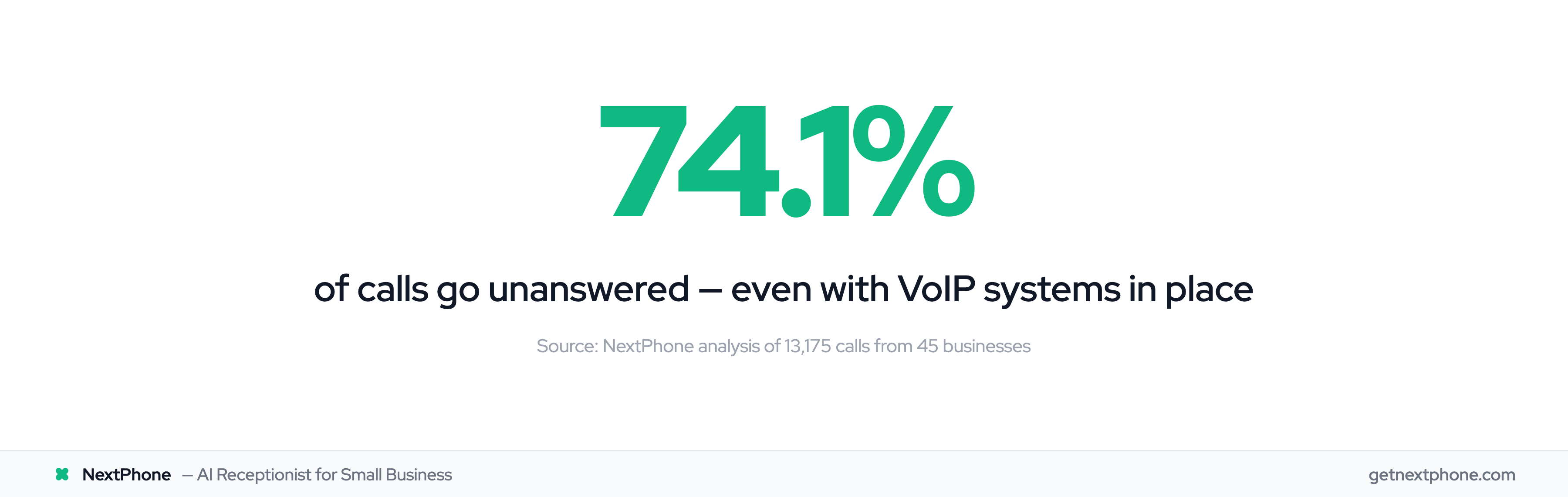
Industry research shows 74.1% of calls to home services contractors go completely unanswered. That's three out of every four potential customers calling someone else, even with modern VoIP systems in place.
This post explains the fundamental difference between VoIP infrastructure (what Zoom Phone provides) and intelligent call handling (what AI receptionists provide), and when each makes sense for your business.
What is Zoom Phone? (And Who Uses It)
Zoom Phone is a cloud-based Voice over Internet Protocol (VoIP) service from Zoom, the video meeting company. If you're already using Zoom for video calls, Zoom Phone is designed to be a natural extension, adding phone service to your existing Zoom setup.
Cloud-Based VoIP System
Zoom Phone replaces traditional landlines with internet-based calling. The VoIP market is projected to grow from $132B to $326B, reflecting the massive shift to cloud-based communications. You can make and receive calls from your computer, mobile device, or desk phone. No copper wires, no phone company infrastructure. Everything runs through the internet.
For businesses comfortable with cloud technology, this is a massive upgrade from traditional phone systems. You get modern features like call forwarding, voicemail-to-email, and mobile apps.
Built for Zoom Meeting Users
The main appeal? Integration with Zoom's ecosystem. If your team already uses Zoom for video meetings and team chat, adding Zoom Phone creates a unified communication platform. You're not learning a new system or switching between apps.
Pricing Plans
According to Zoom Phone pricing, there are two main options:
- Metered Plan: $10/user/month, but you pay $0.0318 per minute for outbound calls in the US and Canada
- Unlimited Plan: $15/user/month with unlimited domestic calling
For a small business with three employees, that's $45/month for the unlimited plan. Looks affordable on the surface.
The VoIP Limitation: Why Zoom Phone Users Still Miss Calls
Here's the problem: VoIP is infrastructure, not availability.
VoIP Provides Infrastructure, Not Availability
Zoom Phone gives you a modern way to make and receive calls. But it doesn't answer the phone when you're:
- On a job site with your hands full
- In a meeting with a client
- Driving between appointments
- Helping a customer in person
- Sleeping (while emergency calls come in)
VoIP replaced copper wires with internet. That's great. But you still need someone (or something) to actually answer the calls.
Real Problems Zoom Phone Users Face
Zoom Phone users report consistent issues:
"Calls get dropped, missed, audio is inconsistent, and voicemail notifications have major delays."
"Very strong internet connection needed to use the phones... can't rely on phone data."
But the biggest complaint is that Zoom Phone doesn't solve the fundamental problem of being unavailable to answer.
When Calls Actually Come In
Here's data most VoIP providers don't talk about: when do customers actually call?
In our analysis of customer service patterns, we found that calls don't happen on your schedule. They happen when customers need help. An HVAC tech on a roof at 2 PM can't answer. A plumber under a house at 11 AM can't answer. A contractor in a client meeting can't answer.
Your Zoom Phone app is on your laptop in the truck. The call rings. You're 30 feet up installing shingles. The call goes to voicemail.
VoIP gives you the infrastructure. But infrastructure doesn't answer calls.
What is an AI Receptionist?
An AI receptionist is software that actually answers and handles your calls, 24 hours a day, 7 days a week.
Intelligent Call Handling vs Infrastructure
This is the key distinction: VoIP systems like Zoom Phone provide phone infrastructure. AI receptionists provide call handling intelligence.
When someone calls your business, an AI receptionist:
- Answers in under 5 seconds (not after 6 rings to voicemail)
- Understands what the caller needs using conversational AI
- Answers common questions: "What are your hours?" "Do you service my area?" "How much does X cost?"
- Collects caller information: name, phone number, service needed, urgency level
- Books appointments or schedules callbacks
- Routes emergency calls to your mobile phone immediately
- Sends you a summary after each call
What AI Receptionists Actually Do
Unlike a basic auto-attendant ("Press 1 for sales, press 2 for support"), AI receptionists have actual conversations.
A caller says: "Hey, I need someone to look at my AC. It's not cooling and it's 95 degrees outside."
The AI understands: (1) HVAC service needed, (2) emergency situation, (3) high urgency. It collects the caller's information, promises a callback within 30 minutes, and immediately sends you a text alert with the caller's details and urgency level.
According to a recent market analysis, seven major communications vendors launched AI-powered virtual receptionists in Q1 2025 alone. This technology is rapidly becoming standard.
While a human receptionist can handle one call at a time, AI can handle unlimited simultaneous calls. Every caller gets answered immediately.
Infrastructure vs Intelligence: The Key Difference
Think of it this way: VoIP is the road system. AI receptionist is the GPS and driver.
What VoIP Solves (Infrastructure)
VoIP systems like Zoom Phone solve:
- How to make calls (internet instead of phone lines)
- How to receive calls (cloud-based, works on any device)
- How to integrate with modern tools (mobile apps, softphones)
- How to reduce phone bills (no traditional phone company)
These are real problems. VoIP is a genuine upgrade from landlines.
What AI Receptionist Solves (Intelligence)
AI receptionists solve:
- Who answers calls when you're unavailable
- How to handle calls intelligently (not just route them)
- How to track callback requests (in our analysis, approximately one in four callers explicitly asks for a callback; basic VoIP has no mechanism to track this)
- How to detect emergencies and route them appropriately
- How to qualify leads and collect information
- How to provide 24/7 coverage without hiring staff
Why You Need Both
Here's what most comparison articles miss: these aren't competing solutions. They're complementary.
You need VoIP infrastructure to make calls and receive them. You need intelligent call handling to actually answer them and handle them properly.
Zoom Phone gives you the ability to make calls. An AI receptionist gives you the ability to never miss them.
Feature Comparison: Zoom Phone vs AI Receptionist
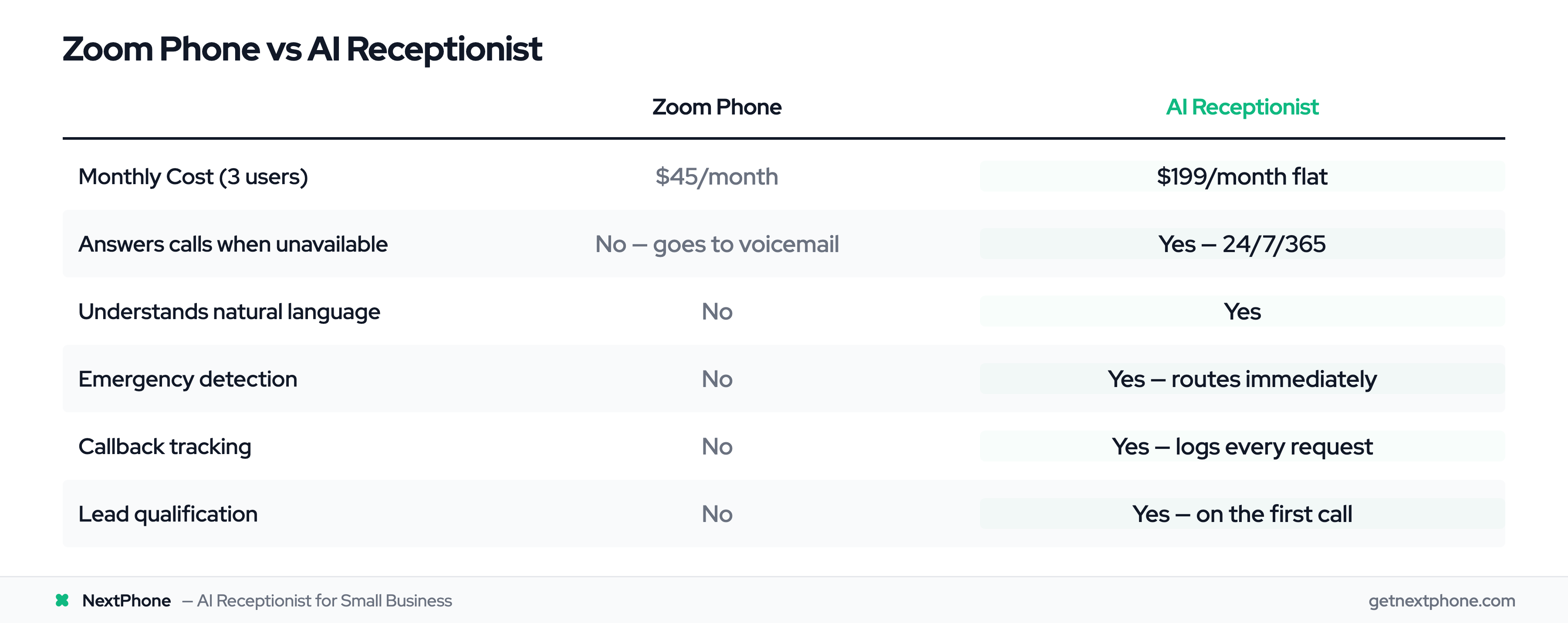
Let's break down what each system actually does.
Basic Call Features (Both Have These)
Both Zoom Phone and AI receptionists handle basic calling:
- Make and receive calls
- Voicemail
- Call forwarding
- Mobile apps
What Zoom Phone Offers
Zoom Phone's strengths:
- Seamless integration with Zoom meetings and chat
- Per-user pricing that scales with team size
- Desk phone support for traditional office setups
- Video meeting integration (click to start Zoom from phone call)
What AI Receptionists Offer (That Zoom Phone Doesn't)
This is where the difference becomes clear:
- 24/7 Call Answering: Every call answered immediately, not sent to voicemail
- Conversational Intelligence: Understands natural language, not just button presses
- Emergency Detection: In our call analysis, urgent calls rank among the top reasons people call, using language like "emergency," "urgent," or "ASAP". AI can detect this and route accordingly
- Callback Tracking: Remember the roughly one in four callers who ask for a callback? AI tracks every single one automatically
- Lead Qualification: Collects caller information and sends it directly to your CRM
- Appointment Scheduling: Books appointments during the call, not just taking messages
- Spam Filtering: Spam is filtered out before it ever rings you. AI blocks robocalls automatically
- Quote Request Handling: Requesting a quote or estimate is among the top reasons people call, and AI collects all the necessary details
Intelligent call handling means actually engaging with callers, not just routing them.
Integration Capabilities
Zoom Phone integrates primarily with the Zoom ecosystem: great if you're all-in on Zoom, limiting if you use other tools.
AI receptionists integrate with your existing tools: any CRM (HubSpot, Salesforce, Pipedrive), any calendar (Google, Outlook, Calendly), any communication channel (SMS, email, Slack). You're not locked into one ecosystem.