
Your phone rings at 2 PM. You're up on a roof, three stories high, hands full of shingles. The call goes to voicemail. It rings again at 6 PM—you're still working, covered in tar. Voicemail again. By the time you check messages at 8 PM, that customer has already hired another contractor. Just lost a $15,000 job.
This happens more than you think. Industry research shows small service businesses miss 60-80% of incoming calls. Every missed call is a potential customer choosing your competitor instead.
AI phone service is changing this reality for small businesses. In this guide, you'll learn exactly how AI-powered phone answering works, what it costs, and how to implement it—even if you're not technical. More importantly, you'll see real data on what it saves (time, money, and lost leads).
What Is AI Phone Service?
AI phone service is software that answers your business phone calls using conversational artificial intelligence. Instead of letting calls go to voicemail or paying thousands monthly for a human receptionist, AI picks up every call and handles it intelligently.
The Basic Definition
Think of AI phone service as an AI virtual receptionist that never sleeps, never takes breaks, and costs a fraction of hiring someone. It uses natural language processing (NLP)—the same technology behind Siri and Alexa—to understand what callers are asking and respond appropriately. The voice recognition market has grown to $26.79 billion, reflecting how widespread this technology has become.
According to Gartner research, the AI customer service market is growing rapidly, driven largely by small businesses discovering they can compete with enterprise-level customer service without enterprise budgets. In fact, 85% of customer service leaders will explore or pilot conversational AI in 2025.
What AI Phone Service Does (vs Doesn't Do)
Here's what AI phone service handles:
- Answers calls in 6-8 seconds (faster than most humans)
- Understands conversational questions ("Are you open Saturday?" not just keywords)
- Provides information from your business knowledge base (hours, pricing, service area)
- Books appointments directly into your calendar
- Detects urgent situations and routes calls to your phone immediately
- Tracks callback requests so no lead falls through cracks
- Filters spam and robocalls automatically
Here's what it doesn't do:
- Replace you entirely (it's augmentation, not replacement)
- Make outbound sales calls (that's a different technology)
- Handle every complex situation (it knows when to route to humans)
Modern conversational AI achieves 85-95% accuracy for routine business inquiries, according to AI research. The key word is "routine"—the questions you answer fifty times a week.
How It's Different from Traditional Solutions
AI phone service isn't a robotic phone tree where customers "press 1 for sales, press 2 for service." Those old IVR (interactive voice response) systems frustrated everyone.
It's also not voicemail. Voicemail is passive—you're hoping the customer leaves a message and hoping you call back in time. Spoiler: Most customers who hit voicemail call the next contractor instead.
And it's different from traditional answering services where humans take messages. Those services charge per call, don't scale affordably, and still require you to call everyone back.
AI phone service is active, intelligent, and available 24/7/365. It's having a conversation, not just collecting information.
Why Small Businesses Need AI Phone Service
Let's talk about the real problem: missed opportunities.
The Hidden Cost of Missed Calls
Industry data paints a brutal picture. Small service businesses miss 60-80% of incoming calls. Not because they're lazy—because they're working.
You can't answer the phone when you're:
- On a ladder, roof, or in a trench
- With a customer in your shop
- Performing a service (haircut, dental work, legal consultation)
- Driving between job sites
- Actually doing the work you're good at
Here's the revenue math. Let's say you get 40 calls per month—typical for a small contractor. If 70% go unanswered, that's 28 missed calls monthly. Industry data shows 6.9% of calls are quote or estimate requests. That's about 2 quote requests you never heard.
If your average project is $5,000 and you close 25% of quotes you provide, each missed quote request costs you $1,250 in potential revenue. Two missed per month = $2,500 lost. That's $30,000 annually you're leaving on the table.
And that's just quotes. We haven't counted:
- The 25.4% of callers who request callbacks (and might not wait for you to call back)
- The 6.2% who have true emergencies and will call five contractors until someone answers
- The new customers who were shopping around and chose whoever picked up first
The After-Hours Problem
Here's a stat that surprises most small business owners: 37% of business calls occur outside standard 9-5 hours, according to business communication research.
Think about when customers need you:
- Sunday night when the AC dies in a heatwave
- 7 AM before work when they notice a leak
- 10 PM when they're finally sitting down to plan their renovation
You're not available at these times. Neither is a receptionist you'd hire. But your competitors with AI phone service? They're answering.
Customer service data shows that 15.9% of calls contain urgency language—words like "emergency," "urgent," "ASAP," or "today." These aren't customers who will patiently wait until Tuesday morning when you check voicemail. They're calling contractors down the list until someone picks up.
Real example from our industry analysis: "Needs emergency AC repair, no cooling in 95 degree weather."
That caller isn't leaving a voicemail. They're booking with whoever answers.
The Interruption Trap
Even when you can answer the phone, should you?
Every interruption costs you 15-20 minutes of productivity once you factor in the time to refocus on what you were doing. Research on knowledge work shows it takes an average of 23 minutes to get back into deep focus after an interruption.
And here's the frustrating part: 6.5% of customer calls are asking repetitive questions you've answered a thousand times:
- "What's your service area?"
- "What are your rates?"
- "Are you open Saturday?"
- "Do you do [specific service]?"
You're stopping real work to answer questions a simple knowledge base could handle.
Why Traditional Solutions Fall Short
Most small businesses try one of three approaches:
Option 1: Hire a receptionist The Bureau of Labor Statistics reports median receptionist salary at $17.90/hour or $37,230 per year. Add benefits, taxes, and management overhead, and you're paying $2,500-3,000 per month. They work 9-5. What about that 37% of calls outside business hours?
Option 2: Use a traditional answering service Ruby Receptionists, AnswerConnect, and similar services charge $300-800 monthly for modest call volumes. But they charge per call or per minute. During busy season when you get 80-100 calls monthly, that bill hits $1,500+. They also can't book appointments—they take messages and you still have to call everyone back.
Option 3: Just let it ring This is what most small businesses do. It's free. It's also costing you five to six figures annually in lost revenue.
None of these solutions work for businesses with unpredictable call volume, tight margins, or time-sensitive customer needs.
How AI Phone Service Works
You don't need to understand machine learning to use AI phone service. But knowing the basics helps you trust it's not just smoke and mirrors.
Natural Language Processing (The Brain)
Natural language processing is the technology that lets AI understand how humans actually talk—not just keywords, but context and intent.
When someone calls and says "I need someone to look at my roof, there's water coming through the ceiling," the AI doesn't just hear "roof" and "water." It understands:
- This is a service request (not a general question)
- There's urgency (water coming through = problem happening now)
- This likely requires immediate attention or at minimum fast callback
According to MIT Technology Review, NLP accuracy has improved 40% in the past two years alone. Modern systems can handle regional accents, background noise, and the natural messiness of how people speak.
Here's a simple example. Customer calls and asks: "Are you open Saturday?"
The AI:
- Processes the audio (speech-to-text)
- Understands the intent (asking about business hours)
- Retrieves your business information (Saturday hours: 9 AM - 5 PM)
- Responds conversationally: "Yes, we're open Saturday from 9 AM to 5 PM. Would you like to schedule an appointment?"
All in under 10 seconds.
Intent Detection and Smart Routing
The real intelligence is in what the AI does with the information.
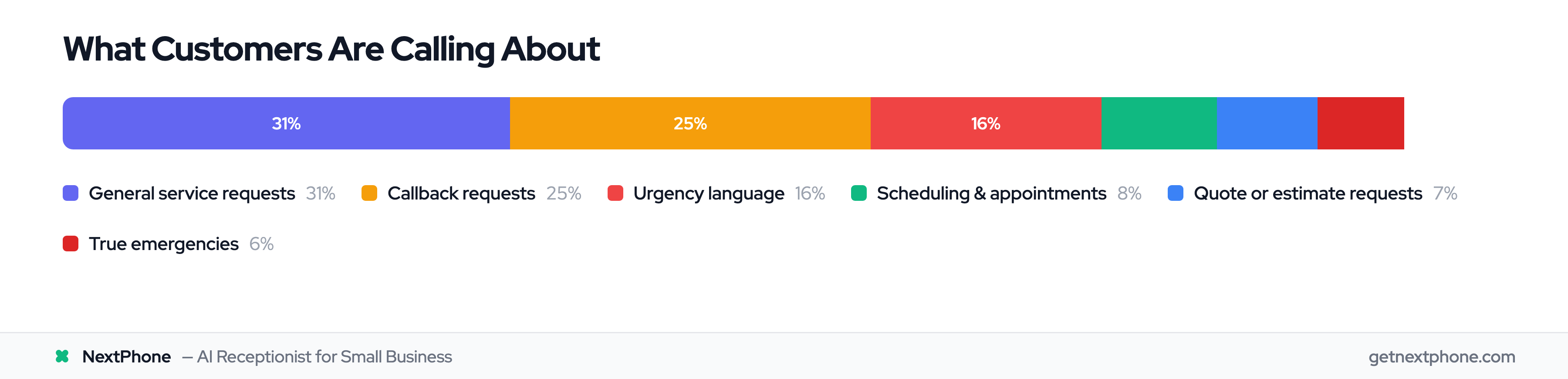
Industry data shows calls break down like this:
- 31.1% are general service requests
- 25.4% are callback requests
- 15.9% contain urgency language
- 7.7% are scheduling or appointment requests
- 6.9% are quote or estimate requests
- 6.2% are true emergencies
AI phone service detects which category each call falls into and routes accordingly.
Routine questions? AI answers directly from your knowledge base.
Emergency detected? (Keywords like "emergency," "urgent," "burst pipe," "no cooling") Routes immediately to your phone.
Appointment request? AI checks your calendar and books it.
General service request? AI gathers details (name, contact, what they need) and either schedules you to call back or transfers to you if you're available.
Real example: "Urgent: Porta potty delivery at 6 PM. Caller is waiting and needs to speak with you right away."
AI detects "urgent" and "waiting" and routes that call to your phone immediately. Meanwhile, when someone calls at 11 PM asking "Do you do kitchen remodels?" the AI can answer that without waking you up.
Integration with Your Business Systems
AI phone service doesn't exist in isolation. It connects to the tools you already use:
Calendar integration: Google Calendar, Outlook, Calendly, or your scheduling software. When AI books an appointment, it goes straight into your calendar with the customer's details.
CRM integration: Salesforce, HubSpot, or whatever you use to manage customer relationships. Every call creates or updates a contact record automatically.
Phone system: Works with any phone setup. Keep your existing number—just forward calls to the AI system or port your number over.
Communication tools: Can send you text or email notifications when certain types of calls come in.
Setup typically takes a few hours, not months. Most platforms offer one-click integrations with popular tools.
The AI + Human Hybrid Approach
Here's what separates good AI phone service from frustrating robot experiences: knowing when to hand off to a human.
McKinsey research shows AI can improve customer service productivity 30-50%. AI handles 60-80% of customer inquiries without needing human intervention. That's the routine stuff—hours, pricing, scheduling, basic service questions.
The other 20-40%? Those need you. Complex situations, upset customers, unusual requests, or anything the AI wasn't specifically trained for.
The best AI phone service platforms route to humans when:
- Caller specifically asks for you
- Question is outside the AI's knowledge base
- Situation requires judgment or empathy
- Technical complexity exceeds AI's capabilities
You're not being replaced. You're being freed from answering the same questions repeatedly so you can focus on the calls that actually need your expertise.
Key Benefits of AI Phone Service
Let's get specific about what AI phone service actually does for your business.
Never Miss a Call Again (24/7 Availability)
Your phone is answered 24 hours a day, 7 days a week, 365 days a year. Including:
- Weekends when you're not working
- Evenings after you're done for the day
- Early mornings before you start
- Holidays when you're with family
- Middle of the night emergencies
Remember that 37% of calls happening outside business hours? You're now capturing every one.
Real scenario: Customer's water heater fails at 9 PM Sunday. They call five plumbers. Four go to voicemail. One answers via AI, gathers the details, detects the urgency, and either books an emergency appointment or routes to the on-call plumber's phone. Guess who gets the $2,500 job?
Capture More Leads and Revenue
Let's talk about the calls you're currently missing:
Callback requests (25.4% of calls): Without a tracking system, industry research shows nearly half of callback requests never get returned. Not because you don't care, but because sticky notes get lost and voicemail messages pile up. AI tracks 100% of callback requests with contact details and timestamps.
Emergency calls (6.2% of all calls): These are your highest-margin opportunities. Emergency plumbing, HVAC, electrical, roofing jobs command premium pricing. If you're not answering, someone else is getting that work.
Quote requests (6.9% of calls): Every quote request is a warm lead. Someone actively wants your services. The data shows a simple truth: "Wants an estimate for a new roof. No urgency." That customer said "no urgency," but they're calling NOW. If you don't answer, they're getting quotes from competitors who did.
Industry data reveals the stark reality: small businesses miss 60-80% of calls. If you're getting 50 calls monthly and missing 35 of them, how many of those 35 were worth thousands in revenue?
Save Time and Focus on Your Work
Here's a benefit that's harder to quantify but possibly more valuable: getting your time back.
That 6.5% of calls asking repetitive questions? AI handles those instantly. No more stopping mid-project to answer "What area do you service?" for the tenth time this week.
The 7% that are spam or robocalls? Filtered automatically. According to our analysis of call patterns, spam accounts for roughly 7% of all incoming calls. That's 3-4 hours monthly you're not being interrupted by "We've been trying to reach you about your vehicle's extended warranty."
You can actually focus on:
- The job site work you're good at
- The customers in front of you
- The complex problems that need your expertise
- Growing your business instead of being chained to your phone
Better Customer Experience
Customers don't want to leave voicemails. They want answers.
AI phone service provides:
- Instant response: Answered in 6-8 seconds vs. going to voicemail
- Immediate information: Hours, pricing, availability answered instantly
- 24/7 access: Customers can get help when they need it, not when you're available
- Consistent experience: Professional greeting every time, not rushed answers when you're busy
Harvard Business Review research found that 63% of small businesses cite phone management as their top operational challenge. Customers notice when you're too busy to answer. AI solves this without making you hire more people.
Cost Savings Compared to Alternatives
Let's do the full math:
AI phone service: $199-499/month flat rate. No per-call charges, no per-minute fees, unlimited calls.
Traditional receptionist: $31,110/year median salary (Bureau of Labor Statistics) = $2,592/month. Add benefits and taxes: $3,000/month. And they're only available 9-5, missing 37% of calls outside those hours.
Traditional answering service: $300-800/month base for modest volume, but charges per call. At 87 calls monthly (what roofing contractors in our analysis average), answering services charge $650-900/month.
Year one cost comparison:
- AI: $2,388-5,988
- Receptionist: $36,000+
- Answering service: $7,800-10,800
- Voicemail: $0 (but costs you $25,000-75,000 in lost revenue)
The ROI is clear.
What Can AI Phone Service Handle?
Let's break down the specific types of calls AI phone service manages effectively.
Routine Questions and Information
These are the calls that interrupt your day but don't actually need you:
Common questions AI handles:
- "What are your hours?"
- "What's your service area?"
- "Do you do [specific service]?"
- "What's your pricing for [standard service]?"
- "Where are you located?"
According to call pattern analysis, 6.5% of calls are these repetitive questions. AI answers them from your business knowledge base in seconds. You train it once on your business details, and it handles these inquiries forever.
Real example: "Inquired about your hours of operation."
That caller got an instant answer. No voicemail, no waiting for callback, no taking you away from actual work.
Appointment Scheduling and Booking
This is where AI phone service really shines. 7.7% of customer calls are scheduling or appointment requests.
Here's how it works:
- Customer calls: "I need someone to look at my leaky faucet. What's your availability?"
- AI checks your connected calendar in real-time
- AI offers available slots: "I have Thursday at 2 PM or Friday at 10 AM available. Which works better?"
- Customer chooses
- AI books it, sends confirmation, adds to your calendar
You wake up to confirmed appointments. No phone tag, no back-and-forth texts, no double-bookings.
Real example from call data: "Wants to schedule service for a leaky toilet, asking about your availability for tomorrow."
AI checks tomorrow's calendar, finds an opening, books it. Done.
Emergency Detection and Urgent Call Routing
This is critical for service businesses. 15.9% of calls contain urgency language—phrases like "emergency," "urgent," "ASAP," "today," "right now," or "immediately."
An additional 6.2% are classified as true emergencies based on the situation described.
AI phone service detects these urgency indicators and routes calls differently:
Emergency detected → Transfers immediately to your phone, bypassing all other handling.
High urgency but not emergency → Takes priority in your callback queue with clear urgency flags.
Standard urgency → Handles normally (books appointment or takes message).
Real examples from our call analysis:
- "Needs emergency AC repair, no cooling in 95 degree weather" → Routes immediately
- "Needs you to come look at and repair a leak around a chimney. It's urgent due to ongoing rain" → Routes immediately
- "Wants to discuss a roof estimate and has questions" → AI handles or schedules callback
The difference? Emergency calls can't wait. The customer calls five contractors. First one to answer gets the $1,200-3,500 job.
Callback Request Tracking
One in four calls (25.4%) include an explicit request for a callback. These are qualified leads saying "I'm interested, call me back."
Without a tracking system, 42% of callback requests never get returned—and 42% of SMBs lose $500+ per month to missed calls. Not maliciously—they just get lost in the chaos of running a business.
AI phone service tracks 100% of callback requests with:
- Full name and contact information
- What they're calling about
- Best time to return the call
- Timestamp of when they called
- Priority level
Real example: "Requested you call back at [phone number]."
That request goes into your CRM or notification system. You see it, you call back, you close the deal.
Spam and Robocall Filtering
Spam isn't just annoying—it's expensive. Every spam call that gets through is an interruption to your productivity.
Call analysis shows 7% of incoming calls are spam or robocalls. For a business getting 60 calls monthly, that's 4 spam calls. Doesn't sound like much until you consider each interruption costs 15-20 minutes of focus time. That's over an hour monthly wasted on "We've been trying to reach you about your car's extended warranty."
AI phone service identifies spam patterns and filters them automatically. You never hear the call. It never interrupts your work.
AI Phone Service Cost and ROI
Let's talk money. What does AI phone service actually cost, and what's the return?
AI Phone Service Pricing Ranges
Current market pricing for small business AI phone service:
Budget tier ($99-199/month):
- Basic call answering
- Limited integrations
- Lower call volume caps
- Good for: Very small businesses, testing the waters
Standard tier ($199-399/month):
- Full call answering and routing
- Calendar and CRM integrations
- Unlimited or very high call limits
- Advanced features (emergency detection, appointment booking)
- Good for: Most small businesses
Premium tier ($399-699/month):
- Everything in standard
- Priority support
- Advanced customization
- Multi-location support
- Good for: Larger small businesses, multi-location
NextPhone sits at $199/month with unlimited calls—you pay the same whether you get 20 calls or 200.
Cost Comparison: AI vs Traditional Solutions
Let's line up the real costs:
Traditional receptionist:
- Salary: $2,592/month (median from Bureau of Labor Statistics)
- Benefits and taxes: +$500-900/month
- Total: $3,000-3,500/month
- Coverage: 9-5 weekdays only
- Misses: 37% of calls outside business hours
Traditional answering service:
- Base fee: $300/month
- Per-call charges: $5-8 per call
- Example at 65 calls/month: $300 + ($6 × 65) = $690/month
- Coverage: 24/7 (good!)
- Capability: Message-taking only, no appointment booking
AI phone service:
- Flat rate: $199/month (NextPhone)
- Per-call charges: $0
- Example at 65 calls/month: $199/month
- Coverage: 24/7
- Capability: Answers, routes, books appointments, integrates with systems
Year 1 total cost:
- AI: $2,388
- Answering service: $8,280
- Receptionist: $36,000+
You save $5,892 vs answering service. You save $33,612 vs receptionist.
Real ROI Calculations for Small Businesses
But the real ROI isn't just what you save on alternatives. It's what you capture that you're currently missing.
-
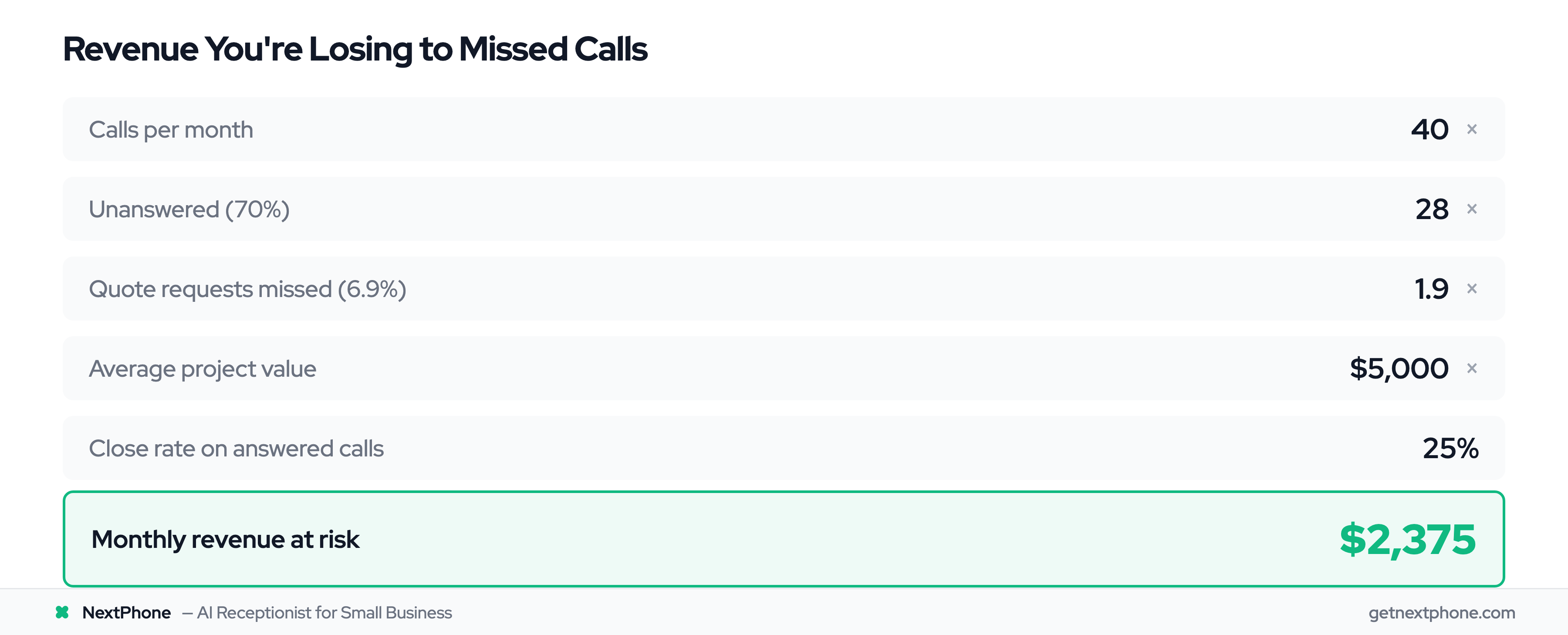
Example 1: General Contractor
-
Current volume: 40 calls/month
-
Industry data: 70% go unanswered = 28 missed calls
-
6.9% are quote requests = 1.9 quotes missed/month
-
Average project value: $5,000
-
Close rate on quotes provided: 25%
-
Monthly revenue loss: 1.9 × $5,000 × 25% = $2,375/month
-
Annual revenue loss: $28,500
-
AI phone service cost: $199/month ($2,388/year)
-
ROI: 11.9X (You save/capture $28,500, you spend $2,388)
-
Example 2: HVAC Contractor (Peak Season)
-
Peak season volume: 50 calls/month
-
70% unanswered = 35 missed calls
-
6.2% are emergencies = 2 emergency calls missed/month
-
Emergency jobs: $1,200 average
-
Close rate on emergencies answered: 90% (they need help NOW)
-
Monthly revenue loss: 2 × $1,200 × 90% = $2,160/month
-
Just in 3-month peak season: $6,480 lost
-
AI cost for 3 months: $597
-
ROI: 10.8X for peak season alone
-
Example 3: Service Business (Any Trade)
-
Volume: 30 calls/month (low volume)
-
60% unanswered = 18 missed
-
25.4% request callbacks = 4.5 callback requests
-
Industry research: 42% of callbacks never get returned = 1.9 lost customers/month
-
Average service value: $800
-
Monthly revenue loss: 1.9 × $800 = $1,520/month
-
Annual: $18,240
-
AI cost: $2,388/year
-
ROI: 7.6X
When AI Phone Service Pays for Itself
The math is simple: AI phone service pays for itself when you capture just one additional job per month that you would have otherwise missed.
For most service businesses:
- One $2,000 service call = 10 months of AI phone service paid for
- One $5,000 project = 25 months paid for
- One $15,000 roof = 75 months (6+ years) paid for
And you're not capturing just one additional job. You're capturing every call that currently goes unanswered.
AI Phone Service vs Traditional Solutions
Let's compare your options directly.
AI vs Hiring a Receptionist
Receptionist strengths:
- Human touch and judgment
- Can handle complex conversations
- Visual presence if you have walk-in traffic
Receptionist limitations:
- Cost: $3,000+/month with benefits
- Hours: Typically 9-5, maybe 8-6
- Misses 37% of calls outside business hours
- Sick days, vacation, turnover
- Can only handle one call at a time
- Needs management and training
The reality: AI at $199/month handles phone calls and routes complex situations to YOU. Walk-in traffic still needs someone at the desk—but phone calls get handled by AI. "Complex interactions requiring judgment"? AI routes those to YOUR phone in under 5 seconds. The question isn't "can you afford $36K/year"—it's why pay $36K when $199/month captures the same calls?
For phone answering: AI wins. Always. (Except medical practices requiring complex diagnostic triage)
AI vs Traditional Answering Service
Answering service strengths:
- Human voice (some customers prefer this)
- 24/7 coverage
- Can handle unexpected situations
Answering service limitations:
- Cost scales with usage ($6-8 per call adds up fast)
- Response time: 30-90 seconds to answer
- Message-taking only (can't book appointments)
- No integration with your calendar or CRM
- You still have to call everyone back
Real cost example: Ruby Receptionists charges a base fee plus per-call charges. For a roofing contractor averaging 87 calls monthly, the bill hits $770/month. That's $9,240 annually vs $2,388 for AI.
The reality: Even at 20 calls/month, answering services cost $250-350 vs AI at $199. Plus AI includes appointment booking, calendar integration, and 1-ring answer speed. The "human interaction" caller waits 30-90 seconds with answering services vs instant with AI. Callers don't care about species—they care about speed.
For any call volume: AI wins. (Except medical practices requiring complex diagnostic triage)
AI vs Just Using Voicemail
Voicemail strengths:
- Free (well, included with phone service)
- Simple
- No setup required
Voicemail limitations:
- Industry research shows 60-80% of callers don't leave messages
- Of those who do, you still have to call them back (and they might not answer)
- Zero information provided to caller
- Feels unprofessional ("They're too busy for me")
- Emergencies go unanswered while you're working
The voicemail trap: It feels free, but it's costing you thousands monthly in lost opportunities.
Example: "Wants an estimate for a new roof. No urgency."
That customer hit your voicemail, didn't leave a message, and called the next three roofers until someone picked up. You never knew they called.
Why Hybrid AI Solutions Work Best
The winning approach isn't "AI or humans"—it's AI for the routine, humans for the complex.
Best practice:
- AI handles: Routine questions, appointment booking, after-hours calls, spam filtering, initial call screening
- Humans handle: Complex situations, upset customers, unusual requests, judgment calls
This gives you:
- 24/7 coverage (AI never sleeps)
- Professional service (AI is consistent)
- Human touch when it matters (complex issues route to you)
- Affordable cost (not paying humans to answer "What's your service area?" for the hundredth time)
NextPhone and similar platforms take this hybrid approach: AI answers every call, handles what it can, and intelligently routes to you when needed.
Who Benefits Most from AI Phone Service?
AI phone service works for almost any business with a phone. But some industries see dramatically better results.
Home Services and Field Service Businesses
This is the sweet spot. Contractors, trades, and field service businesses benefit most because:
You physically can't answer while working:
- On a roof or ladder
- In a trench or crawl space
- With tools in your hands
- Driving between job sites
- With a customer at their property
Your calls are time-sensitive: According to industry data, 10.6% of roofing calls are quote requests. With average roof projects at $15,000, every missed quote call is potentially $15,000 walking away. Customers call three to five roofers—first one to respond usually wins.
Emergency calls are high-value: That 6.2% of calls classified as emergencies? Those command premium pricing. Emergency plumbing, HVAC, electrical, or roofing jobs are your highest-margin work. If you're not answering, competitors are.
Specific trades that benefit:
- Roofing and siding contractors
- HVAC technicians
- Plumbers
- Electricians
- General contractors
- Painters
- Landscapers
- Pool and spa services
- Pest control
Real contractor quote from our research: "I can't answer my phone when I'm on a roof. NextPhone handles it and my schedule stays full."
Professional Services (Legal, Medical, etc.)
Doctors, dentists, lawyers, accountants, and consultants can't interrupt appointments to answer phones.
Why professional services benefit:
- Can't interrupt patient/client appointments
- Calls often need screening (sales vs actual clients)
- Appointment booking is critical
- After-hours calls are common
- Professional image matters
Example: Law office gets call at 8 PM from someone who just got arrested. They're calling lawyers from a list. First one to answer (via AI) captures a $5,000-15,000 client.
Medical and dental practices use AI phone service to:
- Answer "Are you accepting new patients?"
- Provide office hours and location
- Book appointments
- Handle prescription refill requests (route to on-call nurse)
- Screen emergencies vs routine calls
Small Retail and Hospitality
Restaurants, salons, small shops, and hospitality businesses benefit when:
- You're busy with in-person customers
- Calls are primarily for hours, reservations, or availability
- You need 24/7 information availability
- Staff is too small to dedicate someone to phones
Real scenario: Busy restaurant during dinner rush. Phone rings with reservation request. Host is seating tables, can't answer. AI picks up, checks reservation system, books the table. Customer is happy, table is filled.
Any Business That Can't Always Answer the Phone
The common thread across all these industries:
You can't always answer, but every call matters.
If you're:
- A one-person business doing everything yourself
- A small team where everyone has a primary job (no dedicated receptionist)
- Working on-site with customers or at job sites
- Providing services that require your full attention
- Operating in an industry where customers call competitors if you don't answer
Then AI phone service captures the revenue you're currently leaving on the table.
How to Implement AI Phone Service
Good news: Setup is easier than you think. Most businesses are fully operational within a few hours.
Step 1: Choose Your Platform
Research platforms based on your needs:
Key criteria:
- Pricing model (flat rate vs per-call)
- Integration with your existing tools (calendar, CRM, phone system)
- Industry specialization (some platforms optimize for specific industries)
- Customer support quality
- Trial period availability
Most platforms offer 7-day free trials. Test before committing.
Step 2: Set Up Your Business Information
You'll train the AI on your business basics:
Essential information:
- Business hours (including exceptions like holidays)
- Services you provide
- Service area (zip codes, cities, or radius)
- Pricing for common services
- Staff names and roles
- Common questions and their answers
This takes 30-60 minutes. Most platforms provide a simple form or setup wizard.
Step 3: Configure Call Routing Rules
Define how different calls should be handled:
Routing rule examples:
- Emergency keywords ("emergency," "urgent," "burst pipe") → Transfer immediately to my phone
- Appointment requests → Check calendar, book if slot available
- General questions → AI answers from knowledge base
- Quote requests → Gather details, schedule callback
- After 9 PM or weekends → Only transfer if true emergency, otherwise take message
You control how aggressive or conservative the routing is.
Step 4: Integrate with Your Tools
Connect your existing systems:
Common integrations:
- Calendar: Google Calendar, Outlook, Apple Calendar, Calendly
- CRM: Salesforce, HubSpot, or whatever you use
- Phone: Works with any phone system via forwarding or number porting
- Communication: Slack, email, SMS for notifications
- Scheduling: Jobber, Housecall Pro, ServiceTitan, etc.
Most platforms offer one-click integrations. Setup takes minutes.
Step 5: Test and Launch
Before going live:
Testing checklist:
- Call your number from different phones
- Test common scenarios (quote request, emergency, general question)
- Verify calendar integration books correctly
- Check that routing rules work as expected
- Make sure you receive notifications properly
Once testing passes, you're live. Calls start routing to AI immediately.
Most businesses go from signup to fully operational in 2-4 hours of actual work time.
How NextPhone Provides AI Phone Service
For small businesses that can't answer every call, NextPhone offers AI-powered phone service starting at $199/month—less than hiring a part-time employee for one week.
Here's how it works in practice:
When a call comes in, NextPhone's AI answers in under 5 seconds. It handles common questions from your business knowledge base: hours, service area, pricing for standard services, availability.
For emergencies—remember that 15.9% of calls with urgency language—the AI detects keywords like "emergency," "urgent," "burst pipe," or "no cooling" and routes the call to your phone immediately. You get the high-priority calls without being interrupted by "What time do you close?"
The AI can also book appointments directly into your Google Calendar, Outlook, or scheduling system. Customer calls at 11 PM asking for a Thursday morning appointment? The AI checks your availability and books it. You wake up to a confirmed appointment and a call summary.
For callback requests—that 25.4% of callers who say "have them call me back"—NextPhone tracks 100% of them with contact details, what they need, and when they called. No more sticky notes or lost voicemails.
The key difference: NextPhone doesn't try to replace you. It handles the routine calls so you can focus on the important ones. If a caller has a complex question or specifically asks for you, NextPhone routes them through or takes a detailed message with their contact information.
One contractor told us: "I can't answer my phone when I'm on a roof. NextPhone handles it and my schedule stays full. It's like having a receptionist for $200/month."
Frequently Asked Questions
How accurate is AI phone service?
Modern AI phone service achieves 85-95% accuracy for routine business inquiries, according to AI research. The key is training the AI on your specific business—what services you offer, your pricing, your hours, your common questions.
Where AI excels: Answering straightforward questions, booking appointments, gathering basic information, detecting urgency.
Where AI hands off to humans: Complex situations, unusual requests, angry customers, anything requiring judgment or empathy.
The best systems know their limitations and route to humans rather than guessing. Accuracy improves over time as the system learns from corrections and feedback.
Will customers know they're talking to AI?
That's up to you. Most platforms let you choose whether to be transparent about AI or not mention it.
Modern conversational AI sounds natural—not robotic. Most customers care more about "Did I get my question answered quickly?" than "Was that a human or AI?"
Many customers actually prefer AI for simple questions because:
- Instant answer (no hold time)
- Available 24/7 (no "call back during business hours")
- Consistent information (not different answers from different people)
For complex situations where human judgment matters, AI routes to you. Customers who need a human get a human.
Can AI phone service handle angry or upset customers?
AI can handle routine complaints like "My appointment was moved" or "I'm still waiting for a callback." It can apologize, check records, and either resolve or route appropriately.
For truly upset customers—yelling, demanding refunds, threatening—the best practice is immediate transfer to a human. Good AI platforms detect frustration in tone and language and route these calls to you.
The hybrid approach works: AI handles "I'm annoyed my appointment was rescheduled" while you handle "I'm furious and want to speak to the owner RIGHT NOW."
Do I need special phone equipment or a new phone number?
No special equipment needed. AI phone service is cloud-based and works with any phone setup.
Two options for your phone number:
-
Option 1: Call forwarding - Keep your existing number, forward calls to the AI system. Takes 5 minutes to set up.
-
Option 2: Number porting - Transfer your existing number to the AI platform. Takes 1-2 weeks but customers never know anything changed.
You can also get a new number through the platform if you prefer, though most businesses keep their existing number for continuity.
How does AI phone service integrate with my calendar and CRM?
Most platforms integrate via API or native connections with popular business tools.
Common calendar integrations:
- Google Calendar (Workspace)
- Microsoft Outlook / Office 365
- Apple Calendar
- Calendly
- Acuity Scheduling
Common CRM integrations:
- Salesforce
- HubSpot
- Zoho
- Pipedrive
- Industry-specific tools (Jobber, ServiceTitan, Housecall Pro for field service)
The AI can book appointments directly into your calendar, create or update contact records in your CRM, and log call summaries automatically. Most integrations are one-click setup.
NextPhone integrates with the most popular business tools out of the box, and custom integrations are available if you use specialized software.
What happens if the AI can't answer a question?
Good AI phone service has three fallback options when it encounters something it can't handle:
-
Option 1: Transfer to you - If you're available and the call is important enough, AI transfers immediately.
-
Option 2: Take a detailed message - AI gathers the caller's name, contact information, and details about what they need. You get a notification and can call back.
-
Option 3: Escalate to human backup - Some platforms offer human agent backup for situations the AI can't resolve.
You control the routing rules. You might configure it to:
- Always transfer emergencies
- Take messages after business hours
- Route complex questions to you during work hours
- Send you notifications for specific types of calls
All interactions are logged so you can review what the AI said and how it handled each call.
Is AI phone service secure? What about compliance?
Reputable AI phone service platforms use encryption for both calls and data storage. Security standards typically include:
- End-to-end encryption for voice calls
- Encrypted data storage
- Secure API connections
- Access controls and authentication
- Regular security audits
For healthcare businesses: If you handle protected health information (PHI), verify your provider's security practices meet your regulatory needs. Key things to look for:
- Encrypted infrastructure
- Clear data handling procedures
- Audit logs
- Transparent privacy policies
Check with your specific provider about their security certifications and compliance posture.
For most small businesses outside healthcare, standard security is sufficient. Review the platform's privacy policy and security documentation before choosing.
Start Answering Every Customer Call
AI phone service isn't just for enterprises anymore. Small service businesses are using it to capture calls they'd otherwise miss, book appointments 24/7, and compete with bigger companies—all without hiring full-time staff or paying thousands monthly for answering services.
The businesses winning in 2026 aren't the ones with the biggest budgets. They're the ones answering every call.
Industry data shows small businesses miss 60-80% of incoming calls. Every missed call is a customer choosing your competitor instead. The question isn't whether you can afford AI phone service—it's whether you can afford to keep missing calls.
Ready to stop missing calls? Start your free 7-day trial of NextPhone today →