You're in the back of your shop, soldering a delicate motherboard connection. The phone rings. Your hands are full of tiny components, and answering means starting over on a two-hour repair.
The call goes to voicemail.
That customer? They're standing on a sidewalk with a cracked iPhone screen and $150 in their pocket. They needed it fixed today—for work, for their kids, for life. When you didn't answer, they called the shop down the street.
You never knew you lost them.
This happens more than most repair shop owners realize. In an analysis of thousands of customer service calls across small businesses, 74.1% went completely unanswered. For phone repair shops where customers need immediate solutions, that number represents thousands in lost revenue every year.
This guide breaks down your answering service options—AI, live, and hybrid—with transparent pricing and the features phone repair shops actually need. By the end, you'll know exactly which solution captures every cracked screen, dead battery, and water-damaged device that calls your shop.
The Hidden Cost of Missed Calls in Phone Repair
Most repair shop owners think they're answering "most" of their calls. The data tells a different story.
How Many Calls Are You Actually Missing?
Small businesses miss an average of 74.1% of incoming calls. For a typical shop receiving 42 calls per month, that's 31 potential customers who never got through. Some called back. Most didn't.
The problem compounds when you're doing what you're supposed to be doing—repairing phones. Screen replacements require focus. Data recovery requires uninterrupted attention. Every ring you can't answer is a customer deciding whether to wait or move on.
The Math: What Missed Calls Cost Your Repair Shop
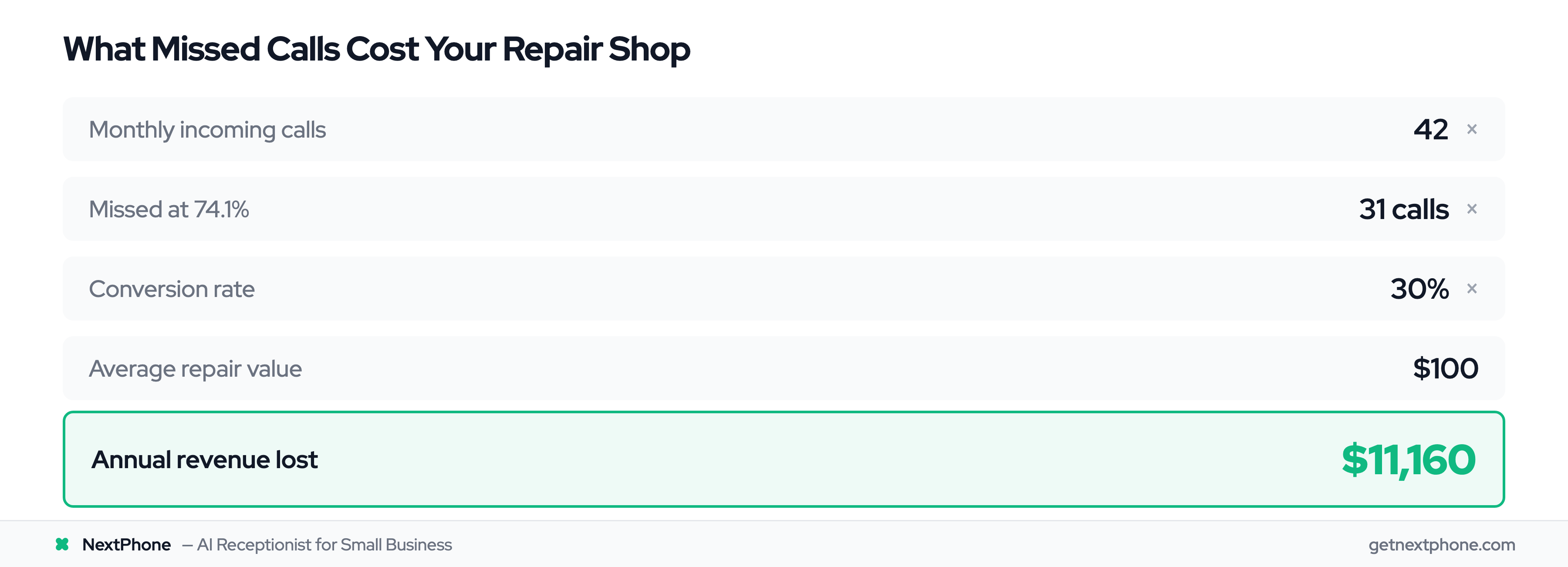
Let's run the numbers for a typical phone repair business:
- Monthly calls: 42
- Missed at 74.1%: 31 calls
- Conversion rate: 30% (industry average for service calls)
- Average repair value: $100
Monthly loss: 31 × 30% × $100 = $930
Annual loss: $11,160
And that's conservative. If your average repair runs $150 (screen + case + tempered glass), you're looking at $16,740 per year walking out the door.
But it gets worse. Each new customer has a lifetime value of $300-500 when you factor in repeat repairs, accessories, referrals to friends, and the family members whose phones inevitably break too. Miss that first call, and you miss all of it.
The Voicemail Trap
"But I have voicemail," you might think. "They can leave a message."
Here's the problem: they won't. Research from BIA/Kelsey shows 80% of callers who reach voicemail hang up without leaving a message. They don't want to wait for a callback—they want their phone fixed now.
Even worse, 85% of people who can't reach you on the first try never call back. They've already found someone else.
Why Phone Repair Customers Won't Wait
Phone repair isn't like hiring a contractor or scheduling a dental cleaning. Your customers have a broken device in their hands right now, and they need it working.
The Broken Phone Urgency
Think about the last time your phone died. Not the battery—the screen, the charging port, the whole thing. How long did you wait before trying to fix it?
Phone repair customers call with immediate need:
- The sales rep whose phone cracked before a client meeting
- The parent whose kid dropped their tablet and school starts tomorrow
- The small business owner whose card reader stopped working mid-shift
These aren't people browsing options for next month. They're solving a problem in the next hour.
Speed-to-Lead: Why First Responders Win
Research from MIT and InsideSales.com found that 78% of customers buy from the first company that responds to their inquiry. Not the cheapest, not the best-reviewed—the first one to pick up the phone.
For phone repair, this is even more pronounced. A customer with a cracked screen will Google "phone repair near me" and call the top 2-3 results. Whoever answers first gets a $150 repair job. The other shops never know they were in the running.
The same research shows that responding within 5 minutes makes you 100 times more likely to connect with a lead compared to waiting 30 minutes. In phone repair, 30 minutes might as well be 30 days—that customer is already at your competitor's counter.
What Happens When You Don't Answer
When your phone rings and nobody picks up:
- 48% of callers immediately search for a competitor
- 85% never try calling you again
- Your Google Ads spend goes to waste (you paid for that call)
- Your reviews stay stagnant while competitors collect happy customers
Every missed call isn't just lost revenue—it's revenue gained by the shop down the street.
Types of Answering Services for Phone Repair Shops
You have four main options for handling calls when you can't answer yourself. Each has trade-offs worth understanding.
AI-Powered Answering Services
AI answering services use natural language processing to have real conversations with callers. They answer questions, book appointments, and route urgent calls—all without human intervention.
Pros:
- Answers every call in under 5 seconds, 24/7/365
- Handles unlimited calls for a flat monthly fee
- Books appointments and sends SMS confirmations automatically
- Learns your business—pricing, services, hours—and answers accurately
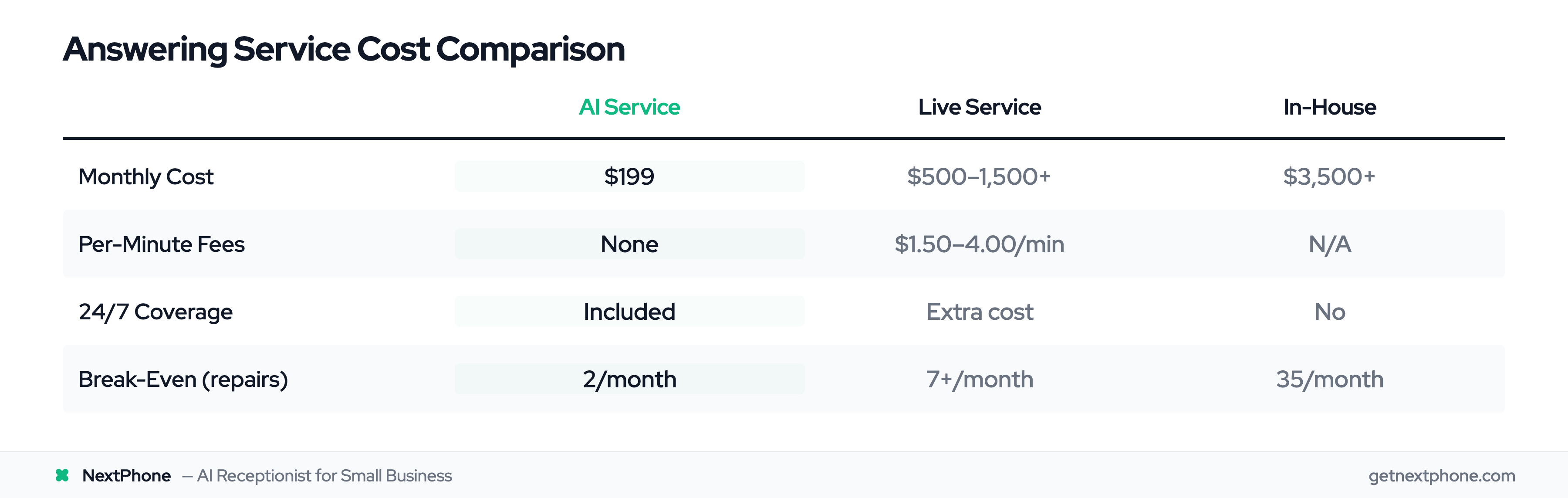
- Costs $50-300/month depending on features
Cons:
- Can't handle truly complex conversations (rare for phone repair)
- Some customers prefer human interaction
- Requires initial setup and training
Best for: High call volume, after-hours coverage, cost-conscious shops, owners who are frequently mid-repair.
Live (Human) Answering Services
Live services employ real people who answer your phone with your business name. They take messages, book appointments, and handle basic inquiries.
Pros:
- Human voice and real-time problem-solving
- Can handle emotional or complex situations
- Familiar to customers who distrust automation
Cons:
- Costs $500-1,500+ per month (based on call volume)
- Per-minute charges add up fast: $1.50-4.00/minute is standard
- Limited hours unless you pay premium for 24/7
- Quality varies by provider and individual operator
- Operators don't know your business as well as you do
Best for: Shops wanting a personal touch, complex intake requirements, customers in demographics that prefer human interaction.
AI-First with Smart Forwarding
AI-first services handle routine calls—hours, pricing, appointment booking—while smart forwarding routes complex issues directly to you.
Pros:
- AI handles volume, you handle exceptions
- Cost-effective with full coverage
- More affordable than pure live service
Cons:
- More expensive than AI-only ($300-800/month typical)
- Handoff between AI and human can feel disjointed
- Still has the per-minute charges for human time
Best for: Shops with varied call complexity, those wanting to test AI with a safety net.
In-House Receptionist
Hiring your own receptionist gives you complete control over the customer experience.
Pros:
- Dedicated to your business only
- Learns your customers and builds relationships
- Can handle walk-ins and phone simultaneously
Cons:
- Costs $35,000-45,000/year in salary alone
- Add benefits, payroll taxes, training: $42,000+/year total
- Only covers 40 hours/week (screens crack on weekends too)
- Sick days, vacations, lunch breaks mean missed calls
- Turnover means constant retraining
Best for: Larger shops with consistent high volume who can afford the overhead.
| Service Type | Monthly Cost | 24/7 Coverage | Best For |
|---|---|---|---|
| AI Answering | $50-300 | Yes | Most phone repair shops |
| Live Service | $500-1,500+ | Extra cost | Personal touch priority |
| Hybrid | $300-800 | Usually | Testing AI with backup |
| In-House | $3,500+ | No | Large, high-volume shops |
Must-Have Features for Phone Repair Shop Answering Services
Not all answering services are built for repair businesses. Here's what actually matters for phone repair shops.
24/7 Availability (Non-Negotiable)
Screens crack at 9 PM on a Friday. Phones fall in toilets on Sunday morning. Water damage happens when it happens.
A large share of small business calls come in outside traditional 9-5 hours. For phone repair specifically, after-hours callers often have the highest urgency—and the most willingness to pay for same-day or emergency service.
If your answering service only covers business hours, you're missing the customers who need you most.
Appointment Scheduling Integration
When a customer calls about a cracked screen, they want to know two things: how much and when.
A good answering service books the appointment right there on the call. No "someone will call you back." No friction between "yes, I want this fixed" and "you're on the schedule."
Research from RepairDesk shows automated appointment reminders reduce no-shows by 29%. That's nearly a third fewer empty time slots from people who forgot they scheduled.
SMS Follow-Up Capabilities
Phone repair has a unique communication need: status updates.
Your answering service should send:
- Appointment confirmation texts
- "Your device is ready for pickup" notifications
- Repair delay alerts (when parts don't arrive on time)
- Review requests after pickup
These aren't nice-to-haves. They're the difference between customers who feel informed and customers who call three times asking "is it done yet?"
Call Routing and Transfer
Not every call should go to voicemail or AI. Some need you immediately:
- Water damage with a phone that's still wet (minutes matter)
- Existing customer with urgent question about repair in progress
- High-value data recovery inquiry
Your answering service should route these calls directly to your cell while handling routine inquiries independently. The best services let you set rules: "If the caller mentions water damage, transfer immediately."
Basic Repair Inquiry Handling
80% of phone repair calls ask the same questions:
- "Do you repair [brand/model]?"
- "How much for a screen replacement?"
- "What are your hours?"
- "Where are you located?"
An AI answering service handles these instantly and accurately—because you trained it on your actual pricing and services. No hold time, no callback, no lost customer.