
It's 2:30 PM on a Tuesday. You're on a ladder installing a new roof when your phone buzzes in your pocket. By the time you climb down safely, the call has gone to voicemail. The message: "Hi, I need an emergency roof repair for a leak. If I don't hear back in the next hour, I'll call someone else." You call back 20 minutes later. No answer. The job—and its $3,500 revenue—is gone.
Research shows that 62% of calls to small businesses go unanswered, and 85% of those customers won't call back. For home services contractors, this translates to an average of $126,000 in lost revenue annually.
62% of calls to home services businesses go unanswered, costing significant revenue. This is where AI phone answering comes in. In this guide, we'll explain exactly how AI phone answering technology works—from the moment a call comes in to how it routes emergencies, schedules appointments, and captures leads—with real examples from actual customer calls.
The Problem AI Phone Answering Solves
Every unanswered call is a potential customer choosing your competitor. For home services businesses, the reality is particularly brutal.
Why Small Businesses Miss Calls
You're not missing calls because you're lazy or unprofessional. You're missing them because you're actually working. You're on job sites, under sinks, in attics, on ladders, with customers—doing the work that pays the bills. When your phone rings at those moments, it goes to voicemail.
82% of customers expect an immediate response when they contact businesses. Industry research shows home services contractors miss 60-80% of incoming customer calls. That's not an occasional problem. That's the norm.
The reasons are clear: you're driving between jobs, you're working after hours when the office is closed, you're with another customer and can't take a second call, or you're simply overwhelmed during busy season when call volume spikes.
The True Cost of Missed Calls
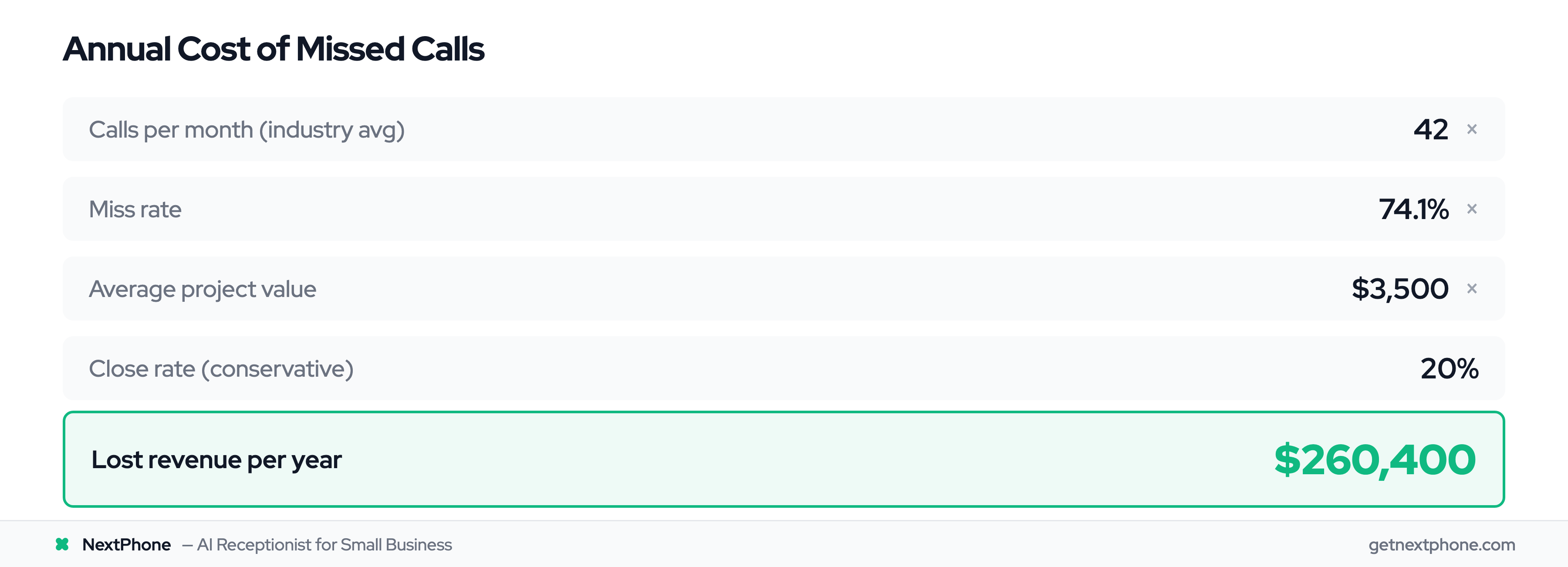
Let's do the math. According to industry research, each missed call costs an average of $1,200 in lost sales. The total annual loss? $126,360 per business from unanswered calls alone.
Here's what makes it worse: 85% of customers whose calls go unanswered will not call back. They move on to the next contractor. Your competitor answers, you lose.
For a general contractor receiving 42 calls per month—a typical volume based on industry data—and missing 74.1% of them, that's 31 missed calls monthly. If just 20% of those callers would have hired you at an average project value of $3,500, you're losing $21,700 per month. That's $260,400 per year walking away because nobody picked up the phone.
Traditional Solutions Fall Short
Most businesses try three approaches, and all have serious limitations.
Hiring a receptionist sounds great until you calculate the cost. At $37,000 per year in salary plus benefits (around $45,000 total), you're spending $3,750 per month. They work 9-5, Monday through Friday. What happens to the evening calls, weekend emergencies, and holiday inquiries? Those still go to voicemail.
Traditional answering services charge $200-600 per month for limited minutes. When research shows the average wait time for customer service is 42 minutes, you're paying premium rates for customers to wait nearly an hour. During busy season when your call volume doubles? Your bill hits $2,000 or more.
Just letting it ring is what most small businesses end up doing. It's free, but it's also costing you six figures in lost revenue.
42% of SMBs lose $500+ per month to missed calls. None of these solutions scale with unpredictable call volume, work after hours, or handle multiple simultaneous calls during peak periods.
Enter AI Phone Answering
According to Gartner's survey of customer service leaders, 85% will explore or pilot conversational AI in 2025. McKinsey's State of AI in 2025 report found that contact center and customer service automation is among the most common AI use cases, with more than two-thirds of companies using AI in multiple functions.
This isn't experimental technology anymore. It's becoming standard practice.
What Is AI Phone Answering?
AI phone answering is technology that uses artificial intelligence to answer incoming phone calls, understand what callers are saying through natural language processing, and respond intelligently using text-to-speech—functioning as an AI virtual receptionist that handles everything from answering FAQs to scheduling appointments to routing emergencies without human intervention.
How It's Different from IVR and Voicemail
If you're thinking "that sounds like those annoying 'Press 1 for sales, Press 2 for support' systems"—it's not.
Traditional IVR (Interactive Voice Response) forces callers to navigate phone trees. "Press 1 for this, press 2 for that." It's menu-driven, not conversational. Customers hate it.
The voice recognition market is valued at $26.79 billion. AI phone answering has an actual conversation. A caller says "I need a plumber for a leaky toilet tomorrow," and the AI responds "I can help you schedule that toilet repair. I have availability tomorrow at 10 AM or 2 PM. Which time works better for you?" No menus. No buttons. Just a conversation.
Voicemail is one-way—the caller leaves a message and hopes you'll call back. Most won't wait. AI phone answering is two-way interaction that takes action immediately while the caller is still on the line.
How It's Different from Traditional Answering Services
Traditional answering services use real humans reading from scripts. They're better than voicemail, but they're expensive, they have wait times (42 minutes on average), and quality varies by operator.
AI phone answering provides instant response—zero seconds of hold time. It costs a fraction of traditional services ($50-300/month versus $500-800/month). And it's consistent every single time. No bad days, no sick calls, no training new operators.
The Rise of Conversational AI
The technology powering AI phone answering is conversational AI—systems that understand natural language, not just keywords.
According to industry research, the global AI chatbot market is valued at $10-15 billion in 2025 and growing at 24-30% annually. This isn't niche technology. It's mainstream.
McKinsey's research shows contact center automation is the most common AI use case across industries. More than 67% of organizations are using AI in multiple business functions. The adoption is accelerating because the technology actually works.
How AI Phone Answering Works: The 5-Step Process
When a customer calls a business using AI phone answering, here's exactly what happens behind the scenes.
Step 1: Speech Recognition (ASR) - Voice to Text
The moment someone starts speaking, Automatic Speech Recognition (ASR) technology converts their spoken words into written text in real-time. Think of it like the live captioning you see on TV, but for phone calls.
Modern ASR systems achieve up to 97.5% accuracy according to research published in ACM Transactions on Accessible Computing. The technology handles different accents, background noise, and varying phone line quality.
This happens in milliseconds. By the time the caller finishes saying "I need an estimate for a roof repair," the AI has already converted that speech to text and is moving to the next step.
Step 2: Natural Language Processing (NLP) - Understanding Intent
Converting speech to text is only half the battle. The AI needs to understand what the caller actually wants.
This is where Natural Language Processing (NLP) comes in. The AI doesn't just match keywords—it analyzes meaning and context to determine intent.
When someone says "Needs emergency AC repair, no cooling in 95 degree weather," the NLP identifies several things:
- Service type: HVAC/AC repair
- Urgency level: Emergency (keywords: "emergency," "95 degree")
- Situation: System failure, immediate need
- Action required: Route to on-call technician immediately
Customer service data reveals that 15.9% of calls contain urgency language like "urgent," "ASAP," "emergency," or "today." The AI detects these signals and adjusts its response accordingly.
Step 3: Dialogue Management - Deciding the Response
Now the AI knows what the caller wants. The "dialogue management" system—essentially the brain—decides what to do about it.
Based on the caller's intent, the system determines the best response:
- If it's a FAQ ("What are your hours?") → Pull answer from knowledge base
- If it's an appointment request → Check calendar availability
- If it's an emergency → Route to on-call human immediately
- If it's a callback request → Capture contact information
- If it's spam → Filter it out
The system uses decision trees and machine learning to get smarter over time. Every call it handles teaches it to respond better to similar situations in the future.
Step 4: Text-to-Speech (TTS) - Talking Back to the Caller
Once the AI composes its response, it needs to speak it. Text-to-Speech (TTS) technology converts the AI's written response back into natural-sounding speech.
Modern TTS has come a long way from the robotic voices of the past. You can customize voice, tone, speed, and accent to match your brand. The result sounds remarkably human—many callers don't immediately realize they're speaking with AI.
When the AI composes "I can help you schedule that. What day works best for you?" the TTS speaks it naturally, maintaining conversational flow.
Step 5: Taking Action - Booking, Routing, or Capturing Information
Here's where AI phone answering becomes more than just a chatbot. It actually does things:
- Books appointments directly into your calendar (Google Calendar, Outlook, scheduling software)
- Sends SMS confirmations to the customer
- Creates CRM entries with lead details automatically
- Routes urgent calls to your phone immediately
- Sends email notifications with call summaries
- Logs all call data for analytics
All of this happens in real-time during the call. The customer hangs up with their appointment confirmed, and you get a notification with all the details.
Full Example Walkthrough
Let's watch all five steps work together with a real customer call example: "Wants to schedule service for a leaky toilet, asking about your availability for tomorrow."
- ASR: Converts spoken request to text
- NLP: Detects intent = "schedule appointment" + service type = "plumbing" + urgency = "tomorrow"
- Dialogue Management: Determines action = check calendar for tomorrow's availability
- TTS: Responds "I can help you schedule that toilet repair. I have availability tomorrow at 10 AM or 2 PM. Which time works better?"
- Action: Once caller chooses, books appointment, sends SMS confirmation, creates CRM entry with customer details
The entire interaction takes 60-90 seconds. The customer gets their appointment. You get a new job on your calendar. Nobody waited on hold. Nobody went to voicemail.
What AI Phone Answering Can Handle (Real Examples)
Let's look at what AI phone answering actually handles in real-world scenarios, using data from actual customer calls.
Appointment Scheduling and Calendar Management
Customer service data shows that 7.7% of calls are scheduling or appointment requests. That might sound small until you realize it's 3-4 calls per month for an average contractor—each one a confirmed job if handled properly.
AI checks your calendar availability, books the appointment, and sends confirmation—all during the call.
Real example: "Needs to schedule T&M for roof patch within the next 5 business days."
The AI detects it's a scheduling request, checks the next five business days for availability, offers options, and books the slot the customer chooses. It integrates with Google Calendar, Outlook, or whatever scheduling system you use.
Answering Frequently Asked Questions
Common questions like "What are your hours?", "What's your service area?", or "Do you offer emergency service?" don't need a human to answer them.
Data shows 5.2% of calls are general questions. The AI pulls from a knowledge base you customize with your business information and responds instantly.
A caller asks "Do you service [city name]?" The AI knows your service area and answers immediately: "Yes, we serve all of [county name] including [city]. Would you like to schedule a service call?"
Capturing Callback Requests (25.4% of Calls!)
Here's the surprising stat: 25.4% of customer calls explicitly request callbacks. That's one in four calls.
These aren't complex negotiations or technical discussions. They're literally "Requested you call back at 888-568-0296" or "Wants you to call them back when you have a chance."
This is critical for contractors who can't answer while on job sites. The AI captures the name, phone number, preferred callback time, and reason for the call. You get a notification with everything you need to call them back.
Without AI, these go to voicemail. With AI, you get structured callback requests you can actually follow up on.
Routing Emergency and Urgent Calls
Data reveals that 15.9% of calls contain urgency language and 6.2% are true emergencies requiring immediate attention.
The AI detects keywords like "urgent," "ASAP," "emergency," "no heat," "flooding," "leak," and immediately routes the call to your on-call staff.
Real examples from actual customer calls:
- "Urgent: Porta potty delivery at 6 PM. Caller is waiting and needs to speak with you right away."
- "Needs emergency AC repair, no cooling in 95 degree weather."
- "Needs you to come look at and repair a leak around a chimney. It's urgent due to ongoing rain."
In each case, the AI recognizes the urgency, captures the essential details (what's the emergency, where, contact info), and routes to a human immediately. No emergency sits in voicemail for hours while the customer calls your competitor.
Qualifying Leads and Capturing Quote Requests
Customer service data shows 6.9% of calls are quote or estimate requests. For roofing businesses specifically, that number jumps to 10.6%—the highest rate among all home service trades.
These are high-value opportunities. The AI captures property address, service needed, timeline, and contact information so you can follow up with a detailed quote.
Real examples:
- "Wants to discuss a roof estimate and has questions; please call them back."
- "Wants an estimate for a new roof. No urgency."
Even that second one marked "no urgency" is a customer calling right now. They're in research mode. If you capture their information and follow up quickly, you're ahead of competitors who let it go to voicemail.
Filtering Spam and Robocalls
Customer service data reveals 7.0% of calls overall are spam or robocalls. For electricians, that rate hits 15.5%—the highest among contractors because electricians' numbers often end up on spam lists.
Nobody wants to climb off a roof to answer "We've been trying to reach you about your car's extended warranty."
AI detects robocalls, telemarketers, and scammers based on calling patterns and filters them out automatically. You only get notified about real customer calls.
This alone saves hours of frustration per month.
The Benefits of AI Phone Answering
Let's talk about what AI phone answering actually delivers for your business.
Never Miss a Call Again (24/7/365 Availability)
AI doesn't sleep, take breaks, go on vacation, call in sick, or take holidays off. It answers every call, every time.
This is particularly valuable for emergency services—plumbing, HVAC, electrical—where after-hours calls are often high-value emergencies. A customer with no heat at 11 PM on a Saturday isn't calling for fun. They need help now and they're willing to pay premium rates.
With AI answering 24/7/365, you capture those calls. Your human competitors are asleep. Their calls are going to voicemail. Yours are getting answered and routed to your on-call tech.
Handle Multiple Calls Simultaneously
A human receptionist handles one call at a time. Everyone else gets a busy signal or voicemail.
AI handles unlimited simultaneous calls. Ten people call at 2 PM on a Friday? All ten get answered immediately.
This matters most during peak seasons. Spring for landscapers. Summer for roofers. Winter for HVAC. When call volume doubles or triples, your costs don't change. AI handles the volume without breaking a sweat.
Instant Response, Zero Wait Times
Research shows the average wait time for a customer service representative is 42 minutes with traditional answering services.
AI response time? Zero seconds.
Customers get immediate attention. No hold music. No "your call is important to us" messages. Just instant response.
According to industry data, AI chatbots handle up to 80% of routine queries without human intervention. For straightforward questions like hours, pricing, and availability, the AI resolves it completely without routing to you.
Consistent Quality Every Single Time
Humans have bad days. They get tired. They're rushed when overwhelmed. They forget to ask for contact information.
AI doesn't. It delivers the same professional greeting, the same thorough information capture, the same courteous responses—every single time, call after call.
Script adherence? 100%. No variation. No shortcuts. No mistakes from fatigue or distraction.
This consistency builds trust with customers. They know they'll get a professional experience whether they call at 9 AM on Monday or 9 PM on Saturday.
Significant Cost Savings
Let's compare the numbers.
A human receptionist costs $37,000 per year in salary plus benefits. Call it $45,000 all in. That's $3,750 per month for 40 hours per week.
Traditional answering services charge $200-600 per month for limited minutes. High-volume businesses pay $500-800 monthly.
AI phone answering costs $50-300 per month with unlimited calls.
Industry research shows leading implementations achieve 148-200% ROI and $300,000+ in annual cost savings. Data from contact centers that have adopted AI shows 30% operational cost reduction on average.
Gartner predicts conversational AI will reduce contact center agent labor costs by $80 billion industry-wide by 2026.
These aren't theoretical savings. They're real numbers from actual implementations.
AI Phone Answering vs. Traditional Alternatives
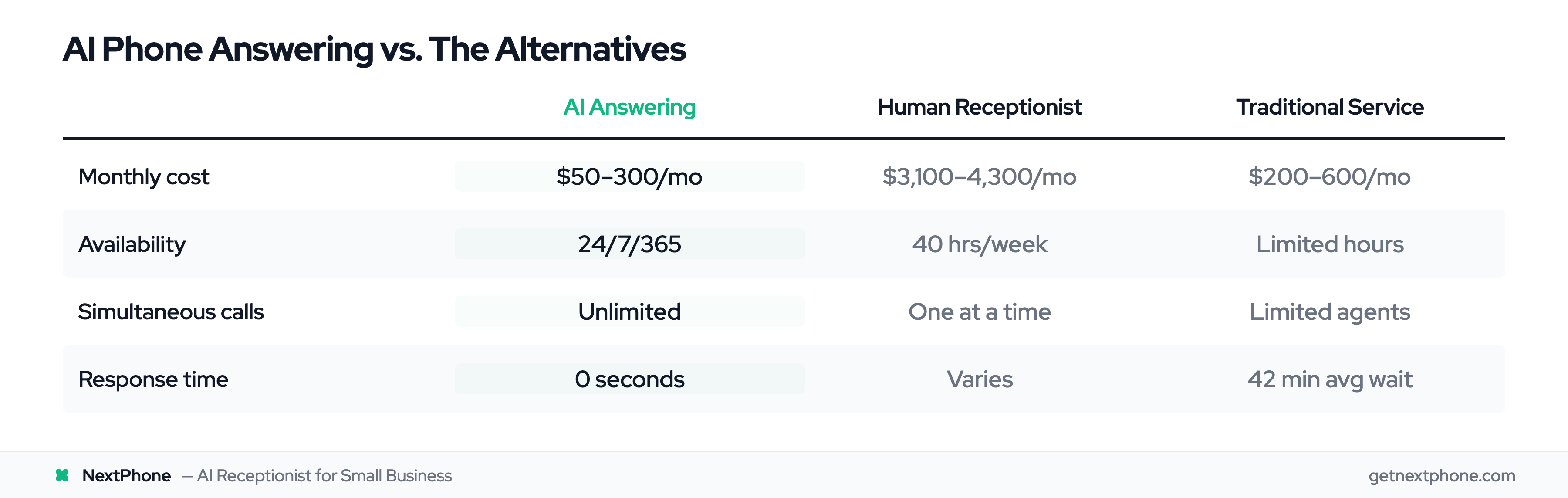
How does AI stack up against other options? Let's compare.
AI Phone Answering vs. Human Receptionist
Cost: $50-300/month for AI versus $3,100-4,300/month for a human receptionist (salary + benefits)
Availability: AI works 24/7/365 versus typical 40 hours/week for human staff
Scalability: AI handles unlimited simultaneous calls versus one call at a time for humans
Consistency: AI delivers identical quality every time versus variable performance based on human mood, fatigue, experience
Setup time: AI launches in hours versus weeks to hire, onboard, and train human staff
When human is better: Complex negotiations, VIP relationships requiring personal touch, nuanced situations needing judgment calls
AI Phone Answering vs. Traditional Answering Service
Cost: AI runs $50-300/month unlimited versus $200-600/month for limited minutes with traditional services
Wait time: Zero seconds with AI versus 42-minute average with traditional services
Quality: AI provides consistent responses versus variable quality depending on which operator takes the call
Integration: AI connects deeply with your CRM, calendar, and systems versus limited integration with traditional services
Customization: AI is fully customizable to your business versus generic scripts with traditional services
When traditional service is better: When your brand requires human touch for absolutely every call
AI Phone Answering vs. Voicemail and IVR
Voicemail is one-way. The caller leaves a message. You hope to call them back before they hire someone else. Research shows 90% of voicemails never get returned by customers. They leave a message and move on.
AI is two-way conversation that takes action immediately. The caller gets their question answered or appointment scheduled while they're still on the line.
IVR ("Press 1 for sales, Press 2 for support") forces menu navigation. It's frustrating for customers and it doesn't take action beyond routing to the right department.
AI has natural conversations. No menus. No buttons. Just "How can I help you?" followed by intelligent responses and actions.
The Hybrid Approach: Best of Both Worlds
The most effective approach isn't pure AI or pure human—it's hybrid.
AI handles routine inquiries that make up 60-80% of calls:
- Scheduling appointments
- Answering FAQs about hours, pricing, service areas
- Capturing callback requests
- Taking messages
Humans handle complex situations that require judgment:
- Price negotiations for large custom projects
- Emotionally sensitive situations like complaints
- Highly technical questions beyond the AI's training
- VIP customers flagged for personal attention
The AI knows when to escalate. If it detects keywords like "complaint," "unhappy," or "speak to manager," it routes immediately. If its confidence is below 70%, it transfers rather than guessing. When a customer specifically asks for a person, the AI connects them seamlessly.
This gives you the best of both worlds: AI captures every call, handles the routine efficiently, and routes the important ones to you.
AI Phone Answering Pricing and ROI
Let's talk real numbers—what it costs and what you get back.
How Much Does AI Phone Answering Cost?
Pricing typically breaks down into three tiers:
Entry-level: $50-100/month for basic features and limited integrations
Mid-tier: $100-300/month for full features, integrations, and analytics
Enterprise: $500-2,000+/month for high volume and custom features
NextPhone runs $199/month with unlimited calls and full features, specifically built for home services businesses.
Compare that to alternatives: human receptionist at $3,100-4,300/month or traditional answering service at $200-600/month for limited minutes.
ROI Calculation for Contractors
Here's the math that matters. Let's calculate exactly what you're losing versus what AI costs.
Example 1: General Contractor
Starting point:
- 42 calls/month (industry average)
- 74.1% missed (60-80% range, mid-point)
- $3,500 average project value
- 20% close rate (conservative estimate)
Calculation:
- 42 calls/month × 74.1% missed = 31 missed calls/month
- 31 missed calls × $3,500 avg project × 20% close rate = $21,700/month in lost opportunities
Annual cost of missed calls: $21,700/month × 12 = $260,400/year
NextPhone cost: $199/month × 12 = $2,388/year
Net benefit: $260,400 - $2,388 = $258,012/year
That's 10,805% ROI.
Example 2: Roofer (High-Value Projects)
Starting point:
- 87 calls/month (roofing businesses have high call volume)
- 10.6% are quote requests (highest rate among trades)
- $15,000 average roof project
- 15% close rate (expensive projects typically have lower close rates)
Calculation:
- 87 calls/month × 10.6% quote requests = 9.2 quote calls/month
- If missing 60% = 5.5 missed quote opportunities/month
- 5.5 missed quotes × $15,000 × 15% close = $12,375/month lost
Annual lost revenue: $148,500
NextPhone cost: $2,388/year
Net benefit: $146,112
That's 6,220% ROI.
Example 3: Emergency Jobs Only
Even if we only count emergency calls, the numbers are compelling:
Starting point:
- 42 calls/month
- 6.2% are true emergencies (from customer service data)
- $1,200 average emergency job value
- 30% close rate (emergencies convert better—people need help NOW)
Calculation:
- 42 calls × 6.2% emergencies = 2.6 emergency calls/month
- If missing 60% = 1.6 missed emergencies/month
- 1.6 × $1,200 × 30% close = $576/month lost
Annual lost revenue from emergencies alone: $6,912
This alone covers 2.9 years of NextPhone at $199/month.
Cost vs. Value: The Missed Call Calculation
The real question isn't "Can I afford AI phone answering?"
The question is "Can I afford to keep missing calls?"
Every missed call is a potential customer choosing your competitor. For contractors missing 60-80% of calls, the ROI is measured in months, not years.
According to industry research, each missed call costs an average of $1,200 in lost sales. At 31 missed calls per month, you're losing $37,200 monthly.
AI phone answering for $199/month captures those calls. The payback period is less than a week.
When AI Should Hand Off to Humans (Limitations and the Hybrid Model)
Let's be honest about what AI does well and where it needs help.
What AI Phone Answering Handles Best
AI excels at routine, repeatable tasks:
- FAQs with clear answers (hours, pricing, service area)
- Appointment scheduling from available calendar slots
- Information capture (name, phone number, service needed)
- Urgency detection and intelligent routing
- Spam filtering
- 24/7 availability for simple requests
These make up 60-80% of typical small business calls. The AI handles them completely without human intervention.
When Human Intervention Is Better
AI struggles with situations requiring judgment, empathy, or complex decision-making:
Complex negotiations: Pricing for large custom projects with multiple variables
Emotionally sensitive situations: Handling complaints, frustrated customers, or difficult conversations
Highly technical questions: Issues beyond the AI's training or requiring deep expertise
VIP customers: Clients who prefer or deserve personal attention from the owner
Nuanced judgment calls: Situations requiring reading between the lines or understanding context the AI can't detect
How Smart AI Knows When to Escalate
Good AI phone answering systems don't guess. When they're uncertain, they route to a human.
The escalation triggers include:
- Confidence scoring: If AI is less than 70% confident it understands the request, it transfers
- Keyword detection: Words like "complaint," "unhappy," "speak to manager," or "cancel" trigger immediate routing
- Direct request: When a caller says "I want to talk to a person," the AI connects them
- VIP lists: Pre-defined customers who always go to a human
- Complexity detection: Multi-part questions or unusual situations beyond training
The handoff happens seamlessly mid-call. No hang up and call back. The AI says "Let me connect you with [name/department]" and transfers with context.
The Hybrid Model: AI + Human Backup
This is the approach that works best in practice.
AI serves as the first line of defense, answering every call in under 5 seconds. It handles the 60-80% of calls that are routine. For the 20-40% that need human attention, it routes intelligently.
Your human staff focuses on high-value interactions—sales conversations, complex problem-solving, relationship building—instead of answering "What are your hours?" for the tenth time that day.
The goal isn't to eliminate humans. It's to eliminate missed calls while empowering your staff to focus where they add the most value.
According to Gartner's prediction, agentic AI will autonomously resolve 80% of common customer service issues by 2029. The 20% that remain will be the complex, high-value situations where human expertise makes the difference.
How NextPhone's AI Phone Answering Works for Home Services
NextPhone is built specifically for home services contractors who need AI that understands their business.
The system is trained on thousands of real customer calls from plumbers, electricians, roofers, HVAC technicians, and general contractors. It understands industry-specific terminology like "T&M," "quote," "estimate," "service call," "emergency dispatch," and project-specific language.
Key features include:
24/7/365 AI answering that picks up every call in under 5 seconds
Intelligent emergency routing that detects urgency language (like "emergency," "ASAP," "urgent") and routes immediately to your on-call staff
Callback tracking that captures the 25.4% of calls requesting callbacks with all the details you need
Appointment scheduling with direct integration to Google Calendar, Outlook, or your scheduling system
Lead capture and CRM integration that automatically creates entries with customer details, service needed, and timeline
Spam filtering that blocks the 7-15% of calls that are robocalls or telemarketers
Hybrid model where AI handles routine calls but transfers complex situations to you seamlessly
Pricing is straightforward: $199/month with unlimited calls. No per-call fees. No hidden costs. No long-term contracts—cancel anytime.
Setup takes hours, not weeks. You provide your business information, customize responses for common questions, connect your calendar and CRM, and you're live.
Whether it's a callback request like "Wants you to call them back when you have a chance" or an emergency like "Urgent: Porta potty delivery at 6 PM," NextPhone's AI knows how to handle it.
The system works with your existing phone number—no need to change the number on your trucks, website, or business cards.
Frequently Asked Questions
Can customers tell they're talking to AI?
Modern AI voice synthesis sounds remarkably natural—not robotic like older systems. Most customers care more about getting their question answered quickly than whether it's AI or human.
For home services contractors, customers prioritize results: "Can you schedule my repair?" or "Can you get someone here for this emergency?" over who answers the phone.
Some businesses choose to disclose upfront with "Hi, this is ABC Plumbing's AI assistant, how can I help you?" NextPhone uses natural conversational patterns and professional tone that many customers don't immediately recognize as AI.
What if the AI doesn't understand what a caller is saying?
Modern AI achieves 85-95% accuracy for routine customer service inquiries. When AI confidence falls below 70%, it routes the call to a human rather than guessing.
The AI can ask clarifying questions: "Just to confirm, you need a plumber for a leaky toilet, correct?"
The hybrid model prevents AI from getting stuck. It knows when to escalate rather than attempting to answer and potentially getting it wrong.
NextPhone's system is trained on thousands of real home services calls, so it understands industry terminology and common requests. It learns and improves over time as it processes more calls from your specific business.
How much does AI phone answering cost for small businesses?
Pricing typically ranges from $50-300/month for small to mid-sized businesses, depending on call volume and features.
NextPhone costs $199/month with unlimited calls and all features included—no per-call fees or hidden costs.
Compare that to alternatives: a human receptionist costs $3,100-4,300/month (salary plus benefits), and traditional answering services charge $200-600/month for limited minutes.
Most contractors see positive ROI within the first month since missing just 2-3 calls can cost more than the monthly AI fee. No long-term contracts with NextPhone—cancel anytime.
Does AI phone answering work 24/7, including weekends and holidays?
Yes—AI phone answering provides 24/7/365 availability with no additional cost. No holidays, sick days, breaks, or time off.
This is especially valuable for emergency services like plumbing, HVAC, and electrical where after-hours calls are often high-value emergencies. A customer with no heat at 11 PM needs help immediately.
Weekend coverage is included in standard pricing with no weekend surcharges. After-hours calls represent significant revenue opportunities that would otherwise go to voicemail or competitors.
Can AI phone answering handle emergency calls?
Yes—AI detects urgency through keywords like "urgent," "ASAP," "emergency," "no heat," "flooding," "leak," and similar phrases.
Customer service data shows 15.9% of calls contain urgency language and 6.2% are true emergencies requiring immediate attention.
When emergency is detected, AI routes immediately to your on-call human staff while capturing critical details (location, issue, contact info) so no information is lost.
Example: A call saying "Needs emergency AC repair, no cooling in 95 degree weather" triggers AI to detect "emergency" + "AC" and route to your on-call HVAC technician immediately.
This ensures no emergency ever goes to voicemail where it might not be heard for hours.
Is AI phone answering difficult to set up?
No—setup typically takes hours, not weeks. Most platforms provide guided onboarding with step-by-step instructions.
Basic setup involves connecting your phone number, customizing greetings, and integrating your calendar.
Advanced customization includes training the AI on your specific FAQs, setting call routing rules, and integrating your CRM.
NextPhone's setup process: provide your business information, customize responses for common questions, connect integrations, and you're live the same day.
No technical skills or coding required—if you can use a smartphone, you can set up AI phone answering.
What industries benefit most from AI phone answering?
Any business with high incoming call volume benefits, but some industries see exceptional ROI.
Home services contractors—plumbers, electricians, roofers, HVAC, landscaping, pest control, general contractors—benefit most due to high miss rates (60-80%) combined with high project values ($3,500-$15,000).
Other top industries include healthcare (appointment scheduling), legal services (lead capture), real estate (property inquiries), property management (maintenance requests), and professional services (consultation booking).
Best fit: businesses where calls are time-sensitive and missing a call directly translates to lost revenue. Retailers, restaurants, and e-commerce businesses that take purchases over the phone see additional ROI with a dedicated order taking answering service that processes full transactions during the call.
Home services particularly benefit because contractors are often on job sites and can't answer, but every missed call is a potential customer choosing a competitor. Industry research shows contractors losing an average of $126,000 per year to missed calls—AI captures those leads automatically.
Start Capturing Every Customer Call
AI phone answering isn't just for enterprises anymore. Small businesses are using it to answer calls they'd otherwise miss, capture leads 24/7, and compete with bigger competitors—all without hiring full-time staff or paying $3,000/month for live answering services.
The businesses winning in 2026 aren't the ones with the biggest marketing budgets. They're the ones answering every call. The ones losing are the ones sending customers straight to voicemail while they're on job sites, with other customers, or simply closed for the day.
For home services contractors missing 60-80% of calls, the ROI is clear: $199/month to answer every call versus $260,400/year in lost revenue. The technology is proven (97.5% accuracy), the hybrid model works (AI handles routine, humans handle complex), and industry adoption is accelerating (85% of service leaders exploring AI in 2025).
About NextPhone
The NextPhone team specializes in AI phone answering solutions for home services contractors. Our technology is trained on thousands of real customer calls to plumbers, electricians, roofers, HVAC technicians, and general contractors, ensuring it understands industry-specific needs and terminology.