
It's 7:40 PM on a Thursday. A man was rear-ended on the interstate two hours ago, and his brother-in-law told him to call a lawyer tonight. He finds your firm, taps the number, and your Quo line rings through the call flow. Nobody's at their desk. Sona picks up, takes his name and number, and tells him someone will call back.
He hangs up and calls the next firm on the list. That firm's intake answers, asks about the accident, the injuries and the insurance, and books him for 9 AM.
That's the real reason most firms search "Quo alternative." Quo is a good phone system. The question is whether it's the thing that should be running new-client intake at night, on weekends and during trial. This guide covers what Quo (formerly OpenPhone) costs in 2026, how Sona's credit pricing actually behaves, and the two ways to fix intake without blowing up the phone setup your team already likes.
Quo Is OpenPhone, Renamed (What Changed and What Didn't)
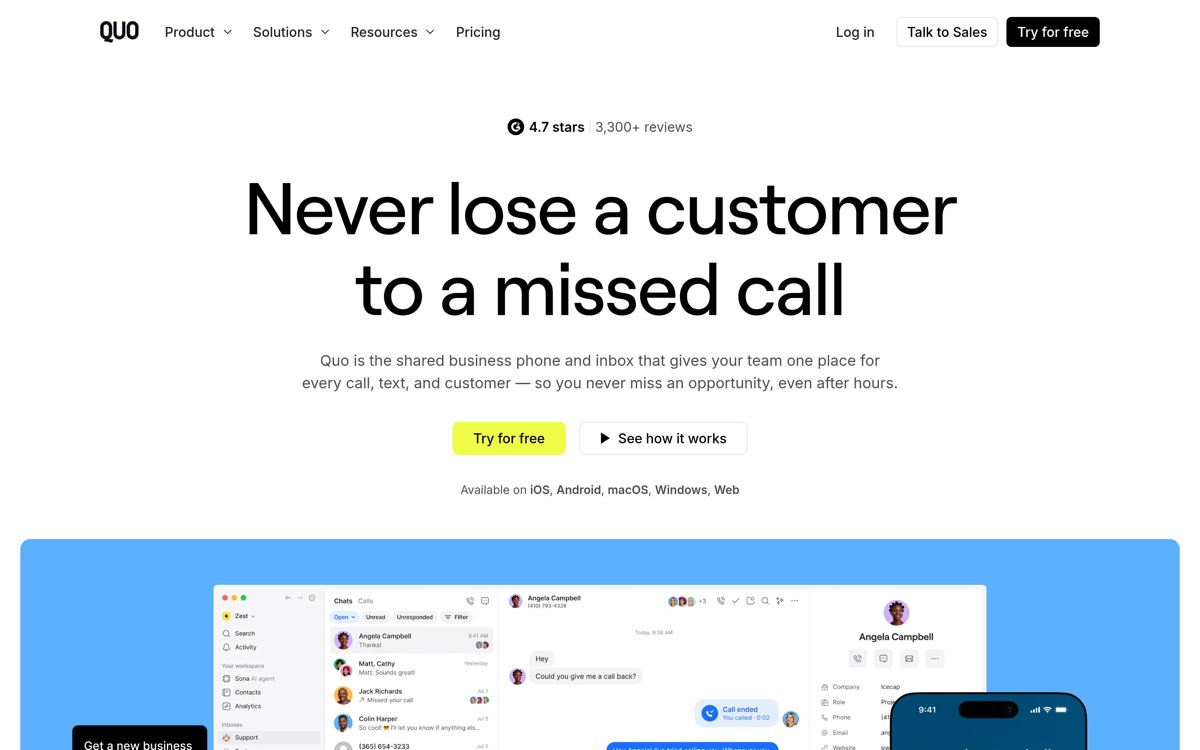
OpenPhone rebranded to Quo in late 2025. The product underneath is the same: a VoIP business number that rings on desktop and mobile, a shared inbox for calls and texts, call flows and phone menus, and integrations with tools like HubSpot, Salesforce and Clio.
What changed is the AI. Quo now bundles Sona, its AI voice agent, into every plan. Sona answers when your team doesn't, uses a knowledge base you write, takes messages and can transfer calls.
So if you're searching for an "OpenPhone alternative" or a "Quo alternative," you're shopping against two things at once:
- The phone system. Numbers, seats, texting, shared inboxes, call flows.
- The answering layer. What happens to the call nobody picks up.
Most law firms that leave aren't unhappy with the first one. They're losing cases in the second.
Quo Pricing in 2026: Seats, Sona Credits and Overages
Quo's pricing has two separate meters: the per-user seat price and Sona's automation credits. Figures below are from Quo's public pricing page and its help center, checked October 1, 2026.
Quo plans (per user, per month)
| Plan | Billed monthly | Billed annually | Notable inclusions |
|---|---|---|---|
| Starter | $19 | $15 | 1 number, unlimited US/Canada calling and texting, voicemail transcripts |
| Business | $33 | $23 | Adds AI call summaries, call transfers, phone menus, HubSpot/Salesforce integrations |
| Scale | $47 | $35 | Adds AI call tags, dedicated onboarding, priority and phone support |
Quo's Clio integration (contact sync plus call and text logging into Clio Manage) is included on the Business and Scale plans.
Sona pricing (billed on top of your seats)
Sona runs on credits. Each answered call uses 100 credits, and calls under 15 seconds don't count. Every workspace gets 1,000 credits a month, which is roughly 10 calls. Past that, you buy a monthly tier:
| Sona tier | Monthly price | Credits | Roughly covers | Overage per extra call |
|---|---|---|---|---|
| Tier 1 | Included | 1,000 | ~10 calls | $1.00 |
| Tier 2 | $25 | 4,000 | ~40 calls | $0.75 |
| Tier 3 | $49 | 10,000 | ~100 calls | $0.65 |
| Tier 4 | $99 | 25,000 | ~250 calls | $0.55 |
| Tier 5 | $199 | 60,000 | ~600 calls | $0.45 |
Two details in Quo's help center matter more than the table:
- Overages are disabled by default. When credits run out, Sona stops answering and the call goes to the fallback path in your call flow. Quo's own alert email says that means voicemail.
- Unused credits expire at the end of each billing period. A quiet month doesn't bank anything for a busy one.
What that looks like in a busy month
Take a three-attorney personal injury firm on Quo Business, billed monthly, with Sona on Tier 3:
- Seats: 3 × $33 = $99
- Sona, normal month (about 100 calls answered by Sona): $49
- Sona, the month after a billboard goes up (about 250 calls): $49 + 150 overage calls × $0.65 = $146.50, if someone turned overages on
Busy-month total: $245.50, versus $148 in a normal month.
And if nobody turned overages on, the bill stays at $148 while call #101 through #250 go to voicemail. Either the bill moves or the intake stops. That's the tradeoff any per-call model makes, and it lands hardest in exactly the month your marketing works.
For contrast, NextPhone doesn't bill per call or per minute. A busy month costs what a quiet one does, and you know next month's bill before it starts. More on how AI receptionist pricing models compare.
Where Sona Fits, and Where It Stops for a Law Firm
Sona is a real step up from a voicemail box, and it's worth saying what it does well. It answers 24/7, reads from a knowledge base you control, collects the information you tell it to collect, texts the caller a link during the call, and can transfer to a teammate, a shared inbox or an outside number. Quo has also added Spanish and French (in beta) alongside English.
For a firm whose calls are mostly "are you open Saturday?", that may be enough. Legal intake asks for more.
1. The transfer is a one-way door
Quo's documentation is direct about this: when Sona transfers a call, Sona leaves the conversation immediately. If the attorney doesn't answer, the call goes to that attorney's voicemail, and Sona can't come back.
For a firm, that's the worst version of a missed call. The caller already told their story once, got handed off, and then hit a voicemail greeting. Attorneys are in court, in depositions and in client meetings. "Can't reach them" is the expected case, not the exception.
2. Intake is a script, not a message
A new PI caller needs the incident date (statute of limitations), the injuries and treatment, the county, and whether insurance is involved. A criminal defense caller needs the charge, the county and whether there's a court date this week. Family law needs the county and whether minor children are involved.
Sona collects "specific information you define." That works for one generic question set. It gets harder when every practice area needs a different one, and the urgent ones (an arrest tonight, a hearing next week) need to jump the queue. See law firm intake scripts by practice area for what those question sets look like in practice.
3. Booking means a link
Sona's scheduling is texting the caller a link mid-call. That's useful, but a consultation booked on the phone, into the attorney's actual calendar, converts better than a link the caller has to remember to open after they hang up.
4. It only works inside Quo
Quo says Sona is built to be used in Quo only. If you ever move off Quo's numbers, the answering layer goes with it.
Who Should Look for a Quo Alternative (and Who Shouldn't)
Stay on Quo, with Sona, if: your team picks up most calls during the day, after-hours volume is light, and you don't run paid ads or billboards that spike calls. Quo is a solid shared phone system at a fair seat price.
Look for an alternative if:
- New-client calls come in after hours and on weekends (PI and criminal defense live there)
- You're paying for leads. A legal LSA lead can run $195 to $250, and every one that hits voicemail is spend you already committed
- Your attorneys are in court for most of the day and transfers die in voicemail
- You've hit the Sona credit cap and watched calls fall through, or turned overages on and watched the bill climb
The stakes are not abstract. In Clio's secret-shopper study, only 40% of law firms answered the phone (down from 56% in 2019). And 85% of callers won't call back if their call goes unanswered, per CallRail. The caller who gets a voicemail box at 7:40 PM is signing with someone else at 9 AM.