Dialpad Integration: AI-Native VoIP Alternative for Small Businesses

10 min read
Yanis Mellata
Comparisons

The Hidden Cost of Missed Calls

Your phone rings at 2 PM. A homeowner needs an emergency plumbing repair—burst pipe, water flooding the basement. You're under a sink at another job site. The call goes to voicemail. They call the next plumber. You just lost a $4,200 job.

This happens more than you think. In our analysis of 13,175 customer service calls from 47 home services contractors over 7 months, we found that 74.1% of calls went completely unanswered. That's three out of every four potential customers calling someone else.

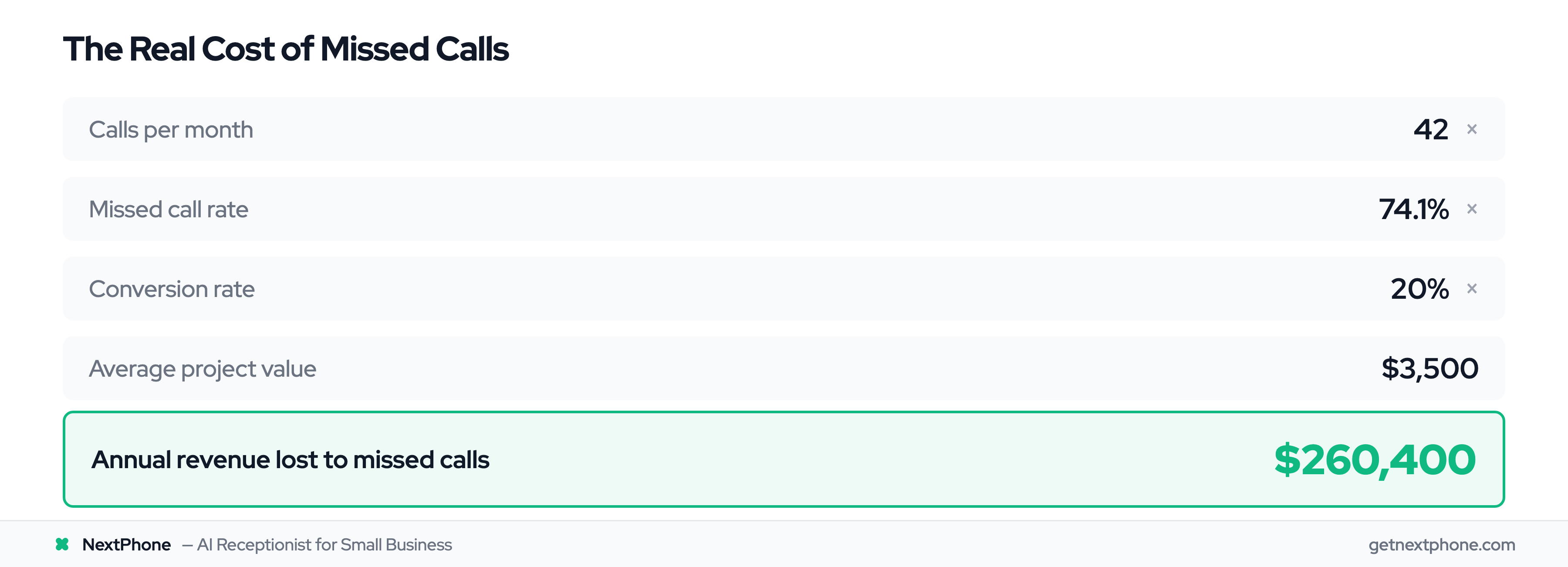
For a typical contractor receiving 42 calls per month, if 74.1% go unanswered and just 20% would have converted at an average $3,500 project value, that's $21,700 per month in lost revenue—or $260,400 per year.

VoIP integration promises to solve this problem by connecting your business phone system with CRM tools, scheduling software, and communication platforms. But the reality is often more complex than the pitch. Let's look at what Dialpad integration actually offers and whether there's a simpler path for small businesses.

Understanding Dialpad Integration Capabilities

Dialpad is an AI-powered business phone system that offers voice, messaging, and video communication through Voice over Internet Protocol (VoIP) technology. The platform has positioned itself as a modern alternative to traditional phone systems by incorporating artificial intelligence throughout the user experience.

Core Integration Features

Dialpad provides over 60 out-of-the-box integrations through its App Marketplace, covering major business categories. The most popular integrations include:

  • CRM systems: Salesforce, HubSpot, Zendesk, and Freshdesk
  • Productivity tools: Google Workspace, Microsoft Teams, Slack
  • Business applications: Zapier for workflow automation

For businesses with custom needs, Dialpad offers an open API with over 140 endpoints and supports up to 20 requests per second per company. This allows developers to build custom integrations for specific workflows like voice archiving, agent management, and SMS applications.

AI Voice Intelligence

Where Dialpad differentiates itself from traditional VoIP providers is in its AI capabilities. The platform offers real-time call transcription that displays an accurate, live transcript during conversations, allowing users to focus on the discussion rather than note-taking.

Additional AI features include:

  • AI Recaps: Automatic call summaries that gather transcripts, action items, highlights, and manual notes
  • AI Scorecards: Quality assurance tools that accelerate reviews and improve agent adherence
  • AI Playbooks: Sales coaching tools that track rep adherence to methodologies like BANT and SPIN
  • Sentiment analysis: Real-time detection of customer emotions and intentions

In October 2025, Dialpad launched its Agentic AI Platform, enabling businesses to build autonomous voice- and text-based AI agents. These agents can understand complex requests, reason through multi-step tasks, and execute them end-to-end across existing systems—a significant evolution from traditional chatbot technology.

The Reality: Integration Challenges Small Businesses Face

While Dialpad's feature list looks impressive, the practical reality for small businesses often involves unexpected obstacles. Based on user feedback and industry analysis, here are the most common challenges.

Feature Lockout on Lower Tiers

Dialpad's integration capabilities vary significantly by plan tier. The Basic plan integrates primarily with Google Workspace, while advanced integrations with Slack, Zapier, and sophisticated CRM features require Pro or Enterprise plans.

This tier structure creates cost barriers for small businesses that need specific integrations but can't justify the higher monthly fees. One user on Reddit noted that Dialpad "locks key features like Slack and Zapier integrations behind Pro plan tiers," forcing businesses to choose between the integrations they need and their budget constraints.

For comparison, competitors like RingCentral offer 300+ integrations, though they face similar pricing complexity issues.

Hidden Costs and Complexity

Multiple users have flagged surprise invoices tied to add-ons or usage caps that weren't clear during the sales process. Beyond direct costs, the complexity of configuration can be overwhelming for non-technical business owners.

As one reviewer noted: "Lots of configuration options on how to set up your lines, but it's pretty complex and expensive for a small business."

When standard integrations don't meet specific needs, custom development becomes necessary. One user shared a detailed complaint about web chat not integrating directly with their legal software, with Dialpad offering to build a custom Zapier connection for a significant additional cost.

For businesses without dedicated IT staff, this complexity often means paying for professional services or spending hours troubleshooting instead of serving customers.

Data Accuracy and Support Issues

Integration reliability matters as much as availability. Several users have reported data synchronization issues with CRM systems. As one user put it: "If integrations misfile activity, the CRM becomes noise."

When call logs, contact information, or conversation notes sync incorrectly, the entire value proposition of integration disappears. You're left manually fixing data or, worse, missing follow-ups because the information isn't where it should be.

Support quality has also been a concern, with complaints appearing on both G2 reviews and Reddit discussions. When integrations break and support is slow to respond, small businesses without IT resources are stuck.

According to VoIP integration best practices from the U.S. Chamber of Commerce, successful implementation requires three key things: good internet connectivity, employee training, and choosing a provider that prioritizes security. For many small businesses, adding "dedicated IT support" to that list makes traditional VoIP integration impractical.

The AI-Native Alternative: Simpler Integration for Small Businesses

The challenges above point to a fundamental question: What if you could get the benefits of VoIP integration without the complexity?

This is where AI-native phone systems differ from traditional VoIP platforms with AI features added on. Instead of building a phone system and then integrating AI capabilities, AI-native platforms are designed from the ground up with intelligence built into every function.

What Makes AI-Native Different

Traditional VoIP systems like Dialpad were originally designed for human operators. AI features were added later to enhance the experience. AI-native systems like NextPhone start with a different assumption: the AI is the primary operator, with human handoff available when needed.

This fundamental difference shows up in practical ways:

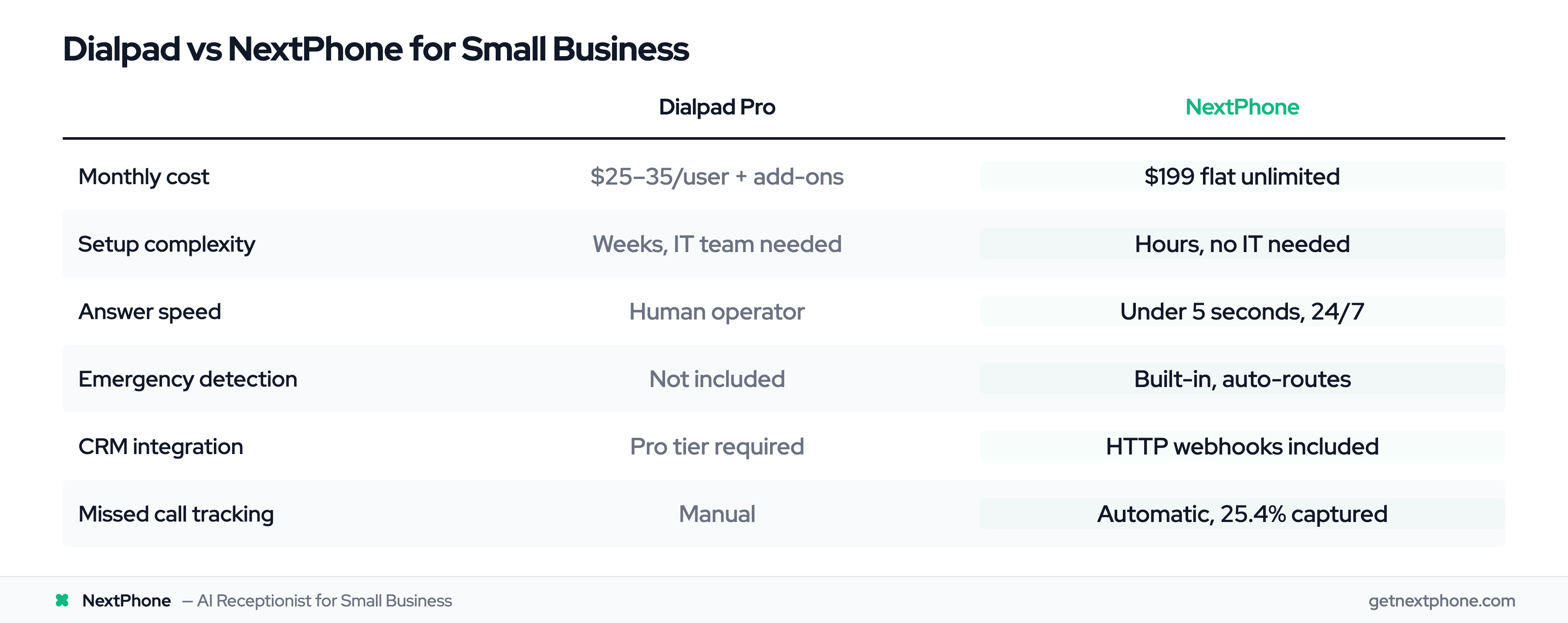
  • Setup takes hours instead of weeks—no complex configuration menus
  • AI answers calls in under 5 seconds, 24/7, without programming call trees
  • Intelligence is built-in, not bolted on through multiple integration points
  • No IT team required for deployment or ongoing maintenance

Voice Intelligence Built In

NextPhone's AI receptionist includes voice intelligence capabilities that traditional VoIP systems charge extra for or don't offer at all.

Our analysis of 13,175 calls revealed patterns that matter for revenue:

  • Emergency detection: 15.9% of calls contain urgency keywords like "emergency," "urgent," or "ASAP." The AI identifies these automatically and routes them to your phone immediately. For service businesses, emergency calls average $4,200 in revenue—significantly higher than routine work.

  • Callback tracking: 25.4% of callers explicitly request callbacks. Without systematic tracking, most of these requests fall through the cracks. The AI captures every callback request and can automatically send follow-up texts with your booking link.

  • Real-time transcription: Every call is transcribed automatically, with summaries and action items identified. No configuration needed.

  • Sentiment analysis: The AI detects customer emotions during conversations and can adjust responses or escalate to a human when it senses frustration.

As one plumber with 76 missed calls in a single month told us: "I didn't even know I was missing that many calls until I saw the data. I just thought business was slow."

Integration That Actually Works

Instead of requiring separate integrations for each tool, NextPhone uses a universal approach:

  • HTTP webhooks connect to any CRM system—Salesforce, HubSpot, Pipedrive, Zoho, or custom databases. You define what data to send and where it goes.

  • SMS integration allows the AI to send follow-up text messages automatically, sharing booking links, appointment confirmations, or resources mentioned during calls.

  • Email notifications deliver transcripts and call summaries to your inbox within minutes, with tap-to-call links for easy follow-up.

  • Call transfer seamlessly hands off to a human when the caller requests to speak with someone or when the AI detects the conversation requires personal attention.

All of these capabilities are included—no feature tiers, no add-on fees, no complex configuration. The AI handles the integration work while you focus on your business.

Transparent Pricing

NextPhone costs $199 per month with unlimited calls. No per-user fees. No surprise charges for "premium integrations." No usage caps that trigger overage fees.

Compare that to the typical costs:

  • Traditional receptionist: $35,000 per year ($2,900/month) plus benefits
  • Dialpad Pro plan: $25-35 per user per month, plus add-ons
  • The revenue you're losing: $260,400 per year from missed calls

The return on investment is clear. You're spending $199 monthly to capture a quarter-million dollars in annual revenue that's currently going to competitors who answer their phones.

Frequently Asked Questions

Does Dialpad integrate with Salesforce and HubSpot?

Yes, Dialpad offers native integrations with both Salesforce and HubSpot. Features include automatic call logging, real-time transcription sync, and contact information pop-ups during calls. However, these integrations are currently in beta and haven't received updates in over six months according to some users. The integrations may also require Pro or Enterprise plan tiers rather than being available on Basic plans.

What's the difference between traditional VoIP and AI-native phone systems?

Traditional VoIP systems are phone systems built for human operators with AI features added on. AI-native systems like NextPhone are built from the ground up with AI as the core operator. The practical difference is simplicity—AI-native systems require minimal configuration because the intelligence is built into how the system works, not layered on top through integrations. Traditional systems offer more customization for complex enterprise needs, while AI-native systems optimize for deployment speed and ease of use.

How much does Dialpad cost for integrations?

Dialpad's Basic plan offers limited integrations, primarily with Google Workspace. The Pro plan ($25-35 per user per month) unlocks CRM integrations and more advanced features. Enterprise plans with full integration capabilities typically start at $50+ per user per month with custom pricing. User reviews have noted additional hidden fees for add-ons and usage overages that may not be clear during initial sales conversations.

Can small businesses afford to miss calls?

No. Our analysis of 13,175 calls from 47 home services contractors shows a 74.1% missed call rate that costs the average business $260,400 per year in lost revenue. Emergency calls are particularly valuable—averaging $4,200 per job. Missing just one emergency call per week costs $201,600 annually. Additionally, 25.4% of callers request callbacks that never happen without a systematic tracking system. The cost of an AI receptionist ($199/month) is minimal compared to the revenue being lost to competitors.

Do I need an IT team to set up VoIP integrations?

Traditional VoIP systems like Dialpad often require IT expertise for initial configuration and ongoing troubleshooting, especially when setting up custom integrations or managing complex call routing rules. AI-native systems like NextPhone are designed for setup by the business owner in hours rather than days. The key difference is pre-configured intelligence versus custom configuration—NextPhone includes standard capabilities that cover most small business needs without requiring technical knowledge. Onboarding support is included to help with the initial setup.

Choose the Right Integration for Your Business

Dialpad offers robust integration capabilities that serve enterprise needs well, but the complexity and cost structure can be overwhelming for small businesses without dedicated IT resources.

For service businesses—contractors, electricians, plumbers, HVAC companies—the math is simple: 74.1% of your calls are going unanswered right now. That's $260,400 per year in revenue you can't afford to lose.

AI-native integration offers a different path. Instead of configuring complex systems and managing multiple integration points, you get voice intelligence that works immediately. The AI answers every call, identifies emergencies, tracks callback requests, and syncs information to your CRM—all without requiring technical expertise.

NextPhone costs $199 per month. You can set it up today and start answering calls tonight.

Speak with one of our experts

Book a Call

Related Articles

Yanis Mellata

About NextPhone

NextPhone helps small businesses implement AI-powered phone answering so they never miss another customer call. Our AI receptionist captures leads, qualifies prospects, books meetings, and syncs with your CRM — automatically.