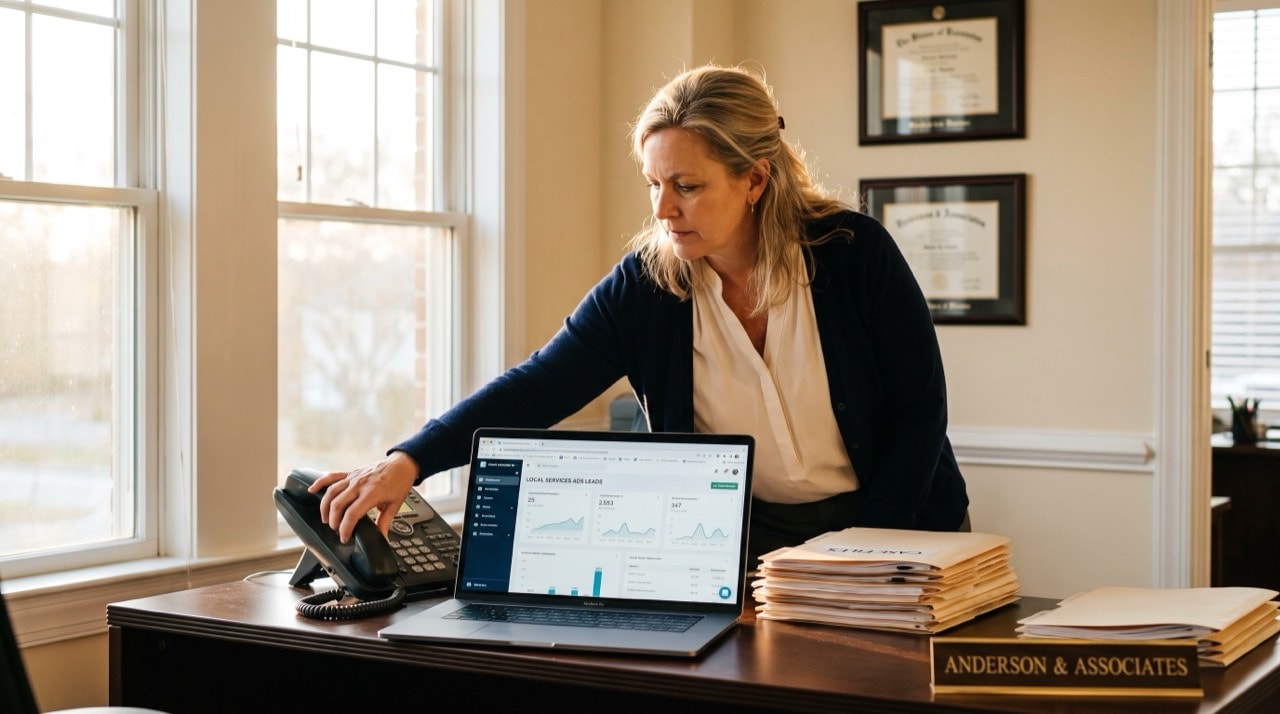
Quick answer: Google Local Services Ads (LSAs) for lawyers put your firm at the very top of the search results with a Google Verified badge, and you pay per lead instead of per click. They work well for high-intent legal searches. What almost nobody tells you is that Google ranks you partly on how fast and how often you answer the phone, so a paid LSA call that hits voicemail does double damage: you lose the case and you lower your ad rank for months. This guide covers the 2026 costs, the new badge rules, and the operational fix for the missed-call trap.
Last updated: July 2026. Pricing and program details verified at time of writing. Confirm current figures on each source's site.
Your Local Services Ad is doing its job. It's Saturday at 9pm, and someone whose spouse just filed for divorce, or whose son was just arrested, taps the call button on your listing. Google charges you for that lead the moment the call connects. Then it rings your office, where nobody is sitting. Seven rings, voicemail, hang up. They tap the next firm on the list.
You just paid for a lead you'll never talk to, and you quietly told Google's algorithm that your firm doesn't answer its phone. Do that a few times and your placement slips, which raises what you pay for the next lead. That is the trap every agency setup guide leaves out, and it's the part that decides whether LSAs make you money or bleed it.
Search for "google local services ads for lawyers" and you'll find a dozen agency guides that walk you through the setup screens. They're fine. This guide is the other half: what LSAs cost for legal in 2026, what changed with the Google Verified badge, how the responsiveness ranking factor actually works, and how to make sure the phone that Google is sending expensive clients to is answered every single time. It's anchored in NextPhone's analysis of 1,446,980 real inbound calls.
Full disclosure: NextPhone makes an AI receptionist. We're upfront about it. The costs, the ranking mechanics, and the badge rules are true regardless of which vendor you use to answer the phone.
What Local Services Ads are for law firms (and the new Google Verified badge)
Local Services Ads sit above the regular text ads and above the map pack, at the literal top of the page for searches like "personal injury lawyer near me" or "divorce attorney [city]." They show your firm name, star rating, review count, and a trust badge. Two things make them different from ordinary Google Ads.
First, they're pay-per-lead, not pay-per-click. You don't pay when someone sees or taps your ad out of curiosity. You pay when a call or message comes through that Google counts as a genuine lead. That's a better deal for legal, where a single click on a competitive term can run $25 or far higher on traditional search ads.
Second, LSAs require verification before you can run them. For law firms, that used to mean the Google Screened program: a background check, a license check, and an insurance check, which earned you a "Google Screened" badge. Contractors got "Google Guaranteed." There was also a separate "License Verified by Google" badge in some categories. Three badges, three names, one confused consumer.
The October 2025 badge change most guides still get wrong
Here's the freshness point that stale agency guides miss. In 2025 Google consolidated all of those into a single blue Google Verified badge. Starting October 20, 2025, "Google Guaranteed," "Google Screened," and "License Verified by Google" all became "Google Verified," and the change rolled out automatically to advertisers who had already completed their verification (Search Engine Journal, Google's announcement).
The part that matters for your marketing copy: the money-back guarantee that used to ride along with Google Guaranteed was retired in the transition and no longer applies after November 2025 (Searchen). For law firms this was mostly cosmetic, since the guarantee never covered legal services the way it covered a botched plumbing job, but it means any consultant still selling you on "Google Guaranteed for lawyers" is working from an outdated playbook. The badge is Google Verified now. If someone's guide still says Google Screened as if it's current, that's your signal to check how fresh the rest of their advice is.
The verification steps behind the badge for a law firm haven't changed much: you still confirm your bar license, insurance, and identity. What changed is the label the public sees.
Setting up LSAs for a law firm (the short version)
Setup is the part agencies over-explain, so we'll keep it tight and send you to the deep guides where they earn their keep. The essentials:
- Verify the firm. Complete the license, insurance, and background checks in the Local Services Ads dashboard. Legal categories require an active bar license for the practicing attorney.
- Pick your practice areas and geography. LSAs let you choose job types (personal injury, family, criminal, estate, immigration, and so on) and a service area by ZIP or radius. Narrow beats broad when you're starting out.
- Set a weekly budget, not a per-lead price. You tell Google how many leads you want per week and it manages the bidding. You can set a target, but the auction does the work.
- Point the phone number at a line that gets answered. This is the field that quietly decides everything, and we'll come back to it, because it's where firms leak the most money.
That's the 90% of setup that matters. For the screen-by-screen walkthrough and bid tuning, the specialist agencies in the search results do a thorough job, and there's no reason to duplicate them here. Where this guide adds value is everything that happens after Google approves your ad and the calls start coming in.
One setup detail worth understanding, because it feeds the ranking section below: Google shows rotating tracking numbers on your ad and routes every LSA call through its own system, recording and analyzing the conversation. All of those tracking numbers forward to the single phone number in your LSA profile, and that field accepts any number you want, including a virtual line or an AI receptionist. Hold that thought.
What legal LSA leads actually cost in 2026
Legal is one of the most expensive categories in the entire Local Services Ads system, because law firms have the case values to justify high bids and they all know it.
In 2026, legal LSA leads run roughly $195 to $250 per lead, charged per lead rather than per click, with personal injury at the top of that band because more attorneys bid in the category (Taqtics, 2026). A multi-year analysis covering 2022 through 2024 put the blended legal LSA cost per lead at around $378, which came out roughly 14% cheaper per lead than traditional Google Search Ads for the same firms (Taqtics, 2026).
But cost per lead is the wrong number to optimize. The number that pays your rent is cost per signed case. Personal injury LSA leads convert to retained clients at about 34%, which puts the true cost per signed PI case in the range of $630 to $735 once you account for the leads that don't sign (Taqtics, 2026). For a case worth tens of thousands in fees, that's a strong return, but only if you actually convert at 34%. Miss a third of your calls and that conversion math collapses, because a lead you never spoke to converts at zero.
Here's the table that reframes the spend:
| Metric | Typical 2026 figure (legal) | Why it matters |
|---|---|---|
| Cost per lead | $195 to $250 | What Google charges when a call connects |
| Blended CPL (2022 to 2024) | ~$378 | ~14% cheaper than traditional search ads |
| PI lead to signed-client rate | ~34% | The multiplier on your true cost |
| True cost per signed PI case | $630 to $735 | The number that decides ROI |
Read the bottom two rows together. Your cost per signed case is your cost per lead divided by your conversion rate. Answering speed is the biggest lever on that conversion rate that you fully control. Which brings us to the mechanic the setup guides bury.
The ranking factor agencies bury: responsiveness
Most guides tell you LSA ranking depends on your bid, your reviews, your proximity, and your profile completeness. All true. What they skim past is that how you answer the phone is a ranking factor, straight from Google's own documentation.
Google lists the factors that determine your LSA ad rank, and "likelihood of generating a lead" is one of them. Inside that factor, Google states plainly: "Your responsiveness to customer inquiries and requests: Missed calls may negatively affect your responsiveness" (Google Local Services Help). Your average response time also feeds profile quality, and Google notes that higher-quality profiles "may rank higher and may also pay lower costs per lead."
Read that last clause twice. Answering well wins you the call in front of you and can lower what you pay for every future lead. Missing calls does the reverse.
How the responsiveness signal compounds
The signal is a rolling average of your answer behavior. Practitioners who watch LSA accounts closely report Google measures responsiveness over a rolling window commonly pegged at roughly 90 days (LeadWinner). That means a rough patch of missed calls, say a receptionist out sick for a week, doesn't cost you a week of ranking. It drags on your placement for months while it ages out of the average.
The benchmarks agencies quote are unforgiving. One 2026 ranking-factors analysis puts it this way: if you're missing more than 5% of calls or averaging response times over 10 minutes, that's your single biggest obstacle to ranking improvement, and "every missed call damages your ranking" (Boomcycle). The same source notes that responding within five minutes makes you about eight times more likely to convert a lead than waiting 30, which is why Google weights speed so heavily in the first place. The speed-to-lead research backs this up across every industry that's been measured: lead quality decays by the minute.
Now stack the two costs of a missed LSA call. You often still pay for the lead you missed (LeadWinner), and you nudge your responsiveness score down, which worsens placement and raises your effective cost per lead going forward. It's a doom loop:
The firms getting crushed by LSA costs usually aren't bidding wrong. They're answering wrong. The legal profession's answer rate makes this worse than most: according to the Clio Legal Trends Report, only about 40% of law firms answer their incoming phone calls, down from 56% in 2019. Sixty percent of firms are routing prospective clients, including the ones they paid Google to send, straight to a competitor. If you're spending on LSAs while sitting inside that 60%, you're funding your own rank decline.
The operational fix: answer every LSA call, 24/7
The fix is making sure the phone number in your LSA profile is answered instantly, every time, including the nights and weekends when high-intent legal calls actually come in. That's a receptionist problem, and it's the one problem the setup guides never solve because it's not a Google setting.
Remember that the LSA phone field accepts any number. Point it at an AI receptionist built for law firms and the doom loop inverts into a flywheel. Here's what NextPhone does with an LSA call the moment it lands.
Every call answered in under 2 seconds. Pickup is under two seconds, day or night. No LSA call goes to voicemail, so your responsiveness score never takes the hit that puts you at the bottom of the auction for the next 90 days. Answered-in-2-seconds is exactly the behavior Google's ranking factor rewards.
Real legal intake, not a name and number. A generic answering service takes a message. That's a voicemail with a human accent. NextPhone runs a practice-area legal intake script: it classifies the matter, asks the questions a PI call needs versus the ones a family or criminal call needs, captures the caller's name, callback, opposing party, jurisdiction, urgency, and the basic facts, and asks a conflict question. When the AI has a real conversation, it books the consultation or sends a booking link, and it resolves 90 to 95% of calls without needing to escalate, while maintaining 99% positive caller sentiment.
Booked to your calendar and pushed to Clio. With Clio Manage, the caller becomes a contact and the consultation lands on your Clio calendar; with Clio Grow, a lead arrives with the call summary and every intake answer. The assigned attorney reads a briefed intake instead of a two-word voicemail. NextPhone is natively integrated with Clio, HubSpot, MyCase, and Lawmatics; PracticePanther, Filevine, and 8,000+ other tools connect via Zapier. This is the Google LSA plus AI phone integration in practice: the ad generates the lead, the AI converts it into a structured intake record.
A transcript of every call, which is your documentation in the auto-credit era. This one is subtle and it's new. Google removed manual lead disputes in 2024 and replaced them with an automated system: machine learning reviews each lead within about 72 hours and credits your account for the ones it judges invalid, like spam, wrong numbers, or duplicates (Google Local Services Help). You can no longer open a ticket and argue a bad lead, and two former categories, "job type not serviced" and "geo not serviced," no longer earn credits at all (Olly Olly). What you can still do is rate leads, which feeds the automated system. A recording and transcript of every LSA call gives you the facts to rate junk leads accurately and to catch the invalid ones the algorithm should be crediting. NextPhone captures that on every call automatically. Spam and robocalls, by the way, are filtered out before they ever ring you, so those never touch your responsiveness score in the first place.
Here's what a sample after-hours intake call sounds like. This is the call a voicemail box loses, and the call your LSA budget paid for.
A sample after-hours call. Listen for the calm tone, the structured capture of the caller's name, matter and callback number, and the promise of a callback first thing in the morning. This is the LSA call that would otherwise hit voicemail at 9pm on a Saturday.
One operational note on the other lead type: LSAs can also send message leads, which arrive in your Local Services Ads app rather than on your phone line, and your response time to those feeds the same responsiveness signal. Assign someone to answer them quickly in the LSA app, or use your lead settings to emphasize phone leads, where your answer rate is the thing you can fully control.
The real comparison here isn't AI versus a human receptionist. It's AI versus voicemail. Your firm can't staff a bar-admitted body on the phone at 2am, but that's when a chunk of your highest-intent LSA calls arrive. Without coverage, those calls go unanswered and your paid leads evaporate. With an AI receptionist, they get answered, qualified, and booked, and your ranking signal stays clean. For the fuller cost breakdown against live services and in-house staff, see our guide to the answering service for law firms.