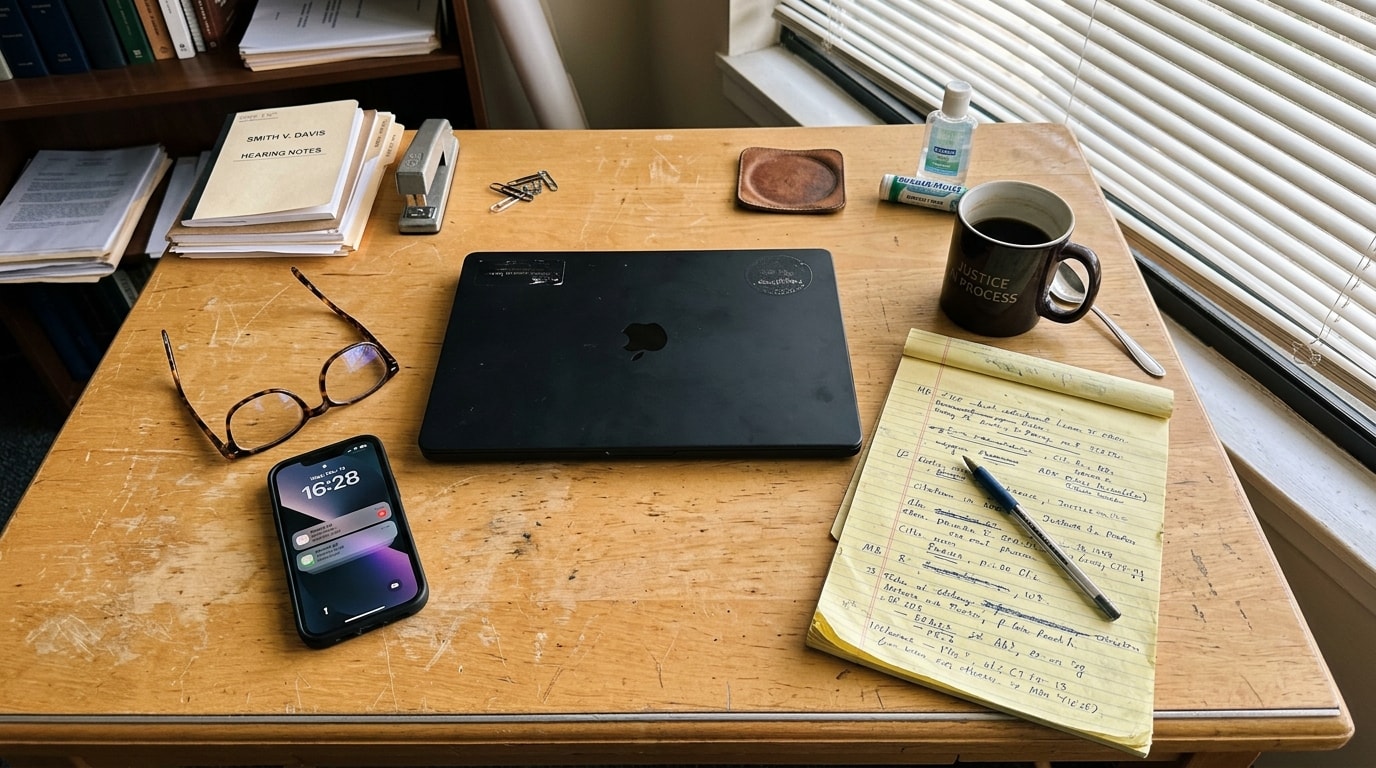
Quick answer: A solo lawyer answering service is a paid receptionist (human, AI, or hybrid) that picks up your firm's calls when you can't, runs a structured intake by practice area, asks a conflict question, and either books a consult or transfers the urgent ones to your cell. For solos, monthly cost runs $0 (voicemail) → $99–$395 (human services) → from $199 flat-monthly AI (NextPhone). The right tier depends on your inbound volume and how many hours a day you're in court.
Last updated: June 2026. Pricing verified at time of writing. Confirm current pricing on each vendor's site.
You're in a deposition until 11:30. You have a 1pm settlement call. In between, six numbers buzzed your cell and none of them left voicemails. Two of them are gone forever. That's the daily life of a solo attorney, and it's the reason "solo lawyer answering service" is a search term with intent behind it.
This guide is for true solos: 1 attorney, 0 support staff, court- or site-bound 3+ hours most days. Not a small firm with a paralegal. A solo. We'll run the billable-hour math nobody runs and walk through a four-tier decision ladder (voicemail → Google Voice → human service → AI), with two sample call recordings embedded so you can hear what voicemail-vs-AI actually sounds like. Pricing is verified September 22, 2026.
Full disclosure: NextPhone makes an AI answering service. We're upfront about it. The math is the math regardless of which vendor you pick, and the tier ladder includes cases where $0 voicemail is the right answer.
The solo attorney's real problem isn't missed calls. It's billable hours.
Every other "answering service for lawyers" page leads with missed-call revenue. That math is fine, but it's not the math that hits hardest for a true solo. The harder math is billable time you can't recover.
You bill $300/hour. You're in court, depositions, or client meetings 3–5 hours per workday. The phone rings 8–15 times in that window. The few you do pick up eat into your day: a 6-minute intake call, a 3-minute "where's my case at" check-in, a 4-minute callback to confirm a hearing. Add the after-court callback queue and you're spending roughly 40 minutes a day on the phone, most of it non-billable.
Do the math: 40 minutes × 250 working days × $300/hour = $50,000 a year of billable time gone. At $500/hour the same 40 minutes is $83,000. That's before counting the calls that hit voicemail and never come back.
The missed-call layer sits on top. According to NextPhone's call data of home-services missed calls, 74.1% of calls to small businesses go completely unanswered. The pattern in our corpus is consistent: across the 2,000,000+ inbound calls our AI receptionist has answered, small businesses routinely miss 60–80% of incoming customer calls. For a solo with 30–50 intake inquiries a month, that's 5–10 unanswered inquiries every month.
The per-hour cost table:
| Hourly rate | 20 min/day phone | 40 min/day phone | 60 min/day phone |
|---|---|---|---|
| $200/hr | $16,667/yr | $33,333/yr | $50,000/yr |
| $300/hr | $25,000/yr | $50,000/yr | $75,000/yr |
| $500/hr | $41,667/yr | $83,333/yr | $125,000/yr |
| $750/hr | $62,500/yr | $125,000/yr | $187,500/yr |
That's your true phone cost: the hours you can't bill against a matter because you were on a non-billable call. Then layer the lost-matter revenue. If 31 of those monthly inquiries went unanswered (the 74.1% unanswered rate from NextPhone call data, applied to 42 calls), and only 20% would have signed at an average $3,500 matter, that's $21,700 a month in lost revenue, or $260,400 a year. The billable-hour cost and the lost-revenue cost are additive, not alternatives.
Hear the call you would have missed at 11:15
You're in court at 11:15. The bench break isn't until 2:45. The clip below is the call you would have missed during that window, and the call you cannot realistically return for three hours, by which point the caller has already dialed the next firm on the search results. Listen for whether the caller gets a usable answer (intake started, the urgency recognized, an attorney on the line) in under 90 seconds, which is roughly the time you'd have to wait for a recess to even check your phone.
A sample criminal-defense call: a parent whose son was just arrested for DUI. The AI offers to put them through to an attorney right away and transfers the call: the live-transfer close a solo needs on arrest calls.
The bar to clear isn't "as good as you on a great day." It's "good enough that the caller hasn't already called the next solo on page one of Google by the time you're free." That bar is much lower than vendors imply, and AI clears it reliably for everything except the most emotionally fraught matter types.
What information should a solo lawyer's answering service collect?
The biggest mistake solos make on intake setup is treating "legal" as one practice area. A PI call and a criminal-defense call need different fields, different urgency signals, and different escalation rules. The solo cut here is narrower than a firm cut: build your intake script around your one or two actual practice areas, not five. Vendors will hand you a generic legal template; that template is wrong for you because it covers practice areas you don't run.
The intake fields differ by practice area. The full matrix for PI, family, criminal, immigration, bankruptcy, and disability lives in our AI receptionist for law firms deep dive, and each area has its own walkthrough: personal injury answering service, answering service for family lawyers, criminal defense answering service, immigration attorney answering service, answering service for bankruptcy attorneys, and answering service for disability lawyers.
The solo cut nobody publishes: what to CUT from the generic legal template if you're a 1-attorney shop. Vendors hand you a 5-practice-area script that bloats the call and trains the AI to ask questions you don't care about. Strip it down:
- Drop conflict-database integration prompts. You don't have a 200-attorney conflict DB. The AI captures the names; you check Clio yourself before the consult.
- Drop multi-language routing unless you're border-state or in an immigrant-heavy metro. Adding Spanish/Mandarin "just in case" trains the AI to mis-detect language on borderline accents.
- Drop after-hours transfer-to-attorney if you're a transactional solo who is genuinely never on call. Capture and summarize is enough; the SMS arrives at 7am.
- Drop paralegal-style document collection (intake forms, ID photos, retainer signature links). Solos onboard at the consult, not the intake call. Adding it lengthens the call and lowers completion.
- Drop multi-attorney routing logic. No "if PI, route to Sarah; if family, route to Mike." There is no Sarah or Mike. Single mobile, single owner.
What stays: the question list for your one or two actual practice areas, the conflict question, the urgency triggers that hit your phone (SOL window, TRO, in-custody, hearing within 72 hours), and the calendar booking link the AI texts the caller before hanging up. Build the script around firm-specific qualifiers too (geographic service area, fee structure, sliding scale eligibility). Those matter more than a generic 5-area template ever will.
Across the inbound calls our AI receptionist answers for law firms, the most common reasons callers reach out, in ranked order, are:
- New-matter intake (PI, family, criminal, employment)
- Booking a consultation
- "Do you offer free consultations?"
- Existing-client case status
- Practice-area qualification ("Do you handle…?")
- Urgent legal matters (arrest, restraining order, eviction)
- Referral and conflict checks
New-matter intake is the entire revenue funnel. A voicemail box loses contingency cases worth $5,000–$150,000 to the next firm on the caller's list.
A short note on conflict questions: the answering service can ask a conflict question and surface the answer. It does not (and should not) query your conflict database. We'll come back to this in the "what AI does not do" section. Treat conflict capture as a flag for you, not a clearance.
The four-tier decision ladder: what to use when (with budget)
Every vendor in this space publishes a "you need our service" page. Almost nobody publishes the version where the cheap tiers genuinely work for some solos. There are four tiers, and you pick based on inbound volume and after-hours exposure.
Tier 0: Voicemail with a real greeting. Costs $0. Loses 85% of callers (CallRail 2025 SMB benchmark). Use it only if your inbound is under 10 calls/month from existing referral clients with no paid ads.
Tier 1: Google Voice with 5-minute callback discipline. Works for 10–20 calls a month if (and only if) you genuinely return calls inside 5 minutes during business hours. The MIT/InsideSales lead-response study of 100,000+ inbound leads found contact rates drop roughly 10x between a 5-minute callback and a 30-minute callback. Most solos cannot maintain this discipline. Between hearings, calls go un-returned for 4–6 hours and the lead is gone. Cost: $0–$10/mo.
Tier 2: Human answering service. Per-minute billing punishes you the moment volume spikes. Posh, Ruby, AnswerConnect, and Answering Legal all bill this way; works fine at 20–40 predictable calls, brutal at 60. Answering Legal does not publish its rates. A busy storm week or a viral local article and your Posh plan ($130/month for 50 minutes) runs out fast, pushing you toward $420/month for 200 minutes. The reason to pay for this tier is the warm human voice for emotionally heavy intake (severe PI, family abuse, criminal in-custody calls from family members). Cost: $99/month for 50 minutes to $395/month for 100 minutes.
Tier 3: AI answering service. Works for 40+ calls a month, after-hours intake volume, predictable flat cost, and native Clio or HubSpot integration. The honest tradeoff: some firms still prefer human-first contact for the most emotionally sensitive matter types. A valid preference. Cost: flat monthly plans from $199 with unlimited calls at NextPhone; CRM integrations, including Clio, start on the $299 Growth plan.
A practical pattern we see: solos start at Tier 0 or 1, hit the inflection point around 30 calls a month, do a 30-day trial of Tier 2 or 3, and land on Tier 3 because the flat-rate predictability matters more than the human voice once they hear what current AI actually sounds like.
How much does a solo lawyer answering service cost in 2026?
A solo lawyer answering service costs from $99/month for 50 minutes to $395/month for 100 minutes depending on whether you choose a budget human service (PATLive at $99/month for 50 minutes or Posh at $130/month for 50 minutes), a premium human service (Ruby at $250/month for 50 minutes, AnswerConnect, now quote only with no published price as of October 5, 2026, Answering Legal, which does not publish its pricing), or a flat-rate AI receptionist (NextPhone $199/mo for unlimited inbound calls). For solo attorneys above roughly 30 calls per month, flat-rate AI usually wins on cost predictability and 24/7 coverage; below 30 calls per month, the cheaper human tier (or even disciplined voicemail) can work.
Prices checked against each provider's own pricing page on October 5, 2026.
| Vendor | Plan | Included | Monthly base | Overage |
|---|---|---|---|---|
| NextPhone Flat monthly plans, no overage | Flat AI receptionist | Unlimited inbound calls | From $199 | None |
| Smith.ai (Human) | 30 calls | 30 calls | $300 | $11.50/call |
| Smith.ai (AI) | Pro (75 calls) | 75 calls | $150 | $2.50/call |
| Ruby | 50 minutes | 50 minutes | $250 | $5.40/min (help center) |
| Posh | Vogue (50 minutes) | 50 minutes | $130 | $2.20/min |
| AnswerConnect Pricing page is a quote form (checked October 12, 2026) | Quote only | Quote only | Quote only | Quote only |
| Alert Communications Quote only; not part of the Price Index | Legal-only | Per-call billed | Quote-based | Per-call |
The cost frame that matters more to a solo is billable-hours-recovered. At $300/hr, the $199 plan pays for itself if it saves you 40 minutes of phone time per month, roughly one weekday's worth of hallway callbacks. At $500/hr the breakeven drops to 24 minutes. Most solos who switch reclaim 10–15 hours a month they were spending on inbound calls. The pricing pays for itself before the lost-matter revenue gets counted.
A few notes on the table:
- Posh publishes the cheapest entry tier, but their per-minute overage kicks in fast at 50 minutes.
- Ruby is the warmest human-voice option; solos serving high-emotion matter types sometimes pay the premium intentionally.
- Answering Legal is the legal-vertical specialist; quality is good but pricing is opaque until you talk to sales.
- Smith.ai publishes both an AI and a human tier, useful for comparing apples-to-apples on the AI question.
Full vendor-by-vendor 5-year TCO (and the in-house assistant math) is in our AI vs human receptionist for law firms deep dive. For the broader vendor comparison covering medium and large firms, our best answering service for law firms post runs the 9-vendor matrix. This page is the solo-specific cut.