
The phone rings at 2 AM. On the other end is someone who was just rear-ended on the highway. They're sitting in an ER waiting room, scared and overwhelmed, searching "personal injury lawyer near me" on their phone.
Your firm shows up first. They call. It goes to voicemail.
By 8 AM, when your office opens, they've already signed with the attorney who answered at 2:15 AM.
This scenario plays out thousands of times daily across the legal industry. A recent study of 1,200 law firm calls found that 35% went completely unanswered during regular business hours. The estimated cost to the legal industry? $109 billion annually in lost revenue.
For personal injury attorneys specifically, where a single case can generate $10,000 or more in contingency fees, every missed call carries serious financial weight.
This guide breaks down how personal injury answering services work, what they cost, and how to choose one that actually captures the cases you're currently losing.
What Is a Personal Injury Answering Service?
A personal injury answering service is a specialized call handling solution designed specifically for PI law firms. Unlike generic answering services that simply take messages, these services are trained to conduct legal intake—gathering the specific details attorneys need to evaluate a potential case.
When someone calls your firm, the service answers in your firm's name using custom scripts. For a personal injury caller, this means collecting:
- Date and circumstances of the accident
- Description of injuries sustained
- Medical treatment received or scheduled
- Information about other parties involved
- Insurance details
- Witness information
- Timeline of events
The difference between a standard answering service and a PI-specialized one is substantial. Generic services might capture a name and callback number. A trained legal intake specialist knows to ask whether the accident happened on private or public property (premises liability), whether the caller was on the clock (workers' compensation), and whether a police report was filed (auto accident documentation).
This level of detail means attorneys receive qualified leads with actionable information—not just a stack of voicemail slips requiring hours of callback and re-questioning. AI lead qualification takes this further by automatically scoring each caller's case viability during the intake call.
The Real Cost of Missed Calls for PI Attorneys
Missing calls isn't just inconvenient. It's expensive. And the numbers are worse than most attorneys realize.
Industry-Wide Miss Rates
That study of 1,200 law firm calls? The 35% unanswered rate only tells part of the story. That's during regular business hours.
After hours—evenings, weekends, holidays—the miss rate climbs to 90%. And here's the real problem: 80% of callers who hit voicemail won't leave a message. They hang up and call the next firm on their search results.
In our own analysis of thousands of calls from service businesses over 7 months, we found a 74.1% overall miss rate. While this data comes from home services contractors rather than law firms, it illustrates a universal truth: businesses of all types dramatically underestimate how many calls they're missing.
What a Missed PI Call Actually Costs
Let's do the math for a personal injury practice.
The median personal injury settlement is around $31,000, according to industry settlement data. At a standard 33% contingency fee, that's approximately $10,230 in attorney fees per case.
Now consider a fairly modest scenario: missing 5 potential client calls per week. Over a year, that's 260 missed calls.
Even if only 5% of those callers would have become clients (a conservative estimate), that's 13 lost cases. At $10,230 average fee, you've lost $132,990 in annual revenue—from missing five calls a week.
For higher-value cases like medical malpractice (median settlements often exceeding $250,000) or severe auto accidents, the losses multiply accordingly.
The Advertising Waste Factor
Here's where it gets painful.
Personal injury leads are expensive to generate. Firms commonly pay $100 to $1,000 per lead depending on market and case type. One analysis found law firms paying $649 per lead through Google Ads.
Picture this: You spend $649 on advertising. A potential client clicks your ad. They call at 5:45 PM, fifteen minutes after your receptionist left for the day. The call goes to voicemail. They hang up and call another firm.
That $649 just bought your competitor a client.
When you factor in both the advertising cost and the potential case value, a single missed after-hours call can represent $10,000+ in combined waste and lost revenue.
Why 24/7 Availability Is Non-Negotiable for PI
Personal injury cases have a unique characteristic that makes around-the-clock availability essential: the injuries happen at all hours.
Accidents Don't Wait for Business Hours
Car crashes happen at midnight. Slip-and-fall incidents occur on weekends at grocery stores. Workplace injuries strike during night shifts.
When someone is injured, they often begin searching for an attorney while the incident is still fresh—sometimes from an emergency room, sometimes from the scene of an accident while waiting for a tow truck. The industry insight that "accidents don't wait for your office hours" isn't just a marketing phrase. It's operationally true.
Studies show that 30-35% of business calls come outside standard 9-5 hours. For personal injury, that percentage is likely higher given the nature of when accidents occur.
The First-Responder Advantage
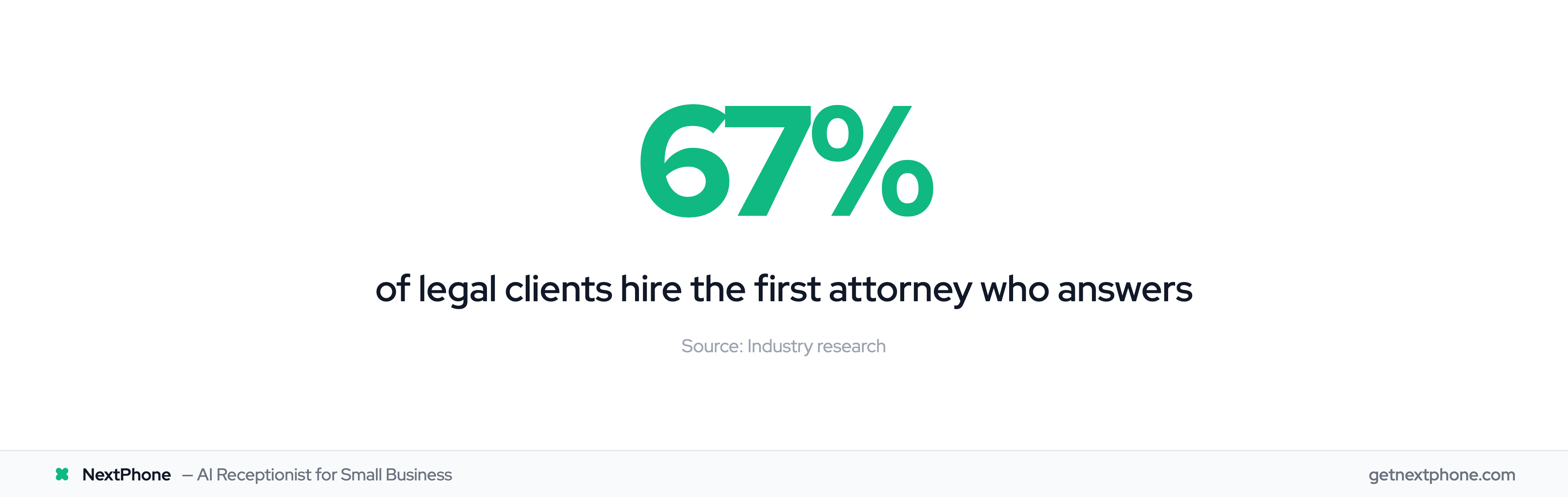
Here's a statistic that should reshape how you think about call handling: 67% of legal clients hire the first attorney who answers their call.
Not the attorney with the best reviews. Not the one with the biggest billboard. The one who picks up the phone.
Research from MIT's lead response studies found that 78% of customers buy from whichever company responds first. The legal industry is no exception.
When a potential client calls three firms and only one answers, that firm wins the case. It's that simple.
The Emotional State of PI Callers
Personal injury callers aren't shopping for services the way someone might browse for a new accountant. They're often scared, in pain, worried about medical bills, anxious about lost wages, and uncertain about their legal options.
They need to talk to someone now. If they reach voicemail, they don't think "I'll wait for a callback." They think "This firm can't help me" and move on.
Meeting potential clients in their moment of need—even at 2 AM—builds immediate trust and dramatically increases conversion rates.
Essential Features of a PI Answering Service
Not all answering services are created equal. For personal injury specifically, look for these capabilities.
Legal Intake Capabilities
The core function should be comprehensive case intake, not just message-taking. This means collecting:
- Accident details: Date, time, location, circumstances
- Injury information: Type of injuries, severity, current symptoms
- Medical treatment: Hospital visits, ongoing treatment, anticipated care
- Other party information: Names, contact details, insurance information
- Documentation: Police reports, witness names, photos taken
- Timeline: Statute of limitations considerations
A proper intake form ensures your team receives enough information to evaluate case viability before making a single callback.
Case Qualification and Screening
The best services don't just collect information—they help filter it. Trained intake specialists can identify potential red flags:
- Statute of limitations issues
- Clear liability challenges
- Cases outside your practice areas
- Calls that are better suited for other firm types
This pre-screening saves attorneys hours of time following up on non-viable leads.
Emergency Routing and Escalation
Some calls need immediate attorney attention. Severe injuries. Time-sensitive evidence situations. High-value case indicators.
Look for services that offer live call transfer capabilities with customizable criteria. You might route all catastrophic injury calls directly to your cell while letting the service handle routine intake for less urgent matters.
Integration With Legal Software
Manual lead entry creates delay and data loss. Modern answering services integrate with case management platforms like Clio, MyCase, Filevine, and others.
When a call ends, the lead information should flow automatically into your system—complete with call recording, transcript, and intake details—ready for your team to review.
Bilingual Support
In many markets, Spanish-speaking capability significantly expands your potential client base. If your firm serves diverse communities, ensure your answering service can handle calls in the languages your clients speak.
Types of Personal Injury Cases Handled
A quality PI answering service should be trained to handle intake across all major personal injury categories.
Motor Vehicle Accidents
Auto accidents remain the most common PI case type. Intake should cover vehicle details, accident description, injuries, police involvement, insurance information, and witness details. Average settlements typically range from $15,000 to $50,000 depending on injury severity.
Premises Liability
Slip-and-fall and other premises cases require specific details: property type, owner information, hazard description, notice issues, and injury documentation. These cases hinge on proving the property owner knew (or should have known) about the dangerous condition.
Medical Malpractice
Med mal cases are complex and high-value—settlements often exceed $250,000. Intake must capture provider information, treatment history, specific error description, and resulting harm. These cases typically require detailed follow-up, but proper initial intake establishes whether the call warrants further investigation.
Workplace Injuries
Work-related injuries involve workers' compensation considerations, employer information, safety violation details, and third-party liability potential. The intake specialist needs to understand the difference between comp-only cases and those with civil liability.
Product Liability
Defective product cases require product identification, purchase details, defect description, and injury documentation. With median product liability payouts around $748,000, these cases warrant careful intake attention.
Other common categories include dog bites, nursing home abuse, wrongful death, and toxic exposure cases. Each has specific intake requirements that trained legal receptionists should understand.
Pricing: Answering Service vs. Alternatives
Understanding the cost comparison helps clarify the ROI of professional call handling.
Traditional Answering Service Pricing
Legal-specialized answering services typically charge between $200 and $800 per month. Pricing usually depends on:
- Call volume (per-minute or per-call billing)
- Hours of coverage (business hours only vs. 24/7)
- Complexity of intake (simple messages vs. full legal intake)
- Add-on features (live transfer, integrations, bilingual support)
Examples of traditional pricing:
- Ruby Receptionists: $230/month for 50 receptionist minutes
- AnswerConnect: $299/month for 100 minutes
- LEX Reception: Custom pricing based on volume
AI-Powered Answering Service Pricing
AI receptionists have changed the pricing equation. Services like NextPhone offer unlimited call handling at flat monthly rates—typically $99 to $299 per month.
The AI approach eliminates per-minute billing anxiety and provides true 24/7 coverage without overtime premiums.
In-House Receptionist Costs
For comparison, hiring a full-time receptionist means:
- Salary: $33,960/year (average)
- Benefits and taxes: $8,490 (25% additional)
Total: approximately $42,450/year
And that receptionist only works 40 hours per week—no nights, weekends, holidays, sick days, or vacation coverage.
The ROI Math
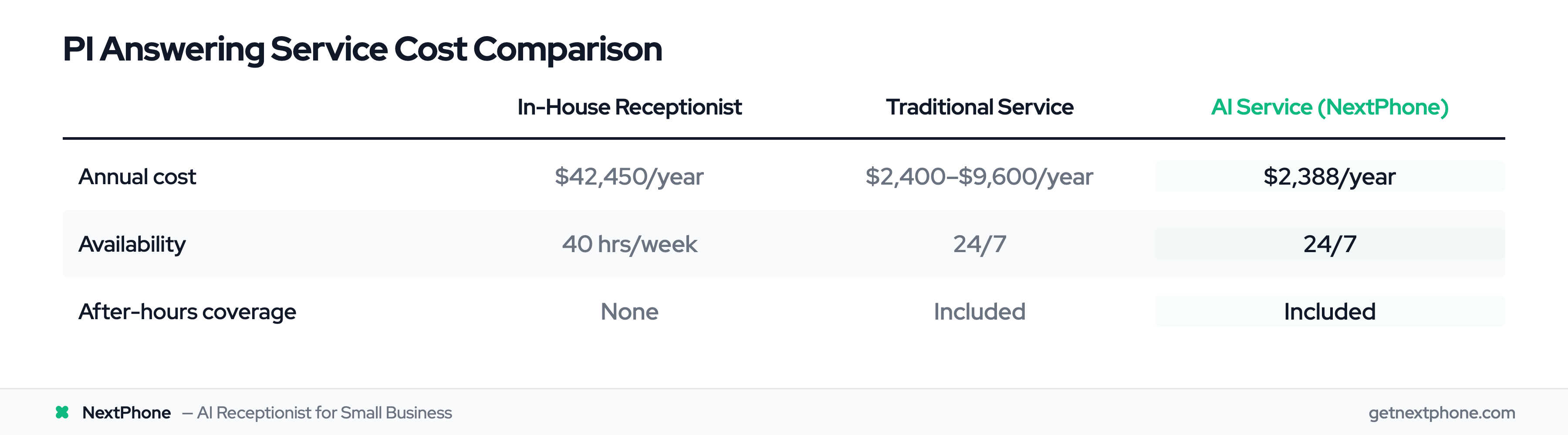
| Option | Annual Cost | Availability | After-Hours |
|---|---|---|---|
| In-house receptionist | $42,450 | 40 hrs/week | None |
| Traditional service | $2,400-$9,600 | 24/7 | Included |
| AI answering service | $1,188-$2,388 | 24/7 | Included |
At $199/month ($2,388/year), an AI answering service costs 94% less than a full-time hire while providing triple the coverage hours.
More importantly: if that service captures just one additional case per year that you would have missed, it pays for itself 4-5 times over.
How to Choose the Right PI Answering Service
With multiple options available, here's how to evaluate which service fits your practice.
Evaluate Legal Specialization
Ask specifically about personal injury training. Generic answering services may sound professional but miss critical intake questions. Inquire about:
- PI-specific intake protocols
- Training on case type differences
- Legal terminology familiarity
- Handling of sensitive caller situations
Check Integration Capabilities
Confirm the service integrates with your existing software. Data should flow automatically, not require manual re-entry. Ask about:
- Case management system compatibility (Clio, MyCase, etc.)
- CRM integration options
- Call recording and transcript delivery
- Lead notification methods
Assess Availability and Response Time
The goal is answering every call quickly. Ask about:
- Average answer time (under 5 seconds is ideal)
- Coverage hours (true 24/7 or business hours only?)
- Handling of overflow and high-volume periods
- Holiday and weekend protocols
Review Pricing Structure
Understand exactly how you'll be billed:
- Per-minute vs. flat monthly rate
- What counts as a billable minute?
- Are there setup fees or minimum commitments?
- What features are included vs. add-ons?
Request a Trial
Reputable services offer free trials. Test the system with real calls before committing. Evaluate how calls are handled, how quickly leads reach you, and whether the experience represents your firm well.
How NextPhone Solves PI Call Challenges
NextPhone takes a different approach to personal injury call handling—using AI to deliver speed and consistency that traditional services can't match.
AI-Powered Speed Advantage
NextPhone answers every call in under 5 seconds. No ringing. No hold time. No "please stay on the line."
When that accident victim calls at 2 AM, the AI receptionist picks up immediately—while competitors are still ringing to voicemail.
This speed matters. With 67% of clients hiring whoever answers first, sub-5-second response time directly impacts case acquisition.
24/7 Coverage Without the Cost
At $199/month with unlimited calls, NextPhone provides around-the-clock coverage at less than 6% the cost of a full-time receptionist.
There's no per-minute billing, no overtime charges for holidays, and no gaps in coverage during lunch breaks or staff turnover.
Seamless Integration and Lead Routing
When a call ends, NextPhone automatically:
- Sends you a complete call summary via email and SMS
- Captures caller details and intake information
- Routes urgent calls to your phone in real-time
- Integrates with your CRM through webhooks
For personal injury attorneys losing cases to missed calls, the math is straightforward: $199/month to potentially capture $130,000+ in annual revenue you're currently missing.
Frequently Asked Questions
How much does a personal injury answering service cost?
Traditional legal answering services charge $200-$800/month depending on call volume and features. AI-powered options like NextPhone start at $199/month with unlimited calls. Compare this to $42,000+/year for an in-house receptionist who only works business hours.
Can an answering service actually qualify personal injury cases?
Yes. Services trained in PI intake gather accident details, injury information, treatment history, and other party details. They can identify red flags like statute of limitations issues and comparative negligence concerns, prioritizing high-value cases for immediate attorney follow-up.
What happens to after-hours calls?
With a 24/7 answering service, after-hours calls receive the same full intake as daytime calls—qualification, detail gathering, and lead capture. Without one, studies show 90% of after-hours calls go unanswered and 80% of callers won't leave a voicemail.
Will callers know they're talking to an answering service or AI?
Professional services answer in your firm's name with custom scripts. Modern AI receptionists sound natural and conversational. Most callers can't distinguish between an AI receptionist and a human—and they don't care, as long as they get help quickly.
How fast should an answering service pick up?
The faster the better. Industry data shows 67% of legal clients hire the first attorney who answers. AI services answer in under 5 seconds, while traditional services may take 15-30+ seconds. After 4-5 rings, you're already losing potential clients.
Can I get calls transferred to me for urgent cases?
Yes. Quality answering services offer live transfer capabilities. You can set criteria for immediate transfers—severe injuries, specific case types, VIP referrals—while routine inquiries are handled and summarized for later follow-up.
Do I need different answering services for different practice areas?
Not necessarily. Many services handle multiple practice areas with trained intake specialists. However, if personal injury is your primary focus, choose a service with specific PI training. Generic answering services often miss critical intake questions that affect case evaluation.
Stop Losing Cases to Missed Calls
The math on missed calls is brutal. At 35% unanswered during business hours and 90% after hours, the typical PI firm is bleeding potential revenue without realizing it.
Every missed call is a potential $10,000+ case walking out the door—to the competitor who answered.
A 24/7 answering service isn't a luxury expense. At $199/month compared to $130,000+ in potential annual losses, it's one of the highest-ROI investments a PI firm can make.
The firms winning new clients aren't the ones with the biggest advertising budgets. They're the ones answering every call, day or night.