
Your phone rings at 11 PM. A woman's voice, trembling, explains that ICE just detained her husband during a traffic stop. She needs an immigration attorney. Now.
You're at home with your family. The call goes to voicemail.
By morning, she's already hired another attorney. That family you could have helped? Gone.
This scenario plays out thousands of times daily across immigration law practices. With more than 3.4 million cases pending in US immigration courts, demand for immigration attorneys has never been higher. Yet most firms still miss the calls that matter most.
An immigration attorney answering service solves this problem - but not just any answering service. Immigration clients speak dozens of languages, face life-altering deadlines, and call during their most vulnerable moments. You need multilingual intake that understands what's at stake.
This guide covers how to choose an answering service built for immigration law - one that speaks your clients' languages, captures the right information, and never lets an urgent call slip through.
Why Immigration Attorneys Need Specialized Answering Services
The Immigration Surge: More Cases, More Calls
Immigration law practices are busier than they've ever been. The backlog in US immigration courts now exceeds 3.4 million cases, with average wait times stretching to 1,424 days - nearly four years. Miami alone has 317,000 pending cases. New York City has 240,000. Dallas, 220,000.
This backlog translates directly into phone calls. Every one of those millions of cases represents a person - usually an entire family - looking for legal help. And when they find your firm's number, they call.
Stakes Are Higher Than Other Legal Calls
When someone calls a personal injury firm, they might be annoyed about a fender bender. When someone calls an immigration attorney, they might be watching their family get torn apart.
Immigration clients face deportation, family separation, and asylum deadlines that can mean the difference between safety and persecution. A missed call isn't just lost revenue - it's a family that didn't get the help they desperately needed.
These callers don't leave voicemails and try again tomorrow. They call the next attorney on their list.
Generic Services Miss the Mark
A standard business answering service might work for a plumbing company. It won't work for immigration law.
Your clients speak multiple languages. They're often afraid and confused. They use terms like "asylum," "adjustment of status," and "notice to appear" that a generic receptionist won't understand. And they call at 2 AM because ICE doesn't operate on business hours.
Immigration attorneys need answering services that understand this reality.
The Cost of Missing Immigration Client Calls
The Voicemail Dead End
Here's a number that should concern every immigration attorney: 80% of callers who reach voicemail never call back.
They don't leave a message and wait patiently. They hang up and call the next firm on their list. In immigration law, where clients are often scared and seeking immediate reassurance, this behavior is even more pronounced.
According to Clio's 2024 Legal Trends Report, only 40% of law firms answer their phones. Nearly half are essentially unreachable during regular business hours. After hours? The numbers get worse.
Speed-to-Lead: Why Response Time Matters
Landmark MIT research on lead response found something that applies directly to immigration law: firms responding to inquiries within 30 minutes see conversion rates 400% higher than those responding after 24 hours.
Think about what that means for your practice. Call back within half an hour, and you're four times more likely to sign that client. Wait a day, and you've probably lost them forever.
For immigration matters, the stakes are even higher. A family calling about an ICE detention can't wait 24 hours. They can't wait 24 minutes. They need someone now.
What This Costs Your Practice
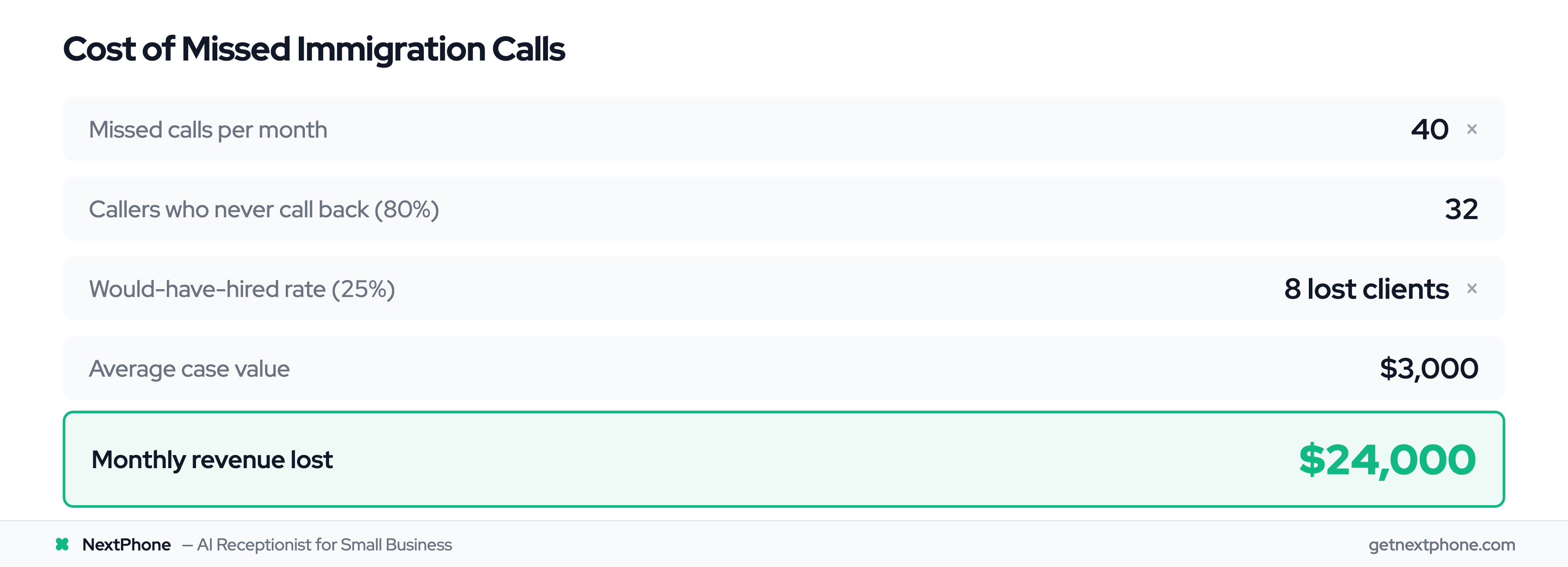
Let's do some math. Say you miss 10 calls per week because you're in court, with clients, or it's after hours. That's 40 missed calls per month.
If 80% never call back, that's 32 potential clients gone. If even 25% of those would have hired you at an average case value of $3,000, you're losing $24,000 per month. That's $288,000 per year walking out the door.
And that's a conservative estimate.
The Multilingual Imperative for Immigration Firms
Spanish Is Just the Starting Point
Spanish fluency isn't a nice-to-have for immigration answering services. It's mandatory.
According to US immigration court data, Spanish accounts for more than 70% of completed immigration cases. If your answering service can't handle Spanish-speaking callers with fluency and cultural competence, you're excluding the majority of your potential client base.
But Spanish alone isn't enough.
The Growing Need for Asian Languages
Pew Research data shows the full picture of immigrant languages in the US:
- Spanish: 42%
- Chinese: 6%
- Hindi: 5%
- Filipino/Tagalog: 4%
- Vietnamese: 3%
More than 275 languages appear in US immigration courts. While you can't support all of them, your geographic market determines which matter most.
Vietnamese communities are concentrated in California and Texas. Korean speakers cluster in New York and Los Angeles. If you practice in these areas, English and Spanish alone leaves money on the table.
What Multilingual Intake Actually Requires
Multilingual support isn't just translation. A truly effective immigration answering service needs:
- Native-level fluency: Clients can tell the difference between fluent speakers and people reading from scripts
- Immigration vocabulary: Terms like "adjustment of status," "notice to appear," and "asylum clock" need to be understood, not fumbled
- Cultural competence: Understanding why a Central American asylum seeker might be reluctant to share certain details on a first call
- Written accuracy: Capturing names, addresses, and case details correctly in any language
A receptionist who "took Spanish in high school" won't cut it.
Immigration-Specific Intake: What Good Looks Like
Different Case Types Need Different Questions
Not all immigration calls are the same. Your answering service should collect different information based on the case type:
| Case Type | Key Intake Questions |
|---|---|
| Asylum | Country of origin, type of persecution, date of US entry, one-year deadline awareness |
| Family Petition | Relationship to petitioner, petitioner's citizenship status, current immigration status |
| Employment Visa | Employer name, job classification, visa type (H-1B, L-1, etc.), timeline urgency |
| Deportation Defense | Court date, location of detention (if applicable), current immigration status, prior orders |
| Naturalization | Green card duration, travel history, criminal history awareness |
A generic "name, number, what's this about?" intake misses critical information that helps you prioritize and prepare.
Time-Sensitive Information That Can't Be Missed
Some immigration matters have hard deadlines that your answering service must flag immediately:
- ICE detentions: These require same-day response. The caller may be a family member with limited information.
- USCIS deadlines: Response deadlines, interview notices, and RFE (Request for Evidence) responses have firm dates.
- One-year asylum deadline: Asylum applicants must file within one year of US entry in most cases. Missing this is catastrophic.
- Court dates: Immigration court dates should trigger immediate notification.
Your answering service needs protocols to identify these situations and alert you instantly - not wait until morning.
Building Trust From the First Call
Immigration clients are often afraid. They may be undocumented. They may have had bad experiences with authority figures. They may be calling about a traumatic situation.
The first voice they hear sets the tone for the entire relationship.
Your answering service should:
- Greet callers warmly, in their language
- Acknowledge the stress they're under without being patronizing
- Collect information efficiently but not coldly
- Provide clear next steps so they know what to expect
A rushed, impersonal intake can lose a client even if you call back quickly.
Cost Comparison: In-House vs Answering Service vs AI
Hiring In-House: The True Cost
A full-time bilingual receptionist for an immigration law firm typically costs:
- Base salary: $35,000-45,000/year
- Benefits (health, PTO, etc.): $8,000-15,000/year
- Training and supervision: Ongoing time investment
- Coverage gaps: Lunch, sick days, vacations, turnover
Total: $43,000-60,000 per year for 40-hour coverage
And that's one person, one language (usually English and Spanish), during business hours only. After 6 PM? Weekends? You're back to voicemail.
Traditional Answering Services: Per-Call or Per-Minute
Traditional legal answering services typically charge in two ways:
Per-call pricing: $1.29-2.80 per call, depending on complexity. Simple message-taking is cheaper; full legal intake costs more.
Per-minute pricing: Around $1.69 per minute. The average legal intake call runs 2-3 minutes, so a busy firm can see costs add up quickly.
Monthly plans typically range from $200-800, with overage charges when you exceed your allotment.
Advantages:
- Human touch
- 24/7 options available
- Legal training possible
Disadvantages:
- Costs scale with volume
- Limited multilingual options beyond Spanish
- Quality varies widely
AI-Powered Services: The New Option
AI answering services have changed the economics:
-
Fixed monthly pricing: $99-300/month
-
Unlimited calls (no per-call charges)
-
24/7/365 coverage standard
-
Multilingual capabilities
-
Consistent quality on every call
-
NextPhone, for example, costs $199/month for unlimited calls - that's 93% less than hiring in-house and predictable costs regardless of call volume.
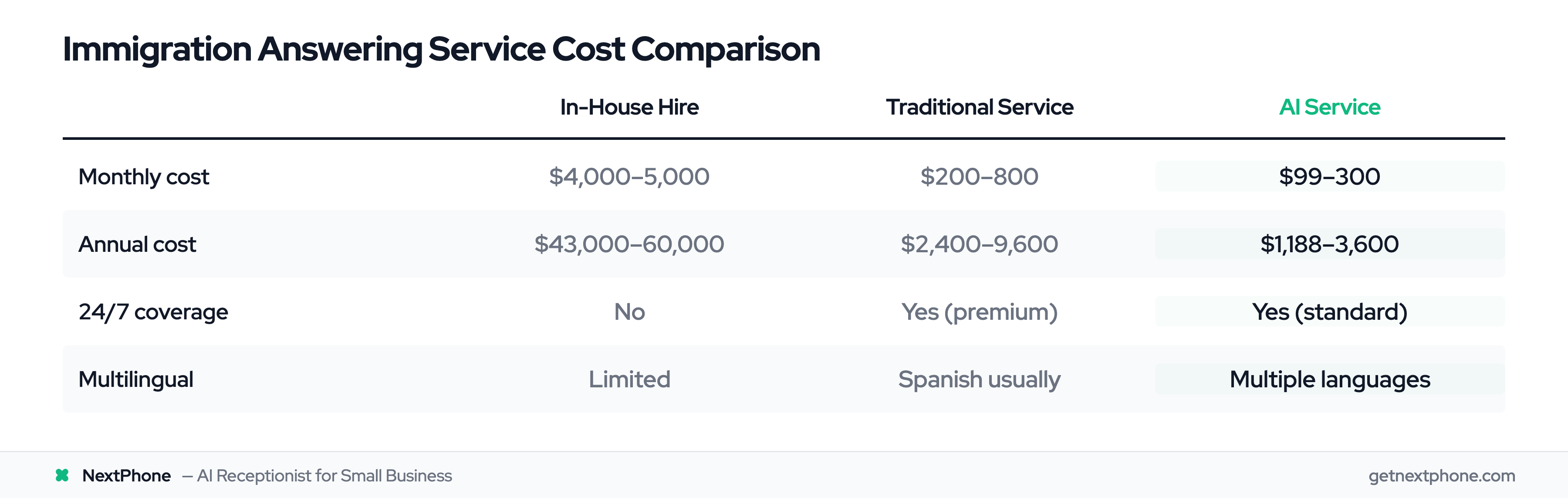
| Factor | In-House Hire | Traditional Service | AI Service |
|---|---|---|---|
| Monthly Cost | $4,000-5,000 | $200-800 | $99-300 |
| Annual Cost | $43,000-60,000 | $2,400-9,600 | $1,188-3,600 |
| 24/7 Coverage | No | Yes (premium) | Yes (standard) |
| Multilingual | Limited | Spanish usually | Multiple languages |
| Consistency | Varies | Varies | Every call identical |