Quick answer: For contingency law firms — personal injury, criminal defense, employment — every missed intake call is a case you'll never file and a fee you'll never collect. The best answering service for most law firms in 2026 is NextPhone: flat-rate AI from $199/month for unlimited calls, with native Clio integration on the $299 Growth plan and 24/7 emergency routing. This guide compares 9 legal answering services on the metrics that matter for law firm intake: pricing model, after-hours coverage, Clio integration depth, and call quality on distressed new-client calls.
Last updated: July 2026. Pricing verified at time of writing. Confirm current pricing on each vendor's site.
Your phone rings at 11:03 PM. A potential client was just in a car accident. They're calling every PI firm on the first page of Google. The first firm that picks up gets the case — and if you work on contingency, that call was worth your next five-figure fee. The second firm gets voicemail.
According to the 2024 Clio Legal Trends Report, only 40% of law firms answer incoming phone calls, down from 56% in 2019. That means 60% of firms are sending potential clients straight to a competitor — and in contingency practice, that's not just a missed call. It's a case you'll never file and a fee you'll never collect.
Our recommendation: NextPhone. It's the only flat-rate AI option in this category with native Clio integration, configurable legal intake questions, and 24/7 emergency routing for arrests, court deadlines, and custody emergencies. Unlimited calls start at $199/month; the Clio-integrated Growth plan is $299/month. For firms handling 50+ calls per month, the pricing math alone usually settles it. A single missed contingency case at $5,000+ average case value costs more than two years of coverage.
Why NextPhone wins on legal intake:
Native Clio + Clio Grow integration. Every new-client call syncs to Clio automatically — case type, urgency, contact info, full call transcript — before you return the call. No manual entry, no sticky notes.
No per-minute meter. Smith.ai's live tier runs $300/month for 30 calls. Ruby runs $250/month for 50 minutes, then bills per minute past it. NextPhone doesn't bill per minute at all: flat monthly plans from $199, and evening intake, weekend emergencies, and mass-tort spikes all cost the same as a quiet week. You know what next month costs before it starts.
24/7 emergency routing. Arrests, restraining orders, and court deadlines route directly to your on-call attorney. After-hours coverage costs nothing extra.
The other eight services on this list serve real use cases: if you're a solo attorney at under 30 calls a month and want a live human voice every time, there are cheaper human options. We'll cover those too. This guide is backed by analysis of 1,446,980 real inbound calls in our production database and focuses on the metrics that matter for legal intake: pricing model, Clio integration depth, after-hours coverage, and call handling on distressed new-client calls.
See how NextPhone handles law firm intake calls
AI answering service that answers, qualifies, and books — 24/7.
Legal consumers who hire the first firm to respond
42%
Gary Falkowitz, intake consultant to 200+ firms
Law firms answering after hours
25% — while 35%+ of legal leads call then
Gary Falkowitz
Human attorney answering service (200 calls/month)
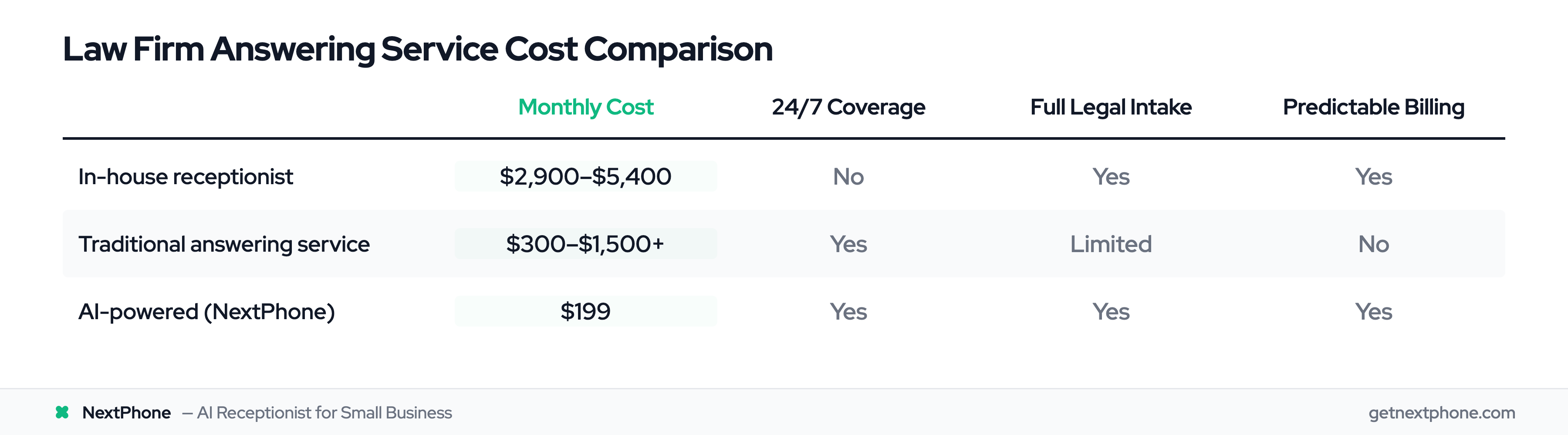
$1,400–$1,725+/month
Smith.ai live plan / Ruby — see comparison below
Flat-rate AI attorney answering service
$199/month, unlimited calls
NextPhone
Smith.ai vs Ruby for law firms: Both charge per-call or per-minute. At 200 calls/month, Smith.ai (live plan) runs approximately $1,400 and Ruby approximately $1,725+. NextPhone charges $199 flat — the same price whether the month brings 20 calls or 200, including every after-hours and weekend intake. For the full side-by-side, see Smith.ai vs Ruby vs NextPhone for Law Firms below.
After-hours attorney answering service: Only 25% of law firms answer after-hours calls, despite 35%+ of legal leads calling outside business hours. Our real call data shows roughly 1 in 5 law firm calls arrives outside Mon–Fri 9–5, with the 8am hour alone carrying more volume than 5pm through midnight combined — people call about their legal matter on the way to work, before offices open. A 24/7 attorney answering service that costs the same at midnight as at noon is the only model that captures that window without billing surprises.
Note: Pricing verified from provider websites and third-party review platforms as of May 2026. Per-minute services show base plan pricing before overages.
What Happens to the Intake Call When You Miss It?
The difference between a true law firm intake service and a generic answering service is what happens the moment your phone rings and you can't pick up. Here's how each model handles a missed intake call:
Scenario
NextPhone (flat-rate AI)
Per-minute human services
Call comes in at 11 PM
AI answers in under 2 seconds — intake captured instantly
Per-minute billing starts on ring; after-hours routing varies by plan
Criminal defense emergency
Flags urgency from caller's words, transfers to on-call attorney; if no answer, takes detailed transcript and emails it immediately
Human receptionist captures a message; per-minute meter runs throughout
High-volume intake month
Same flat monthly bill — zero overage
Bill scales with every minute of intake at the same per-minute rate
Call details synced to Clio
Automatic post-call sync, same flat plan
Manual entry or Zapier, per-minute regardless of what happens after
Three callers ring simultaneously
All answered at once — unlimited concurrent calls, no busy signals
Callers queue or hit voicemail when all agents are occupied
For law firms where a missed contingency case starts at $5,000+ in potential fees, the law firm intake service choice is a revenue decision, not a cost decision.
NextPhone: Best Flat-Rate Option for High-Volume Firms
Best for: Firms that want a predictable bill and no per-minute meter on intake calls
NextPhone takes a fundamentally different approach to legal answering. Instead of charging per minute or per call, the AI receptionist handles unlimited inbound calls for a flat $199/month. For law firms fielding 100+ calls per month, the math changes dramatically. Hang-ups, short inquiries, and after-hours voicemail-replacement calls — the kind of calls a per-minute plan still gets billed minimums for — all absorb at zero marginal cost.
Key features:
24/7 AI receptionist with unlimited concurrent call handling (no busy signals when three DUI calls hit at midnight)
Unlimited calls, no overages, no per-minute billing
Smart forwarding routes complex calls directly to the attorney's cell
Clio integration plus 8,000+ apps via Zapier
Fully configurable intake questions per phone line (name, contact, case type, urgency, plus custom fields you define for conflict-check)
9 languages supported natively
Spam filtering blocks ~9.0% of inbound traffic before it reaches you (our post-2026-05-16 average)
Pricing: flat monthly plans from $199. No setup fees, no per-minute charges, no overage surprises — the bill is the same whether you take 20 calls or 200. A 7-day free trial lets you test before committing.
What the data shows: In our analysis of 1,446,980 inbound calls across law firms and professional services businesses, 90–95% of calls resolve without a human escalation — routine intake captured and logged automatically before the attorney returns the call. The AI answers in under 2 seconds. No busy signals. No missed after-hours cases.
Where it falls short: NextPhone is AI-first. While the AI handles routine intake cleanly, some complex legal conversations (distressed clients needing emotional reassurance, nuanced case evaluations) benefit from smart forwarding to your team. Smart forwarding routes those calls directly to you, so the alternative to the AI isn't a stranger reading a script, it's you.
How legal intake actually works: two real workflows
After-hours new-client call — criminal defense:
Your intake line rings at 11 PM. A caller's family member was just arrested. The AI answers in under 2 seconds, identifies a new client, and walks through your configured intake questions — charge type, county, callback number. When the caller describes an active arrest situation, the AI flags urgency and routes to your on-call number with a warm transfer: the call summary is announced before the connection completes. If the transfer doesn't connect, the AI takes a detailed message and sends you an email transcript immediately. The caller never hits voicemail.
Conflict-check intake — new prospective client:
A caller explains an employment dispute and names their employer. The AI asks your configured intake questions and captures the full conversation in a transcript. Call details sync to Clio automatically, giving you a structured intake record before you return the call — not a sticky note, not a voicemail with a callback number and no context. The caller gets a next-step booking link via text during the call. You review the intake record and confirm the consultation after the conflict check runs, with full caller context already in front of you.
Both workflows run identically at 2 PM and 2 AM, on the same flat monthly plan. See our complete legal intake services guide for intake question templates by practice area.
Pick the voice your intake line answers in
The voice your firm picks up with matters. Legal callers — especially first-time PI, criminal defense, or family-law inquiries — respond better to a calm, neutral, unhurried voice than to anything chirpy or chatty. NextPhone ships a 28-voice production library; the calmer end of it is what most attorneys end up choosing for their inbound line. Three to start with:
Hear it: Isabel — calm, neutral, fitted for legal intake
0:00
0:00
Isabel is the default we recommend for legal intake lines. Zero flourish, even pacing, no upspeak — the tonal opposite of a generic call-center greeting. Strong fit for criminal defense, family law, and PI firms where callers are often in distress.
Hear it: Emma — warm-professional female
0:00
0:00
Emma reads warmer than Isabel — friendly without being chatty. Strong fit for estate planning, business law, and immigration practices where callers want reassurance before they explain their situation.
Hear it: Jonathan — deeper male, executive feel
0:00
0:00
Jonathan reads with authority and even pacing — a fit for litigation, corporate, and senior-partner-facing intake lines where the firm wants the phone voice to match the partner-level brand.
Best for: Firms that want phone, chat, and SMS answering from a single provider
Smith.ai combines AI-powered call handling with North America-based live agents. The hybrid model handles routine calls through AI and escalates complex conversations to human receptionists. For law firms, this means initial screening happens instantly while sensitive intake conversations get a human touch.
Legal intake and lead qualification with custom screening questions
Native integrations with Clio, Salesforce, HubSpot, and 8,000+ apps via Zapier
Bilingual support (English/Spanish)
Outbound calling for appointment confirmations
Per-call billing (no per-minute surprises on call length)
Payment collection through LawPay integration
Pricing: Live Receptionist plans start at $300/month for 30 calls ($11.50/call overage), scaling to higher tiers for greater volume. Per-call pricing means longer intake conversations don't inflate your bill the way per-minute does.
Where it falls short: Costs scale quickly at higher volumes. A firm handling 200 calls/month on the live plan could spend $1,400+ monthly. Setup can also be complex when connecting multiple workflows across practice areas.
Ruby: Best Premium Human Experience for Small Firms
Best for: Solo and small firms (1-5 attorneys) that prioritize human warmth on every call
Ruby has been the gold standard in virtual receptionist services since 2003. US-based live receptionists answer calls with a warm, professional tone that callers often mistake for in-house staff. For law firms where first impressions on sensitive matters are everything, Ruby delivers a consistently polished experience.
Key features:
24/7/365 US-based live receptionists
Legal intake support with custom scripts
Mobile app for real-time call management and status updates
Integrations with Clio, MyCase, Rocket Matter, and Calendly via Zapier
Pricing: Plans start at $250/month for 50 receptionist minutes, scaling to $720/month for 200 minutes and $1,725/month for 500 minutes. All plans include the same features. Per-minute billing means costs increase with call volume and duration — and remember, every call rounds up to the next full minute.
Where it falls short: Per-minute billing creates unpredictable costs. At 3 minutes per call and 200 calls/month, you'd exhaust even the $720/month (200-minute) plan quickly, triggering overage charges. No rollover on unused minutes.
Answering Legal: Best for Legal-Only Specialization
Best for: Firms that want receptionists trained exclusively in legal intake
Answering Legal serves only law firms. Their receptionists understand legal terminology, intake workflows, and the urgency behind different case types. This legal-first focus means less training friction and fewer mistakes on specialized calls.
Key features:
24/7/365 live answering by legal-trained receptionists
Full legal intake and lead capture
CRM integration with automatic call logging
Bilingual support (English/Spanish)
Mobile app for message management
Customizable scripts and call handling per practice area
Pricing: Per-minute, on a minutes-bucket model with overages beyond your plan. Answering Legal does not publish pricing on their website — their pricing page is a lead capture form — so you'll need to contact them. Ask for the per-minute overage rate in writing, not just the monthly plan price.
Where it falls short: "Legal-specific" doesn't always mean "your firm-specific." If you handle multiple practice areas with nuanced routing rules, confirm how deeply Answering Legal can customize branching scripts. Per-minute costs can still climb during intake-heavy months.
LEX Reception: Best for Structured Legal Intake
Best for: Firms that need both inbound answering and outbound follow-up calling
LEX Reception is a legal-focused answering service offering 24/7 receptionist coverage with an emphasis on structured intake processes. Their outbound calling capability sets them apart for firms that need proactive follow-up with leads.
Key features:
24/7/365 live legal receptionists
Legal intake, lead qualification, and live transfers
Outbound calling for follow-up and appointment confirmation
Live chat service for website lead capture
Bilingual reception (English/Spanish)
Integrations with Clio, MyCase, and other legal software
Mobile app for managing messages and account
Pricing: Entry plan at $425/month for 150 minutes with a $75 setup fee and $2.75/minute overages. Best Value plan at $450/month for 300 minutes with $2.25/minute overages. Growth plan at $775/month for 500 minutes.
Where it falls short: Higher entry price point than most competitors. Billing rounds up to the nearest minute in one-minute increments, which can inflate costs on shorter calls. The setup fee adds friction for firms wanting to test the service. For a closer comparison, see our LEX Reception alternative guide.
AnswerConnect: Best Forbes-Rated Live Service
Best for: Firms wanting a human-only answering service with CRM integrations
AnswerConnect was named the Best Answering Service for 2026 by Forbes. They take a firm "no AI, no bots" stance, relying entirely on trained human receptionists. For law firms that want every call handled by a live person, AnswerConnect delivers consistent, professional service.
Key features:
24/7 live human answering (no AI component)
Legal client intake and appointment scheduling
Native CRM integrations with Salesforce, HubSpot, and Zendesk
Bilingual support (English/Spanish)
Custom scripting for each practice area
Returning caller recognition
Pricing: Plans start around $350/month for 200 minutes. A one-time $49.99 setup fee applies. Per-minute billing with interactions rounded up to the nearest minute.
Where it falls short: The per-minute model penalizes firms with longer intake calls. At 200 calls/month with a 3-minute average, you'd need 600 minutes, pushing monthly costs well above $1,000. No AI option means every call, including simple appointment confirmations, uses your minute allotment.
Abby Connect: Best for Dedicated Receptionist Teams
Best for: Firms wanting a small, dedicated team of receptionists who learn your business
Abby Connect assigns a team of 10-20 dedicated virtual receptionists to each client account. The same people answer your calls consistently, learning your firm's preferences, attorneys, and case types over time. For law firms, this translates to fewer intake errors and a more personal caller experience.
Key features:
Dedicated receptionist teams (not a rotating call center pool)
US-based receptionists in Las Vegas office
Legal intake and appointment scheduling
Bilingual support (English/Spanish)
Abby Intelligence AI-powered call summaries and transcriptions
Integrations via Zapier (connects with Clio, HubSpot, Salesforce, and 3,000+ apps)
14-day free trial
Pricing: Plans start at $329/month for 100 minutes. Higher tiers available for increased minute allotments. Extended hours (beyond standard business hours) available as an add-on. Setup fees may apply.
Where it falls short: Not true 24/7 service by default. Per-minute billing still applies.
Hear it: AI handling a legal after-hours intake
0:00
0:00
A real after-hours call from our production system. The legal-relevant fields — caller name, callback number, nature of matter, urgency — get captured before the office reopens. Same flow whether it's 7pm Tuesday or 2am Saturday, at the same monthly cost.
VoiceNation: Best Budget Option for Solo Attorneys
Best for: Solo practitioners with low call volume who need basic 24/7 coverage
VoiceNation offers the most accessible entry point in the legal answering service market. For solo attorneys who receive fewer than 30 calls per month and need someone to pick up the phone, VoiceNation provides basic coverage at a fraction of what premium services charge.
Key features:
24/7 live answering
Bilingual support
Customizable scripts
Message delivery via email, text, or app
Free mobile app
Call forwarding and warm transfers
Pricing: Plans start at $50/month for 30 minutes, with Business ($99), Pro ($249), and Executive ($449) tiers available. Per-minute overages apply once you exceed your plan.
Where it falls short: Limited legal-specific capabilities. VoiceNation serves all industries, so receptionists may not understand legal intake nuances, case terminology, or urgency levels the way legal-focused services do. At higher call volumes, overage charges quickly push the "budget" option above $200/month.
Moneypenny: Best for a Dedicated Legal Receptionist
Best for: Firms wanting a single assigned receptionist who acts as an extension of your team
Moneypenny assigns one dedicated receptionist to your law firm rather than routing calls through a large agent pool. This creates the closest experience to having an in-house receptionist without the $45,000+/year salary.
Key features:
Dedicated receptionist assigned to your firm
24/7 answering coverage
Legal intake and bespoke call handling
Integrations with legal practice management software
Call forwarding and message delivery
Both human and AI receptionist options available
Pricing: Custom pricing based on firm needs. Moneypenny also operates VoiceNation's plans and offers AI answering service options alongside their human receptionist service.
Where it falls short: Lack of transparent, publicly listed pricing makes it harder to compare against other services.
AI vs. Live Answering Services for Law Firms
The debate between AI and human answering services isn't binary.
The legal intake math: Only 40% of law firms answered the phone when secret-shopped — down from 56% in 2019 (Clio 2024 Legal Trends Report, 500 firms). 85% of callers won't call back after an unanswered call (CallRail 2025). 42% of legal consumers hire the first firm that responds (Gary Falkowitz, intake consultant to 200+ firms). The right approach depends on your call types, volume, and budget.
Factor
AI-Only
Human-Only
Hybrid (AI + Human)
Cost (200 calls/mo)
From $199/mo flat monthly
$600-$1,800/mo
$400-$1,400/mo
Availability
True 24/7, no holidays
24/7 (with staffing costs)
24/7
Simultaneous calls
20+ at once
Limited by agents on shift
Varies
Legal intake
Routine intake (name, case type, contact, scheduling, conflict-check fields)
Complex intake + emotional support
Routine via AI, complex via human
Consistency
Same script, every time
Varies by agent quality
Varies
Languages
9
Typically 2 (English/Spanish)
2-5
Speed to answer
Under 2 seconds
10-30 seconds
5-15 seconds
Cost predictability
Completely flat
Unpredictable (per-minute/call)
Somewhat predictable
After-hours/weekend coverage
Same cost as business hours
Often extra, or routed to backup
Mixed
According to the Clio Legal Trends Report, 79% of legal professionals now incorporate AI tools into their daily work, up from just 19% in 2023. The legal profession is embracing AI for operational tasks, and call answering is no exception.
The Real Cost of Answering Services for Law Firms
Pricing pages are misleading. The starting price is never your real cost. Here's what answering services cost a law firm receiving 200 calls per month at an average of 3 minutes per call.
Pricing Model
Provider Example
Monthly Cost (200 calls)
Annual Cost
Per-minute
Ruby ($250/mo for 50 min)
~$1,725+ (500 min tier + overages)
$20,340+
Per-minute
Answering Legal (rate not published)
Rises with call volume
Scales with a busy month
Per-minute
LEX Reception ($425/mo for 150 min)
~$1,100-$1,400
$13,200-$16,800
Per-call
Smith.ai ($300/mo for 30 calls)
~$1,400 (live plan at scale)
$16,800
Flat-rate
NextPhone (from $199/mo, unlimited)
$199
$2,388
The math is clear: a law firm receiving 200 calls per month could save $10,000-$18,000 per year with flat-rate pricing compared to per-minute alternatives.
Smith.ai vs Ruby vs NextPhone for Law Firms
The most common comparison law firms run: Smith.ai (hybrid AI + human) vs Ruby (human-only) vs a flat-rate AI option. Here is what each costs at 200 calls/month and what it includes for legal intake specifically.
Smith.ai (Live)
Ruby
NextPhone
Billing model
Per-call
Per-minute
Flat monthly
Base price
$300/mo (30 calls)
$250/mo (50 min)
$199/mo (unlimited)
Cost at 200 calls/mo
~$1,400/mo
~$1,725+/mo
$199/mo
After-hours coverage
Yes
Yes
Yes, same price
Clio integration
Yes
Via Zapier
Native (Growth plan)
Legal intake script
Customizable
Customizable
Fully configurable per line
Best for
Multi-channel (phone + chat + SMS)
Premium human warmth
High-volume, predictable billing
For firms handling 50+ calls/month, the flat-rate model is almost always the lower-cost option. At 200 calls, the savings run $14,000-$18,000/year vs Ruby or Smith.ai's live tier.
Legal-Specialist Services: LEX Reception and Answering Legal vs. NextPhone
LEX Reception and Answering Legal dominate search results for "answering service for law firms" because they train receptionists exclusively for legal intake — legal terminology, urgency triage, practice-area routing. The tradeoff: both use per-minute billing, and your busiest intake months carry the largest bills.
LEX Reception
Answering Legal
NextPhone
Billing model
Per-minute
Per-minute (rate not published)
Flat monthly
Entry plan
$425/mo for 150 min + $75 setup
Quote required
Flat monthly plans from $199 for unlimited calls
Cost at 100 calls/mo (3 min avg)
~$600–$880 (overages at $2.75/min)
Quote-only
$199
Cost at 200 calls/mo (3 min avg)
~$1,100–$1,400
Quote-only
$199
After-hours coverage
Yes
Yes
Yes, same flat price
Clio integration
Yes
Yes (via Zapier)
Native (Growth plan)
AI answering (24/7, concurrent)
No — human only
No — human only
Yes — unlimited concurrent calls
Answering Legal does not publish rates on their website — their pricing page is a lead-capture form. Ask for the per-minute overage rate in writing before signing, not just the monthly plan price.
For most firms above 80 calls per month, the pricing gap between LEX Reception or Answering Legal and a flat-rate answering service for law firms closes after one busy intake month. Above 150 calls, flat-rate AI is almost always the lower-cost option — while covering every after-hours call at no extra charge.
But the real ROI calculation isn't about what you spend on the service. It's about what you lose without one. According to Equivity, 80% of callers who reach voicemail will never leave a message, and 72% of potential clients hire the first attorney who responds. At a 35% missed call rate and $5,000 average case value, a firm handling 50 inbound calls per week could be losing $87,500 per month in potential revenue.
The real question isn't "Can I afford $199/month?" It's "Can I afford to keep losing $5,000 per missed client?"
For a complete breakdown of answering service pricing models, read our Answering Service Cost Guide.
Beyond the comparison table: what our real legal call data actually says
Most "best answering service" pages stop at the feature grid. We can go one step further: Our analysis corpus covers 1,446,980 real inbound business calls across 2,074 businesses — for this section we isolated the law firms in that dataset and analyzed six months of their inbound calls. Here is what legal intake actually looks like, measured rather than asserted.
About 1 in 5 calls to a law firm arrives outside Mon–Fri 9–5. Roughly 9% land before 9am and roughly 9% after 5pm, with the rest on weekends. That share holds whether you weight by call or by firm, so it is not one big practice skewing the number.
The 8am hour is the single most underrated slot in legal intake. It carries more inbound volume on its own than 5pm through midnight combined — people call about their legal problem on the way to work, before your office opens. A service that starts answering at 9am misses that block entirely, every single day.
Most legal calls end in a message, not a booking. Ranked by frequency, the outcomes are: a message captured for the firm, then no interaction at all (the caller hangs up), then a transfer to a human, then a new lead recorded, then an appointment booked. That ranking matters when you evaluate vendors, because a demo will always showcase the clean booking — the rarer scenario — rather than the message-taking and hang-up recovery that make up most of the volume.
Methodology: inbound calls only, six months, business-local time derived from each firm's area code and address rather than a configured setting. Sample sizes available on request.
The honest read: if your firm handles fewer than ~30 calls per month, a budget human service (VoiceNation, Posh) is fine. Between 30 and ~80 calls, a per-call hybrid like Smith.ai gets competitive. Above 80 calls — and especially above 150 calls — flat-rate AI is the only pricing model that doesn't punish you for being busy or for after-hours intake.
For law firms specifically, the after-hours and weekend skew is the lever. Legal intake calls run longer than average, arrive more often outside business hours, and carry higher revenue per call than most service-business categories. Every one of those structural factors makes per-minute billing more expensive for law firms than for any other vertical we serve.
What Lawyers Need From an Answering Service
Solo attorneys, small firms, and multi-partner practices all share the same core problem: a call that goes unanswered is a potential client calling the next lawyer listed on Google. But beyond that baseline, what makes a good answering service for lawyers depends on your practice area and call volume.
The must-haves for any lawyer answering service:
True 24/7 availability. Criminal defense, family law, and personal injury clients don't keep business hours. Arrests happen at midnight. Custody emergencies happen on Sundays. The service has to be on when you aren't, at no extra cost for after-hours coverage.
Legal intake, not just message-taking. A generic service captures "John called." A proper phone answering service for lawyers captures practice area, nature of the matter, urgency level, and contact details — the minimum you need to decide whether to call back in five minutes or first thing tomorrow.
Urgent call routing. Arrests, restraining orders, and court deadlines need an attorney, not a voicemail. The best legal answering service routes those calls directly to the on-call attorney while handling routine intake on its own.
Practice management integration. Manual data entry between an answering service and Clio (or MyCase, or any other system) is how intake details fall through the cracks. Native Clio integration — or a reliable Zapier connection for other tools — turns every answered call into a structured case record automatically.
On call volume and billing model:
Legal intake calls run longer than average business calls. A criminal defense or family law intake typically takes 4–8 minutes to capture properly. Per-minute services bill by the minute and round up — that's where the bill inflates on the calls that matter most. A flat-rate lawyer answering service eliminates that math entirely. At 50+ calls per month, the billing model usually determines the budget conversation before any other feature does.
On call recording disclosures:
Recording rules vary significantly by state — some require single-party consent, others two-party. Before configuring how your intake line records, review our state-by-state call recording law guide to confirm the disclosure language you need.
On structuring the intake itself:
What you capture on the first call shapes how well you qualify the lead and staff the follow-up. For a deeper look at intake best practices — what fields to collect by practice area, how to route by urgency, and when to route to a human versus take a structured message — see our legal intake services guide.
How We Evaluated These Services
Choosing a legal answering service is not a one-size-fits-all decision. After analyzing call data from hundreds of thousands of real business calls and reviewing what law firms need, we focused on five evaluation criteria.
1. Pricing transparency and cost predictability. Per-minute billing is the industry standard, but it creates a hidden cost trap. Call volume can spike 30-40% during busy months (think mass tort campaigns, accident seasons, or post-holiday custody cases).
2. Legal intake capabilities. Generic message-taking isn't enough. A legal answering service needs to capture case type, urgency level, and contact details. Services experienced with legal intake tend to handle this naturally; generic call-center scripts don't.
3. Emergency routing. The service must route urgent calls (arrests, restraining orders, court deadlines) directly to the attorney while still capturing structured intake on the non-urgent ones.
4. Practice management integrations. Clio integration (with additional legal-software connections available via Zapier) prevent double data entry and keep intake flowing into your existing workflows. Native integrations beat Zapier workarounds on reliability and on the speed a new lead lands in the case file.
5. AI vs. human handling. Routine intake calls (name, case type, contact info, scheduling) follow predictable scripts. Complex calls (distressed clients, urgent legal matters) need human judgment or smart forwarding to the attorney.
Do answering services for law firms integrate with Clio, MyCase, and other practice management software?
Most established legal answering services offer integrations with major practice management tools. Smith.ai integrates natively with Clio, Salesforce, and HubSpot, plus 8,000+ apps through Zapier. Ruby connects with Clio, MyCase, and Rocket Matter via Zapier. LEX Reception and Answering Legal also sync with Clio and MyCase. NextPhone offers native Clio integration plus 8,000+ apps via Zapier. Always confirm whether your specific software has a native integration or requires a Zapier workaround, as native connections are more reliable and push leads into the case file faster.
How much does a legal answering service cost per month?
Legal answering service costs range from $50/month for basic plans (VoiceNation, 30 minutes) to $1,725+/month for premium human services (Ruby, 500 minutes). Per-minute services typically cost $600-$1,800/month for a firm handling 200 calls. AI-based flat-rate services like NextPhone offer unlimited calls at $199/month, making them the most cost-predictable option for mid-to-high volume firms.
Can an AI answering service handle legal client intake?
Yes, with the right script. NextPhone's intake questions are fully configurable per phone line — name, contact, case type at the category level, urgency signal, and any custom fields you want captured. Smart forwarding lets you write transfer criteria — for example, "transfer to the attorney when the caller mentions arrest, court deadline, or restraining order" — and the AI applies that rule in real time. You write the criteria; the AI decides per call. Where AI reaches its limit is emotionally complex conversations — distressed clients, nuanced case evaluations — which should route to a human via smart forwarding rather than continue with the AI.
What is the best answering service for solo attorneys?
Solo attorneys need affordable 24/7 coverage without per-minute surprises. For low call volumes (under 30 calls/month), VoiceNation's $50/month plan provides basic coverage. For solo practitioners handling 50+ calls/month, NextPhone's $199/month flat rate eliminates overage anxiety and includes emergency routing, appointment booking, conflict-check intake fields, and native Clio integration.
Why is per-minute billing especially expensive for law firms?
Two reasons specific to legal intake. First, legal intake calls run longer than average business calls — a criminal defense or family-law intake typically takes 4-8 minutes vs. a 1-2 minute appointment-confirmation call elsewhere. Second, per-minute services round every call up to the next full minute: a 1:01 call bills as 2 minutes, a 4:05 call bills as 5. Flat-rate AI sidesteps both.
How does NextPhone protect attorney-client privilege?
NextPhone encrypts all call data in transit and at rest. Call recordings and transcripts are accessible only to your firm's authorized users. The AI never shares caller information across client accounts. You control data retention policies and can delete call records at any time. When evaluating any answering service, ask specifically about call recording policies (some states require two-party consent disclosure), data storage security, and staff confidentiality training.
How do law firms handle missed calls from potential clients?
Most law firms currently return missed calls during business hours — which means after-hours and weekend calls often go unaddressed until the next day. The problem: 42% of legal consumers hire the first firm that responds (Gary Falkowitz, intake consultant to 200+ firms), so an overnight delay typically means the case goes to whoever picked up. The fastest-growing fix for practices handling 50+ calls/month is a 24/7 AI receptionist that answers every inbound call, captures structured intake (name, matter type, urgency, callback number), and routes arrests or court deadlines directly to the on-call attorney. Our internal data shows roughly 1 in 5 law firm calls arrives outside Mon–Fri 9–5, with the 8am hour alone carrying more volume than 5pm through midnight combined — calls from people who call about their legal situation on the way to work, before the office opens.
What answering service do most law firms use?
Most law firms rely on human virtual receptionist services (Smith.ai, Ruby, Answering Legal) or attempt to answer calls in-house. The fastest-growing shift for practices handling 50+ calls per month: flat-rate AI. NextPhone at $199/month flat is the only service in this comparison with native Clio integration, 24/7 AI answering, and no per-call or per-minute billing — which means no overage surprises during mass-tort intake spikes or after-hours coverage windows.
Does NextPhone integrate with Clio?
Yes — NextPhone is natively integrated with Clio and Clio Grow. New-client calls sync to Clio automatically as structured intake records: caller name, case type, urgency level, contact info, and full call transcript are pushed after every call with no manual entry required. HubSpot is the other native integration; Lawmatics, MyCase, PracticePanther, Salesforce, and 6,000+ other tools connect via Zapier — which covers the full spectrum of legal practice management software law firms run.
What is a law firm intake service?
A law firm intake service captures new-client information when your office can't answer the phone — case type, urgency, caller contact details, and any matter-specific questions your firm needs before the first conversation. The best services run 24/7 and sync intake data directly to your practice management system so the information is waiting for you when you return the call. For contingency practices, a law firm intake service is the difference between a signed case and a caller who reached the next firm on Google.
What should a law firm intake service capture on the first call?
At minimum: caller name, callback number, type of legal matter, urgency level, and how the caller heard about your firm. For criminal defense, also capture the nature of the alleged offense and county. For personal injury, capture incident type and date. For family law, capture whether there's an active court proceeding. NextPhone lets you configure up to three custom intake questions per phone line — plus conflict-check fields — so what gets captured matches how your firm actually qualifies new clients.
What is the best law firm intake service for after-hours coverage?
For firms handling 50+ calls per month, a flat-rate AI intake service handles after-hours the most cost-effectively: the AI answers every call in under 2 seconds, routes urgent matters (arrests, restraining orders, court deadlines) to the on-call attorney, and captures structured intake on everything else — at no additional cost beyond the base monthly plan. Our call data shows roughly 1 in 5 law firm calls arrives outside Mon–Fri 9–5, with the 8am hour alone carrying more legal intake volume than 5pm through midnight combined. A service that starts at 9am misses that window every day.
What is an attorney answering service?
An attorney answering service handles inbound calls on behalf of solo attorneys and law firms — capturing new-client intake, routing urgent legal matters to the on-call attorney, and providing 24/7 after-hours coverage. Unlike a generic answering service, an attorney answering service is configured for legal-specific scenarios: urgency triage (arrests, court deadlines, custody emergencies), conflict-check intake fields, and confidentiality practices appropriate for privileged communications. The billing model varies: per-minute services (Ruby, LEX Reception, Answering Legal) charge for every minute of intake; flat-rate AI (NextPhone) charges a single monthly fee regardless of call volume or call length.
What is a lawyer answering service?
A lawyer answering service is functionally identical to an attorney answering service — 24/7 inbound call coverage for legal practices, with intake configured for the specific matters that practice handles. The two terms are interchangeable in the market. The practical decision is billing model: per-minute services cost more as call volume grows (at 200 calls/month: $1,400–$1,725+ for leading services); flat-rate AI (NextPhone at $199/month) costs the same whether the month brings 30 calls or 300. For solo attorneys under 30 calls/month, a budget human service covers the basics; above 50 calls/month, flat-rate AI is almost always the lower-cost option — while answering every after-hours call at no additional charge.
Try NextPhone AI answering service
AI answering service that answers, qualifies, and books — 24/7.