Why Smart Spam Filtering Matters
Your business phone rings. It could be a $4,500 job. It could be a robocall about your car's extended warranty.
Across the 1,446,980 business calls in our analysis, spam and robocalls are a real but small slice of the volume: a handful of calls per month for a typical contractor receiving 42 calls monthly.
Here's the challenge: those spam calls waste a few minutes of your time each month. But blocking even one legitimate customer call costs you a potential $3,500 project.
That's why smart spam call filtering is about protecting your time without risking your revenue.
The Real Cost of Spam Calls (And Blocking Real Ones)
How Much Spam Do Businesses Actually Get?
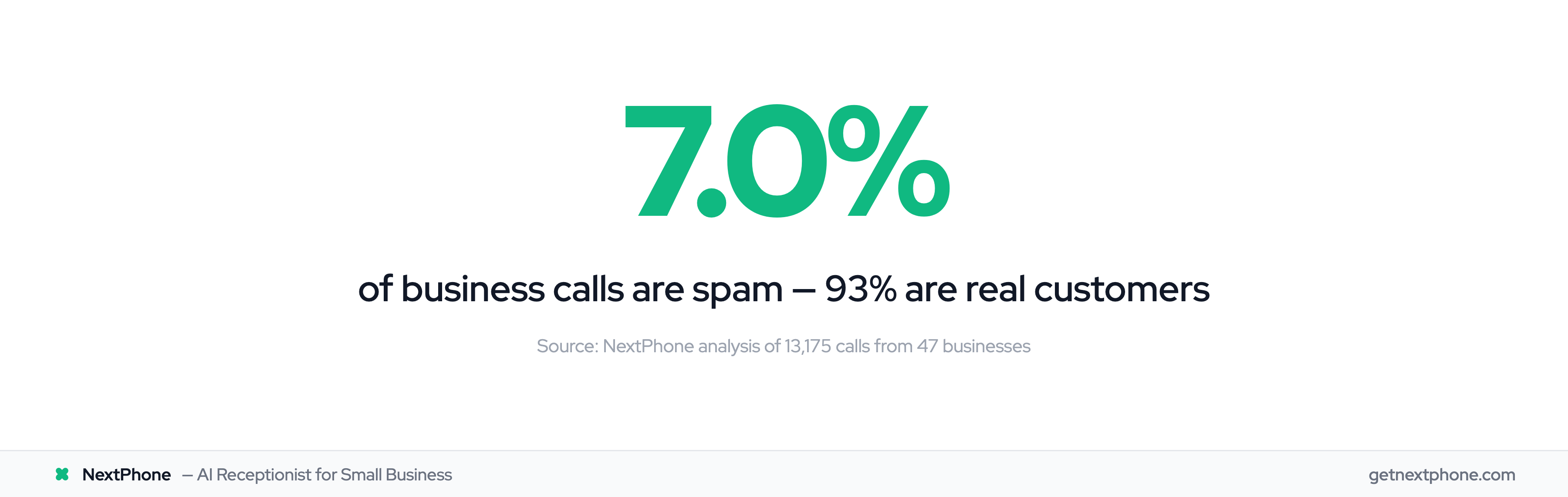
Let's start with real numbers instead of scary headlines. Hiya's State of the Call report shows approximately 30% of calls to mobile phones in the US are spam, though only 52% of calls are answered by Americans, and 1 in 4 spam calls now use AI-generated voices.
Across the 1,446,980 business calls in our analysis, spam and robocalls are a small minority. The vast majority of incoming calls to small businesses are legitimate: customers, vendors, or important contacts.
For the typical home services contractor handling 42 calls per month, that translates to a handful of spam calls. Not hundreds. Not dozens. A handful. While national data shows 35% of US calls are spam, business lines tend to see lower volumes due to less public exposure.
The Time-Wasting Impact
Those spam calls waste about 2 minutes each, a few minutes total per month. Annoying? Yes. Business-destroying? No.
The bigger issue is the interruption. You're in the middle of a job, phone rings, you stop what you're doing, and it's a robocall. That context-switching costs more than the 2 minutes you spent on the call. Nationally, US consumers received 52.5 billion robocalls in 2025, the highest volume in 6 years.
The Bigger Risk: Blocking Legitimate Customers
Here's what keeps business owners up at night: false positives.
A false positive is when your spam filter incorrectly blocks a real customer. Maybe they're calling from a work phone instead of their saved mobile number. Maybe they're out-of-state. Maybe they're a first-time caller.
With the vast majority of calls being legitimate, aggressive spam filtering is dangerous. Block one real call and you've potentially lost a $3,500 project. That dwarfs anything spam will ever cost you in wasted time. The stakes are high on both sides: 68 million Americans (26%) have lost money to phone scams, with average losses of $3,690 per victim in H1 2025.
As one enterprise communications company notes, "Phone companies are simply not equipped to know what is a wanted vs. unwanted business call." Your personal spam filter can be aggressive. Your business filter needs to be smart.
How Spam Call Filtering Actually Works
What Is Spam Call Filtering?
Spam call filtering is automated screening that checks incoming calls against multiple signals before deciding whether to let them through.
Think of it like email spam filters, but with higher stakes. An email in your spam folder can sit there for days. A blocked phone call is a lost opportunity.
How Filters Identify Spam
Modern spam filters don't rely on a single signal. They analyze multiple factors simultaneously:
- Caller ID information and whether it's been verified
- STIR/SHAKEN authentication status (more on this in a minute)
- Calling patterns and frequency
- Known spam number databases
- Time of day and calling behavior
- Whether the number has called before
The system assigns a "spam score" based on these factors. High confidence spam gets blocked. Low confidence calls ring through. The middle ground is where things get interesting, and where different systems make different choices.
What Happens to Blocked Calls
Depending on your system settings, blocked calls either go straight to voicemail or get rejected entirely.
The smarter approach? Let suspected spam callers leave a message. Real customers will. Robocalls won't. You can review voicemails later and whitelist any legitimate numbers that got caught.
One important reality: no filter catches 100% of spam. According to the FCC's guidance on stopping unwanted robocalls, combining multiple methods works best, but some calls will always slip through. The goal is reducing spam significantly without creating false positives.
STIR/SHAKEN: Caller ID Verification Explained
What STIR/SHAKEN Does
STIR/SHAKEN sounds like a drink order, but it's actually a digital certificate system that verifies phone calls haven't been spoofed.
STIR stands for Secure Telephony Identity Revisited. SHAKEN stands for Secure Handling of Asserted information using toKENs. Together, they're the phone industry's answer to caller ID fraud.
The FCC's STIR/SHAKEN mandate required large carriers to implement the system by June 30, 2021. The goal: stop scammers from faking caller ID information to make calls appear local or legitimate. Advanced fraud prevention goes beyond basic authentication: Vonage's fraud prevention APIs show silent auth is 3-5x faster with 8 points higher conversion, and SIM swap detection improves fraud detection by 30-40%.
How Caller ID Authentication Works
Here's the simplified version: When a call is made, the originating phone carrier adds a digital signature, like a tamper-proof seal. As the call travels through the network, each carrier can verify that seal hasn't been broken.
If the call passes verification, it gets an "A" attestation (authenticated). If something seems off, it gets marked accordingly. Your phone or spam filter can use this information to decide whether to trust the caller ID.
STIR/SHAKEN Limitations
STIR/SHAKEN helps, but it's not a complete solution.
As one analysis of the STIR/SHAKEN framework explains, "STIR/SHAKEN authenticates the originating carrier, but that solves a different problem than authenticating caller ID." It confirms the call came from where it claims to come from, but not whether that caller is legitimate.
Plus, many spam calls originate overseas, outside the reach of U.S. regulations. STIR/SHAKEN only works on IP-based networks, so older phone systems need upgrades or workarounds. PIRG research shows robocalls surged 15.4% in 2025, and only 44% of voice providers have installed caller ID authentication.
Think of STIR/SHAKEN as one tool in your spam filtering toolkit, not the whole toolbox.
AI-Powered Spam Detection: How Modern Systems Work
Real-Time Pattern Analysis
Modern AI spam filters analyze behavior patterns in real-time.
An AI system might notice: This number has called 47 different businesses in the past hour. All calls lasted under 10 seconds. None resulted in conversations. That's a robocall pattern.
Or: This number called once last week, left a voicemail, and is calling back now. That's a customer pattern.
Multiple Signal Detection
AI filters evaluate dozens of signals simultaneously:
- Does the STIR/SHAKEN attestation check out?
- Is this number in known spam databases?
- What's the calling frequency?
- What time of day is it?
- Has this number called before?
- Did previous calls connect to humans?
- Are there similar spam reports from other businesses?
The system weighs all these factors and assigns a confidence score in milliseconds, before your phone even rings.
Machine Learning Adaptation
The smartest spam filters learn and adapt. They're trained on millions of spam examples and constantly update their detection models.
When spammers change tactics (like using "neighborhood spoofing" to make calls appear local), machine learning systems detect the new pattern without needing manual rule updates.
This is why AI-powered spam detection can be more effective than simple blocklists. Spammers rotate through thousands of numbers. AI learns to recognize the behavior, not just the specific number.
Blacklist vs Whitelist: Managing Your Spam Filter
Blacklist: Blocking Specific Numbers
A blacklist is exactly what it sounds like: a list of numbers that can't reach you.
You can blacklist individual numbers (that persistent telemarketer), area codes (if you don't serve certain regions), or number patterns that match known spam.
The challenge? Spammers rotate numbers constantly. You block one, they call from another. Blacklists work best for persistent harassment from the same source, not for general spam protection.
Whitelist: Ensuring VIPs Always Get Through
A whitelist is the opposite: approved numbers that always ring through, regardless of spam score.
This is where you put your top 20 customers, key vendors, property managers, family members: anyone who should never get blocked under any circumstances.
Whitelisting solves the false positive problem for your most important contacts. Even if their call comes from an unknown number or triggers some spam signal, they get through.
Which Approach Works Best?
For businesses, a hybrid approach is ideal:
- Whitelist your VIP customers and essential contacts (zero false positive risk)
- Use AI filtering for unknown numbers (catches spam, evaluates legitimate callers)
- Blacklist only specific persistent spam sources
- Let moderate-confidence calls through with flagging
This balances protection with accessibility. You're not missing revenue opportunities while still filtering out obvious spam.
The False Positive Problem: When Good Calls Get Blocked
What Are False Positives?
A false positive happens when your spam filter incorrectly identifies a legitimate call as spam and blocks it.
Common triggers include:
- Unknown numbers (first-time customers)
- Out-of-area calls (customer traveling, different office location)
- Callback requests from different numbers
- Calls from businesses with auto-dialer systems
With the vast majority of business calls being legitimate based on our analysis, false positives are a real revenue risk.
The Revenue Risk for Small Businesses
Let's do the math.
Our data shows the average home services project is worth $3,500. Emergency calls, which rank among the top reasons people call, average even higher at $4,200.
If your spam filter is too aggressive and blocks just one real customer per month, you're risking $3,500 in potential revenue to save a few minutes of spam call time.
That's not good business math.
How to Minimize False Positives
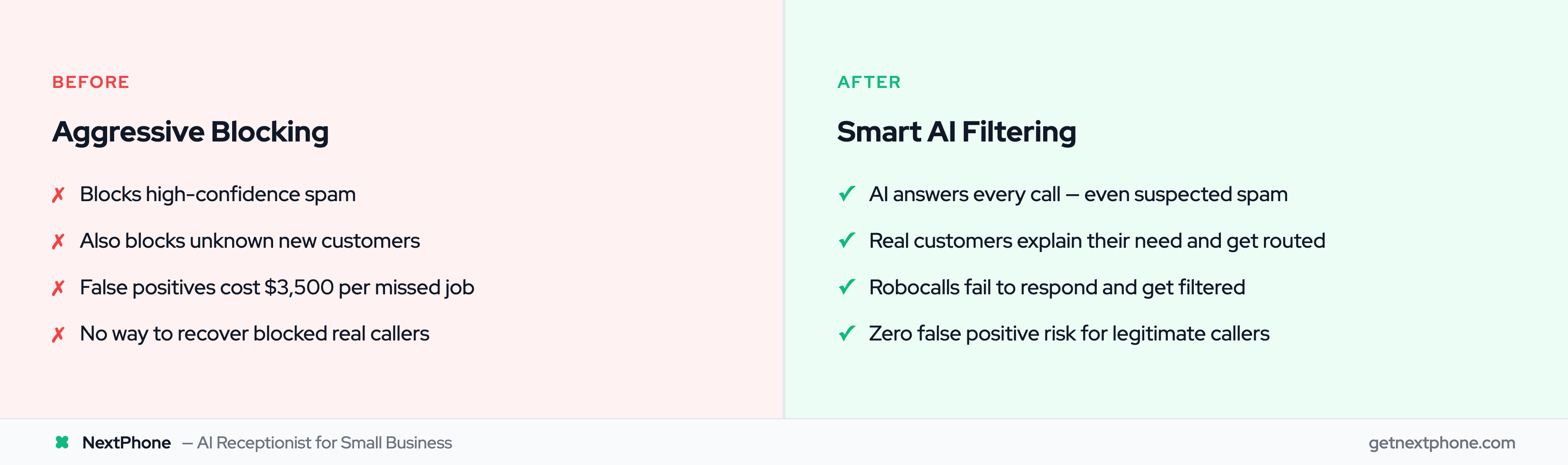
Smart strategies to reduce false positives:
- Set moderate spam thresholds (block only high-confidence spam)
- Let medium-confidence calls go to voicemail instead of hard blocking
- Review your spam folder regularly for legitimate calls
- Whitelist numbers immediately after confirming they're real customers
- Use an AI system that can answer calls and evaluate intent
- Monitor your spam filter's accuracy and adjust settings
The goal is zero missed opportunities.
How NextPhone Handles Spam Filtering
AI-Powered First-Line Defense
NextPhone's voice AI receptionist analyzes all incoming calls in real-time, checking STIR/SHAKEN authentication, consulting spam databases, and evaluating calling patterns.
High-confidence spam gets blocked automatically. But here's the difference: medium-confidence calls get answered.
The AI picks up, greets the caller, and asks how it can help. Real customers explain what they need and get routed appropriately. Robocalls hang up or fail to respond like humans. Problem solved without risking false positives.
Smart Whitelisting
NextPhone automatically builds a whitelist from your repeat callers. Called twice and had real conversations? You're approved. Future calls ring through with priority.
You can also manually whitelist VIP customers, vendors, or anyone who should always reach you directly.
Human Override Option
You stay in control. Review spam confidence scores, adjust filtering thresholds, and override any automated decisions.
All calls are logged with their spam scores, so you can see exactly what was blocked and why. If a legitimate call got caught, whitelist it with one click.
The system learns from your adjustments, getting smarter about what you consider spam versus legitimate for your specific business.
Frequently Asked Questions
Can spam call filters block 100% of robocalls?
No spam filter blocks 100% of robocalls. Spammers constantly adapt their tactics, rotating numbers and changing patterns. Combining multiple methods (AI detection, STIR/SHAKEN verification, and whitelisting) can catch 95% or more, but some calls will slip through. The tradeoff: aggressive filtering that blocks 100% of spam would also block legitimate customer calls, which is worse for your business.
What happens if my spam filter blocks a real customer?
Good spam filtering systems let blocked callers leave voicemail rather than rejecting calls entirely. This gives legitimate customers a chance to explain who they are. Review your spam folder regularly, and immediately whitelist any real customer numbers that got caught. NextPhone's approach avoids this problem by having the AI answer all calls (even suspected spam) and evaluate the caller's intent in real-time.
How do I whitelist important customers?
Most business phone systems let you add trusted numbers to an approved whitelist manually through your settings. Many systems also automatically whitelist repeat callers after successful conversations. You can typically whitelist individual numbers, area codes, or number patterns. Once whitelisted, those calls always ring through regardless of spam score, eliminating false positive risk for your VIPs.
Does STIR/SHAKEN stop all spoofed calls?
STIR/SHAKEN verifies that caller ID information hasn't been tampered with during transmission, which reduces spoofing significantly. However, it doesn't eliminate it entirely. The system only works on IP-based phone networks, so older systems have limited protection. Additionally, many spam calls originate from overseas, outside the reach of U.S. regulations that mandate STIR/SHAKEN implementation.
How does AI spam detection work in real-time?
AI spam filters analyze multiple signals simultaneously the moment a call comes in: calling patterns, frequency, time of day, STIR/SHAKEN authentication status, and comparison against spam databases updated constantly. Machine learning models trained on millions of spam examples assign a confidence score in milliseconds, before your phone rings. This allows the system to filter spam without noticeable delay.
What's better for businesses - blacklist or whitelist?
A hybrid approach works best for businesses. Whitelist your VIP customers and essential contacts to guarantee they always get through with zero false positive risk. Use AI-powered filtering for unknown numbers to catch spam while evaluating legitimate callers. Only blacklist specific known spam sources that repeatedly harass your business. This balance protects your time while keeping you accessible to new customers.
How much time does spam filtering actually save?
For a typical contractor receiving 42 calls monthly, spam represents a handful of calls and a few minutes per month. The time savings is minimal. The real value is preventing interruption and maintaining focus on your work. But the bigger benefit is peace of mind: knowing your spam filter won't block legitimate customer calls that could represent thousands in revenue.
Stop Spam Without Blocking Customers
Spam call filtering is about protecting your time while ensuring every legitimate customer can reach you.
Across the 1,446,980 business calls in our analysis, spam is real but manageable, and it gets filtered out before it ever rings you. The rest are potential revenue. Smart filtering uses STIR/SHAKEN verification, AI-powered pattern detection, and whitelist management to catch spam without creating false positives.
The businesses that get this right filter intelligently, whitelist strategically, and keep humans in the loop for decisions that matter.
Your phone system should work for you, not cost you opportunities.
Ready to stop spam without blocking customers? Try NextPhone's intelligent spam filtering free for 7 days.
