You're paying $69 per Google Local Service Ads lead. Your competitor answers in 3 seconds. You answer in 30 minutes, if you answer at all.
They win 8x more jobs.
And then Google notices. Every missed call tanks your LSA phone response score. Lower score = lower ad placement = fewer leads shown to you. You lose the job and pay for months of reduced visibility on top of it.
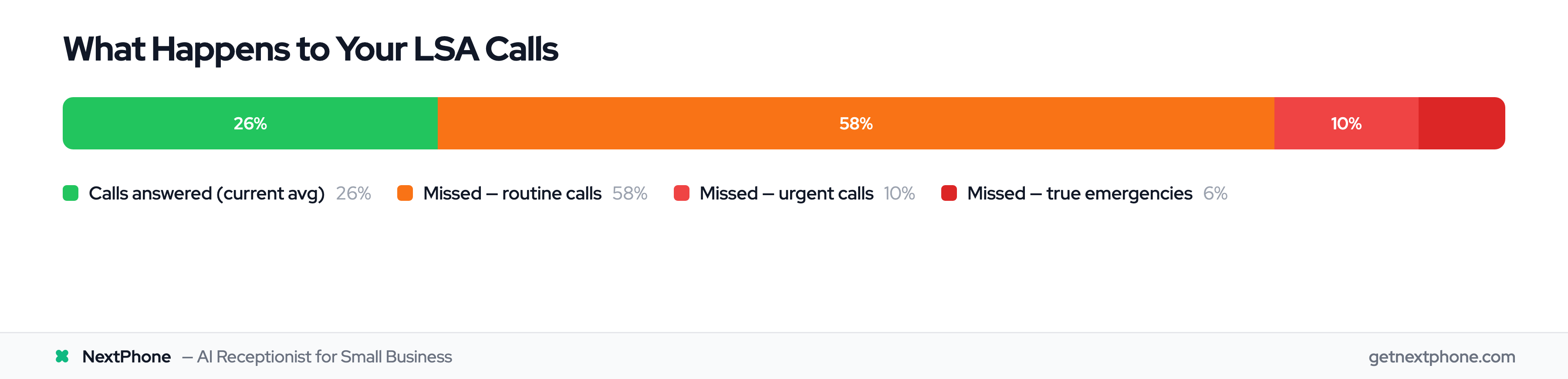
Here's the brutal truth: across the 2,000,000+ inbound calls our AI receptionist has answered, the pattern is unambiguous: small businesses routinely miss 60–80% of incoming customer calls. When you're paying $50–249 per LSA lead (lawyers paying the most), missing most of them is a double penalty: lost revenue from missed jobs AND a tanked LSA ranking that shows your ad to fewer people going forward.
The problem with Google Local Service Ads is call handling, specifically your Google LSA phone response score.
This post breaks down how the response score works, why the 2025 Google Verified update changed the game, and how AI phone integration turns the same LSA spend into 4x the revenue.
What Are Google Local Service Ads?
Google Local Service Ads (LSAs) are pay-per-lead advertisements that appear at the very top of Google search results, even above traditional Google Ads. Instead of paying every time someone clicks your ad, you only pay when a potential customer actually contacts you through the ad.
Pay-Per-Lead vs Pay-Per-Click
Here's the key difference: traditional Google Ads charge you for clicks, whether that person calls or not. Google Local Service Ads only charge you when someone picks up the phone and calls, or sends you a message through the platform.
For a plumber, that might be $69 per lead. For an HVAC contractor, around $80. For a roofer, $162. For a personal injury lawyer? $249 per verified lead.
You get the customer's name, phone number, and details about what they need. Google provides a unique forwarding number that tracks every call.
Where LSAs Appear in Search Results
When someone searches "emergency plumber near me" or "personal injury lawyer free consultation," Local Service Ads appear in a carousel at the top of the page, complete with your business photo, star rating, and the Google Verified badge. 84% of consumers contact an HVAC company after searching online; that's your potential lead pool.
According to recent research, 27.78% of consumers prefer clicking Local Service Ads, making them the second most popular option after Google Maps (41.27%). Traditional Google Ads come in at just 11%.
People trust LSAs because Google has verified your business.
Industries That Qualify
LSAs are available for home services (plumbing, HVAC, electrical, roofing, house cleaning, landscaping), legal services (law firms, personal injury, criminal defense, estate planning), professional services (accounting, financial advisory), and more. If you're a service business that goes to customers or they come to you, there's likely an LSA category for you.
For law firms especially: LSAs are one of the highest-ROI advertising channels in legal. Personal injury and criminal defense attorneys pay $249+ per verified lead, and a missed intake call on a contingency case can cost tens of thousands in lost fees. The stakes for call responsiveness are higher here than in any other vertical.
Google Local Service Ads vs Google Ads
If you're already running Google Ads, you might be wondering what makes LSAs different, and which one is better for service businesses.
Payment Model Differences
Google Ads: You pay per click. Someone sees your ad, clicks it, maybe calls, maybe doesn't. You paid for that click either way.
Google Local Service Ads: You pay per lead. You only get charged when someone actually calls or messages you through the ad. No contact = no charge.
For service businesses, this is huge. 60% of local searchers prefer calling over forms or chat, and you're not paying for idle browsers or people who clicked by mistake. You're paying for actual customer inquiries.
Trust Signals: Google Verified Badge (Updated October 2025)
Google Verified badge replaced the old Google Guaranteed and Google Screened programs in October 2025. Google consolidated what were previously three separate verifications (Google Guaranteed, Google Screened for licensed professionals like lawyers, and License Verified) into a single "Google Verified" badge.
Key change: The old Google Guaranteed program included a money-back guarantee for dissatisfied customers. That guarantee was dropped when Google moved to the unified Google Verified badge. You may still see the old "Guaranteed" or "Screened" terms in older articles; current program is Google Verified only.
To get verified, Google requires:
- Background checks on you and your employees
- Proof of insurance
- License verification (where applicable)
- Business registration confirmation
Regular Google Ads don't come with this trust signal. LSAs do.
Which One Is Right for Service Businesses?
For contractors, lawyers, plumbers, HVAC techs, electricians, and similar service businesses, LSAs typically perform better because:
- They target people actively searching for your service right now (high intent)
- They appear above regular ads (better visibility)
- They build trust with the Google Verified badge
- You only pay for actual contacts, not clicks
Many successful service businesses run both: LSAs for immediate leads, Google Ads for broader brand awareness.
The Google LSA Phone Response Score: How It Works
This is the mechanic that most LSA advertisers miss. Your LSA phone response score directly controls how often your ad appears and how prominently.
The 5-Minute Rule: Why Instant Response Wins LSA Leads
You paid $69 for that LSA lead. If you don't answer the phone in 5 minutes, you might as well have set that money on fire.
According to industry research, responding within 5 minutes makes you 8 times more likely to convert that lead compared to waiting 30 minutes.
Think about that. Same lead. Same service needed. Same pricing. The only difference is you called back in 5 minutes instead of 30.
8x higher conversion rate.
That's the difference between winning 1 out of 10 LSA leads versus winning 8 out of 10.
How Google Calculates Your Response Score
Google doesn't just care whether you answer calls. It measures your responsiveness mathematically. Google's official guidance states that "having a consistently fast response time could improve your ad's ranking on search and increase your ability to receive leads."
According to Google's phone responsiveness metric, Google calculates your average phone lead responsiveness over the last 90 days by dividing connected calls by total calls. If you're missing most calls, your responsiveness score drops, and so does your ad placement.
The key mechanics:
- 90-day rolling window: every call in the last 90 days counts
- Connected calls vs total calls: missed calls hurt your ratio
- Business hours tracking: Google tracks response time during your listed hours
If you maintain a fast response time, Google will display "Typically responds in a few minutes" on your LSA listing, a badge that dramatically improves click-through rates because customers know you'll actually answer.
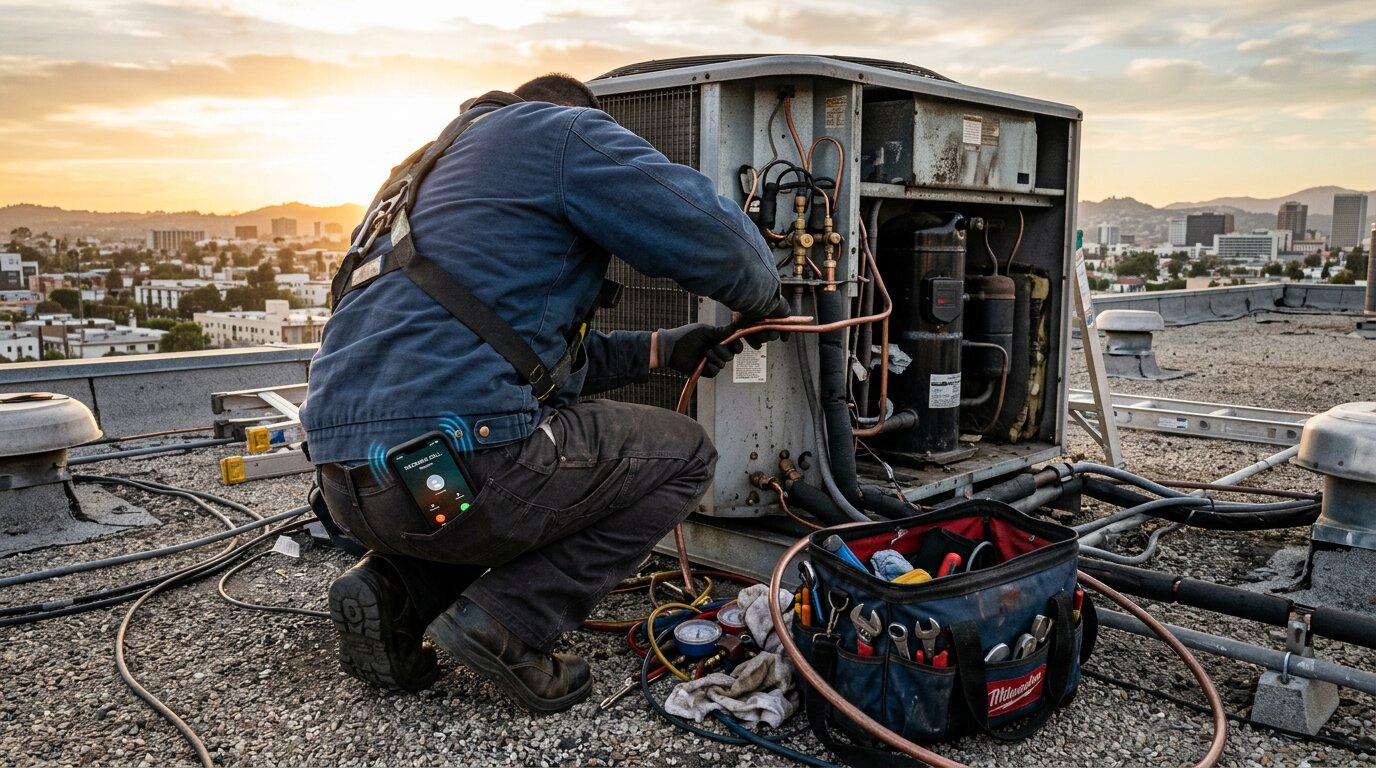
But here's the problem: you're on a job site. You're in a deposition. You're under a house. You can't answer your phone in 5 minutes.
Across the 2,000,000+ inbound calls our AI has answered, the pattern holds: most service businesses miss the majority of their incoming calls. If you're only answering a fraction of LSA calls, you're not winning the response score game.
The Double Penalty of Missed LSA Calls
Missing an LSA call doesn't just lose you that one job. It triggers a cascade of problems that costs you for months.
Lost Revenue: The Immediate Cost
You pay for the LSA lead whether you answer or not. Miss the call, and you've spent $69 for nothing.
Worse, that customer doesn't wait around. They call the next contractor on the list, the one who answers in 3 seconds instead of never.
For a typical contractor handling 42 calls per month, with 74.1% going unanswered (Invoca data), that's 31 missed calls. If just 20% of those would have converted at an average $3,500 job value:
31 missed calls × 20% conversion × $3,500 = $21,700 per month in lost revenue
That's $260,400 per year you're leaving on the table.
For law firms, the math is even more brutal. A personal injury attorney paying $249 per LSA lead, missing 74% of calls, losing potential contingency cases worth $50,000–$200,000 each: the numbers don't lie.
Tanked Ranking: The Hidden Penalty
Here's where it gets worse. Low responsiveness scores directly lower your ad ranking. Google's official guidance explicitly states: "If you regularly fail to answer calls or respond to messages, your ad ranking may be affected."
Lower ranking means:
- Your ad shows up less often in search results
- You get fewer leads shown to you
- The leads you do get are lower quality
- Your cost per lead goes up (you're competing from a weaker position)
So you lose the immediate job and poison your LSA account for the next 90 days, reducing your future lead flow and increasing your costs.
Miss calls today, pay for it for three months.
Google Local Service Ads Cost Per Lead (2026 Data)
Let's talk numbers. How much do LSAs actually cost, and is it worth it?
Cost Per Lead by Industry
According to 2025 industry cost data, here's what different service businesses pay per LSA lead:
- Personal Injury Lawyers: $249
- Roofers: $162
- HVAC: $80
- Plumbers: $69
- Electricians: $35–70
- Painters: $40
- House Cleaning: $28
Pricing benchmarks show the average ranges from $15 to $100 depending on your industry, location, and how competitive your market is.
Monthly Budget Recommendations
Google recommends setting a budget for at least 10 leads per week, which translates to 40–50 leads per month.
For a plumber at $69 per lead, that's roughly $2,000–3,500/month.
For a roofer at $162 per lead, you're looking at $6,500/month minimum.
For a personal injury law firm at $249 per lead, a competitive budget runs $10,000+/month.
These aren't small numbers. You're making a real investment.
Is LSA Worth the Cost?
Here's the thing: LSA is absolutely worth it, if you answer calls and convert at a decent rate.
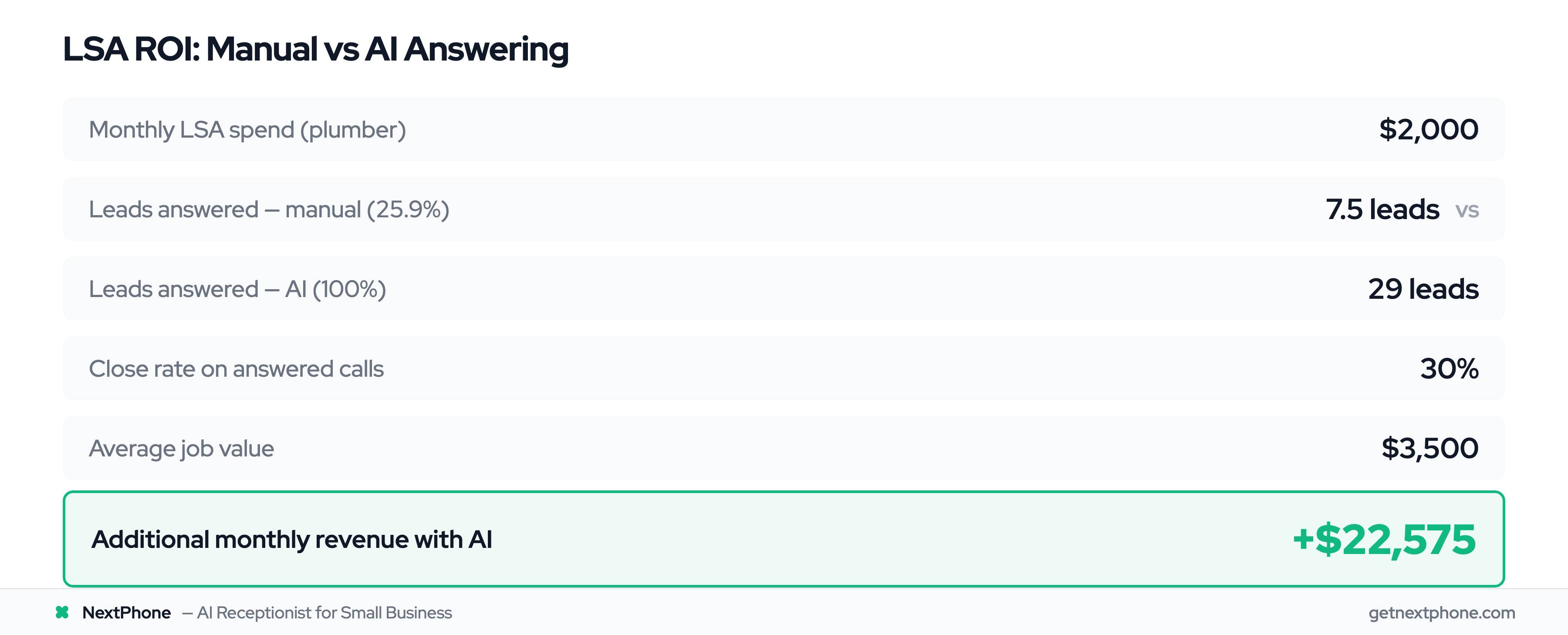
Let's say you're a plumber spending $2,000/month on LSA (29 leads at $69 each). If you answer 50% of calls and close 30% of answered calls, you'd win about 4.4 jobs per month.
At $3,500 per job, that's $15,400 in revenue from a $2,000 spend. Not bad.
But if you're missing 74% of calls, you're only answering 7.5 leads, winning 2.25 jobs, and generating $7,875 in revenue. Your ROI drops, and you're leaving $7,525 on the table every single month.
LSA isn't expensive. Missing the calls is expensive.
The After-Hours LSA Problem
Here's what nobody talks about: your Google Local Service Ads are running 24/7. Your phone is not.
LSAs Run 24/7, But You Don't
Your LSA shows up when someone searches at 9 PM on a Saturday. Or 6 AM on a Tuesday. Or 11 PM on a Friday night when their AC just died in 95-degree heat.
You're asleep. You're at dinner. You're watching your kid's soccer game.
The call goes to voicemail. They call the next contractor. That contractor has an AI answering service that picks up in 3 seconds.
They book the job. You paid for the lead anyway.
Emergency Calls = Higher Value
Emergencies are among the highest-intent calls in our corpus, and they skew heavily toward after-hours. When someone's basement is flooding at 2 AM, they're not waiting until 9 AM. They're calling everyone on Google right now.
For law firms, the parallel is arrests, restraining orders, and injury emergencies. A criminal defense attorney who answers a Saturday-night DUI call wins a client. One who sends it to voicemail loses them, permanently.
If you're not answering after-hours, you're missing your highest-value leads.
Check your own LSA data: what percentage of your leads come in outside 9-5? For most service businesses, it's a third or more. Every one of those is a missed response-score opportunity on top of the lost job.
For more on how fast you need to respond to LSA leads, including the specific 30-second window that maximizes contact rates, see our deep-dive on lead response time.
Weekend and Night Lead Conversion
Most contractors answer calls Monday through Friday, 9 AM to 5 PM. That's 40 hours per week.
There are 168 hours in a week.
You're available for 24% of the time your LSA is showing to customers.
The other 76% of the time? Straight to voicemail.
And because Google tracks your responsiveness 24/7, all those missed after-hours calls drag down your ranking just as much as missed business-hour calls.
How LSA Dispute Credits Work (2024 Update)
Before diving into the solution, one more mechanic to know: how invalid lead credits work.
Prior to mid-2024, getting a refund for a bad LSA lead (a spam call, a wrong number, a call for a service you don't offer) required manually disputing it in your LSA dashboard. You'd submit the dispute, Google would review it, and you'd wait.
In mid-2024, Google replaced manual disputes with ML auto-credit. Now, Google's machine learning system automatically identifies invalid leads and issues credits within approximately 72 hours, no dispute submission required. Junk leads, robocalls, and out-of-scope inquiries are assessed automatically.
You can still manually dispute leads in your dashboard if you believe a lead was invalid and wasn't auto-credited. But for most invalid leads, you don't need to do anything: the credit shows up on its own.
This matters for AI integration: when your AI answers every call (including calls that turn out to be junk), Google's ML system can still auto-credit the invalid ones. You don't lose responsiveness points AND you recover the lead cost.