Quick answer: Answering service costs range from $25 to $2,000+ per month depending on type. Automated IVR: $25–$100/mo. AI-powered answering: $50–$300/mo. Live human operators: $200–$2,000/mo. Hybrid (AI + human): $250–$1,000/mo.
For most small businesses, the best value is flat-rate AI answering at $199/month. NextPhone handles unlimited inbound calls 24/7 — appointment booking, lead capture, call transfers, emergency routing — for one flat rate with no per-minute overages and no per-call charges. That's 60–85% less than comparable live operator coverage.
The price you'll actually pay depends on call volume, service hours, and whether you choose per-minute, per-call, or flat monthly pricing. Hidden fees — setup charges, overage rates, rounding increments, and holiday surcharges — routinely add 30–50% to advertised rates. This guide breaks all of that down.
Here's how every category compares:
| Service Type | Monthly Cost | Per-Minute Rate | Best For |
|---|---|---|---|
| Automated IVR | $25-$100 | N/A (flat) | Simple routing, lowest budget |
| AI-Powered | $50-$300 | $0.05-$0.30 | 24/7 coverage, predictable cost |
| Live Operators | $200-$2,000+ | $0.75-$1.50 | High-value clients, complex calls |
| Hybrid (Human + AI) | $250-$1,000 | Varies | Sales + routine call mix |
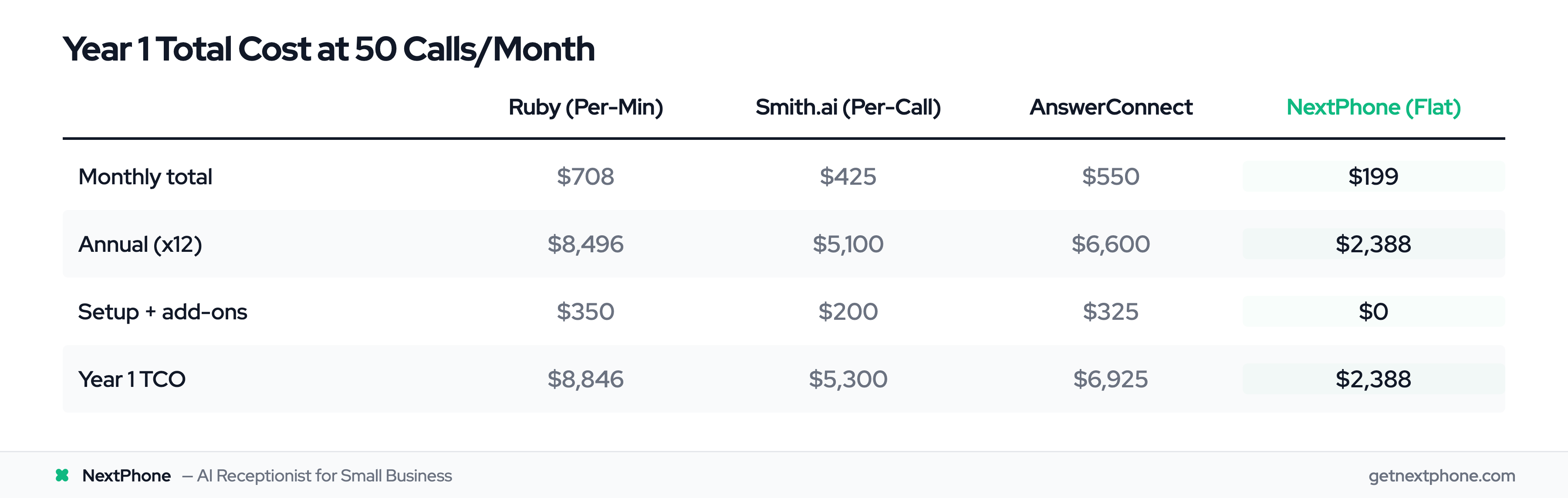
Our pick for small businesses: NextPhone at $199/mo flat — the only AI answering service in this comparison with truly unlimited inbound calls. No per-minute meter. No overage tier. Every feature included. For businesses with 40–200 calls per month, that pricing model saves $3,000–$14,000/year versus per-minute live services (see the TCO comparison below).
Before you compare costs, know what the best services actually deliver. Across 1,446,980+ real business calls in our production database, today's AI answering services resolve 90–95% of calls without human escalation, pick up in under 5 seconds, and maintain 99% positive caller sentiment. Traditional live services answer in 30–90 seconds and cap your volume. The performance gap is as wide as the price gap.
The rest of this guide breaks down exactly what drives these prices, where hidden fees add 30-50% to advertised rates, and which model fits your business.
Comparing specific providers instead? This guide covers how answering-service pricing works — the models, hidden fees, and what you'll actually pay. If you want a side-by-side of named providers (Ruby, Smith.ai, AnswerConnect, NextPhone, and others) to pick a vendor, see our provider-by-provider comparison. Come back here once you have a quote — this is where you sanity-check it.
What Affects Your Answering Service Cost
Six factors determine what you'll actually pay:
Call volume is the primary driver. More calls = higher cost, except on flat-rate plans where volume doesn't matter.
Service hours: Business-hours-only is cheapest. Extended hours (7am-9pm) adds 10-20%. 24/7 coverage adds 25-50% for live services.
Call complexity: Basic message-taking is the lowest tier. Appointment scheduling is standard. Sales intake and custom scripting are premium.
Integrations: Calendar connections (Google, Outlook) are usually included. CRM integration (Salesforce, HubSpot) often costs $50-$200 setup. Industry software (ServiceTitan) runs $100-$300.
Compliance requirements: Regulatory compliance for medical adds $50-$150/month. Legal confidentiality commands premium pricing.
Pricing model: Per-minute, per-call, or flat monthly. The wrong model can double your costs at the same call volume. (Details in the pricing models section below.)
Live Answering Service Costs
Live answering services employ real humans who answer your business calls — trained receptionists who take messages, answer questions, transfer calls, or book appointments. According to BLS receptionist occupational data, the median receptionist salary is $37,220/year before benefits. Providers like Ruby, AnswerConnect, and Smith.ai outsource this role so you don't carry that payroll. They're the premium option.
Per-Minute Pricing: $0.75-$1.50 Per Minute
Budget providers: $0.75-$1.00/min. Lower quality, potentially offshore operators, basic message-taking only.
Standard providers: $1.00-$1.25/min. Domestic operators, professional service, some customization.
Premium providers: $1.25-$1.50+/min. Ruby charges effectively $2.45-$3.39/min when you calculate their $245/100 minutes plan.
The math adds up fast — and that's before rounding. A 3-minute call at $1.25/min costs $3.75. Get 50 calls at that rate: $187.50. If calls average 5 minutes (common when booking appointments): $312.50.
Per-Call Pricing: $5-$12 Per Call
Smith.ai uses this model at $9.75 per call with a 30-call minimum ($292.50/month starting).
Advantage: Call length doesn't matter. Rounding doesn't apply. Disadvantage: Expensive at scale, and brutal on short calls. 100 calls at $9.75 = $975/month — and remember, in our data, half of all inbound calls end in under 15 seconds. You're paying $9.75 for a hang-up.
Monthly Plans
Budget tier (50-100 min): $150-$300/mo — basic message-taking, business hours, email delivery.
Standard tier (100-250 min): $300-$600/mo — appointment scheduling, extended hours, some integrations.
Premium tier (250-500 min): $600-$1,500/mo — 24/7 coverage, full integrations, custom scripting.
True unlimited live answering is rare: typically $1,500-$2,500/month. When you factor in the SBA's estimate of how much does an employee cost — 1.25-1.4x base salary once you add benefits, taxes, and overhead — outsourced live answering still undercuts a full-time hire.
When Live Answering Makes Sense
Live answering justifies the premium when your clients are high-value (legal, financial), calls require empathy and judgment, sales conversations need human rapport, or complex intake can't be handled by AI yet. A law firm charging $500/hour easily justifies $600/month for professional intake.
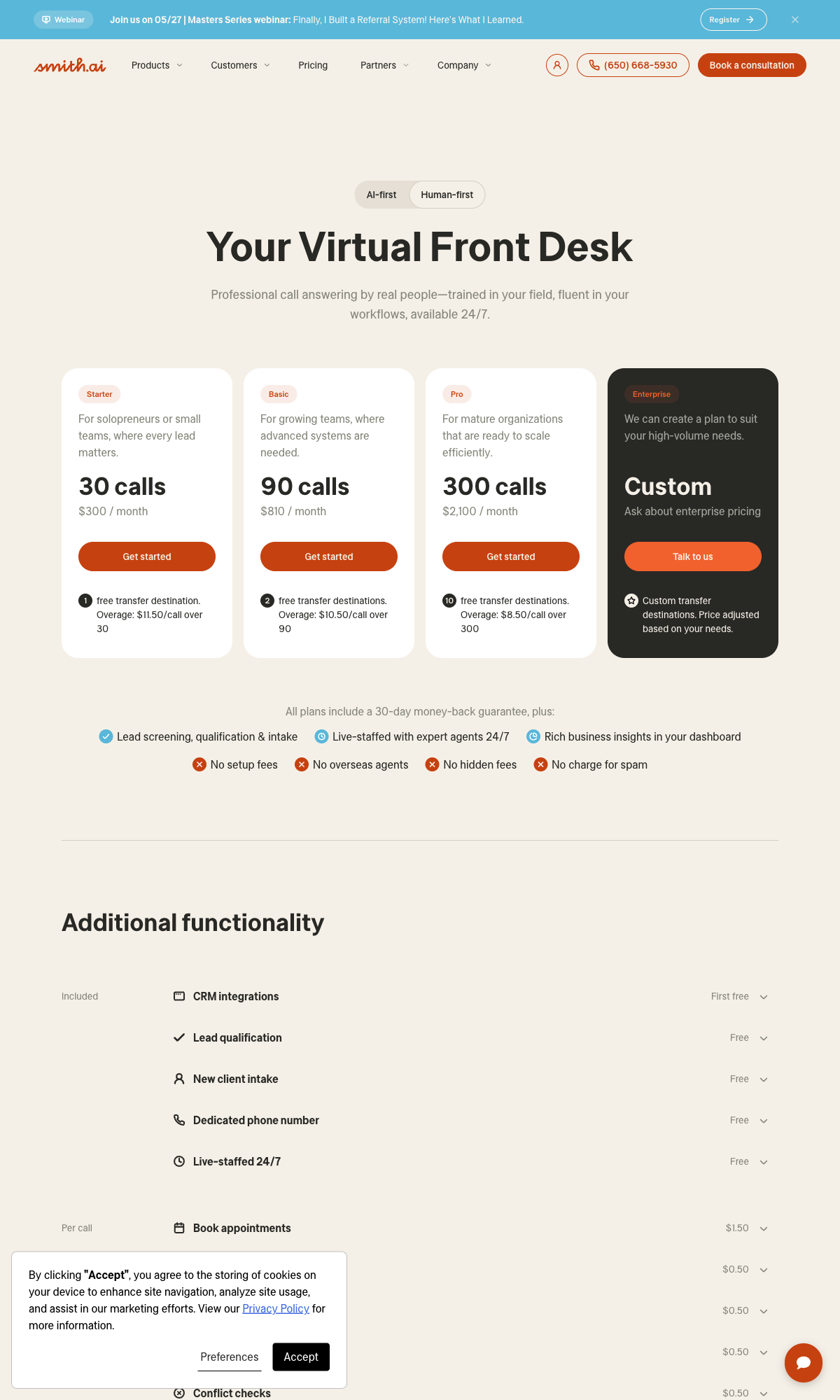
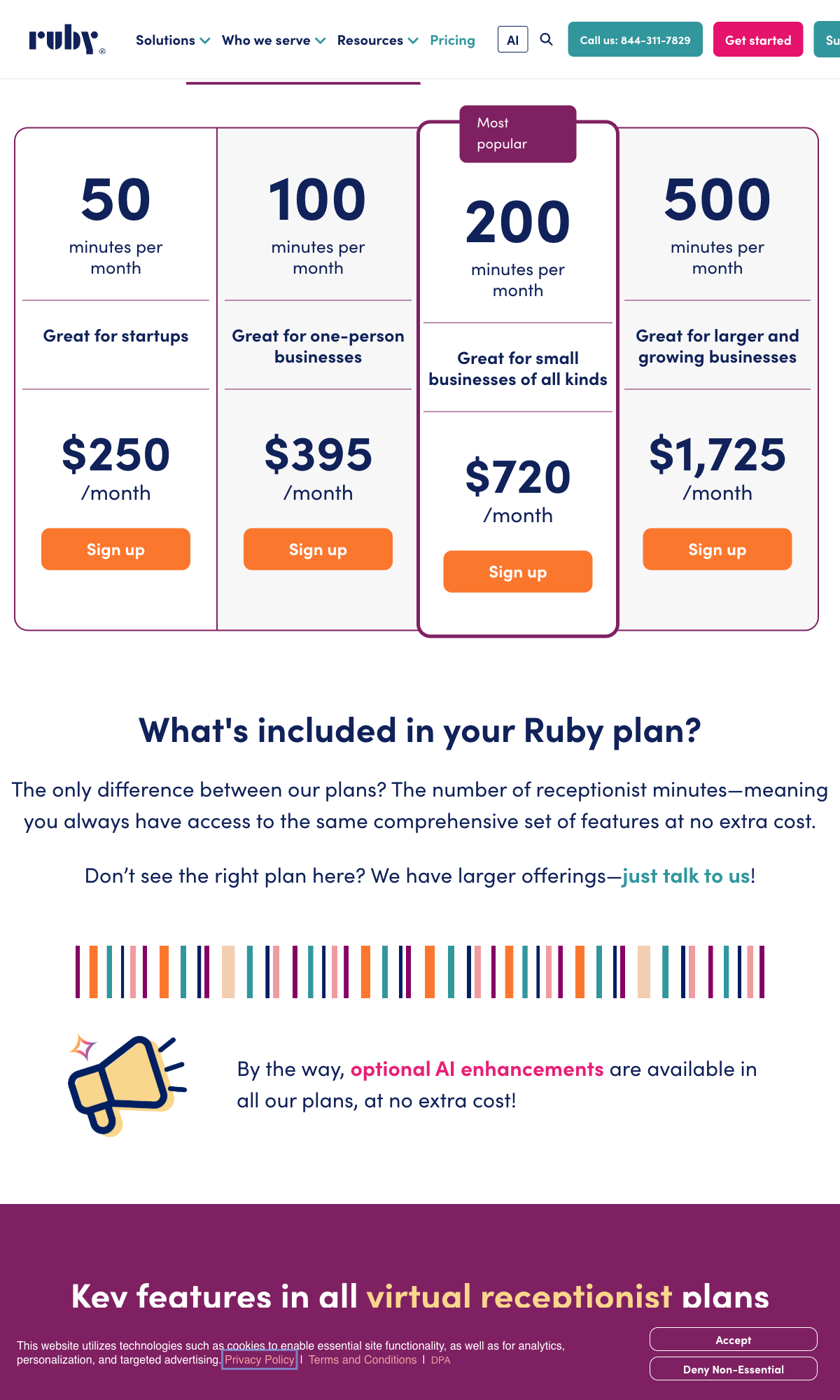
Verified competitor pricing (snapshots dated 2026-05-26)
Numbers in this section change quarterly. The screenshots below were captured directly from each vendor's published pricing page on 2026-05-26 so you can verify the math yourself.
NextPhone — Flat-rate $199/month with unlimited inbound calls, 24/7 coverage, and every feature included. No per-minute meter, no per-call charge, no overage tier — the only flat-rate AI receptionist in this comparison.
| Plan | Price | Calls included | Overage |
|---|---|---|---|
| NextPhone Pro | $199/mo | Unlimited | None |
Smith.ai — AI-first tiers at 30 / 90 / 300 calls per month for $300 / $810 / $2,100 / mo, with per-call overage at $11.50 / $10.50 / $8.50.
Ruby Receptionists — Virtual receptionist plans at 50 / 100 / 200 / 500 minutes per month for $250 / $395 / $720 / $1,725.
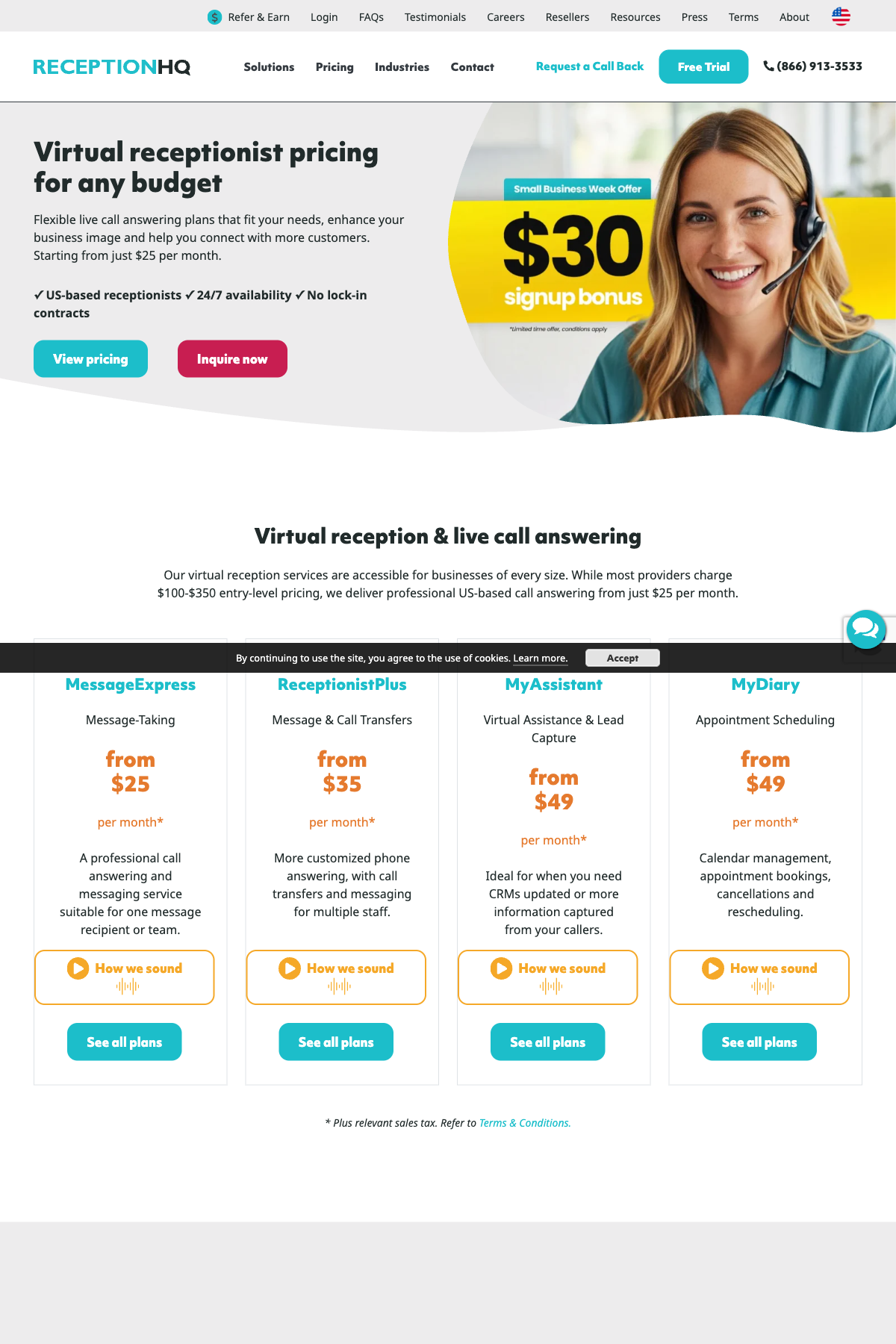
ReceptionHQ — Tiered live virtual receptionist plans starting from $25 / $35 / $49 / $49 per month (MessageExpress, ReceptionistPlus, MyAssistant, MyDiary), with per-call billing on top.
Automated Answering Service Costs (IVR)
Automated IVR is the "Press 1 for sales, press 2 for support" system. These route calls based on caller selections without human involvement — cheap because they don't answer questions or take action, just route and record.
Basic IVR: $25-$100/Month
Covers simple routing, after-hours voicemail, call forwarding, and business hour announcements. Grasshopper starts at $29/month. Google Voice offers simple routing free for personal use.
Advanced IVR: $100-$300/Month
Adds multiple menu layers, skills-based distribution, CRM integration, analytics, and queue management. RingCentral and similar VoIP providers offer this in $100-$200/month business plans.
The Hidden Cost of Customer Frustration
67% of customers express frustration with automated phone systems according to consumer research. IVR systems see 30-40% call abandonment rates. The Forrester CX Index consistently shows that better customer experience drives measurable revenue gains — so that's not a savings if those abandoned calls represent lost customers.
When IVR makes sense: Very high-volume call centers, internal company calls, supplementing other systems with basic after-hours routing, or situations where callers expect automation (tech support queues). For customer-facing small businesses, IVR is usually penny-wise and pound-foolish.
AI-Powered Answering Service Costs
AI answering has become the sweet spot for small businesses — affordable, capable, and available 24/7. Modern conversational AI understands natural language, answers questions, books appointments, identifies emergencies, and integrates with calendars and CRM systems. Callers have a natural conversation, not a button-pressing menu.
One of 28 voices in NextPhone's library. The voice you pick is what every caller hears — pricing is the same regardless.
AI Pricing Models
Per-minute AI: $0.05-$0.30/min (10-20% of live operator rates). Ask the increment.
Per-call AI: $1-$5/call (vs $5-$12 for live). Example: 50 calls x $2.50 = $125/month. Better fit for the short-call reality.
Flat monthly AI: $50-$300/month unlimited. Most popular for small businesses. Example: NextPhone at $199/month unlimited.
How AI Costs Compare to Live Answering
At 3-minute average call duration:
At 50 calls/month:
- Live per-minute ($1.25): $187.50
- Live per-call ($9.75): $487.50
- AI flat monthly: $199
- AI per-minute ($0.15): $22.50
At 100 calls/month:
- Live per-minute: $375
- Live per-call: $975
- AI flat monthly: $199
- AI per-minute: $45
At 200 calls/month:
- Live per-minute: $750
- Live per-call: $1,950
- AI flat monthly: $199
AI costs 60-85% less than live answering for similar call handling. And costs have dropped ~40% since 2022 as technology matured, competition increased, and infrastructure costs fell.
Hybrid Answering Service Costs
Hybrid services combine AI efficiency with human capability. AI answers all calls, screens and handles routine requests, then transfers calls requiring human touch to live operators. You pay for human time only when truly needed.
Hybrid Pricing: $250-$1,000/Month
Entry level ($250-$400/mo): AI handles most calls, limited human minutes (25-50/month), basic after-hours coverage.
Standard ($400-$700/mo): More human availability, extended hours, better integrations.
Premium ($700-$1,200/mo): Extensive human coverage, dedicated team, complex workflow handling.
Smith.ai exemplifies hybrid pricing: 30 calls at $292.50/mo ($9.75/call), 50 calls at $412.50/mo, 100 calls at $675/mo.
When Hybrid Makes Sense
Hybrid is worth the premium when sales conversion matters (AI qualifies, humans close), you have a mix of simple and complex calls, or you're transitioning from live to AI gradually. In our 1,446,980-call production database, only 4.0% of calls were transferred to a live person — meaning for most service businesses, full AI handles the overwhelming majority of inbound traffic and the hybrid premium pays for headroom you rarely use.
Pricing Models Explained
Choosing the right pricing model matters as much as choosing the right service type.
Per-Minute Pricing
Live rates: $0.75-$1.50/min | AI rates: $0.05-$0.30/min
Only pay for actual usage — except you don't. The rounding increment determines what "usage" means on your invoice. Cheap on the rate card, expensive on the bill. Best for: Under 30 calls/month, longer-than-average call duration, and only if you pin them down to 6-second increments.
Per-Call Pricing
Live rates: $5-$12/call | AI rates: $1-$5/call
Predictable per-call cost. Long calls don't cost extra, rounding doesn't apply. Best for: 30-80 calls/month, average call length over 2 minutes, low spam exposure.
Flat Monthly Fee
AI rates: $49-$300/mo (often unlimited) | Live rates: $1,500-$2,500/mo for unlimited (rare)
Complete budget certainty. Scales with growth for free. Seasonal spikes don't cost extra. Rounding inflation doesn't apply. Best for: 80+ calls/month, unpredictable or seasonal patterns, anyone who hates surprise bills.
Volume Crossover: Which Model is Cheapest?
At 3-minute average call duration:
AI per-minute at clean 6-second billing: 30 calls x 3 min x $0.15 = $13.50.
30-80 calls/month: Per-call competitive. AI per-call: 60 calls x $3 = $180 vs flat $199.
80+ calls/month: Flat monthly wins. AI per-call: 100 calls x $3 = $300 vs flat $199 — saves $101.
Seasonal businesses: This is where flat monthly pricing dominates. An HVAC contractor with 40 winter calls and 120 summer calls pays $9,360/year on per-call at $9.75, vs $2,388/year on flat $199/month — saving $6,972/year. The same logic applies to landscapers (winter lull, spring surge) and roofers (storm season spikes). Flat pricing protects you when you need coverage most.