
See how NextPhone answers every call in under 5 seconds. Learn more
You're paying someone $400 to $800 a month to answer your phone. That's the deal, right? Calls come in, they pick up, customers get helped.
But here's what nobody tells you: your answering service takes 5 to 7 rings to pick up. That's 15 to 20 seconds of your potential customer listening to dead air, wondering if anyone's coming, and slowly moving their thumb toward the "end call" button.
Think about that. You're paying for a service that answers your phone slower than you could answer it yourself - if you weren't on a ladder, under a house, or driving to your next job.
The monthly fee isn't your biggest cost. The slow answer is. And we can prove it.
We've answered 1,446,980+ business calls for home services businesses. The data tells a story most answering services don't want you to hear.
What 7 Rings Actually Costs You (The Data)
Let's get specific about what happens to your conversion rate with each ring. This isn't theory - it's what the data shows across hundreds of thousands of calls and industry research from SQM Group and contact center benchmarks.
The Ring-by-Ring Breakdown
Here's how caller satisfaction and conversion probability change with each ring:
| Ring Count | Time Elapsed | Caller Satisfaction | Conversion Impact |
|---|---|---|---|
| 1st ring | 0-3 seconds | 95%+ | Highest (can feel aggressive) |
| 2nd ring | 4-8 seconds | 90-95% | Optimal sweet spot |
| 3rd ring | 9-15 seconds | 85-90% | Still acceptable |
| 4th ring | 16-20 seconds | 80-85% | Decline begins |
| 5+ rings | 20+ seconds | Below 80% | 10-25% lower conversion |
That fourth ring is your cliff. Everything before it is professional. Everything after it is costing you real money.
A caller at ring 2 is thinking "Great, they're picking up." A caller at ring 5 is thinking "Should I just call the next company on the list?"
The 80/20 Rule Most Services Barely Meet
The call center industry has a standard called the 80/20 rule: 80% of calls should be answered within 20 seconds. That's roughly 3 rings.
This isn't aspirational. According to contact center benchmarks from Plivo, this is the baseline service level agreement across the industry. It's the minimum for professional phone handling.
And here's the problem: the industry average speed of answer across all contact centers sits at 28 seconds. That means most services are already past the 4-ring cliff as their AVERAGE - meaning half their calls take even longer.
Where Frustration Starts
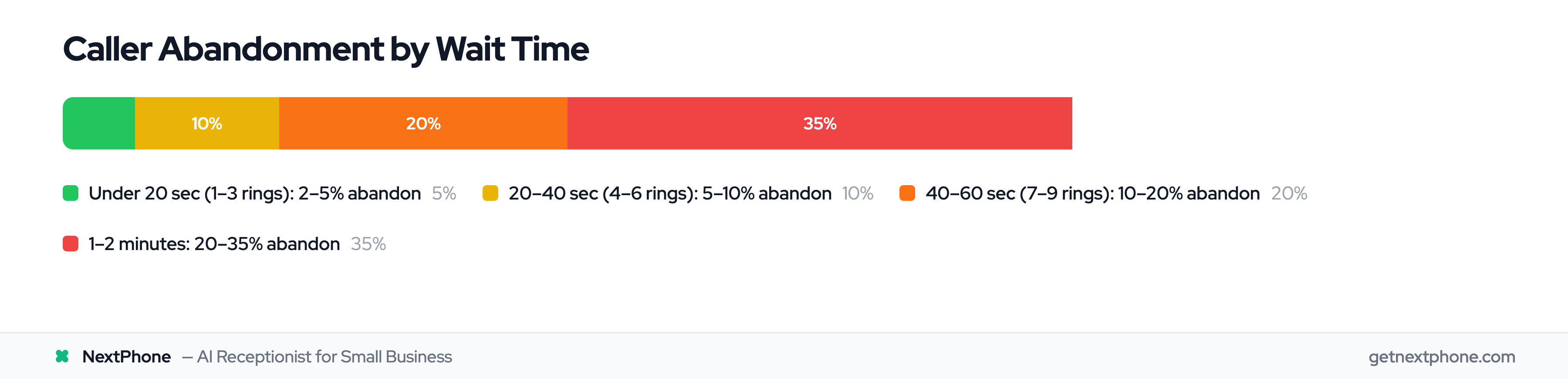
Caller patience isn't linear. It breaks in stages:
- Under 20 seconds (1-3 rings): Only 2-5% abandon. Callers are patient and engaged.
- 20-40 seconds (4-6 rings): 5-10% abandon. Frustration is building. They're opening Google on their phone.
- 40-60 seconds (7-9 rings): 10-20% abandon. Most callers are actively considering hanging up.
- 1-2 minutes: 20-35% abandon. You've lost a third of your potential customers.
That 30% abandonment rate after one minute? Those aren't idle callers. In our call data, urgent calls rank among the top reasons people call, using language like "emergency," "urgent," or "ASAP." These people aren't waiting around. They're calling your competitor before your answering service finishes their coffee.
The Per-Ring Revenue Calculator: How Much Slow Answering Really Costs
Here's where most business owners get a nasty surprise. The slow answering service cost isn't the $400/month you see on your credit card statement. It's the revenue walking out the back door while your service takes its time picking up.
The Basic Math No One Shows You
Let's use realistic numbers. A typical home services contractor receives 42 calls per month. Not all are leads - some are existing customers, some are spam. But a significant portion represent new revenue.
Here's the slow-answer tax calculation:
- 42 calls/month (typical contractor volume)
- 10% lost to slow answer (conservative - data shows 10-25% conversion drop at 5+ rings)
- That's 4.2 calls/month where the customer hung up or was already frustrated when your service finally answered
- 20% of those would have converted at an average project value of $3,500
- Monthly hidden cost: $2,940
That's nearly $3,000 per month you're losing - and you don't even know it because the call technically "got answered." Your answering service reports a 90% answer rate. What they don't report is the conversion rate of frustrated callers who waited through 7 rings to talk to someone who doesn't know your business.
What This Looks Like Over a Year
Annual slow-answer cost for the same contractor:
- $2,940/month x 12 = $35,280 per year
Compare that to what you're paying for the service itself ($400-800/month = $4,800-$9,600/year). You're spending $5,000-$10,000 on a service that's silently costing you $35,000+ in lost conversions.
The service fee is the tip of the iceberg. The slow answering service cost underneath the surface is 4-7x larger.
Emergency Calls: Where Slow Answer Is Fatal
The stakes get even higher with urgent calls. Our data shows true emergencies are a recurring reason people call - pipe bursts, power outages, AC failures in summer heat. Jobs like these commonly run around $4,200 (significantly higher than routine work).
When someone's basement is flooding, they're not waiting through 7 rings. They're hanging up at ring 3 and calling the next plumber on Google. One missed emergency call per week at $4,200 is $16,800/month in lost revenue - gone because your answering service took 20 seconds to pick up.
Why Your Answering Service Can't Answer Fast (It's Not Their Fault)
Before you fire off an angry email to your answering service, understand this: traditional services are slow because of how they're built. Speed limitations are structural, not accidental.
The Human Bottleneck Problem
A human receptionist handles one call at a time. That's it. While they're talking to caller A, callers B, C, and D are sitting in queue. Your answering service might have 50 agents handling 200 clients. During peak hours (10am-12pm and 2pm-4pm, according to our data), every agent is on a call and your customers are waiting.
This isn't incompetence. It's math. Human-powered services will always have capacity constraints during volume spikes.
The Queue You Don't See
Your answering service shows you metrics like "average answer time" and "calls handled." What they don't show you is the queue depth - how many callers waited, for how long, before anyone picked up.
The average wait time across contact centers is 46 seconds. That's after routing, after the automated greeting, after the "please hold" message. Nearly a full minute before a human voice says hello.
And remember: their "average" answer time of 28 seconds means half the calls take longer than that. Some of your callers are waiting 45, 60, even 90 seconds. By then, you've lost them.
The "Please Hold" Tax
Even when your service answers within the 80/20 window, there's often a secondary wait. The agent picks up, hears the caller's name, then says "Let me pull up your account" or "Let me check on that." More dead air. More frustration.
Traditional services charge you for those hold seconds too. Per-minute billing means you're paying for the time your customer spends being annoyed.
How Fast Do Popular Answering Services Actually Answer?
Let's name names. If you're paying for an answering service, you deserve to know what you're actually getting for speed.
Ruby Receptionists
Ruby claims an average answer time of under 10 seconds - less than one full ring cycle. That's genuinely impressive for a human-powered service. But there's context:
- Cost: $235 to $715/month for just 50-200 minutes
- Per-minute overage: Additional charges when you exceed your plan
- Volume-dependent: During peak hours, that "under 10 seconds" average includes calls that took 30+ seconds
Ruby is the premium tier of live answering. If budget isn't a concern and you need a human voice, they're one of the faster options. But you're paying a significant premium for speed that still can't match instant.
AnswerConnect
AnswerConnect was recognized by Forbes as the best overall answering service for 2025. Their pitch is "swift communication" with North American-based receptionists.
- Cost: $350 to $525/month
- Speed SLA: No published average speed of answer metric
- Reality: Customer reviews praise "fast responses" but no concrete time guarantee
The lack of a published speed guarantee is telling. When a service won't commit to a specific answer time, it usually means their average isn't something they want to advertise.
MAP Communications
MAP offers 24/7 coverage with bilingual agents starting at lower price points.
- Cost: $47 to $396/month
- Speed claim: "Fast pickup times" - no specific seconds or rings committed
- Reviews: Mixed feedback on speed - some praise, some mention "long wait for someone to pick up"
The Industry Average Reality
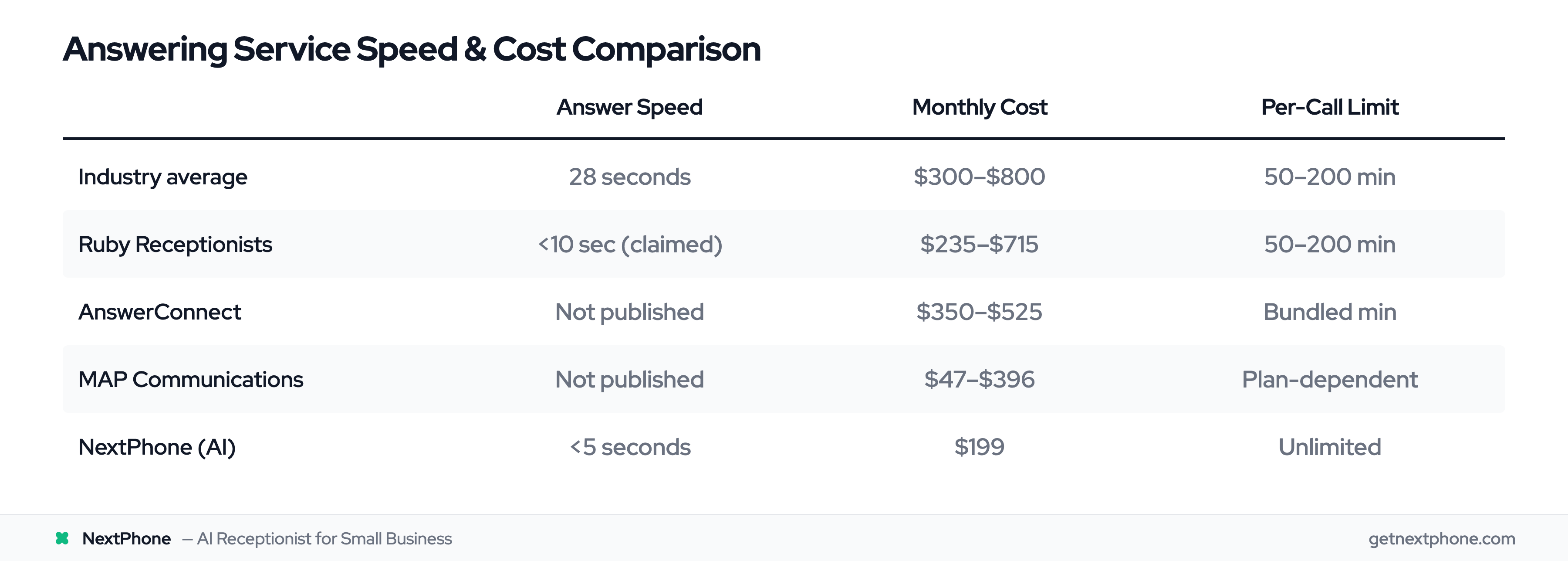
Across all traditional answering services, the industry average speed of answer is 28 seconds. Some calls answer faster. Some answer much slower. But as an average, 28 seconds puts most services squarely in the 4-6 ring zone - the exact range where conversion starts dropping.
Here's the comparison that matters:
| Service Type | Answer Speed | Monthly Cost | Per-Call Limit |
|---|---|---|---|
| Industry average (call centers) | 28 seconds | $300-$800 | 50-200 minutes |
| Ruby Receptionists | <10 sec (claimed) | $235-$715 | 50-200 minutes |
| AnswerConnect | Not published | $350-$525 | Bundled minutes |
| MAP Communications | Not published | $47-$396 | Plan-dependent |
| AI Receptionist (NextPhone) | <5 seconds | $199 | Unlimited |
The gap isn't subtle. Traditional services charge more, answer slower, and cap your usage. The slow answering service cost compounds in both directions: you pay more for the service AND lose more revenue to slow answers. (For a deeper dive on features and pricing, see our virtual receptionist comparison.)