Key Takeaways
- For most SMBs, NextPhone is the pick — flat $199/month for unlimited calls with live call transfers to your team included, answers in under 2 seconds, 99% positive caller sentiment verified across 1,446,980 real calls. The only exception: medical practices where every call requires complex diagnostic triage.
- Live call transfer (AI hands the call directly to your team mid-conversation) is included in NextPhone at no extra cost. Human services charge per-minute for the same outcome.
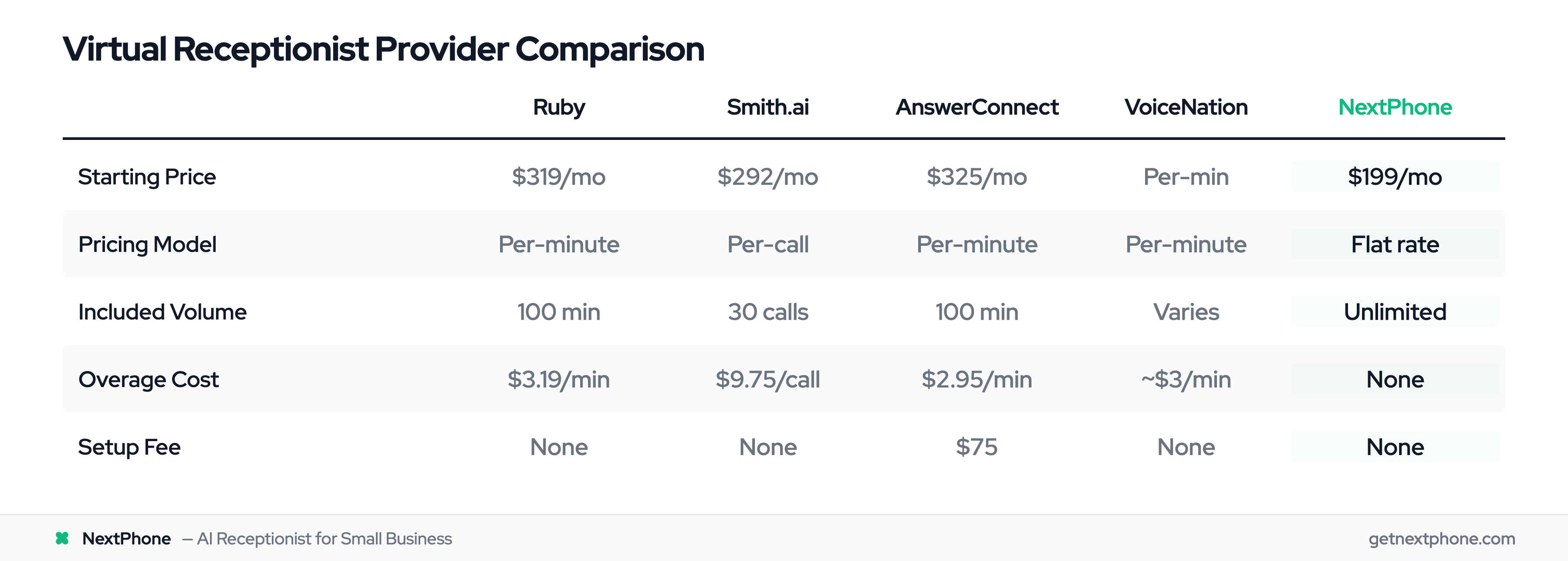
- Virtual receptionist pricing ranges from $199/month (NextPhone flat-rate) to $1,380/month (Abby Connect premium tiers). For a complete pricing breakdown, see our virtual receptionist pricing guide and AI receptionist pricing comparison.
- Live human services charge per-minute ($2.95-$3.50/min); AI services offer flat-rate unlimited pricing — the pricing model is the most important decision in this comparison
- Other providers: Ruby (premium U.S.-based live agents), Smith.ai (AI/human hybrid), AnswerConnect (human-first), VoiceNation (budget entry)
- A full-time in-house receptionist costs $35,000-$45,000/year; NextPhone at $199/month totals $2,388/year — a $26,000+ annual difference
Quick answer: We compared five virtual receptionist services on pricing, features, and live call transfer capabilities. For most SMBs, NextPhone is the clear winner — flat $199/month for unlimited calls with live transfer to your team included, no per-minute billing, no overage surprises, and 99% positive caller sentiment verified across 1,446,980 real calls. The full comparison is below, but unless you're a medical practice that needs 100% human operators for complex diagnostic triage, the math points one direction. Start free trial →
Every missed call represents potential revenue walking out the door. Yet research by 411 Locals found that businesses answer only 37.8% of their inbound calls on average. Another 37.8% go to voicemail, and 24.3% receive no response at all. Making matters worse, 67% of callers refuse to leave voicemail messages for businesses, meaning those opportunities simply disappear.
A virtual receptionist solves this problem by ensuring every call receives a professional response, whether from a live human or an AI-powered system. And the performance ceiling has moved: across 1,446,980 real business calls, the best AI virtual receptionists resolve 90-95% of calls without human intervention, answer in under 2 seconds, and maintain 99% positive caller sentiment. Human services answer in 30-90 seconds at 3-5x the cost.
The virtual receptionist market is projected to grow from $4.64B in 2026 to $10.85B by 2035, reflecting how essential this service has become. But with dozens of providers offering different pricing structures, feature sets, and service approaches, choosing the right one requires careful comparison.
This virtual receptionist comparison guide breaks down the top services in the market. Here's the quick comparison:
| Feature | NextPhone | Ruby | Smith.ai | AnswerConnect | VoiceNation |
|---|---|---|---|---|---|
| Starting Price | $199 | $319 | $300 | $325 | Per-minute |
| Pricing Model | Flat rate | Per-minute | Per-call | Per-minute | Per-minute |
| Included Volume | Unlimited | 100 min | 30 calls | 100 min | Varies |
| Overage Cost | None | $3.19/min | $11.50/call | $2.95/min | ~$3/min |
| 24/7 | Yes | Yes | Yes | Yes | Yes |
| Live Call Transfer | Yes (included) | Yes (per-minute) | Yes (per-call) | Yes (per-minute) | Yes (per-minute) |
| AI Option | Yes | No | Yes | No | No |
| Best For | AI-native + transfers | Premium live service | Hybrid flexibility | Human-first | Budget |
What Is a Virtual Receptionist?

Definition and Core Services
A virtual receptionist is a remote professional or AI system that answers calls on behalf of your business. Unlike an in-house receptionist sitting at your front desk, virtual receptionists work from call centers or cloud-based platforms, handling incoming calls according to your specifications.
Core services include call answering, screening, routing, and message-taking. Many providers extend beyond basics to offer appointment scheduling, lead qualification, customer intake, FAQ responses, and direct CRM updates. The result is a seamless caller experience where customers interact with what feels like your own staff, without the overhead of a full-time employee.
Virtual Receptionist vs Answering Service
While the terms are sometimes used interchangeably, meaningful differences exist between a virtual receptionist and an answering service:
Virtual receptionists typically offer more personalized, brand-aligned service. They may have dedicated or semi-dedicated teams assigned to your account, familiarizing themselves with your business operations and culture. They handle broader tasks like scheduling, administrative work, and lead qualification. Customization options tend to be extensive.
Answering services focus on script-based, standardized responses optimized for high call volumes. They excel at 24/7 availability, message-taking, and basic routing at lower per-call costs. Personalization is limited since operators may handle dozens of different businesses per shift.
The right choice depends on your business: relationship-driven firms (law, accounting, consulting) often benefit from virtual receptionists, while high-volume businesses may find answering services or AI solutions more economical.
Types of Virtual Receptionist Services
Three main categories exist today:
Live human receptionists: Real people answering calls from call centers. Premium pricing reflects the human touch, typically charged per-minute or per-call.
AI-powered virtual receptionists: Automated systems using natural language processing to handle calls, schedule appointments, and route inquiries. Typically flat-rate pricing with unlimited capacity.
Hybrid models: AI handles routine calls while humans take complex ones. Offers cost efficiency without sacrificing human touch for difficult situations.
Which AI Virtual Receptionists Include Live Call Transfers?
Live call transfer — where the AI hands a caller directly to your team mid-conversation — is one of the most important features to look for. Here's how the main providers compare:
| Provider | Live Transfer Included | How It's Charged |
|---|---|---|
| NextPhone | Yes — blind or warm (with summary) | Included in $199/month flat |
| Smith.ai (AI tier) | Yes — escalates to human | Counted against per-call quota ($3.25/call overage) |
| Ruby | Yes — transfers to your number | Counts against per-minute plan ($3.19/min overage) |
| AnswerConnect | Yes | Counts against per-minute plan ($2.95/min overage) |
| VoiceNation | Yes | Per-minute billing applies |
Why this matters: with per-minute or per-call providers, every transfer costs you — hold time during handoff, the summary conversation, the wait. With NextPhone's flat rate, transfers to your team are included regardless of volume. The AI handles the conversation, captures context, and connects the caller directly when you configure a transfer trigger (e.g., caller says "I want to speak to someone," or an urgency keyword fires).
A production call — the AI greets, qualifies, and transfers to the configured number with context. This is what live transfer sounds like from NextPhone.
Top 5 Virtual Receptionist Services Compared
Let's examine the leading virtual receptionist providers across pricing, features, and best-fit use cases.
1. NextPhone AI Virtual Receptionist
NextPhone takes a fundamentally different approach with flat-rate AI answering that includes unlimited calls. Instead of tracking minutes or counting calls, businesses pay one predictable monthly price.
Pricing:
- $199/month flat rate
- Unlimited calls included
- No per-minute or per-call charges
- No setup fees
- No overage surprises
Key Features:
- 24/7 AI-powered answering
- Handles unlimited simultaneous calls (no busy signals, no hold times)
- Appointment scheduling and calendar integration
- Intelligent call routing and transfers
- Custom greetings and call flow configuration
- CRM integrations
- Bilingual support
Pros:
- Lowest effective cost for high-volume callers
- Completely predictable monthly expense (no bill shock)
- No overage fees regardless of call volume
- Scales instantly with demand spikes
- Never puts callers on hold
Why it wins:
- Answers in 1 ring (3x faster than call centers taking 3-5 rings)
- 9 languages included at flat rate (competitors charge $6-8 extra per Spanish call)
- Frontier AI technology (latest GPT/Claude models, not legacy scripts)
- Trained on YOUR business (learns from your website, not generic templates)
- Unlimited simultaneous calls (handles surges without capacity limits)
- Live in 1-2 days (no weeks of operator training)
- 99% caller satisfaction (callers can't tell it's AI)
The obvious choice for: Any business handling 50+ calls/month. Contractors needing 24/7 emergency coverage. Anyone tired of surprise bills. Businesses serving multilingual customers. Literally anyone answering routine calls (hours, pricing, scheduling)—which is 80% of businesses. The only exception: medical practices with 100% complex diagnostic triage.
For a deeper look at AI-only platforms including platform-by-platform call demos, see our best AI receptionist comparison.
Try NextPhone free for 7 days
AI answering service that answers, qualifies, and books — 24/7.
2. Ruby Receptionists
Ruby has built its reputation on premium, U.S.-based live receptionist service since 2003. Every call is answered by a trained professional working from Ruby's own facilities, never offshore call centers.
Pricing:
- $319/month for 100 minutes
- $529/month for 200 minutes
- $859/month for 500 minutes
- $3.19 per additional minute (overage)
- No setup fees
- 100% U.S.-based receptionists
- 24/7/365 availability
- Bilingual English/Spanish support
- Mobile app for real-time call management
- Custom call handling scripts
- Live chat add-on available (bundled packages offer 25% savings)
Pros:
- U.S.-based receptionists with consistent training
- 24/7 availability, no weekend surcharges
- Bilingual English/Spanish included
Cons:
- Among the most expensive options in the market
- Per-minute overages accumulate quickly at moderate call volumes
- Limited third-party integrations compared to newer competitors
- Charges for spam calls unless you pay for filtering
The pricing reality: At 150 calls/month, you're paying $700-900/month vs $199 unlimited AI. That's $6,000-8,400/year extra for "premium" service that's indistinguishable from AI (99% caller satisfaction proves callers can't tell). Unless you're a medical practice with complex diagnostic triage, you're overpaying for marketing narratives.
3. Smith.ai
Smith.ai differentiates itself with a hybrid approach, offering both AI and human receptionist options plus a unique per-call (rather than per-minute) pricing model.
Pricing:
- Human Virtual Receptionists: ~$300/month for 30 calls
- Overage: $3.25/call (AI) or $11.50/call (human)
- 7-day money-back guarantee (up to $1,000)
- No setup fees or annual contracts required
Key Features:
- Per-call pricing provides cost predictability (no watching the clock)
- Free spam call filtering (no charges for unwanted calls)
- AI tier with seamless human escalation when needed
- Extensive CRM integrations (5,000+ via Zapier, plus native Salesforce, HubSpot, Clio)
- Outbound calling and lead qualification capabilities
- Live chat services available
Pros:
- Flexible choice between AI and human answering
- Predictable per-call costs eliminate timing concerns
- No charges for spam, wrong numbers, or sales calls
- Strong technology integrations for modern workflows
Cons:
- Per-call overage fees add up at higher volumes
- Human tier significantly more expensive than AI
- Complexity in determining which tier fits your needs
The hybrid tax: At 100 calls/month on human tier: $300 + (70 × $11.50) = $1,105/month vs $199 AI. You're paying 5x more for "hybrid" that's really just expensive human answering. AI handles routine, transfers complex—same outcome at 1/5 the cost.
4. AnswerConnect
AnswerConnect positions itself as a human-first service, no AI, no bots, just trained receptionists answering calls. Forbes named them the #1 Answering Service in 2025.
Pricing:
- $325/month for 100 minutes
- $2.95 per additional minute (overage)
- $75 setup fee
- No extra charges for nights, weekends, or holidays
Key Features:
- 24/7/365 live answering with no weekend or holiday upcharges
- 99.43% of calls answered within 1-4 rings
- 25+ platform integrations
- Bilingual English/Spanish service
- Sustainability-focused distributed workforce
- Message taking, appointment scheduling, lead capture
Pros:
- Human-answered calls 24/7, no weekend upcharges
- Free spam call filtering
- 25+ platform integrations
Cons:
- Per-minute pricing escalates quickly with longer or more frequent calls
- No AI option for cost-conscious users
- Setup fee required ($75)
- No path to unlimited or flat-rate pricing
The per-minute trap: At 200 calls (400 minutes): $325 + (300 × $2.95) = $1,210/month vs $199 AI. Success literally costs you more—your busiest month = your highest bill. Per-minute pricing punishes growth.
5. VoiceNation
VoiceNation offers the most accessible pricing in the virtual receptionist market, making professional call handling available to businesses watching every dollar.
Pricing:
- Per-minute billing with low base plans
- Approximately $3/minute overage
- No setup fees
- Instant activation
Key Features:
- 24/7 call answering
- Mobile app for on-the-go management
- Bilingual English/Spanish
- Customizable call scripts
- Quick activation process (often same-day)
Pros:
- Most affordable entry point in the market
- No long-term contracts required
- Fast setup and activation
- Solid value for budget-conscious businesses
Cons:
- Higher per-minute rate on smaller plans
- Fewer features and integrations than premium competitors
- Less depth in specialized capabilities
The "budget" trap: Low base plans include minimal minutes. At 100 calls/month, overages push the total above $200/month. That's MORE than AI flat-rate for "budget" service with fewer features. Per-minute pricing is bait and switch—the advertised price is never your real cost.