"How much does an answering service actually cost?" It's a simple question with a frustratingly complicated answer.
Some providers charge $0.95 per minute. Others charge $9.75 per call. Some offer flat rates starting at $199. And nearly all hide setup fees, overage charges, and contract terms in the fine print.
This confusion isn't accidental. When you can't compare apples to apples, providers win—you sign up for a "$99/month" plan that becomes $250/month after overages kick in.
This guide cuts through the noise. We'll compare all three pricing models with real math, expose hidden fees that inflate your bill, show exactly how traditional live services stack up against AI alternatives, and help you calculate whether any answering service is worth the investment.
Answering Service Pricing Overview: What to Actually Expect
Before diving into pricing models, let's establish realistic expectations for what answering services cost in 2025.
The Real Cost Range: $50 to $2,000+ Per Month
Answering service pricing spans a massive range. At the low end, basic AI services start around $50/month. At the high end, enterprise live answering with specialized features can exceed $2,000/month.
For most small businesses, here's what the market actually looks like:
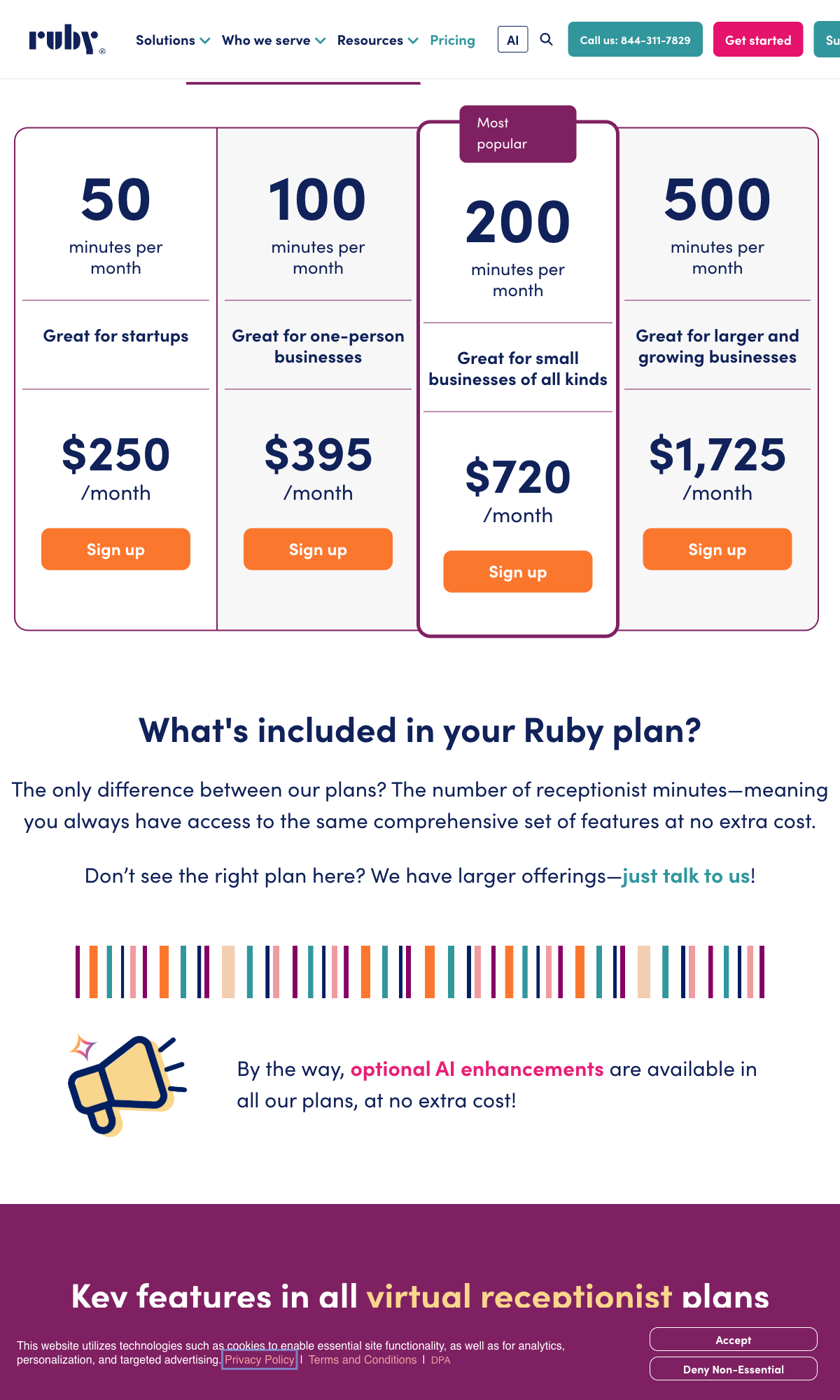
Live answering services (human operators): $150-$1,000+ per month. These are traditional call centers with real people answering your phones. Ruby Receptionists, AnswerConnect, and Smith.ai fall into this category.
AI answering services: $49-$300 per month. These use artificial intelligence to answer calls, take messages, and schedule appointments. NextPhone, Numa, and MyAIFrontDesk are examples.
The virtual receptionist market is projected to reach USD 44.2 billion by 2034 according to market research, driven largely by cost-conscious small businesses seeking affordable alternatives to traditional services.
Why Prices Vary So Dramatically
Several factors drive the price difference:
Call volume is the primary driver. Most services price based on minutes used or calls handled. A business receiving 30 calls monthly pays far less than one receiving 150 calls.
24/7 vs business hours affects pricing. Round-the-clock coverage costs more than 9-5 answering.
Live human vs AI is the biggest differentiator. Human operators cost significantly more than AI systems.
Features matter. Basic message-taking is cheap. Add scheduling, CRM integration, bilingual support, or industry compliance (HIPAA, legal), and prices climb.
What Small Businesses Actually Pay
Most small businesses pay between $100 and $400 per month for adequate answering service coverage.
Budget options exist, but they come with limitations—low minute caps, basic features only, and high overage charges.
Premium services justify higher costs with specialized features, dedicated operators, or industry-specific expertise.
The key isn't finding the cheapest option—it's finding the right pricing model for your call patterns.
Three Pricing Models Explained: Per-Minute vs Per-Call vs Flat-Rate
Understanding how answering services structure their pricing is more important than comparing individual providers. Choose the wrong pricing model, and you'll overpay even if you pick a "cheap" service.
There are three main ways answering services charge: per-minute, per-call, or flat monthly fee. Each works very differently.
Per-Minute Pricing: How It Works
Per-minute pricing charges you for every minute an operator or AI spends on your calls. Rates typically range from $0.75 to $2.50 per minute depending on provider and plan tier.
How the math works: If you receive 50 calls averaging 3 minutes each, that's 150 minutes of usage. At $1.50/minute, you pay $225 for the month.
What to watch for:
- Most per-minute plans include a minimum monthly fee ($50-$150), even if you don't use those minutes
- Overage rates often spike after you exceed your plan's included minutes ($1.95-$2.50/minute)
- Some providers round up to the next minute for each call
Popular per-minute providers:
- PATLive: $1.33-$1.67 per minute depending on plan
- VoiceNation: $0.79-$1.49 per minute
- MAP Communications: Various per-minute tiers
Pros:
- Pay only for actual talk time
- Good for very low volume (under 25 calls/month)
- Predictable if volume is consistent
Cons:
- Costs add up fast with longer calls
- Unpredictable bills when volume fluctuates
- Scheduling calls (5-8 minutes each) get expensive quickly
Real example: A contractor thought 50 minutes/month was plenty. But appointment scheduling takes 5-8 minutes per call. His 10 scheduling calls used 60 minutes, plus 15 quick message calls (30 minutes) = 90 minutes. He hit his limit and paid $1.95/minute for the next 40 minutes = $78 in overages. His "$99/month" plan cost $177.
Per-Call Pricing: How It Works
Per-call pricing charges a flat fee for each call handled, regardless of how long the call lasts. Rates typically range from $5 to $12 per call.
How the math works: If you receive 50 calls at $9.75 each, you pay $487.50 for the month. Whether those calls are 30 seconds or 10 minutes, the cost is the same.
What to watch for:
- Most providers require minimum bundles (30, 50, or 100 calls)
- Overage charges apply after exceeding your bundle ($10-$15/call)
- Some define "call" differently (any ring vs connected calls vs calls over 30 seconds)
Popular per-call providers:
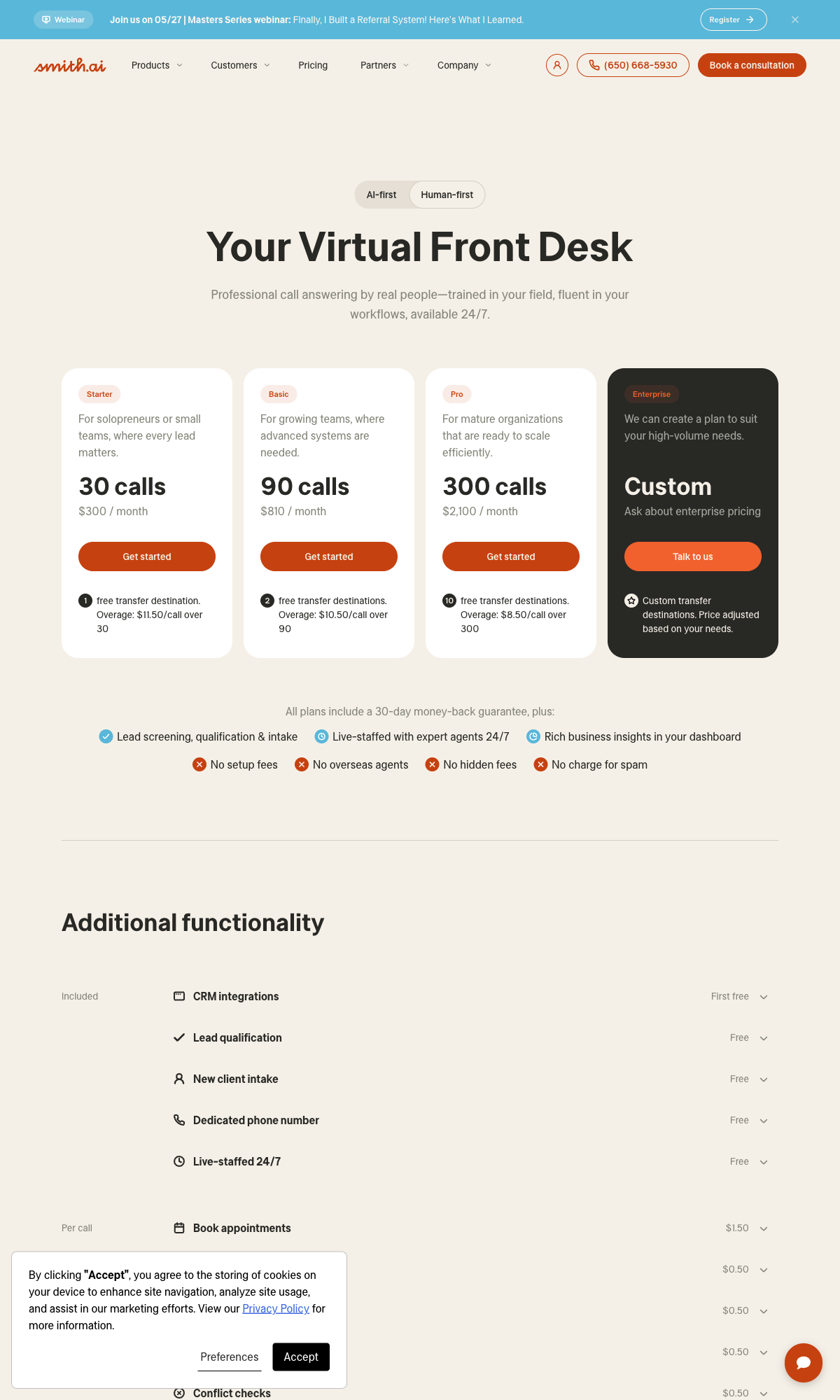
- Smith.ai: $9.75 per call (30 call minimum = $292.50/month)
- Various legal and medical specialty services
Pros:
- Predictable per-call cost
- Long calls don't cost more than short ones
- Good for detailed intake or consultation calls
Cons:
- Gets very expensive at high volume
- Minimum bundles can exceed your needs
- Quick 30-second calls cost the same as 10-minute calls
Real example: A law firm signed up for Smith.ai at 30 calls/month for $292.50. Good months brought 80 calls. That's 30 bundled + 50 overage calls at $11/each = $292.50 + $550 = $842.50 total.
Flat-Rate Pricing: How It Works
Flat-rate pricing charges a fixed monthly fee regardless of call volume. Plans typically range from $99 to $300 per month.
How the math works: You pay $199/month whether you receive 30 calls or 150 calls. No per-minute tracking. No per-call counting.
What to watch for:
- Some "flat rate" plans actually have caps (500 calls/month)
- Features included vary significantly between providers
- Quality matters—cheap flat rate may mean poor service
Popular flat-rate providers:
- NextPhone: $199/month unlimited calls
- Numa: $49/month unlimited (basic features)
- Various AI services with high caps
Pros:
- Complete budget predictability
- No overage anxiety during busy periods
- Scales with your business growth
- Best value for medium-high volume
Cons:
- May overpay if volume is very low (under 25 calls/month)
- Not all unlimited plans include the same features
Real example: An HVAC company gets 40 calls in winter, 120 calls in summer. With per-call at $9.75, that's $390/month in winter but $1,170/month in summer. With flat-rate at $199/month, they pay $199 year-round—saving $971 in their busiest month.
Quick Comparison: Which Model Costs What?
Let's compare all three models at 100 calls per month with a 3-minute average call duration:
Per-minute pricing ($1.50/minute): 100 calls x 3 minutes = 300 minutes x $1.50 = $450/month
Per-call pricing ($9.75/call): 100 calls x $9.75 = $975/month
Flat-rate pricing: $199/month (NextPhone) regardless of volume
At 100 calls monthly, flat-rate costs less than half of per-minute and less than a quarter of per-call pricing.
The crossover point where flat-rate beats per-minute is typically around 40-60 calls monthly (depending on call duration). Flat-rate beats per-call pricing almost immediately for any business getting more than 20-30 calls monthly.
Hidden Fees to Watch For: What Providers Don't Advertise
Advertised prices rarely tell the full story. Here's where answering services hide additional charges that can inflate your bill by 30-60%.
Setup and Onboarding Fees
Setup fees range from $0 to $500 depending on the provider and complexity of your account.
What triggers higher setup fees:
- Custom call scripts
- Phone number porting
- CRM or calendar integrations
- Bilingual setup
- Industry-specific compliance configuration
Red flags to watch:
- "Implementation fee" buried in terms and conditions
- "Professional onboarding" as an add-on
- Training fees for your account
What to ask: "Is there any one-time fee to get started, including setup, training, or implementation?"
Some providers waive setup fees for annual contracts—but then you're locked in.
Overage Charges: The Silent Budget Killer
This is where advertised prices become misleading.
Per-minute overages: Most plans include a base number of minutes (100, 200, 500). Exceed that, and overage rates kick in—typically $1.50 to $2.50 per minute.
Real example: A "$149/month for 100 minutes" plan sounds reasonable. But your calls average 4 minutes, not 2. With 50 calls, you use 200 minutes—100 over your limit. At $1.95/minute overage, that's $195 in extra charges. Your "$149 plan" cost $344.
Per-call overages: Bundle plans include set call quantities. Exceed them, and you pay $8-$15 per additional call.
Real example: A "50 calls for $300/month" plan seems straightforward. But a good marketing month brings 90 calls. That's 40 overage calls at $12 each = $480 extra. Your "$300 plan" cost $780.
How to protect yourself:
- Choose a plan 30-50% above your average volume
- Ask: "What happens if I exceed my limit?"
- Consider flat-rate if volume is unpredictable
- Get caps on overage charges in writing
Contract Terms and Early Termination
Annual contracts offer 10-30% discounts compared to month-to-month pricing. But they come with risks.
Early termination fees: $100-$500 if you cancel before the contract ends. Unhappy with service in month 3 of a 12-month contract? You'll pay to leave.
Auto-renewal clauses: Your annual contract automatically renews unless you cancel 30-60 days before expiration. Miss the window, and you're locked in for another year.
Price increases: "Introductory pricing" that jumps 20-30% at renewal. The $99/month you signed for becomes $129/month on year two.
What to ask:
- Can I cancel anytime without penalty?
- Is there an early termination fee? How much?
- Does the price change at renewal?
- What's the cancellation notice requirement?
Month-to-month flexibility typically costs 10-20% more per month but gives you freedom to leave if the service doesn't work.
Features That Cost Extra
Many providers advertise low base prices but charge separately for essential features.
Common add-ons that should arguably be included:
- Call recording: $10-$30/month
- Voicemail transcription: $10-$20/month
- Analytics dashboard: $20-$50/month
- Calendar integration: $25-$75/month
- Additional phone numbers: $5-$15/month each
- Bilingual support: $50-$100/month
- Real example: A "$99/month base plan" catches your eye. But you need call recording ($20), analytics ($30), and a second phone number ($10).
- Actual monthly cost: $159 — 60% more than advertised.
What to ask: "What features are included? What costs extra?" Get a complete feature list before signing.
NextPhone includes all core features—voicemail transcription, analytics, calendar integration, and more—in the base $199/month price. No add-on fees.
Traditional Live Answering vs AI Answering: Price Comparison
The biggest pricing decision isn't which provider—it's whether to use traditional live answering (human operators) or AI-powered answering.
What Traditional Live Answering Services Charge
Live answering services employ real humans to answer your phones. They provide a personal touch but come with significant costs.
Major provider pricing:
| Provider | Pricing Model | Monthly Cost | What You Get |
|---|---|---|---|
| Ruby Receptionists | Per-minute | $319-$1,079/mo | 50-500 minutes |
| AnswerConnect | Per-minute | $149-$799/mo | 100-500 minutes |
| Smith.ai | Per-call | $292.50-$2,025/mo | 30-300 calls |
| PATLive | Per-minute | $199-$999/mo | 75-600 minutes |
| VoiceNation | Per-minute | $79-$499/mo | Various tiers |
The math at 100 calls/month (3-minute average):
- Ruby (200 min plan): $549/month + potential overages
- AnswerConnect (200 min plan): $325/month + potential overages
- Smith.ai (100 calls): $975/month
- PATLive (150 min plan): $369/month + potential overages
Most live services require 200-300+ minutes to handle 100 calls, landing you in the $300-$600/month range before overages.
What AI Answering Services Charge
AI answering services use artificial intelligence to handle calls. They've improved dramatically and now handle scheduling, FAQs, and message-taking as well as humans—at a fraction of the cost.
Major provider pricing:
| Provider | Pricing Model | Monthly Cost | What You Get |
|---|---|---|---|
| NextPhone | Flat-rate | $199/mo | Unlimited calls |
| MyAIFrontDesk | Flat-rate | $79-$119/mo | Various features |
| Numa | Flat-rate | $49/mo | Basic features |
The math at 100 calls/month:
- NextPhone: $199/month (same at any volume)
- MyAIFrontDesk: $119/month (pro plan)
- Numa: $49/month (limited features)
AI services typically use flat-rate pricing because their marginal cost per call is nearly zero—once built, the AI can handle 50 calls or 500 calls at similar cost.
Side-by-Side Cost Comparison
At various monthly call volumes, here's what you'd pay:
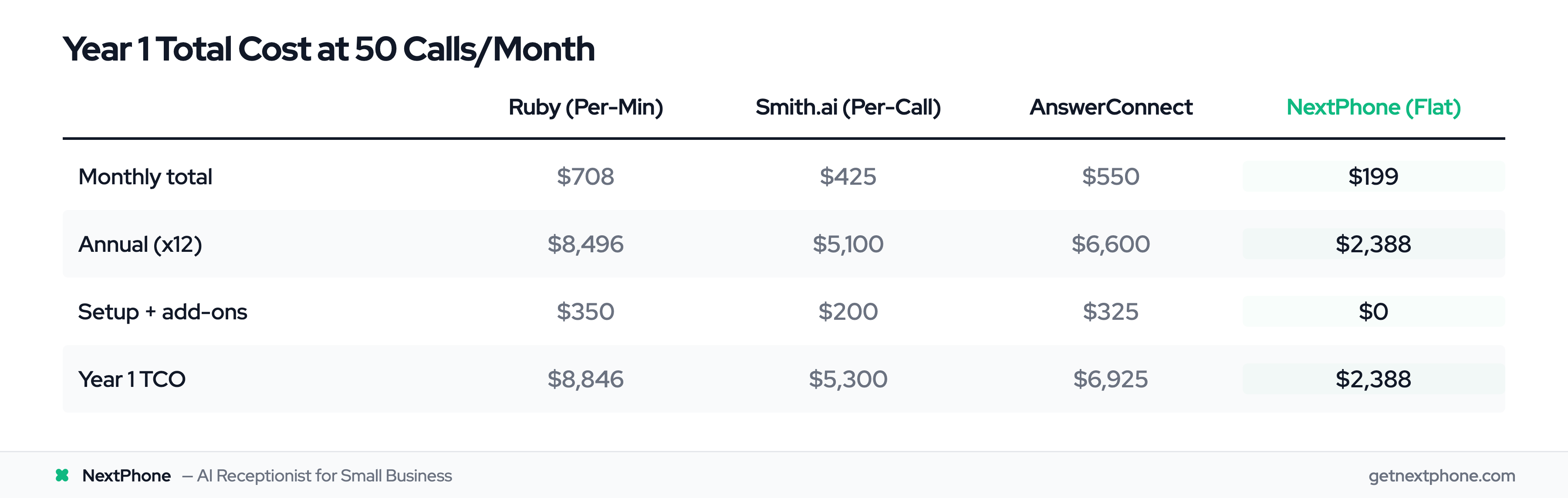
At 50 calls/month (3-min avg = 150 minutes):
| Service Type | Provider Example | Monthly Cost |
|---|---|---|
| Live | Ruby (50 min plan) | $319 + $195 overage = $514 |
| Live | AnswerConnect (100 min plan) | $149 + $98 overage = $247 |
| AI | NextPhone | $199 |
At 100 calls/month (3-min avg = 300 minutes):
| Service Type | Provider Example | Monthly Cost |
|---|---|---|
| Live | Ruby (200 min plan) | $549 + $195 overage = $744 |
| Live | Smith.ai (100 calls) | $975 |
| AI | NextPhone | $199 |
At 150 calls/month (3-min avg = 450 minutes):
| Service Type | Provider Example | Monthly Cost |
|---|---|---|
| Live | Ruby (500 min plan) | $1,079 |
| Live | Smith.ai (150 calls) | $1,462.50 |
| AI | NextPhone | $199 |
AI answering services cost 70-90% less than traditional live services for equivalent call volume.
When Live Answering Is Worth the Premium
Despite the cost difference, live answering makes sense in specific situations:
Complex consultations: Legal intake, medical triage, or technical support where human judgment and empathy are essential.
High-touch sales: Industries where relationship-building during the first call directly impacts close rates.
Regulated industries: Situations requiring licensed operators (nursing triage, legal advice).
Crisis situations: Mental health lines, emergency services, or situations demanding immediate human empathy.
When AI Wins
For most small businesses, AI answering provides better value:
Routine call handling: Taking messages, answering FAQs, providing business hours and location.
Appointment scheduling: AI integrates with calendars and books appointments efficiently.
After-hours coverage: 24/7 availability that would cost $3,000+/month with live services.
High volume: When you're receiving 100+ calls monthly, AI's flat pricing delivers massive savings.
Budget constraints: When you need professional answering but can't afford $500+/month.
A general contractor switched from AnswerConnect ($380/month after overages) to NextPhone ($199/month). Annual savings: $2,172—with 24/7 coverage he didn't have before.
What You'll Actually Pay: Real Cost at Different Volumes
Theory is one thing. Let's see exactly what each pricing model costs at specific call volumes.
Low Volume: 30 Calls Per Month
Assuming 3-minute average call duration (90 total minutes):
Per-minute ($1.50/min): 90 minutes x $1.50 = $135. But most plans have $149 minimums, so you pay $149/month.
Per-call ($9.75/call): 30 calls x $9.75 = $292.50/month. This is Smith.ai's minimum bundle.
Flat-rate: $199/month regardless of volume.
Winner: Per-minute is cheapest if you stay under the minimum threshold. But you're paying for 49 minutes you don't use.
Best choice: If volume stays consistently low (under 30 calls), per-minute can work. But most businesses grow—flat-rate prevents painful transitions later.
Medium Volume: 60 Calls Per Month
Assuming 3.5-minute average call duration (210 total minutes):
Per-minute: 100-minute base plan at $149 + 110 overage minutes at $1.95 = $363.50/month.
Per-call: 60 calls x $9.75 = $585/month.
Flat-rate: $199/month.
Winner: Flat-rate by $164-$386/month.
Reality check: At 60 calls monthly, flat-rate saves you $1,968-$4,632 annually compared to per-minute or per-call.
High Volume: 100 Calls Per Month
Assuming 4-minute average call duration (400 total minutes):
Per-minute: 200-minute plan at $325 + 200 overage minutes at $1.95 = $715/month.
Per-call: 100 calls x $9.75 = $975/month.
Flat-rate: $199/month.
Winner: Flat-rate by $516-$776/month.
Annual savings: $6,192-$9,312 by choosing flat-rate over per-minute or per-call.
Seasonal Spike: 150 Calls Per Month
This scenario hits seasonal businesses hardest—HVAC in summer, roofers in spring, landscapers in peak season.
Assuming 4-minute average call duration (600 total minutes):
Per-minute: 500-minute plan at $799 + 100 overage minutes at $1.95 = $994/month.
Per-call: 150 calls x $9.75 = $1,462.50/month.
Flat-rate: $199/month.
Winner: Flat-rate by $795-$1,263/month.
The seasonal trap: A business averaging 50 calls normally but hitting 150 during busy season faces a $1,263 bill shock with per-call pricing—versus the same $199 with flat-rate.
Key insight: Flat-rate pricing wins decisively above 50-60 calls/month. Per-minute only makes sense for very low, consistent volume—and even then, growth will eventually make flat-rate cheaper.
How to Calculate Your Answering Service ROI
Is an answering service actually worth the money? Let's calculate.
Calculate Your Current Missed Call Costs
Before evaluating any service, understand what you're losing now.
Step 1: Estimate monthly inbound calls Check your phone bill for total incoming calls. Don't have that data? Use 42 calls/month—the industry average for home services contractors.
Step 2: Estimate your current miss rate Be honest: when your phone rings while you're on a job site, driving, or in a meeting, do you answer? Industry research shows contractors miss 60-80% of incoming calls.
If you check voicemails at day's end and find 8-10 messages, you're likely missing more than you realize.
Step 3: Identify high-value call types Not all missed calls are equal. Based on industry data:
- 6.9% are quote/estimate requests - These are ready-to-buy prospects
- 6.2% are emergencies - High urgency, high value ($1,200+ average)
- 25.4% request callbacks - Of these, 42% never get returned
Step 4: Apply your average job value What's your typical project worth?
- General contractors: $3,500 average
- Roofers: $15,000 average
- Plumbers: $600-$800 average
- HVAC: $1,200 emergency / $4,000 installation
- Electricians: $1,500 average
Step 5: Calculate lost revenue Formula: Monthly calls x miss rate x quote percentage x average job value x close rate
Estimate Revenue Capture Improvement
An answering service won't capture 100% of calls—some callers hang up regardless, some are spam. But a good service captures 80-95% of calls you currently miss.
Conservative assumption: You convert 50% of newly captured calls into value (quotes, appointments, or jobs).
The Simple ROI Formula
(Monthly Calls x Miss Rate x Quote % x Avg Job x Close Rate x 12) - Annual Service Cost = Net Gain
If Net Gain is positive, the service pays for itself.
Industry-Specific Examples
General Contractor:
- 42 calls/month x 74% missed = 31 missed calls
- 6.9% are quotes = 2.1 quote requests missed monthly
- $3,500 average job x 20% close rate
- Monthly lost revenue: 2.1 x $3,500 x 20% = $1,470
- Annual lost revenue: $17,640
If NextPhone ($199/month = $2,388/year) captures 50% of those missed quotes:
- Annual captured revenue: $8,820
- Net gain: $6,432/year
Break-even: Capture just one $3,500 job that you would have missed. That single job pays for 17+ months of service.
Roofer:
- 42 calls/month x 76% missed = 32 missed calls
- 10.6% are quotes (highest of any trade) = 3.4 quotes missed monthly
- $15,000 average roof x 20% close rate
- Monthly lost revenue: 3.4 x $15,000 x 20% = $10,200
- Annual lost revenue: $122,400
If NextPhone captures just 25% of missed quotes:
- Annual captured revenue: $30,600
- Net gain: $28,212/year
Break-even: Capture one roof every 9 months that you would have missed.
HVAC (Emergency Focus):
- 42 calls/month x 74% missed = 31 missed calls
- 6.2% are emergencies = 1.9 emergency calls missed monthly
- $1,200 average emergency x 30% close rate (higher due to urgency)
- Monthly lost revenue: 1.9 x $1,200 x 30% = $684
- Annual lost revenue from emergencies alone: $8,208
If NextPhone captures 60% of missed emergencies:
- Annual captured revenue: $4,925
- Net gain: $2,537/year (just from emergencies—quote requests add more)
Choosing the Right Pricing Model for Your Business
Now that you understand how each model works, which is right for you?
When Per-Minute Makes Sense
Per-minute pricing works best for very specific situations:
Choose per-minute if:
- Volume is very low: Under 25-30 calls/month, consistently
- Calls are short: Under 2 minutes average (quick messages only)
- Volume is predictable: Same number of calls every month
- You're testing: Trying answering service before committing
Don't choose per-minute if:
- You handle scheduling (5-8 minutes per call)
- Volume varies month to month
- You're growing and expect more calls
- Budget predictability matters
Example fit: A solo consultant receiving 15 quick inquiry calls monthly—each under 90 seconds. Per-minute at $0.99/min = $22/month. Flat-rate at $199/month would be overkill.
When Per-Call Works Best
Per-call pricing suits moderate-volume businesses with variable call lengths:
Choose per-call if:
- Volume is moderate: 30-70 calls/month
- Call length varies wildly: Some 1 minute, some 10 minutes
- You need per-call reporting: Legal intake, sales tracking
- Volume is consistent: No seasonal spikes
Don't choose per-call if:
- Volume exceeds 100 calls/month (too expensive)
- You have seasonal surges
- You're growing rapidly
- Budget certainty is critical
Example fit: A small law firm receiving exactly 40 intake calls monthly, ranging from 2-15 minutes each. Per-call at $9.75 = $390/month. Predictable and fair regardless of call length.
When Flat-Rate Is the Right Choice
Flat-rate pricing fits most small businesses:
Choose flat-rate if:
- Volume is medium to high: 50+ calls/month
- Volume is unpredictable: Varies week to week
- You're seasonal: Summer rush, holiday peaks
- You're growing: Volume increasing over time
- Budget certainty matters: Need to know exact monthly cost
- You don't want to track minutes/calls
Example fit: A general contractor receiving 40-80 calls monthly depending on marketing and season. Flat-rate at $199/month means no surprises—same bill whether it's a slow winter week or spring rush.
Special Case: Seasonal Businesses
If your call volume fluctuates seasonally, flat-rate pricing protects your budget.
HVAC:
- Winter: 40 calls/month
- Summer: 120 calls/month
With per-call at $9.75: $390 winter / $1,170 summer = $780 swing With flat-rate at $199: $199 both seasons = $971 saved in peak month alone
Roofing:
- Winter: 30 calls/month
- Spring: 100 calls/month
With per-minute (3 min avg): $135 winter / $450 spring = $315 swing With flat-rate at $199: $199 both seasons = $251 saved in peak month
Landscaping:
- Winter: 20 calls/month
- Summer: 80 calls/month
With per-call at $9.75: $195 winter / $780 summer = $585 swing With flat-rate at $199: $199 both seasons = $581 saved in peak month
Seasonal businesses benefit enormously from flat-rate because their busiest months—when they most need calls answered—don't spike their bill.
NextPhone Pricing: Transparent, Flat-Rate, No Surprises
We built NextPhone specifically for small businesses frustrated by confusing answering service pricing.
Simple Pricing: $199/Month Unlimited
Our pricing is straightforward: $199 per month for unlimited calls.
That's it. No per-minute charges. No per-call fees. No overage surprises. Whether you receive 30 calls or 150 calls, you pay $199.
What "no surprises" actually means:
- No setup fees ($0 to start)
- No contracts (month-to-month)
- No termination fees (cancel anytime)
- No overage charges (unlimited means unlimited)
- No feature add-ons (everything's included)
What's Included: Everything You Need
For $199/month, you get everything a small business needs:
Call Handling:
- 24/7 AI answering (under 5 seconds)
- Unlimited call volume
- Voicemail transcription included
- Call recording included
- Spam filtering (blocks 7% of junk calls)
Smart Features:
- Emergency keyword detection and instant routing
- Appointment scheduling with calendar integration
- Callback tracking (captures all 25.4% of callback requests)
- Custom business info (hours, services, pricing, service area)
- Bilingual support where needed
Integrations Included:
- Google Calendar / Google Workspace
- Microsoft Outlook / Office 365
- Basic CRM connections
- Email and SMS notifications
- Zapier for custom workflows
No Extra Charges For:
- Setup or onboarding
- Analytics and call reporting
- Phone number porting
- Software updates and new features
Why We Chose Flat-Rate for Contractors
We analyzed call patterns across hundreds of home services businesses. Here's what we learned:
Volume is unpredictable. You can't predict when a pipe will burst at 2 AM or when a heat wave will trigger 50 AC calls in a week.
Seasonality is real. HVAC gets 3X summer volume. Roofers surge in spring. Landscapers go quiet in winter. Per-call pricing punishes you during your most profitable months.
You're out in the field. You can't monitor minute usage or worry about whether answering a call will blow your budget.
Growth shouldn't be penalized. When your marketing works and calls increase, your bill shouldn't double.
Flat-rate solves all of this. Budget certainty. Scales with growth. Protects during seasonal rushes.
One HVAC contractor told us: "Summer we get 120 calls, winter 40. Same $199 means no bill shock. I finally know what I'm paying."
An electrician shared: "Setup took 2 hours. No setup fee, just started working. First week it captured 3 quotes I would have missed."
Ready to Stop Missing Customer Calls?
Try NextPhone's AI receptionist free for 7 days. See how other small businesses are capturing more leads 24/7.
Get StartedFrequently Asked Questions
How much does an answering service cost per month?
Answering services cost $50-$1,000+ per month depending on pricing model and call volume. Per-minute services charge $0.75-$2.50/minute—100 calls at 3 minutes each costs $225-$750/month. Per-call services charge $5-$12/call—100 calls costs $500-$1,200/month. Flat-rate services charge $99-$300/month regardless of volume. AI-powered services like NextPhone offer unlimited calls for $199/month, while traditional live services like Ruby start at $319/month for just 50 minutes.
Is per-minute or per-call pricing cheaper?
It depends on call volume and duration. Per-minute is cheaper for very low volume (under 30 calls) with short calls (under 2 minutes). Per-call is cheaper when calls vary significantly in length. However, at 60+ calls monthly, flat-rate pricing beats both. Example: 100 calls at 3-minute average costs $450 per-minute or $975 per-call versus $199 flat-rate. For most small businesses, flat-rate offers the best value and budget predictability.
What hidden fees do answering services have?
- Common hidden fees include: setup/onboarding fees ($50-$500), overage charges for exceeding minute/call limits ($1.50-$2.50/min or $8-$15/call), feature add-ons (recording $20/mo, analytics $30/mo, extra numbers $10/mo), and annual contract termination fees ($100-$500). A "$99/month" plan can easily become $200-$300/month with typical usage.
- Always ask: What's the setup fee? What are overage rates? Can I cancel anytime? NextPhone charges $199/month with no hidden fees—everything is included.
How does AI answering compare to live answering pricing?
AI answering services cost 70-90% less than live answering. Live services like Ruby charge $319-$1,079/month for 50-500 minutes. AI services like NextPhone charge $199/month for unlimited calls. At 100 calls monthly, live answering costs $500-$1,000 while AI costs $199. The trade-off: live operators handle complex conversations better, but AI excels at routine answering, scheduling, and 24/7 coverage that would cost $3,000+/month with live services.
Is an answering service worth the cost?
For businesses missing calls, absolutely. Home services contractors miss 60-80% of calls—at 42 calls/month and $3,500 average jobs, that's $17,000+ in annual lost revenue. An answering service at $199/month ($2,388/year) pays for itself if you capture just one additional job. Calculate your ROI: Monthly calls x miss rate x quote percentage x job value x close rate = lost revenue. If lost revenue exceeds service cost, it's worth it.
Do answering services require contracts?
Many traditional services require 6-12 month contracts with early termination fees of $100-$500. Annual contracts offer 10-30% discounts but lock you in. Month-to-month options exist but typically cost more per month. Always ask about contract terms, auto-renewal clauses, and cancellation policies before signing. NextPhone offers month-to-month pricing with no contracts and no termination fees—cancel anytime without penalty.
What's included in answering service pricing?
Basic plans include call answering, message taking, and email notifications. Mid-tier plans add appointment scheduling, call routing, and basic integrations. Premium plans include CRM integration, analytics, call recording, and multilingual support. Watch for features that cost extra: voicemail transcription, additional phone numbers, calendar sync. NextPhone's $199/month includes all core features—24/7 answering, scheduling, emergency routing, transcription, analytics, and integrations—no add-on fees.
Stop Losing Revenue to Missed Calls
Answering service pricing comes in three models: per-minute ($0.75-$2.50/min), per-call ($5-$12/call), and flat-rate ($99-$300/month). For most small businesses handling 50+ calls monthly, flat-rate delivers the best value and budget predictability.
Hidden fees can add 30-60% to advertised prices, so always ask about setup costs, overages, and contracts before signing.
AI answering has changed the game—what cost $500-$1,000/month with live services now costs $199/month with AI. For businesses missing 60-80% of calls, the question isn't "Can I afford it?" but "Can I afford NOT to answer those calls?"
The math is simple: If you capture just one additional $3,500 job that you would have missed, $199/month pays for itself for 17+ months.
Stop losing revenue to missed calls. Try NextPhone's transparent $199/month pricing—unlimited calls, no setup fees, no contracts, no surprises.
Ready to Stop Missing Customer Calls?
Try NextPhone's AI receptionist free for 7 days. See how other small businesses are capturing more leads 24/7.
Get Started
About the Author
This guide was written by the NextPhone team, who analyzed answering service pricing across dozens of providers to help small businesses understand their options. Our mission is transparent pricing and proven ROI for home services contractors.
Related Articles
- Cost of Virtual Receptionist: Complete Pricing Guide - Comprehensive breakdown of virtual receptionist costs including traditional vs AI comparison and total cost of ownership calculations.
- AI Receptionist Pricing: 2025 Guide - Deep dive into AI-specific answering service pricing with detailed ROI calculations for contractors.
- Virtual Receptionist ROI: Is It Worth the Investment? - How to calculate whether a virtual receptionist pays for itself using real missed call data.
- How AI Answering Service Works - Technical breakdown of how AI handles calls, routes emergencies, and books appointments for home services businesses.
DRAFT COMPLETE
Metadata:
- Title: Answering
- Service Pricing: Complete 2025 Guide
- Meta Description: Compare answering service pricing models—per-minute, per-call, and flat-rate. See real costs at different volumes, expose hidden fees, and calculate your ROI.
- URL Slug: /blog/answering-service-pricing
- Primary Keyword: answering service pricing (used in title, intro, H2s naturally)
- Schema Markup Needed: BlogPosting schema, FAQ schema (7 questions)