
Key Takeaways
- 7% of all business calls are spam or robocalls - that's roughly 3-4 interruptions per day for a busy contractor
- Some industries get hit much harder: electricians face 15.5% spam rates while landscapers get almost none (0%)
- Each spam call costs you 23+ minutes - not just the call itself, but the time to refocus on your work
- Basic solutions like the Do Not Call registry rarely work for businesses; AI filtering is the only reliable approach
- AI can automatically identify and block spam calls while ensuring real customers always get through
Introduction
Your phone rings. You drop what you're doing, wipe your hands, dig the phone out of your pocket - and it's another robocall trying to sell you an extended warranty. Or someone claiming there's a problem with your Google Business listing. Or a solar panel pitch.
If this happens multiple times a day, you're not alone. Analysis of thousands of business calls shows that 7% are spam or robocalls - meaningless interruptions that waste your time and break your focus. And for some industries, it's far worse. Electricians face a 15.5% spam rate, meaning nearly one in six calls is junk.
This guide breaks down exactly why businesses get hit with so much spam, which industries suffer most, what it's actually costing you in time and money, and the solutions that work - ranked from "barely helps" to "actually solves the problem."
Let's stop wasting time on calls that don't matter.
The Scale of the Spam Problem
Before we talk solutions, let's be clear about how massive this problem really is.
Billions of Robocalls - And Your Business Gets Its Share
Americans received 38.8 billion robocalls in just the first eight months of 2024. That's 158 million robocalls per day. Over 1,800 every second. Hiya's research found 35% of US calls are spam. And that number only counts the calls that actually connect - not the ones blocked by carriers before reaching you.
Businesses are prime targets because your phone number is public by design. It's on your website, your Google listing, your business cards, the side of your truck. Unlike consumers who can keep their numbers private, you need people to call you. Spammers know this. U.S. consumers received 52.5 billion robocalls in 2025—the highest in 6 years.
And the calls are getting more sophisticated. Robocalls hit a 6-year high in 2025 with a 15.4% surge.
Research from Hiya shows 1 in 4 spam calls now use AI-generated voices—complete with realistic speech patterns, natural pauses, and convincing scripts. The days of obviously robotic calls are ending. Today's spam sounds human.
Types of Spam Calls Businesses Receive
Not all spam is the same. Understanding what you're dealing with helps identify the right solution:
Telemarketing (36%): Legitimate-ish companies selling services you don't need. Credit card processing, insurance, office supplies. Annoying but usually not dangerous.
Scam calls (22%): Fake IRS threats, computer virus warnings, account suspension notices. Designed to steal money or information. Increasingly uses AI voices. The average loss to scam robocalls was $3,690 in the first half of 2025.
Alert/reminder spam (25%): Fake appointment reminders, delivery notifications, and "your account has been compromised" messages. Designed to get you to call back a scam number.
Payment reminder spam (16%): Fake invoices, "unpaid bill" threats, and collections scams. Often targets businesses specifically. 68 million Americans (26%) have lost money to phone scams.
The "Google Business listing" calls are particularly common - and particularly annoying. Someone claiming to be from Google says there's a problem with your listing and you need to pay to fix it. Google doesn't make these calls. Ever.
Why Your Business Gets Targeted
If you're wondering why your phone rings with spam constantly while your neighbor's landscaping business seems to never deal with it - there's actually a reason.
Public Numbers Mean Public Targets
Your business phone number exists in dozens of places you might not even think about:
- Your website (often multiple pages)
- Google Business listing
- Yelp, Angie's List, and other directories
- Facebook business page
- Business cards and mailers
- Permit applications and licensing databases
- Industry association listings
- Job site signs and truck lettering
Every one of these is a data source for lead generation companies and spammers. Your number gets scraped, compiled into lists, and sold repeatedly. The more visible your business, the more lists you're on.
Some Industries Get Hit Harder Than Others
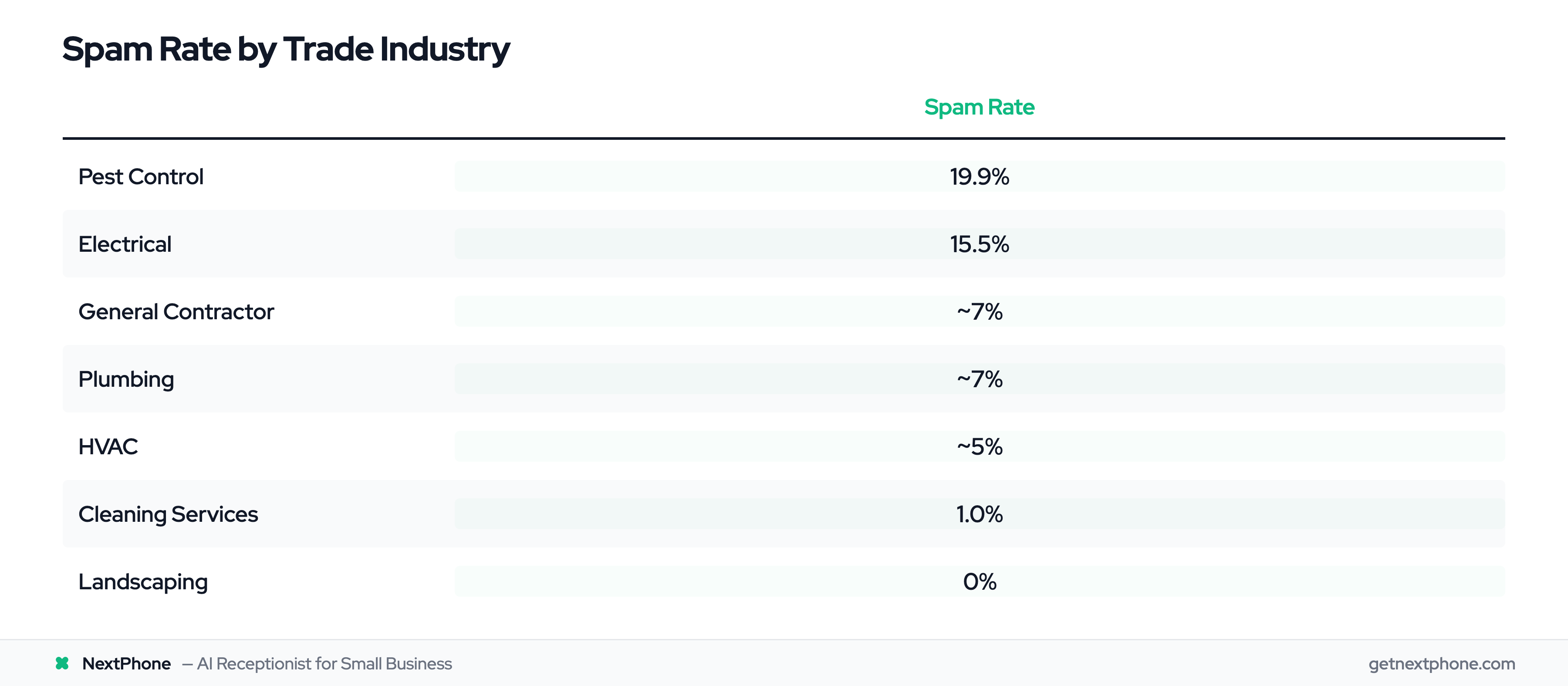
Here's where the data gets interesting. Not all trades face the same spam burden:
| Industry | Spam Rate |
|---|---|
| Pest Control | 19.9% |
| Electrical | 15.5% |
| General Contractor | ~7% |
| Plumbing | ~7% |
| HVAC | ~5% |
| Cleaning Services | 1.0% |
| Landscaping | 0% |
The difference is staggering. If you're an electrician, nearly 1 in 6 calls is spam. If you're a landscaper, you might never get a single spam call.
Why Electricians Get the Most Spam
Electricians and pest control operators face the highest spam rates for specific reasons:
Public licensing requirements: Electrical work requires permits in most jurisdictions. These permit applications include your phone number - and they're often public record.
Licensing databases: State licensing boards maintain searchable databases of licensed contractors. Spammers scrape these lists because they know the numbers are active businesses.
High-value job perception: Lead generation companies specifically target trades with expensive jobs. Roofing, electrical, HVAC - they assume you have money to spend on services.
Repeat targeting: Once your number is on a spam list that shows results (meaning you answered once), it gets flagged as a "live" number and sold to more lists.
Landscapers, by contrast, often operate with fewer public licensing requirements and less visibility in scraped databases. Their numbers simply don't end up on the same lists.
The Real Cost of Spam Calls
Every business owner knows spam calls are annoying. Fewer realize just how expensive they actually are.
It's Not Just 30 Seconds - It's 23 Minutes
Here's the part that most people miss: the real cost of a spam call isn't the 30 seconds you spend on it. It's the 23 minutes after.
Research from UC Irvine found that it takes an average of 23 minutes and 15 seconds to fully refocus after any interruption. Your brain was engaged in complex work - solving a wiring problem, calculating materials, planning a job sequence. The interruption breaks that focus. Getting back to the same level of concentration takes significant time.
This is true for every interruption, but spam calls are particularly damaging because they're entirely worthless. At least when a real customer calls and interrupts you, you might book a job. Spam gives you nothing except lost time.
The Math That Matters
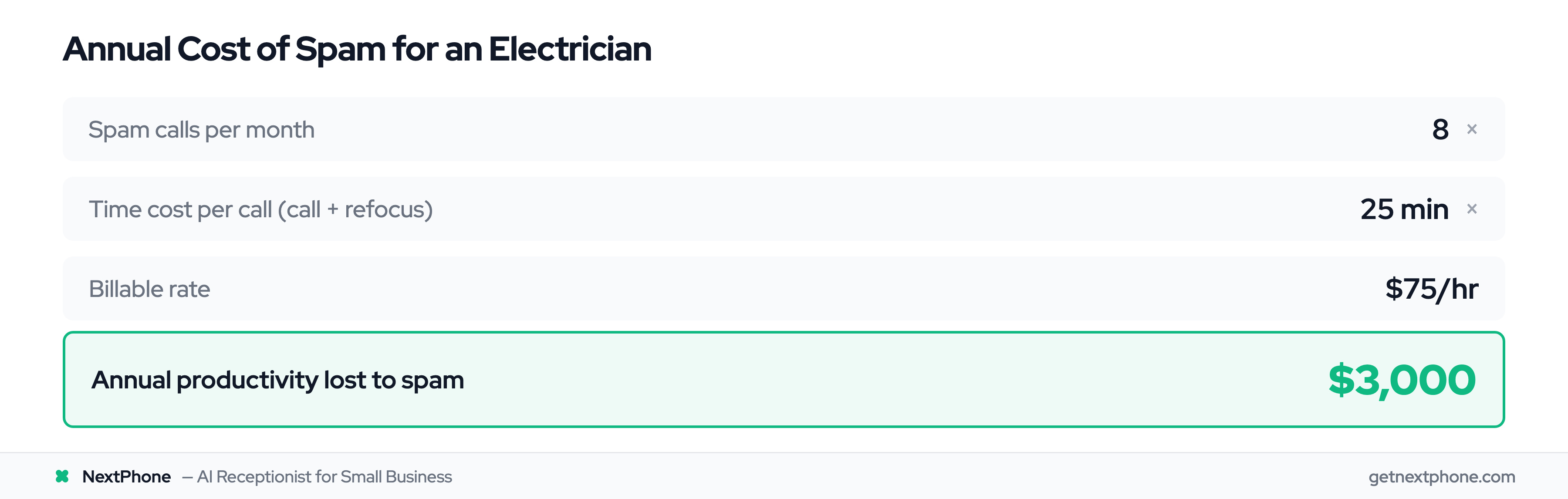
Let's calculate the real cost for a typical electrician:
Monthly call volume: 50 calls Spam rate: 15.5% Spam calls per month: 7.75 (round to 8)
Time per spam call:
- Direct handling: 2-3 minutes (answer, realize it's spam, hang up)
- Refocus time: 23 minutes Total per call: ~25 minutes
Monthly time lost: 8 calls x 25 minutes = 200 minutes = 3.3 hours Annual time lost: 40 hours (an entire work week)
At $75/hour billable rate:
- Monthly cost: $250
- Annual cost: $3,000
That's $3,000 per year in lost productivity - just from spam calls. For a busy electrical contractor, spam is essentially a part-time employee who does nothing but waste your time.
The Hidden Costs
Beyond the math, spam creates costs that don't show up on a spreadsheet:
Mental load: Every time your phone rings, you have to stop and evaluate. Is this a real customer? Should I answer? The constant evaluation is exhausting.
Missed real calls: While you're on a spam call, real customers are getting voicemail. Those 2-3 minutes might cost you a job.
Frustration bleed: Starting your day with three spam calls puts you in a worse mood for the legitimate calls that follow. Customers notice.
Distrust: After enough spam, you start hesitating to answer calls from unfamiliar numbers. Some of those are real customers.
Spam Filtering Solutions Ranked
Not all solutions are created equal. Here's an honest assessment of what works and what doesn't.
The Do Not Call Registry (Barely Works)
Effectiveness: 10-20% Cost: Free Time to set up: 5 minutes
The federal Do Not Call registry was designed for consumers, not businesses. While you can register your business number at donotcall.gov, the results are disappointing.
Legitimate telemarketers might honor it. Scammers ignore it completely. And many business-to-business calls are exempt anyway.
Verdict: Worth doing because it's free and takes 5 minutes, but don't expect much.
Manual Call Blocking (Better Than Nothing)
Effectiveness: 20-30% Cost: Free (built into your phone) Time to set up: Ongoing
Every smartphone lets you block numbers after they call. The problem: spammers use new numbers constantly. Block one, and tomorrow they call from a different number.
Manual blocking only catches repeat offenders. Since most spam comes from rotating or spoofed numbers, you're playing whack-a-mole with limited success.
Verdict: Good for persistent nuisance callers, useless for most spam.
Carrier Spam Filtering (Hit or Miss)
Effectiveness: 40-50% Cost: Free to $10/month Examples: Verizon Call Filter, AT&T Call Protect, T-Mobile Scam Shield
Most carriers now offer spam filtering built into their service. These use massive databases of known spam numbers plus behavioral analysis to identify and block suspicious calls. Advanced fraud prevention like Silent Auth can be 3-5x faster with 8 points higher conversion.
The problem: they're designed primarily for consumer lines. Business numbers behave differently - you receive calls from unfamiliar numbers constantly because customers are supposed to call you. Carrier filters sometimes can't tell the difference between spam and a new customer.
Verdict: Enable it if it's free, but don't rely on it completely.
Third-Party Blocking Apps (Moderate Success)
Effectiveness: 50-60% Cost: $3-10/month Examples: Hiya, RoboKiller, Nomorobo
These apps use crowd-sourced databases and AI analysis to identify spam callers. They're generally more aggressive than carrier solutions and can block or warn you before you answer.
The challenge remains false positives. A new customer calling from a number that was previously flagged (maybe they have a number similar to a spam pattern) might get blocked. For businesses that can't afford to miss legitimate calls, this is a real concern.
Verdict: Better than carrier solutions, but still imperfect.
AI-Powered Call Filtering (Most Effective)
Effectiveness: 95%+ Cost: $199/month (as part of AI receptionist) Time to set up: 10-15 minutes
AI filtering through an answering service takes a fundamentally different approach. Instead of guessing based on phone numbers (which can be spoofed), AI actually answers every call and determines who's calling before you're interrupted.
Here's how it works:
- AI answers: Every incoming call is greeted professionally
- Caller identified: The AI asks who's calling and why
- Intent determined: Is this a customer? A spam call? An emergency?
- Routing decision: Real customers are announced to you; spam is filtered; emergencies get priority
The key difference: blocking apps have to guess based on phone numbers. AI actually talks to the caller and finds out.
Verdict: Only solution that catches nearly all spam while protecting against false positives. The $199/month cost is offset by hours of reclaimed productivity.
Why AI Filtering Works Best
Traditional spam solutions all share the same fundamental problem: they try to identify spam based on the phone number calling you. This is increasingly ineffective because:
- Spammers spoof legitimate-looking numbers
- New spam numbers are created constantly
- Numbers flagged as spam may later belong to real customers
- Business lines receive calls from unfamiliar numbers by design
AI filtering sidesteps all of these issues.
How AI Call Screening Actually Works
When a call comes in, the AI receptionist:
- Answers professionally in your business name
- Engages the caller - asks their name and reason for calling
- Analyzes the response using natural language processing
- Cross-references against spam patterns and known robocall scripts
- Makes a determination - legitimate caller or spam
Spam calls typically fail at step 2 or 3. Robocalls can't respond intelligently to questions. Telemarketers often hang up when they realize they're talking to an AI. Real customers continue the conversation naturally.
Why AI Doesn't Block Real Customers
The fear with any spam solution is: "What if it blocks a real customer?"
AI filtering essentially eliminates this concern because it doesn't block - it screens.
Every caller gets answered. Every caller gets a chance to identify themselves. Only after the AI confirms a call is spam does it get filtered out.
Real customers are announced to you with context: "John from Smith Construction calling about a kitchen remodel estimate." You can pick up immediately or let AI take a message.
Emergency calls are detected through urgency language - "urgent," "emergency," "flooding," "no power" - and get priority routing to your phone instantly.
The system identifies the 7% spam without touching the 93% legitimate calls.
The Transformation
Before AI filtering, an electrician with a 15.5% spam rate deals with:
- 8 spam calls per month
- 3+ hours of lost time
- $250/month in lost productivity
- Constant interruptions and frustration
After AI filtering:
- 0 spam interruptions (AI handles them all)
- 3+ hours reclaimed for billable work
- $250/month in recovered productivity
- Phone only rings for real customers
The $199/month cost pays for itself before month's end - just in reclaimed productivity, before counting any additional jobs booked.
How to Get Started Today
You don't need to implement everything at once. Start with the free options and escalate if needed.
Quick Wins You Can Do Right Now (Free)
Today:
- Register on donotcall.gov (5 minutes) - Might reduce spam 10-20%
- Enable carrier spam filtering (5 minutes) - Check your carrier's app
- Block the last 10 spam numbers you remember (10 minutes) - Catches repeat offenders
- Download a spam ID app (5 minutes) - At least you'll know before answering
- Note which numbers are spam this week (ongoing) - Helps identify patterns
Total time: About 30 minutes
These won't solve the problem completely, but they'll reduce spam volume somewhat and help you understand your specific spam situation.
When Free Solutions Aren't Enough
Consider upgrading to AI filtering if:
- You're in a high-spam industry (electrical, pest control, HVAC)
- Getting more than 5 spam calls per week
- Current solutions aren't working
- Can't afford interruptions during jobs (contractors, technicians)
- Want automatic protection without ongoing effort
- Time lost to spam is costing real money
For an electrician losing 40 hours per year to spam, a $199/month solution that eliminates the problem completely is an obvious investment.
Setting Up AI Filtering
The process is straightforward:
- Forward your business line to the AI receptionist number
- Customize your greeting and business information (10 minutes)
- Set routing rules - who gets what types of calls
- Start receiving filtered calls - spam handled, real customers announced
From day one, every call is screened. Spam never reaches you. Customers are announced with context. Emergencies get priority.
No ongoing management required. The AI learns and improves automatically.
Frequently Asked Questions
What percentage of business calls are spam?
On average, about 7% of all incoming business calls are spam or robocalls. However, this varies dramatically by industry - electricians see 15.5% spam rates while landscaping businesses report almost none. Your actual spam rate depends on how publicly your number is listed and what industry you're in.
Will spam filtering block my real customers?
Traditional call blocking apps can occasionally block legitimate calls because they rely on phone number databases that aren't always accurate. AI-powered filtering is different - it actually answers and engages with every caller before making a determination, ensuring real customers always get through while spam gets filtered out.
Why do electricians get so many spam calls?
Electricians face 15.5% spam rates - the second-highest among trades - because their phone numbers appear on public permit records and licensing databases. Lead generation companies scrape these lists and resell them repeatedly. The combination of publicly required licensing and high-value jobs makes electricians prime targets.
Does the Do Not Call registry work for businesses?
The Do Not Call registry has limited effectiveness for businesses - it might reduce spam by 10-20% at best. Many spam callers operate illegally and ignore the registry entirely, while others claim exemptions for "business-to-business" calls. It's worth registering since it's free, but don't expect it to solve the problem.
How much time do spam calls actually waste?
Each spam call costs far more than the 30 seconds you spend on it. Research from UC Irvine shows it takes 23 minutes to fully refocus after any interruption. For a contractor getting 8 spam calls per month, that's 3+ hours of lost productive time - worth $200-300 at typical billable rates.
What's the best spam call blocker for contractors?
For contractors who can't afford interruptions during jobs, AI-powered filtering is the most effective solution. Unlike apps that just block numbers, AI answers every call and determines if it's spam or a real customer. This eliminates spam interruptions completely while ensuring you never miss a legitimate job inquiry.
Conclusion
Spam calls aren't just annoying - they're actively stealing time and money from your business. Every robocall that interrupts your work costs you 23+ minutes of focused productivity. For high-spam industries like electrical and pest control, that adds up to 40+ hours per year - an entire work week - lost to calls that provide zero value.
The free solutions help marginally. The Do Not Call registry might cut spam by 10-20%. Carrier filtering catches maybe half. But for businesses that can't afford constant interruptions, only AI filtering truly solves the problem.
AI doesn't guess based on phone numbers. It answers every call, talks to the caller, and makes an intelligent determination. Spam gets filtered. Real customers get answered professionally. Emergencies get priority routing. You get your time back.
For contractors in high-spam industries, the math is simple: 3+ hours of reclaimed productivity per month is worth far more than $199. The spam stops. The interruptions end. Your phone only rings when it actually matters.
Ready to stop wasting time on spam? See how NextPhone automatically filters spam calls while ensuring every real customer gets answered professionally - for just $199/month, no hidden fees, no per-minute charges.