Business Missed Call Solutions: 4 Ways to Stop Losing Customers

17 min read
Yanis Mellata
AI Technology

Introduction

A homeowner's water heater just failed. Water is pooling on the basement floor. They grab their phone and search for a plumber, then call the first result. Four rings. Five rings. Voicemail.

They don't leave a message. They call the next plumber on the list.

Someone answers.

Twenty minutes later, they have a plumber scheduled for that afternoon. You lost a $1,500 job and never even knew the opportunity existed.

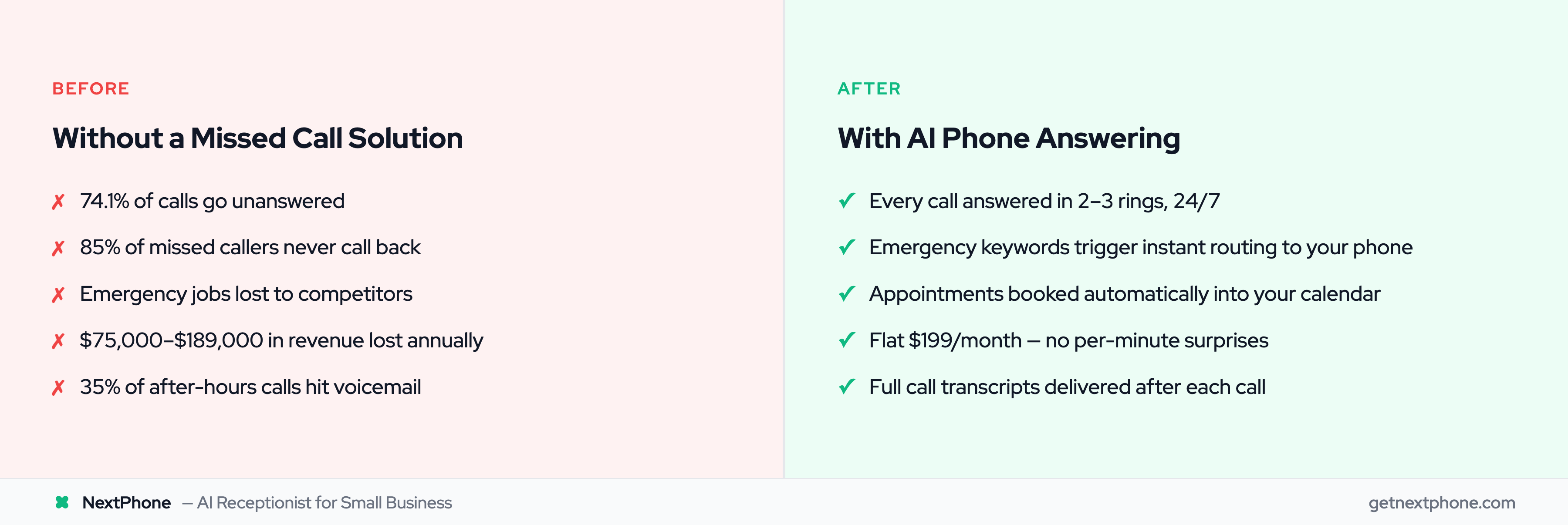
This scenario plays out thousands of times every day across small businesses. Our analysis of 13,175 customer calls from 45 home services contractors revealed that 74.1% of calls go completely unanswered. That's nearly three out of every four potential customers hitting voicemail and moving on.

The data on what happens next is brutal: 85% of callers won't call back if they don't reach someone on the first try. They'll simply call your competitor instead.

Finding the right business missed call solution can transform your revenue. In this guide, we'll compare four approaches: call forwarding, enhanced voicemail, live answering services, and AI phone answering. You'll see the real costs, honest pros and cons of each, and a framework for choosing what fits your situation.

The True Cost of Missing Business Calls

Missed calls aren't just an inconvenience. They're direct revenue walking out your door.

According to research from Ruby Receptionist, the average small business loses $75,000 or more annually to missed calls. For service businesses like contractors, plumbers, and electricians, our data suggests the number is even higher, often exceeding $189,000 per year.

The math is simple but devastating:

  • 62% of customers will call a competitor if their first call goes unanswered
  • 35% of calls come in after hours when nobody's available
  • Emergency and urgent calls (the highest-margin work) can't wait for callbacks

When You're Losing the Most Calls

Most businesses don't realize when they're hemorrhaging opportunities. The calls you miss aren't evenly distributed:

On job sites: Contractors, technicians, and service professionals are physically doing the work. You can't answer when you're on a ladder, under a sink, or in a client meeting.

During appointments: Medical offices, legal practices, and consultants are with patients or clients. Interrupting them to answer the phone isn't professional.

Rush hours: Restaurants, retail, and high-volume businesses have predictable busy periods where calls stack up faster than staff can handle them.

After hours: 35% of calls arrive outside normal business hours. For most small businesses, that's 35% of opportunities going directly to voicemail.

The Customers You're Losing

Not all missed calls are equal. The ones you're most likely to miss are often the most valuable:

Emergency jobs: Water heater failures, AC units dying in summer heat, burst pipes. These customers need help NOW, not in two hours when you check voicemail. They're also willing to pay premium rates.

New customers: Someone calling for the first time won't wait. They're hot leads who searched, found you, and decided to call. If you don't answer, they'll find someone who does.

Quote requests: These callers are ready to buy. They want pricing. They want to schedule. Every unanswered quote request is a job going to your competition.

Referrals: When an existing customer refers someone, that referral expects a similar experience. If they can't reach you, your reputation takes a hit.

Solution 1: Call Forwarding to Your Cell Phone

The simplest business missed call solution is routing your business line to your mobile phone when you can't answer. Most phone systems and VoIP providers include this feature for free or minimal cost.

How It Works

When your main business line rings without an answer (usually after 3-4 rings), the call forwards to your cell phone. You answer personally, wherever you are.

Cost: Typically free with existing phone plans, or $10-20/month for advanced features like simultaneous ring or sequential forwarding through multiple numbers.

The Pros

No added cost. If you're using basic forwarding, it's likely already included in your phone service. You're not paying anything extra.

Personal touch. When you answer, customers are talking to the business owner or a real team member. Some customers genuinely prefer this.

Simple setup. Log into your phone admin, set the forwarding number, and you're done in five minutes.

Uses existing technology. No new apps to install, no new systems to learn. Just your cell phone.

The Cons

Only works if you can answer. This is the fatal flaw. Call forwarding doesn't solve the problem; it just moves it. If you're on a roof, under a car, or in a meeting, you still miss the call.

Work-life boundaries disappear. Your business line now rings at 10 PM, during dinner, on vacation. You become the 24/7 solution, which isn't sustainable.

Single point of failure. If you're busy, sick, or unavailable, there's no backup. Every call to you that you can't take is still a missed call.

Doesn't scale. As your business grows and call volume increases, you can't personally answer 50+ calls a day while also doing your actual job.

Best For

Call forwarding works for side hustles with minimal call volume, businesses where a second person can take forwarded calls, or as a temporary solution while you evaluate better options.

Solution 2: Enhanced Voicemail with Transcription

A step up from basic voicemail, enhanced voicemail services provide professional greetings, transcription to email or text, and better organization of messages.

How It Works

When calls go to voicemail, the message is recorded, transcribed, and sent to your email and/or phone as a text message. You can respond to messages faster because you're reading them instead of listening.

Cost: $5-25/month depending on provider. Google Voice offers basic transcription free. Services like Grasshopper charge $29/month with additional features.

The Pros

Very affordable. At $10-25/month, it's one of the cheapest upgrades you can make.

Instant transcription. No more listening to rambling voicemails. Read the transcript, respond to the urgent ones first.

Professional greetings. Record different greetings for business hours versus after hours. Sound more professional.

Low effort. Setup takes 15-30 minutes. Minimal ongoing maintenance.

The Cons

85% of callers won't leave a voicemail. This is the fundamental problem. Enhanced voicemail only helps with the 15% who actually leave messages. The other 85% hang up and call someone else.

Reactive, not proactive. You're still calling people back hours later. By then, many have already hired your competitor.

No real interaction. The caller didn't get help. They got a recording. That's not a customer service experience.

Can't book appointments. Someone wants to schedule service for tomorrow. They have to leave a message, wait for a callback, and hope you have availability. That's friction that loses customers.

Emergencies treated the same as routine calls. A burst pipe voicemail sits in your inbox alongside a routine question. No prioritization.

Best For

Enhanced voicemail works for businesses where existing customers are the primary callers (they'll leave messages), as a backup to other solutions, or for extremely tight budgets where even $100/month isn't feasible.

The reality: slightly better voicemail is still voicemail. You're still losing 85% of first-time callers who won't leave a message.

Solution 3: Live Answering Service (Human Operators)

For businesses willing to invest more, live answering services provide real humans who answer your phones 24/7, following scripts you create.

How It Works

Your calls forward to a call center. Trained operators answer as if they're at your business, using your company name and following your scripts. They take messages, answer basic questions, and route urgent calls to you.

The Pros

Real humans. Many customers still prefer talking to a person. Live answering services provide that experience.

Handle complex conversations. Unlike voicemail, operators can have back-and-forth conversations, ask clarifying questions, and genuinely help callers.

Empathy when needed. Upset or frustrated callers benefit from human understanding. A skilled operator can de-escalate and turn a complaint into a positive experience.

24/7 coverage available. Most services offer round-the-clock availability, so you never miss after-hours calls.

The Cons

Expensive. This is where live answering services break down for small businesses. Expect to pay:

  • Base fee: $200-400/month
  • Per-call or per-minute charges: $1-6 per call or $1-2 per minute

Real cost example: Ruby Receptionists charges $319/month base plus $5.19 per call. At 50 calls/month, you're paying $579/month ($6,948/year). At 100 calls/month, it's $838/month ($10,056/year).

Script limitations. Operators don't truly know your business. They follow scripts. Ask them something off-script, and they take a message.

Quality varies wildly. Some services are excellent. Others have undertrained operators, long hold times, and poor experiences that damage your brand.

Per-minute charges add up. Storm season hits and your call volume spikes? Your bill spikes too. There's no predictability.

Best For

Live answering services work for businesses where every call is potentially high-value ($10,000+ per client, like legal or medical), where human empathy is essential to the service, and where budgets can support $500+/month for phone coverage.

Solution 4: AI Phone Answering (Virtual Receptionist)

The newest business missed call solution uses artificial intelligence to answer calls, have natural conversations, and handle most routine interactions without human involvement.

How It Works

AI-powered phone systems answer calls within 2-3 rings, 24/7. Using natural language processing, the AI understands what callers need, answers common questions, books appointments directly into your calendar, and routes urgent calls to your phone immediately.

The technology has advanced dramatically. Today's AI sounds natural, understands conversational speech, and handles the majority of routine calls without callers realizing they're not speaking to a human.

The Pros

24/7/365 coverage at a flat rate. Every call answered, day or night, with no additional charges for after-hours coverage.

No per-minute fees. This is huge. Whether you get 10 calls or 1,000 calls, your cost stays the same. Busy seasons don't blow up your budget.

Instant answers. AI picks up in 2-3 rings and responds immediately. No hold times, no "let me transfer you," no waiting.

Learns your business. AI is trained on your specific services, pricing, hours, and FAQs. It answers with accurate information, not generic scripts.

Automatic appointment booking. "I need someone Thursday afternoon." AI checks your calendar, books 2:30 PM, sends confirmation. Done in 60 seconds without your involvement.

Emergency detection. AI recognizes urgency keywords ("flooding," "no heat," "sparks") and routes those calls to your phone immediately. Routine calls become messages; emergencies reach you.

Infinite scalability. Same price for 10 or 1,000 calls. As your business grows, your phone system grows with it at no additional cost.

Data and analytics. Every call is logged and transcribed. You can see patterns, common questions, peak call times, and more.

The Cons

Can't handle truly complex situations. AI has limits. Complex troubleshooting, nuanced negotiations, or situations requiring judgment get routed to you.

Some caller skepticism. A small percentage of callers prefer humans and may react negatively to AI. Good AI handles this by offering human callback options.

Initial setup required. You need to train the AI on your business specifics. This typically takes 1-3 hours initially, with refinement over the first week.

The Cost Comparison

NextPhone AI Answering: $199/month for unlimited calls.

Compare that to live answering at 50 calls/month:

  • NextPhone: $199/month = $2,388/year
  • Ruby: $579/month = $6,948/year

At 100 calls/month:

  • NextPhone: $199/month (still) = $2,388/year
  • Ruby: $838/month = $10,056/year

The more calls you receive, the more AI answering saves.

Best For

AI phone answering works for service businesses that miss calls while on jobs, businesses needing 24/7 coverage without 24/7 cost, high call volumes where per-minute charges become prohibitive, any business with predictable/definable emergency scenarios, and cost-conscious owners who want premium coverage at reasonable rates.

The Hybrid Approach

The most effective implementation uses AI + humans together. AI handles the 60-70% of calls that are routine: questions about hours, service areas, basic pricing, appointment booking. You handle the 20-30% that need expertise: complex quotes, technical troubleshooting, upset customers. Emergencies (5-10%) route to you immediately.

Choosing the Right Business Missed Call Solution

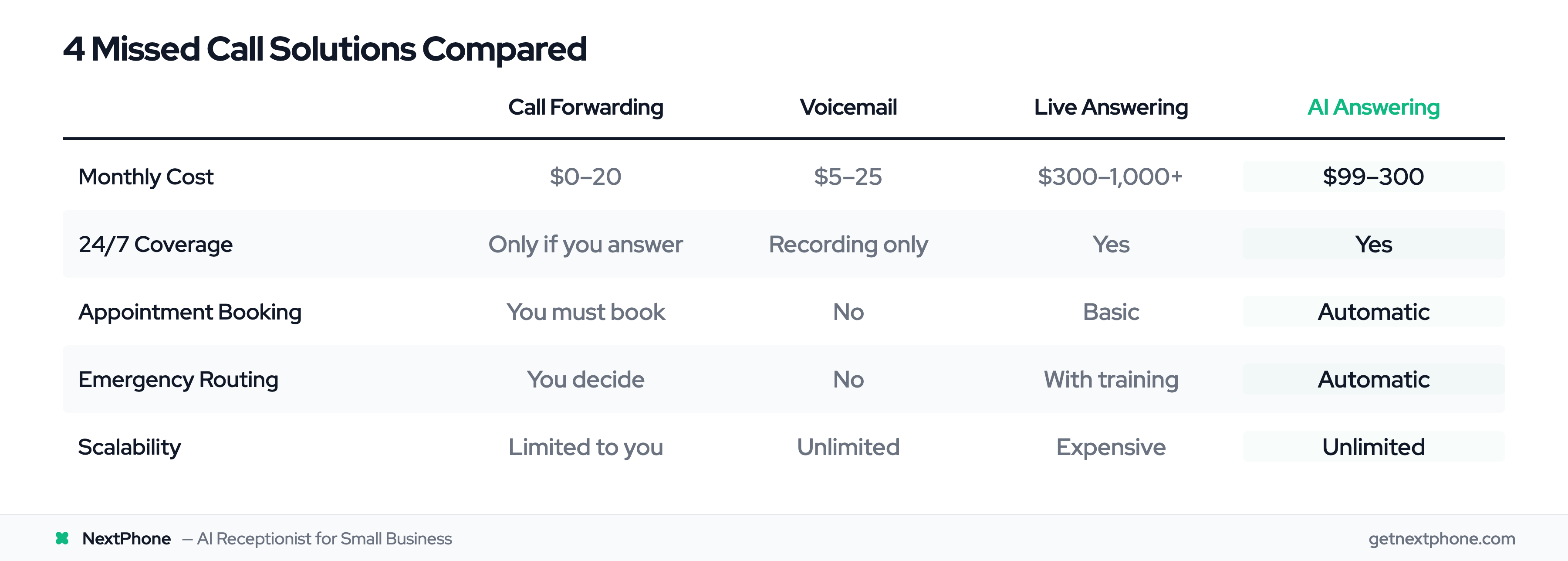
Here's a direct comparison to help you decide:

FeatureCall ForwardingVoicemailLive AnsweringAI Answering
Monthly Cost$0-20$5-25$300-1,000+$99-300
24/7 CoverageOnly if you answerRecording onlyYesYes
Real ConversationsYou personallyNoYesYes
Appointment BookingYou must bookNoBasicAutomatic
Emergency RoutingYou decideNoWith trainingAutomatic
ScalabilityLimited to youUnlimitedExpensiveUnlimited
Setup Time5 minutes15 minutes1-2 weeks1-2 hours

Choose Call Forwarding If...

  • You have very low call volume (under 10 calls/week)
  • You can personally answer most calls
  • Your budget is extremely limited
  • You have a reliable backup person to take forwarded calls

Choose Enhanced Voicemail If...

  • Your callers are primarily existing customers who will leave messages
  • You only need after-hours backup for your current system
  • Budget is very tight and you're okay losing some callers
  • You're already using it as part of your phone system

Choose Live Answering If...

  • Every call is potentially high-value ($10,000+)
  • Human empathy is essential to your service (therapy, legal, medical)
  • Your budget comfortably supports $500+/month
  • Most of your calls are complex and require human judgment

Choose AI Answering If...

  • Missing calls is costing you real money
  • You need 24/7 coverage without 24/7 cost
  • You want predictable monthly expenses (no per-minute surprises)
  • You're a service business with definable scenarios
  • You value efficiency and instant response
  • Call volume is growing and you want a scalable solution

For most small businesses, AI answering offers the best combination of coverage, capability, and cost. It solves the missed call problem without breaking the budget or requiring you to be personally available around the clock.

How to Get Started with Each Solution

Implementation doesn't have to be complicated. Here's what's involved for each approach:

Call Forwarding

  1. Log into your phone or VoIP admin panel
  2. Set forwarding rules (after X rings, forward to cell)
  3. Test by calling your business number 4. Time: 5-10 minutes

Enhanced Voicemail

  1. Choose a provider (Google Voice, Grasshopper, etc.)
  2. Set up your account and record professional greetings
  3. Configure email/SMS notifications for new messages 4. Time: 15-30 minutes

Live Answering

  1. Research and compare services (read reviews carefully)
  2. Develop detailed call handling scripts
  3. Complete onboarding and training with the service
  4. Monitor call quality regularly 5. Time: 1-2 weeks typically

AI Answering

  1. Connect your phone system (forward your number or port it)
  2. Train the AI on your business basics (hours, services, pricing)
  3. Set up emergency keywords for your industry
  4. Configure calendar integration for appointment booking
  5. Test thoroughly before going live 6. Time: 1-2 hours for initial setup, refinement over first week

How NextPhone Solves Missed Calls for Small Businesses

NextPhone was built specifically for service businesses where missed calls mean missed revenue. We analyzed over 13,000 real customer calls to understand exactly what small businesses need.

What You Get

$199/month, unlimited calls. That's it. No per-minute charges. No setup fees. No contracts.

Included:

  • 24/7/365 AI answering
  • Emergency call routing to your phone
  • Calendar integration (Google, Outlook, Apple)
  • Call transcripts and summaries via email/SMS
  • Custom training on your business
  • Spam filtering
  • 7-day free trial

Real Results

NextPhone handles over 45,000 customer calls daily. Our average customer captures jobs worth $189,000/year that they were previously missing. At $2,388/year cost, that's an ROI that pays for itself many times over.

Setup takes 1-2 hours. Most businesses are live the same day.

Stop Losing Customers to Missed Calls

Every missed call is a potential customer choosing your competitor. The good news: it's a solvable problem.

You have four options: 1. Call forwarding - Free but limited to when you can personally answer

2. Enhanced voicemail - Cheap but 85% of callers won't leave messages

3. Live answering - Human touch but expensive and variable quality

4. AI answering - 24/7 coverage, predictable cost, handles most calls automatically

For most small businesses, AI phone answering delivers the best value: full coverage at a fraction of what you'd pay for live answering, with automatic emergency routing, appointment booking, and infinite scalability.

The cost of doing nothing is steep. At $75,000+ lost annually to missed calls for the average small business, the math is clear. One captured job pays for months of an AI solution.

Ready to Stop Missing Customer Calls?

Try NextPhone's AI receptionist free for 7 days. See how other small businesses are capturing more leads 24/7.

Get Started
. No contracts, cancel anytime. See how many calls you're actually missing, and start capturing them instead.

Frequently Asked Questions

What's the best business missed call solution for contractors?

For contractors who are on job sites and physically can't answer their phones, AI phone answering typically provides the best value. It answers every call 24/7 at a flat rate, routes emergencies immediately to your cell, and books appointments directly into your calendar. Call forwarding only works when you can answer, and live answering gets expensive quickly at $5+ per call.

How much does a business miss from unanswered calls?

According to industry research, the average small business loses $75,000 or more annually to missed calls. For service businesses, our analysis of 13,175 calls suggests the number can exceed $189,000 per year. With 85% of callers not leaving voicemails and 62% calling a competitor when they don't reach someone, each missed call represents significant lost revenue.

Is AI phone answering as good as a human receptionist?

For routine calls (60-70% of volume), AI handles them just as well or better than humans: faster answers, 24/7 availability, and consistent accuracy. For complex situations, AI routes to humans rather than attempting to handle them poorly. The hybrid approach gives you AI efficiency for routine work and human judgment for complex needs.

How quickly can I set up an AI phone answering system?

Most AI phone answering solutions can be set up in 1-2 hours. You connect your phone system (usually via call forwarding), train the AI on your business basics, configure emergency keywords, and integrate your calendar. NextPhone customers typically go live the same day they sign up, with refinement happening over the first week as the AI learns your specific patterns.

What happens when AI can't handle a call?

Good AI systems recognize their limitations. When a call is too complex, involves an upset customer, or contains emergency keywords, the AI takes one of two actions: routes the call immediately to your phone (for emergencies) or takes a detailed message and sends it to you for callback (for complex situations). The caller gets help or a clear path to human assistance.

AI Customer Service: The Complete 2025 Guide for Small Businesses

Learn how AI customer service works, what it costs, and why small businesses are using it to capture more leads. Real data from 13,175 calls analyzed.

AI Receptionist Pricing: Complete 2025 Cost Guide

Complete breakdown of AI receptionist costs, from budget solutions to full-service platforms, with ROI calculations and pricing comparisons.

Virtual Receptionist Services: Complete Business Guide

Everything you need to know about virtual receptionist services: how they work, what they cost, and how to choose the right one for your business.

How Does an AI Receptionist Work?

A clear explanation of the technology behind AI receptionists, from natural language processing to emergency detection and calendar integration.

SEO Optimization: Primary keyword in title, H1, first paragraph, meta title/description, URL slug. Related keywords distributed throughout. Comparison table for featured snippet potential.

Related Articles

Yanis Mellata

About NextPhone

NextPhone helps small businesses implement AI-powered phone answering so they never miss another customer call. Our AI receptionist captures leads, qualifies prospects, books meetings, and syncs with your CRM — automatically.