
Friday, 6:15 PM. Your phone rings. A customer needs their AC fixed Monday morning—wants to book an appointment right now. You're wrapping up a job, hands dirty, can't get to the phone. The call goes to voicemail.
They call the next HVAC company. You just lost a $400 service call.
This scenario plays out constantly across small businesses. Industry research shows 7.7% of customer service calls are appointment scheduling requests. With 74.1% of calls going completely unanswered, you're losing multiple appointments every single week to competitors who simply answered first.
This guide shows exactly how AI appointment scheduling captures these calls automatically—the technology behind it, real costs with ROI calculations, and which businesses benefit most. You'll see actual data from thousands of scheduling calls and learn how to stop losing appointments to voicemail.
What Is AI Appointment Scheduling?
AI appointment scheduling goes far beyond those "book a time" calendar links you've seen on websites. This AI virtual receptionist technology actively handles incoming booking requests from any channel—phone calls, texts, web forms, even emails—and books them into your calendar automatically.
Here's the critical difference: A Calendly link requires your customer to visit your website, click through to find the booking page, scroll through available times, and submit the form. That's fine if they're already on your computer.
The scheduling software market is projected to reach $1.5B by 2032. ChiliPiper research shows 66.7% of qualified forms book meetings versus 30% industry average, with live call options achieving 69.2% form-to-meeting conversion. But what about the 54% of customers who prefer calling to book appointments? They want to talk to someone, ask a question, and book on the spot. If no one answers, they're calling your competitor.
How AI Differs from Traditional Scheduling
Traditional online booking is passive. You put a link somewhere, hope customers find it, and cross your fingers they follow through. Manual scheduling means someone physically answers calls, checks the calendar, writes down the appointment, and confirms it—eating up hours each week.
AI appointment scheduling is active. When someone calls and says "I need an appointment Tuesday," the AI responds conversationally: "I can help you schedule. What service do you need?" Customer says "AC repair." AI checks your calendar in real-time and replies "I have Tuesday at 2 PM or Thursday at 10 AM available. Which works better?"
The customer chooses. The AI books it instantly. Confirmation text goes out immediately. The appointment appears in your calendar with all the customer details. Done in 30 seconds.
The Phone-First Reality
Here's what most scheduling software companies won't tell you: According to Zendesk's 2024 customer service trends report, 54% of customers still prefer calling to book appointments versus 46% who prefer online booking forms.
For home services especially, that percentage is even higher. Contractors working on job sites can't navigate booking forms on their phones between tasks. Medical patients calling their doctor prefer talking to someone. When someone's water heater is leaking, they're calling—not filling out forms.
Industry research shows 7.7% of all customer service calls are scheduling or appointment requests. If your business gets the industry average of 42 calls per month, that's 3.2 scheduling calls monthly. With 74.1% of calls going unanswered, you're missing 2.4 appointments every single month.
That's where AI changes everything. It answers the phone in 2-3 rings, handles the booking conversation naturally, and confirms the appointment—whether it's 2 PM on Tuesday or 11 PM on Friday.
What AI Appointment Scheduling Actually Does
Modern AI scheduling platforms integrate with your existing calendar—Google Calendar, Outlook, iCal—and sync availability in real-time. When a scheduling request comes in, the AI:
- Understands the request using natural language processing (NLP)
- Checks your calendar for available time slots
- Offers options to the customer
- Books the confirmed time immediately
- Sends confirmation via text and email
- Adds the appointment to your calendar with customer details
- Sets up automated reminders to reduce no-shows
Google Calendar has 500M+ users, with 95% of G Suite businesses relying on it. According to Gartner, 80% of customer service organizations will apply AI technology by 2025. Appointment scheduling is one of the fastest-growing use cases because it's repetitive, time-consuming, and costly when done wrong.
The Hidden Cost of Missed Scheduling Calls
Let's talk about what you're actually losing when scheduling calls go to voicemail.
How Many Scheduling Calls Are You Missing?
Industry research shows 7.7% of customer calls are scheduling or appointment requests. That might sound small, but the math adds up fast.
If you're getting 42 calls per month (the industry average for small businesses), that's 3.2 scheduling calls. With 74.1% of calls going unanswered, you're missing 2.4 appointments monthly.
At an average service call value of $400, that's $960 per month in lost revenue. Over a year? $11,520 walking out the door because the phone rang at the wrong time.
Research from Business News Daily found that 47% of small businesses report losing appointments specifically due to phone calls going unanswered. You're not alone in this problem—but you don't have to accept it as inevitable.
The Math on Lost Appointments
Here's a real example from our analysis of customer service calls:
"Wants to schedule service for a leaky toilet, asking about your availability for tomorrow."
That's a straightforward booking request. Customer has a problem, wants it fixed tomorrow, ready to schedule. If that call goes to voicemail, they're calling the next plumber. You lose a $350-500 service call because you were busy with another customer.
Another example: "Wants to schedule an appointment for heating electrical service and requested a callback."
This customer is polite—they'll wait for a callback. But industry data shows 25.4% of callers request callbacks, and without a tracking system, many never get returned. Even when you do call back, it becomes phone tag. Meanwhile, they've already booked with someone else.
One more: "Needs to schedule T&M for roof patch within the next 5 business days."
Flexible timeline, but still time-sensitive. This customer is calling multiple contractors to see who can fit them in first. The contractor who answers immediately gets the job. The one checking voicemail three hours later gets nothing.
Let me show you the revenue impact with specific calculations:
Small Service Business (HVAC, Plumbing, Electrical):
- 42 calls/month (average)
- 7.7% are scheduling requests = 3.2 scheduling calls
- 74.1% missed = 2.4 appointments lost monthly
- $400 average service call
- Lost revenue: $960/month = $11,520/year
You're leaving $11,520 on the table annually because scheduling calls go unanswered.
After-Hours and Weekend Scheduling Loss
Here's the scenario that kills small businesses: Friday evening, 6:30 PM. Customer calls needing a Monday morning appointment. No one's in the office. Call goes to voicemail.
Saturday morning, 9 AM. Another customer calls wanting to schedule for next week. No one works weekends. Voicemail again.
Patient self-scheduling adoption surged 30% YoY. Software Advice's 2024 research found that 68% of customers prefer businesses that offer 24/7 appointment booking capabilities. They're not asking you to work 24/7—they're asking for the ability to book whenever it's convenient for them.
62% of home service companies say finding clients is their biggest challenge, and 94% of customers are more likely to book if online scheduling is available. The Healthcare Contact Center Survey 2024 shows similar patterns in medical scheduling. After-hours calls represent high-intent customers. They need help urgently, or they're planning ahead outside normal business hours. Either way, they're motivated to book. If your system can't capture that appointment immediately, someone else's will.
The Callback Problem (25.4% Request Follow-Up)
Our analysis of customer service calls shows 25.4% of callers explicitly request callbacks. That's one in four people saying "please call me back" or "have them return my call."
Many of these are scheduling-related: "Wants you to call them back about scheduling an estimate" or "Requested callback to set up an appointment."
Without an AI system tracking these requests, what happens? The receptionist writes it down on a sticky note that gets lost. The office manager forgets. The contractor sees it three days later. By then, the customer has moved on.
97% of studies show reminders improve attendance, with reminders reducing no-shows by 34%, and 88% of healthcare leaders use automated reminders. Each unreturned callback isn't just a lost appointment—it's a damaged relationship. That customer called you first. You didn't call back. They remember that.
See how AI answers every call and tracks callback requests automatically.
How AI Appointment Scheduling Works
The technology behind AI scheduling sounds complex, but the experience is simple. Here's what happens behind the scenes when someone calls to book an appointment.
Natural Language Processing (Understanding Requests)
Natural language processing (NLP) is the AI capability that understands how humans actually talk. Not robotic commands like "schedule appointment Tuesday 2 PM," but real conversational requests like "Can I get someone out there Tuesday afternoon?"
Google AI Research shows modern NLP achieves 92% accuracy in understanding appointment booking requests. The AI recognizes intent even when phrasing varies wildly:
- "I need an appointment Tuesday"
- "Can you come out Tuesday?"
- "What's your availability Tuesday?"
- "Book me for Tuesday if you can"
- "Tuesday work for you?"
All mean the same thing: Customer wants Tuesday. The AI gets it.
The technology also detects urgency. There's a huge difference between "I need my water heater fixed today" and "I want an estimate for a new roof sometime next week." The AI recognizes urgency keywords—today, urgent, ASAP, emergency, now—and handles those requests differently.
Calendar Integration and Availability Checking
Once the AI understands what the customer wants, it checks your calendar in real-time. This isn't a static calendar that updates once per day—it's live two-way synchronization with your Google Calendar, Outlook, or other calendar system.
If you block off 2-4 PM for an existing job, the AI sees that immediately. It won't offer that time slot to the next caller. If someone books an appointment at 10 AM, your calendar updates instantly. Two minutes later, another customer calls asking for that same time—the AI says it's no longer available and offers alternatives.
Here's how a typical conversation flows:
Customer: "I need my water heater fixed tomorrow afternoon."
AI: "I can help you with that. I have 2 PM and 4 PM available tomorrow. Which works better for you?"
Customer: "2 PM works."
AI: "Perfect, you're booked for 2 PM tomorrow for water heater repair. I'm sending you a confirmation text right now with the details."
Total time: 30 seconds. No hold music, no "let me check the schedule," no calling you back later.
Booking Confirmation and Notifications
The moment a customer confirms a time, several things happen automatically:
- The appointment is added to your calendar with customer name, phone number, service type, and any notes
- A confirmation text goes to the customer immediately: "Your appointment is confirmed for Tuesday, Jan 23 at 2 PM for water heater repair. Reply CANCEL to cancel or RESCHEDULE to change."
- A confirmation email follows with more details
- The appointment is logged in your CRM if you have one connected
- Automated reminders are scheduled (typically 24 hours before and 2 hours before)
Online scheduling reduces no-show rates in healthcare, and AI can predict no-shows to reduce hospital costs. Each prevented no-show is $200-400 in recovered revenue.
Research from Solutionreach shows automated appointment reminders reduce no-shows by 29% compared to manual reminders.
Integration with Existing Systems
The beauty of modern AI scheduling is it works with what you already use. You don't need to change your calendar system, abandon your CRM, or switch phone providers.
Most AI scheduling platforms integrate with:
- Calendars: Google Calendar, Outlook, iCal, Apple Calendar
- CRM systems: Salesforce, HubSpot, Zoho, Pipedrive
- Phone systems: Any VoIP provider, traditional phone lines with call forwarding
- Communication: Twilio for texts, SendGrid for emails, Slack for team notifications
Setup typically takes a few hours, not weeks. You connect your Google Calendar via OAuth (one click), configure your appointment types, set your availability, and you're live.
See how NextPhone integrates with your systems for specific integration details.
6 Benefits of AI Appointment Scheduling
Beyond just "automating scheduling," AI appointment systems deliver measurable business benefits. Here are six backed by data.
1. 24/7 Availability (Never Miss After-Hours Bookings)
Software Advice's research found that 68% of customers prefer businesses that offer 24/7 appointment booking capabilities. Your competitors might not answer at 8 PM on Friday or 10 AM on Sunday. If your AI does, you get those bookings by default.
After-hours scheduling calls represent motivated customers. They're not browsing—they have a problem or they're planning ahead during their own free time. Capture these calls and you're filling your schedule while competitors are offline.
Real example from our call data: "Needs a water heater replaced tomorrow afternoon at 3:30 PM" came in at 7:42 PM on a Thursday. The customer needed someone Friday afternoon. An AI system books it immediately. A traditional office doesn't see that voicemail until Friday morning—by which point the customer has called three other companies and booked the first one that answered.
2. Reduce No-Shows by 29%
Solutionreach's study found automated appointment reminders reduce no-shows by 29% compared to manual reminders or no reminders at all.
AI scheduling systems send automatic reminders at strategic times:
- 24 hours before: "Reminder: You have an appointment tomorrow at 2 PM for AC repair. Reply CONFIRM or CANCEL."
- 2 hours before: "Your appointment is in 2 hours at 123 Main St. See you soon!"
Customers can confirm with a simple text reply. If they need to cancel or reschedule, they can do it via text instead of calling. This reduces last-minute no-shows where the customer forgot entirely.
For a medical practice where each missed appointment costs $200-300, a 29% no-show reduction translates to thousands in recovered revenue monthly. For contractors where each no-show means wasted drive time and lost productivity, it's equally valuable.
3. Save 4+ Hours Per Week
Harvard Business Review's productivity research found employees spend an average of 4.2 hours per week on appointment scheduling tasks. That includes answering calls, checking calendars, calling customers back, confirming appointments, sending reminders, and handling reschedules.
At an average wage of $16/hour, that's $3,484 per year in labor costs just for scheduling. For businesses where the receptionist or office manager has higher-value tasks—handling billing, managing projects, actual customer service—that's incredibly expensive time being spent on repetitive booking tasks.
AI handles scheduling in seconds, not minutes. Your staff can focus on work that actually requires human judgment and relationship-building.
4. Eliminate Double Bookings
How many times have you had two customers show up for the same appointment slot? Someone took a call, wrote down "2 PM Tuesday," forgot to update the calendar, and 30 minutes later took another call for the same time.
AI eliminates this entirely. The system checks your calendar in real-time before offering any time slot. The moment someone books 2 PM, that slot is blocked. The next caller gets different options.
No human error. No awkward conversations with customers about scheduling mistakes. No lost trust.
5. Capture Emergency Appointments Immediately
Industry research shows 6.2% of customer service calls are true emergencies requiring immediate response. For home services, these are your highest-value opportunities: emergency AC repair in summer, emergency plumbing, urgent electrical issues.
AI can detect urgency through keywords and phrasing:
- "Emergency AC repair, no cooling in 95 degree weather"
- "Needs emergency plumber immediately, pipe burst"
- "Water heater leaking, need someone today"
The system can handle these two ways:
- Route to you immediately - Critical emergencies go straight through to your phone
- Book ASAP slot - If you've configured same-day emergency slots, AI books the first available urgent appointment
Emergency jobs typically pay 1.5-2X normal rates. Capturing these calls is crucial. Missing them means losing premium-priced work to whoever answers first. Dealership data shows service calls on hold 2+ minutes dropped from 13% to 2% in 2025, with AI handling service calls successfully 91% of the time.
6. Improve Customer Experience
From the customer's perspective, AI scheduling is often preferable to waiting for a callback. They call, state what they need, get offered specific times, choose one, and receive instant confirmation. Total time: under a minute.
Compare that to leaving a voicemail, waiting hours (or days) for a callback, playing phone tag, and finally getting scheduled. The instant-booking experience feels professional, efficient, and customer-focused.
Your business appears available 24/7, organized, and easy to work with. That perception matters in competitive markets where customers are calling multiple providers.
Phone-First AI Scheduling: Why It Matters
Most articles about AI appointment scheduling focus on web forms, chatbots, and booking links. They're missing half the picture.
54% of Customers Still Prefer Calling
Zendesk's 2024 customer service trends report found that 54% of customers still prefer calling to book appointments versus 46% who prefer online booking forms.
Why? Because calling is immediate, conversational, and allows them to ask questions. If someone needs an AC repair and wants to ask "How much will this cost?" or "Can you come today?", they call. They're not filling out a web form and waiting for email responses.
For home services especially, phone calls dominate. Customers are often older, less tech-savvy, or simply prefer human interaction for service-based businesses. Contractors, plumbers, electricians, HVAC companies—your customers are calling first.
If your only scheduling option is a Calendly link buried on your website, you're ignoring 54% of your potential bookings — and scheduling software for service businesses alone won't capture them.
Emergency vs. Routine Appointment Detection
Here's where phone-first AI scheduling shows its value: the ability to distinguish between urgent and routine requests in real-time.
Our analysis of customer service calls shows 15.9% contain urgency language—words like "today," "urgent," "ASAP," "emergency," "now," or "immediately."
Emergency request: "Needs emergency AC repair, no cooling in 95 degree weather."
That's a same-day or next-available booking. The customer cannot wait three days. They're calling competitors until someone can help today.
Routine request: "Wants an estimate for a new roof. No urgency."
The customer even says "no urgency." They're planning ahead, flexible on timing, just want to get it scheduled.
AI can detect this distinction and handle appropriately:
- Emergency: Route to you immediately for phone conversation OR book first available urgent slot (if you've configured same-day emergency availability)
- Routine: Book normal appointment slot, confirm, send details
A web form can't make this distinction. Everyone fills out the same form, and you have to triage later. By then, the emergency customer has found someone else.
See how AI routes emergency calls immediately while handling routine requests automatically.
Handling "I'll Call Back to Schedule" Requests
Our data shows 25.4% of callers request callbacks. Many are scheduling-related: "Have them call me back about scheduling" or "I'll call back later to set up an appointment."
The problem? "I'll call back" often never happens. Life gets busy. The customer forgets. Or they call a competitor in the meantime and book there instead.
AI scheduling systems log every callback request with customer details, timestamp, and reason. If someone says "I'll call back to schedule," the AI:
- Logs the request in your CRM
- Sends you a notification
- Optionally follows up with the customer via text: "Still need to schedule your AC repair? Reply YES and I'll help you book a time."
This follow-up alone recovers appointments that would've fallen through the cracks.
AI Appointment Scheduling Cost and ROI
Let's talk real numbers—what you'll pay and what you'll save.
What AI Scheduling Costs
For small businesses, AI appointment scheduling platforms typically range from $99-500 per month depending on call volume, features, and whether you need phone answering or just web/text booking.
NextPhone pricing: $199/month with unlimited calls. Whether you get 20 calls or 200, your cost stays fixed.
Enterprise solutions: $500-2,000/month. These are usually overkill for businesses under 50 employees, with features (multi-location support, complex integrations, dedicated account managers) most SMBs don't need.
DIY options: Some platforms like Calendly with Zapier automation run $20-80/month but require significant setup and don't handle phone calls—only web bookings.
Comparison: AI vs. Receptionist vs. Manual
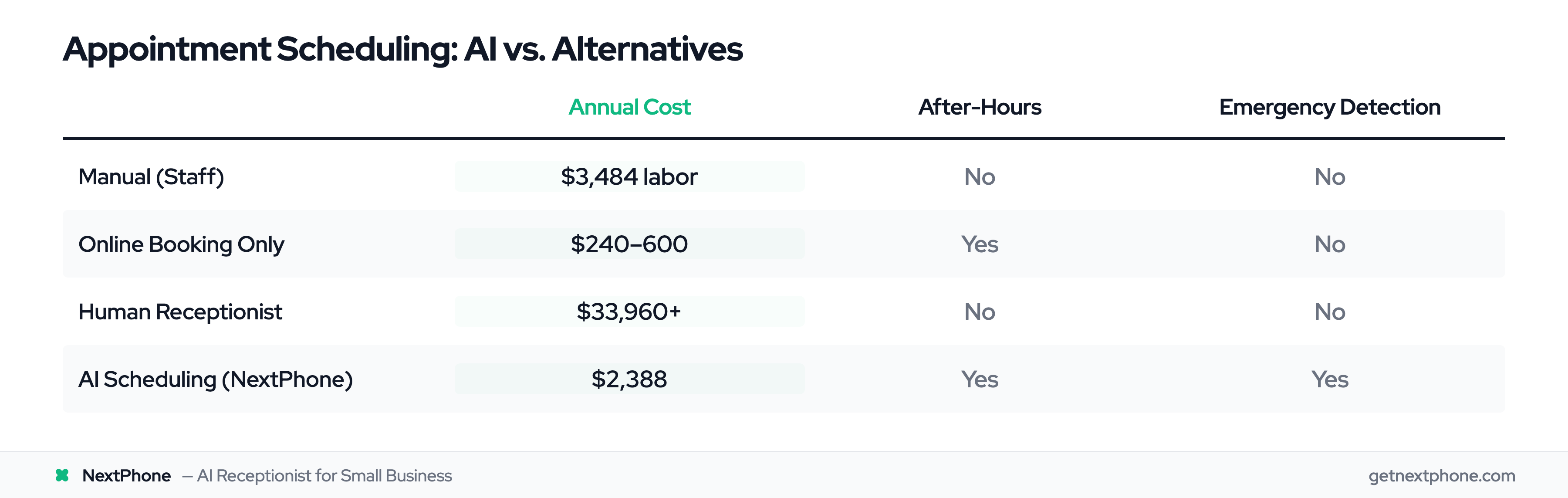
Let's compare three approaches to appointment scheduling:
Manual Scheduling (You or Staff Handle It):
- Cost: "Free" in dollars, expensive in time
- Harvard Business Review research shows 4.2 hours/week spent on scheduling
- At $16/hour × 4.2 hours × 52 weeks = $3,484/year in labor costs
- Plus missed calls when you're busy = lost appointments
Online Booking Only (Calendly, Acuity, etc.):
- Cost: $20-50/month = $240-600/year
- Pros: Cheap, easy to set up, works for web-savvy customers
- Cons: Misses the 54% who prefer calling, no phone support, no emergency detection
Human Receptionist:
- Cost: Bureau of Labor Statistics median receptionist salary is $33,960/year = $2,830/month
- Pros: Human touch, handles complex questions
- Cons: Expensive, only works business hours (misses after-hours calls), takes vacations/sick days
AI Appointment Scheduling:
- Cost: $199/month = $2,388/year (NextPhone)
- Pros: Works 24/7, handles phone + web, detects urgency, never calls in sick
- Cons: Best for routine bookings, routes complex situations to human
- Savings vs. receptionist: $31,572/year
Real ROI Calculations by Industry
Here's where AI appointment scheduling pays for itself multiple times over. Let's calculate exact ROI for three different industries.
HVAC / Plumbing / Electrical Contractor:
- 42 calls/month (industry average for small service businesses)
- 7.7% are scheduling requests = 3.2 scheduling calls/month
- 74.1% missed without AI = 2.4 appointments lost monthly
- Average service call value: $400
- Lost revenue: 2.4 × $400 = $960/month = $11,520/year
- AI cost: $199/month = $2,388/year
- Net savings: $11,520 - $2,388 = $9,132/year
- ROI: 4.8X return (you save $4.80 for every $1 spent)
If you capture just ONE additional $400 service call you would've otherwise missed, you're profitable for that month. Capture 2.4 per month (what the data shows you're currently missing), and you save over $9,000 annually.
- 42 calls/month (average)
- 34.7% are scheduling requests (HIGHEST of any home service trade!)
- That's 14.6 scheduling calls monthly
- 74.1% missed = 10.8 lost appointments/month
- Average annual contract value: $600 (monthly service × 12 months)
- Lost revenue: 10.8 × $600 = $6,480/month = $77,760/year
- AI cost: $2,388/year
- Net savings: $75,372/year
- ROI: 32.5X return
For pest control where one-third of calls are scheduling requests, AI isn't optional—it's a revenue necessity. Capturing those recurring contracts is your entire business model.
Medical or Dental Office:
- 80 calls/month (higher volume than contractors)
- 15% are scheduling requests = 12 scheduling calls/month
- 60% missed (better answer rate than contractors) = 7.2 lost appointments monthly
- Average appointment value: $200
- Lost revenue: 7.2 × $200 = $1,440/month = $17,280/year
- AI cost: $2,388/year
- Net savings: $14,892/year
- ROI: 7.2X return
Even with better answer rates than contractors, medical offices lose significant revenue to missed scheduling calls. Each prevented no-show or captured booking pays for the AI system multiple times over.
See NextPhone pricing to calculate ROI for your specific business.
Which Industries Benefit Most from AI Appointment Scheduling
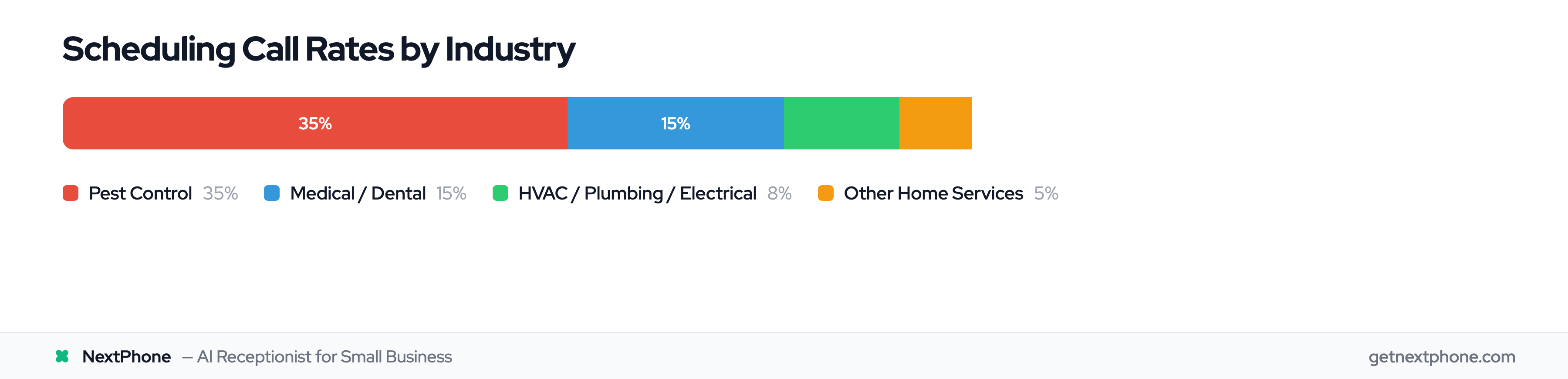
AI appointment scheduling works for any business that takes appointments, but some industries see dramatically higher ROI than others.
Home Services (Highest Missed Call Rates)
Plumbers, HVAC techs, electricians, general contractors, roofers—anyone working in the field faces the same problem: You can't answer your phone when you're on a roof, under a sink, or running wire through walls.
Industry research shows home services businesses miss 74.1% of incoming calls. With 7.7% being scheduling requests, you're losing multiple appointments every month simply because you were working.
Real examples from our call data:
"Wants to schedule service for a leaky toilet, asking about your availability for tomorrow." — Plumbing scheduling request that can't wait for callback
"Needs to schedule T&M for roof patch within the next 5 business days." — Roofing job with flexible timeline but customer is calling multiple contractors
These are qualified leads ready to book. Miss the call, lose the appointment to whoever answers first.
Average home services project value ranges from $400 (routine service call) to $3,500 (major repair or installation). Each missed scheduling call is potentially hundreds or thousands in lost revenue.
See AI receptionist for home services contractors for industry-specific implementation.
Pest Control: The Scheduling Champions (34.7% of Calls!)
If there's one industry where AI appointment scheduling is non-negotiable, it's pest control.
Our analysis found 34.7% of pest control calls are scheduling or appointment requests—the highest rate of any home service trade. That's more than one in three calls.
Why so high? Pest control operates on a recurring service model. Customers call to:
- Schedule initial service
- Book follow-up treatments
- Reschedule due to weather or timing
- Add seasonal services
- Schedule emergency treatments
Your entire business model is built on keeping customers on schedule. Miss those booking calls and your recurring revenue drops.
With 42 calls/month average and 34.7% being scheduling requests, that's 14.6 scheduling calls monthly. At a 74.1% miss rate, you're losing 10.8 appointments per month. Each lost customer represents $50-100/month in recurring revenue × 12 months = $600-1,200 annual contract value.
The ROI calculation from earlier: $75,372 in annual savings for the average pest control business implementing AI scheduling.
Medical and Dental Practices
Medical and dental offices face different challenges than contractors, but appointment scheduling is equally critical.
High call volume: Most practices receive 80-200 calls monthly. About 15% are scheduling-related—that's 12-30 scheduling calls. Missed phone calls are dental offices' largest revenue loss, and ADA reports offices receive up to 50 daily calls.
Peak call times: Monday mornings and first thing when the office opens (8-10 AM) see massive call spikes. Everyone calling to schedule this week's appointments. Front desk staff get overwhelmed, calls go to voicemail, patients get frustrated.
No-show costs: Each missed appointment costs a dental practice $200-300 in lost revenue. Medical practices lose similar amounts. Automated reminders reducing no-shows by 29% pays for AI scheduling by itself.
Real scenario: Patient calls at 7 PM asking to schedule a cleaning next month. Office is closed. Call goes to voicemail. Patient calls another dentist the next day, books there, never calls back. You lost a patient before they even became one.
AI scheduling captures after-hours calls, handles peak-time overflow, sends automated reminders, and reduces the administrative burden on front desk staff who can focus on in-person patient care.
Professional Services (Legal, Accounting, Consulting)
Lawyers, accountants, financial advisors, and consultants bill by the hour. Every minute spent on scheduling is a minute not spent on billable work.
A partner at a law firm charging $400/hour shouldn't be scheduling their own appointments. But if their assistant is out and a prospective client calls to book a consultation, someone needs to handle it.
AI scheduling captures those calls automatically. Clients can book consultations 24/7. Multi-attorney firms can configure the system to check all attorney calendars and offer available slots with whoever's free first.
Professional services also benefit from the professional image. Instant appointment booking, immediate confirmations, automated reminders—it all signals "we're organized and easy to work with." B2B appointment setting averages just 2.23% conversion, making every captured scheduling call crucial.
Any Business with After-Hours Demand
If customers call you outside of 9-5 wanting to book appointments, you need AI scheduling.
This includes:
- Service businesses with emergency calls (plumbing, HVAC, electrical, towing)
- Medical urgent care and dental emergency lines
- Veterinary clinics with after-hours emergencies
- Property management companies with maintenance requests
- Any business where customers have jobs/lives during your business hours and call during their free time
Friday 6 PM, Saturday morning, Sunday afternoon—these are when your customers are free to call. If no one answers and they can't book, they're calling competitors until someone captures that appointment.
How to Implement AI Appointment Scheduling
Setting up AI appointment scheduling is simpler than most businesses expect. Here's the step-by-step process.
Step 1: Choose Your Platform
Key questions when evaluating platforms:
Does it handle phone calls or just web forms? Many scheduling tools only work for web/text booking. If 54% of your customers call, you need phone support.
Does it integrate with your calendar? Google Calendar, Outlook, iCal, Apple Calendar—make sure your calendar system is supported.
What's the pricing model? Per-call pricing can get expensive fast. Flat-rate unlimited is better for businesses with variable call volume.
Can it detect urgency and route emergencies? Critical for home services and medical practices.
NextPhone handles phone calls, integrates with major calendar systems, costs $199/month unlimited, and routes urgent calls immediately.
Step 2: Connect Your Calendar
Most platforms offer one-click calendar integration using OAuth—you authorize access to your Google Calendar or Outlook, and sync begins immediately.
Two-way sync is critical: Bookings from AI appear in your calendar, and blocks in your calendar prevent AI from offering those times.
If you use multiple calendars (work calendar, personal calendar, shared team calendar), connect all of them. The AI will check availability across all calendars before offering time slots.
Step 3: Configure Appointment Types and Availability
This is where you teach the AI about your business. Define:
Appointment types:
- Service call (2 hours, $400)
- Estimate (30 minutes, free)
- Emergency service (immediate or same-day, $600)
- Routine maintenance (1 hour, $250)
Duration for each type: How long does each appointment take?
Buffer time: Do you need 15 minutes between appointments for drive time?
Your availability:
- Business hours (M-F 8 AM - 5 PM)
- Days off
- Lunch breaks
- Vacation blocks
- Emergency availability (same-day slots for urgent calls)
Emergency routing rules: What keywords should trigger immediate routing to your phone vs. automatic booking?
Example configuration for an HVAC contractor:
- Emergency service: 2 hours, detects "urgent," "today," "emergency," "no cooling," "no heat"
- Regular service call: 1.5 hours, standard priority
- Free estimate: 30 minutes, flexible scheduling
- Buffer time: 30 minutes between appointments for drive time
- Availability: M-F 8 AM - 6 PM, Saturday 8 AM - 2 PM (emergency hours)
Step 4: Test with Sample Bookings
Before going live, test the system thoroughly:
-
Make test calls yourself: Call and request different appointment types. Verify the AI understands and offers correct time slots.
-
Test emergency detection: Use urgency keywords. Confirm it routes appropriately (to you or to emergency slots).
-
Check calendar sync: Book a test appointment. Verify it appears in your calendar with correct details.
-
Verify confirmations: Make sure confirmation texts and emails send immediately with correct information.
-
Test reschedules and cancellations: Can customers reschedule via text? Does the calendar update?
-
Try edge cases: Same-day booking, booking far in advance, requesting unavailable times, asking questions before booking.
Spend 30-60 minutes testing different scenarios. Fix any issues before real customers interact with the system.
Step 5: Go Live and Monitor
Once testing is complete, forward your business line to the AI system and go live.
Monitor closely for the first week:
- Review booking logs daily to see what the AI handled
- Check calendar to verify appointments are accurate
- Gather customer feedback—how was the booking experience?
- Look for patterns in requests the AI struggled with
Most businesses are fully operational within 3-5 days. Minor adjustments (tweaking appointment durations, adjusting availability hours, refining emergency keywords) happen in the first week.
After that, it runs on autopilot. Your calendar fills automatically, confirmations send, reminders go out, and you focus on the actual work instead of scheduling logistics.
How NextPhone Provides AI Appointment Scheduling
For small businesses that can't afford full-time receptionists but can't afford to miss scheduling calls, NextPhone offers AI-powered appointment scheduling starting at $199/month—less than hiring a part-time employee for a single week.
Here's how it works: When a scheduling call comes in, NextPhone's AI answers in under 5 seconds (usually 2-3 rings). The AI handles the conversation naturally:
Customer: "I need an appointment Tuesday."
NextPhone AI: "I can help you schedule. What service do you need?"
Customer: "AC repair."
NextPhone AI: "I have Tuesday at 9 AM, 2 PM, or 4 PM available. Which works best for you?"
Customer: "2 PM."
NextPhone AI: "Perfect, you're booked for Tuesday at 2 PM for AC repair. I'm sending you a confirmation text right now."
The AI checks your Google Calendar or Outlook in real-time, only offering slots that are actually available. The moment the customer confirms, the appointment is booked, added to your calendar with customer details, and confirmation texts/emails go out immediately.
For emergencies—remember that 15.9% of calls contain urgency language—NextPhone detects keywords like "emergency," "urgent," "today," or "ASAP" and routes the call to your phone immediately. You talk to the customer directly and book the urgent appointment yourself.
For routine scheduling, the AI handles it entirely automatically. You wake up to a calendar full of confirmed appointments, each with customer name, phone number, service needed, and any special requests.
The system also tracks the 25.4% of callers who request callbacks. If someone says "I'll call back later to schedule," NextPhone logs it in your dashboard and can optionally send a follow-up text: "Still need to schedule your service? Reply YES and I'll help you book a time."
It works 24/7. Friday evening, Saturday morning, holiday Monday—whenever customers call, NextPhone answers and books appointments. You capture the after-hours scheduling calls that would otherwise go to voicemail and then to competitors.
Setup takes 3-5 days. You connect your calendar, configure your appointment types and availability, test it, and go live. No complex integrations, no months-long implementations.
$199/month flat rate with unlimited calls means your cost stays fixed whether you get 30 calls or 300. Compare that to a receptionist at $2,830/month or traditional answering services at $500-800/month for small businesses.
One HVAC contractor told us: "I can't answer my phone when I'm on a roof. NextPhone handles scheduling and my calendar stays full. It's like having a receptionist for $200/month."
See how NextPhone handles scheduling calls 24/7 →
Frequently Asked Questions
Can AI appointment scheduling handle complex booking requests?
Modern AI handles most complexity well: different appointment types, varying durations, buffer time between appointments, and checking multiple calendars. Google AI Research shows current NLP technology achieves 92% accuracy for routine booking requests.
For truly unusual requests—like "I need three technicians at two different locations on the same day"—AI can take a detailed message and route it to a human for follow-up. The best practice is to configure your common appointment types upfront (service call, estimate, emergency, routine maintenance) so the AI knows your standard options.
What happens if someone books an appointment when I'm actually not available?
AI only offers time slots that show as available in your connected calendar. Two-way calendar sync means if you block time off in Google Calendar (for a job, personal appointment, vacation, or any reason), the AI won't offer that slot to customers.
Real-time checking prevents double bookings and scheduling conflicts. You control your availability the same way you always have—by managing your calendar. The AI respects whatever you've set.
How does AI prevent double bookings?
The AI checks your calendar in real-time before offering each time slot. When a customer confirms an appointment, it's booked immediately and your calendar updates within seconds. If another customer calls 30 seconds later requesting that same time, they'll see it as unavailable and get offered different options.
There's no human error like writing down an appointment on a sticky note and forgetting to add it to the calendar. No accidentally booking two customers for the same slot because you didn't refresh the schedule. The AI checks live availability every single time.
Enterprise-grade calendar APIs ensure no conflicts or sync delays that could cause double bookings.
Can AI handle same-day or emergency appointment requests?
Yes. AI can detect urgency through keywords and phrasing. When someone calls saying "I need my water heater fixed today" or "This is an emergency, no cooling in 95-degree weather," the system recognizes the urgency.
You can configure emergency handling two ways:
- Route to you immediately - Critical emergencies go straight through to your phone so you can talk to the customer directly and assess the situation
- Book first available urgent slot - If you've configured same-day emergency availability, the AI can book it automatically
For same-day routine requests ("Can you come out this afternoon?"), the AI checks today's calendar and offers whatever slots are still open.
See how AI routes emergency calls while handling routine requests automatically.
Does AI appointment scheduling integrate with my existing calendar?
Yes. Most platforms integrate with Google Calendar, Outlook, iCal, Apple Calendar, and other standard calendar systems. Setup is typically one-click OAuth authentication—you authorize access and sync begins immediately.
Two-way synchronization means bookings made through AI appear in your calendar, and blocks in your calendar prevent AI from offering those times. Everything stays in sync automatically.
AI scheduling platforms also integrate with CRM systems (Salesforce, HubSpot, Zoho) to log customer information, and with communication tools (Slack, Microsoft Teams) to notify your team about new appointments.
See all NextPhone integrations for specific platform compatibility.
How much does AI appointment scheduling cost?
For small businesses, AI appointment scheduling typically ranges from $99-500 per month depending on call volume, features, and whether you need phone support (not just web booking).
NextPhone costs $199/month with unlimited calls. Whether you get 20 scheduling calls or 200, your cost stays fixed.
Enterprise solutions run $500-2,000/month with features most small businesses don't need (multi-location support, complex integrations, dedicated account managers).
Compare AI scheduling at $199/month to hiring a receptionist at $2,830/month (Bureau of Labor Statistics median salary of $33,960/year). You save $31,572 annually. SMBGuide's 12+ appointment scheduling statistics for 2025 confirm the growing adoption of automated scheduling.
The ROI is positive if you capture just 1-2 additional appointments per month that you would've otherwise missed. Most businesses capture many more than that.
See NextPhone pricing and calculate your specific ROI.
Will customers be frustrated talking to AI instead of a human?
Modern AI sounds natural and handles scheduling conversations smoothly. For simple booking requests ("I need an appointment Tuesday"), customers often prefer AI—it's faster than waiting on hold for a receptionist to check the calendar.
Software Advice research found that 68% of customers value 24/7 booking availability over specifically talking to a human. They want convenience and speed.
For complex situations where customers have unusual requests or want to discuss multiple service options, the AI can seamlessly route to a human. The key is a hybrid approach: AI handles routine 80% of bookings, humans handle complex 20%.
Most businesses find that customers don't notice they're talking to AI until you tell them—and once they realize how fast and easy the booking was, they don't care.
Start Capturing Every Scheduling Call
AI appointment scheduling isn't just about convenience—it's about capturing the 7.7% of calls that are booking requests, the 2.4 appointments you're missing every month, and the thousands in annual revenue going to competitors who simply answered their phone first. It's about working 24/7 without hiring staff, reducing no-shows by 29%, and saving 4+ hours per week in manual scheduling tasks.
The businesses winning in 2026 aren't the ones with the best services—they're the ones that are easiest to book. When a customer's AC dies on Friday evening and they're calling five contractors, the one with AI scheduling gets the job. When a patient calls a dental office at 7 PM wanting to schedule a cleaning, the practice with after-hours booking captures that patient before competitors even check voicemail.
For industries like pest control where 34.7% of calls are scheduling requests, AI appointment scheduling isn't a luxury or a "nice to have." It's the difference between capturing recurring revenue and watching it walk to competitors. For home services contractors where 74.1% of calls go unanswered while you're on job sites, it's the difference between a full calendar and lost opportunities.
The ROI is clear. AI scheduling costs $199/month. Missing 2.4 appointments monthly at $400 each costs $11,520/year. Capture those appointments and you save $9,132 annually. For pest control companies missing 10.8 appointments monthly, the savings exceed $75,000 per year.
Set up takes days, not months. Connect your calendar, configure your appointment types, test it, and go live. Your phone rings, AI answers in under 5 seconds, customer books an appointment, confirmation texts go out immediately, and your calendar fills automatically. You focus on the actual work instead of scheduling logistics.