
CallRail tells you which ad made the phone ring. It does not answer the call.
That single sentence explains why so many owner-operated businesses go looking for a CallRail alternative. You spend real money on Google Ads, Local Services Ads, and your website. CallRail proves those channels are working by attributing each call back to a source, a campaign, even a keyword. Then the phone rings while you are on a ladder, under a sink, or driving to a job, and the most expensive part of the funnel just goes to voicemail.
Here is the part that stings. CallRail's own small business benchmarking report, built on 1.1 million leads, found that up to 85% of callers whose calls go unanswered never call back. So the company that measures your missed calls better than anyone also documents exactly how much they cost you. Measurement is not the same as capture.
This guide compares six CallRail alternatives honestly. Some are call-tracking tools that do what CallRail does at a different price. One answers the phone instead, and it now hands out tracking numbers per channel too, so the answering and the attribution come from the same place. We will show you where CallRail is genuinely the right choice, and where a different tool fits the way owner-operated businesses actually lose money.
What CallRail Actually Is (and Isn't)
CallRail was founded in 2011 in Atlanta by two Georgia Tech grads. It grew into one of the category leaders, crossing $100 million in annual recurring revenue in 2024 and serving around 220,000 small businesses, with Sageview Capital holding a majority stake. It is a real, well-run company. None of this is a knock on the product.
But it helps to be precise about what the product does. CallRail is a call-tracking and marketing-attribution platform. Its core trick is dynamic number insertion, or DNI: a small snippet of JavaScript on your website swaps the phone number a visitor sees based on how they arrived. Someone who clicks a Google Ad for "emergency water heater repair" sees a different tracking number than someone who found you through organic search. When either person calls, CallRail knows which channel, campaign, and keyword drove that call, then pushes that offline conversion back into Google Ads and GA4 so your reporting is complete.
It records the call. It transcribes the call. It logs the call against a source. What it does not do is pick up the call. When your line is busy or you are unavailable, CallRail faithfully records that a high-intent lead reached voicemail and left. That is the gap.
When CallRail Is the Right Tool
Be fair about this. If you run a marketing agency managing large ad accounts, or you are an in-house marketer whose job is to prove ROI on spend, CallRail is excellent and hard to replace. You need session-level, keyword-level attribution across dozens of campaigns. You need clean conversion data flowing back to Google Ads to feed Smart Bidding. You need form tracking alongside call tracking. That is CallRail's home turf, and no AI receptionist does keyword-level DNI with visitor session pools. If measurement across a big media budget is your bottleneck, keep CallRail or look at another call-tracking tool below.
The question this guide answers is different: what if your bottleneck is not measurement, but the fact that nobody answers?
Why Owner-Operated Businesses Look for a CallRail Alternative
Two reasons come up again and again.
1. The Bill Creeps
CallRail's published pricing page looks tidy at the top. After a recent restructure, the four current plans run from Lead Tracking at $50/month up to Lead Conversion Complete at $195/month on annual billing, with month-to-month rates about 10% higher. The old $45, $90, and $135 Call Tracking tiers are retired, and the AI features that used to be a $90 add-on now sit behind the $150 Lead Conversion tier.
The base number is not the real number, though. CallRail layers usage fees on top: about $0.06 per call minute beyond the 250 included, $3/month for each tracking number beyond the five included, $0.03 per text, and about $0.02 per form submission. If you run several campaigns, each needs its own pool of tracking numbers, and the meter runs on minutes and numbers. A "$50 tool" quietly becomes a $150 to $300 line item, and it fluctuates month to month.
2. Attribution Without Answering Still Loses the Call
This is the deeper problem. Say CallRail does its job perfectly and tells you that your Local Services Ads campaign drove 40 calls last month at a great cost per lead. Now look at how many of those 40 you actually answered. For most owner-operated businesses the honest answer is far fewer than they assume, and missed sales calls are consistently among the costliest leaks in home services. You paid for the click, CallRail proved the click turned into a call, and then the lead hit voicemail and dialed your competitor.
Across the 1,446,980 inbound calls in our analysis, the pattern is unambiguous: small businesses routinely miss a large share of incoming customer calls. Every missed call is a customer choosing your competitor. They do not leave a voicemail and wait. They call the next business on Google. CallRail measures that leak with precision. It does not plug it.
The reframe worth sitting with: an AI receptionist gives you channel-level attribution as a side effect of answering. Give each channel its own dedicated number, point them all at the AI, and every call is answered, transcribed, tagged to its source line, and logged as a lead or a booking. You get the "which channel worked" answer and the "we actually captured the lead" outcome from the same tool.
The 6 Best CallRail Alternatives for 2026
Here is the shortlist at a glance, then a full breakdown of each.
| Tool | What it is | Starting price | Answers the call? | Best for |
|---|---|---|---|---|
| NextPhone | AI receptionist | From $199/mo, flat monthly, unlimited | Yes | Owner-operated businesses losing calls |
| CallRail | Call tracking + DNI | $50/mo + usage | No | Agencies, marketers needing keyword attribution |
| WhatConverts | Lead + call tracking | $30/mo + usage | No | Lead reporting across calls, forms, chat |
| CallTrackingMetrics | Call tracking + contact center | $79/mo + usage | Partial (human agents) | Teams that already staff a phone desk |
| Nimbata | Budget call tracking | Free / $39/mo | No | Cost-conscious attribution, pay per answered call |
| Invoca | Enterprise call tracking + AI | Custom (enterprise) | No | Large brands with big paid-media budgets |
1. NextPhone (AI Receptionist): Best for Businesses That Are Losing Calls
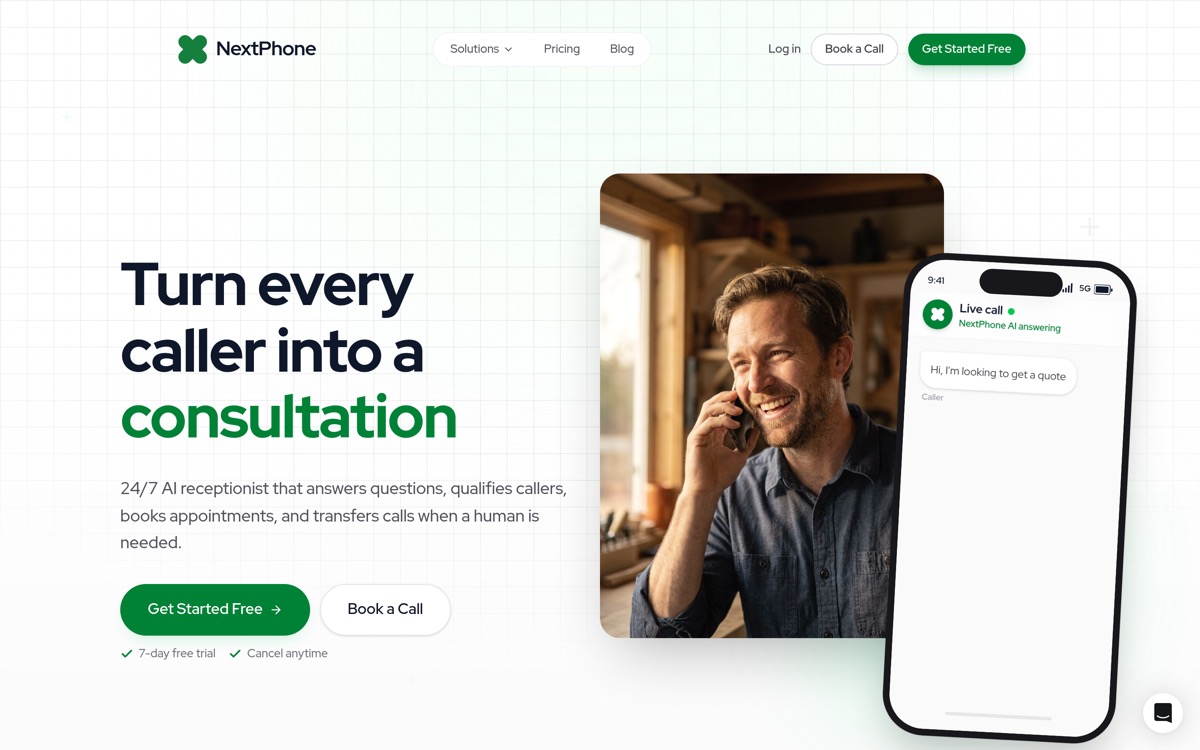
NextPhone is an AI receptionist that answers your phone in a natural conversation, qualifies the caller, books the appointment, captures a structured lead, and pushes it to your CRM. It picks up in under 2 seconds, resolves 90-95% of calls without human escalation, and keeps 99% positive caller sentiment across the 1,446,980 calls in our analysis.
Here is why it belongs at the top of a CallRail alternatives list, even though it does something different. The reason you tracked calls in the first place was to make more money from the phone. CallRail improves that by telling you where to spend. NextPhone improves it by making sure the calls you already paid for get answered. For a business missing most of its inbound calls, answering is the higher-leverage fix by a wide margin.
You still get attribution, and it is now a built-in feature rather than something you rig up yourself. NextPhone issues a dedicated tracking number for each marketing channel: one for your Local Services Ads, one for Google Ads, one for Yelp, one for your website, one for the truck wrap. Every number rings the same AI receptionist with the same greeting, questions, and booking setup, and every call arrives tagged with the channel that produced it. You learn which channel drives real, answered, booked business, not just which channel makes the phone light up. It is channel-level attribution rather than session-level keyword attribution, and for most owner-operated shops that is exactly the resolution they need.
Listen to what "answered" actually sounds like. This is a sample call where the AI qualifies a lead and captures the details CallRail would only have recorded a voicemail for.
A sample lead-intake call. The AI answers, asks the right questions, and records scope, budget, timeline, and address as a structured lead, then books the estimate. This is the call a tracking pixel can only prove you missed.
What it does well:
- Flat monthly plans from $199 for unlimited inbound calls. No per-minute meter, no transcription caps.
- Answers 24/7, including the after-hours and weekend calls that are often the highest intent.
- Books appointments, sends a text follow-up, and writes the lead to your CRM. It is natively integrated with HubSpot, GoHighLevel, and Clio, plus 8,000+ other tools through Zapier. CRM integrations like HubSpot start on the $299 Growth plan.
- Handles calls in 14 languages, in whatever language the caller speaks.
- Filters spam and robocalls before they ever ring you, so your data is not polluted with junk.
Where it is not the right fit: if you are an agency that lives and dies by keyword-level attribution across a large media budget, NextPhone will not replace CallRail's DNI. It answers calls beautifully; it does not run visitor number pools tied to ad keywords. Use both, or use CallRail. For everyone else, NextPhone replaces CallRail and a separate answering service in one tool.
See how it compares across the AI receptionist landscape, or read why the real comparison is AI versus voicemail.
2. CallRail Itself: Keep It When You Need Keyword Attribution
Sometimes the best alternative to a tool is that tool, used for the job it is great at. If you are a performance marketer or an agency, CallRail's dynamic number insertion, keyword-level attribution, form tracking, and clean offline-conversion export to Google Ads and GA4 are genuinely best in class. The Conversation Intelligence add-on auto-transcribes and scores calls, which is useful when you are optimizing scripts across a call team.
CallRail is the right pick when measurement across a big paid-media budget is the goal, when you have people whose job is to answer the phones, and when you need to feed Smart Bidding accurate call-conversion data. Its weakness is not the product. It is that measurement alone does not help the solo operator who is missing the calls in the first place. Pricing starts at $50/month plus usage, as covered above.
3. WhatConverts: Lead Tracking Across Calls, Forms, and Chat
WhatConverts is a close CallRail competitor built around a slightly different idea: track leads, not just calls. It ties calls, form submissions, and chats together into one lead-reporting view, with dynamic number insertion like CallRail. Pricing starts around $30/month plus usage, which makes entry pricing look approachable for a small team.
It is a solid pick if your reporting question is "which marketing dollars produce qualified leads across every channel, not just phone calls." Like CallRail, it tracks and records but does not answer. If your problem is proving marketing ROI, WhatConverts is worth a look. If your problem is that nobody picks up, it has the same gap CallRail does.
4. CallTrackingMetrics: Attribution Plus a Contact Center
CallTrackingMetrics, often shortened to CTM, is the most feature-heavy option here. It combines call, text, and form attribution with actual contact-center tooling: a softphone, agent routing, and team performance tracking. Pricing runs from about $79/month for Marketing Lite up to about $329/month for Sales Engage, with an enterprise tier well beyond that.
CTM makes sense for a team that already staffs a phone desk and wants attribution and agent tooling in one platform. The catch is the same one running through this whole category: the "answering" still depends on your humans being available. If you have the staff, CTM is powerful. If you are the staff, it does not solve the coverage problem, and it is a heavier, pricier tool than an owner-operator needs.
5. Nimbata: Budget Attribution That Bills Per Answered Call
Nimbata is the value pick for pure call tracking. It has a free entry tier and paid plans from $39/month, with dynamic number insertion and the essential integrations. Its clever pricing wrinkle: it bills per answered call rather than per minute, so you pay for real conversations, not call duration.
Nimbata is a genuinely cost-effective CallRail alternative if attribution is all you need and you want to keep the bill low and predictable. It is still a measurement tool, not an answering tool. Pair it with something that actually picks up if missed calls are your real leak.
6. Invoca: The Enterprise End of the Category
Invoca sits at the opposite end from Nimbata. It is enterprise-grade call tracking and conversation intelligence, aimed at large brands with big paid-media budgets that need deep AI analysis of call outcomes at scale. Pricing is custom and firmly enterprise.
Most owner-operated businesses will never need Invoca, and its research is more useful to them than its software: Invoca's own published data is where the widely cited missed-call cost figures for home services come from. If you are a national brand running attribution across hundreds of locations, Invoca is a real CallRail alternative. If you are a contractor, it is overkill.
NextPhone vs CallRail: The Direct Comparison
Strip away the other tools and the core decision is this. CallRail is the best way to measure your phone marketing. NextPhone is the best way to capture it. They optimize different halves of the same funnel.
| Factor | CallRail | NextPhone |
|---|---|---|
| Primary job | Measure which ad drove the call | Answer and convert the call |
| Answers the phone | No | Yes, in under 2 seconds |
| Attribution grain | Session-level, keyword-level (DNI) | Channel-level: dedicated tracking number per channel, tagged in inbox, insights, and CRM |
| Tracking numbers per channel | Yes, via number pools and DNI | Yes, one per ad channel, all of them answered |
| Records and transcribes | Yes | Yes |
| Books appointments | No | Yes |
| Writes to your CRM | Pushes conversions to Google Ads / GA4 | Writes the lead and its channel to HubSpot and GoHighLevel natively; Clio native too, 8,000+ via Zapier (CRM sync on $299 Growth plan) |
| After-hours coverage | Records the miss | Answers the call |
| Spam handling | Logs spam calls | Filters spam before it rings you |
| Pricing | $50-195/mo base + usage fees | From $199/mo, flat monthly, unlimited |
| Best for | Agencies, marketers, big ad budgets | Owner-operated businesses losing calls |
The real question is not "which is better." It is "which half of the funnel is your bottleneck." If you have staff answering every call and you need to prove ROI, CallRail wins. If your ads work but the calls go to voicemail, NextPhone wins, and it hands you channel-level attribution on the side.
For a lot of businesses the honest answer is that they bought CallRail hoping better data would fix a revenue problem that was actually a coverage problem. Better data on a leak you cannot plug is expensive comfort.