Two contractors get the same lead notification at 2:15 PM on a Tuesday. Same neighborhood. Same services offered. Similar pricing, similar reviews.
Contractor A calls back at 2:18 PM - three minutes later. Contractor B sees the notification at 4:45 PM after finishing a job. By then, Contractor A has already booked the appointment.
This isn't bad luck. It's math. And the research behind it is devastating for anyone who thinks "I'll call them back when I get a chance."
The concept is called speed to lead. It's the single most predictive factor in whether a lead becomes a paying customer — whether you're a plumber, a SaaS company qualifying demo requests, a real estate agent fielding listing inquiries, or an insurance broker quoting policies. The channel changes (phone, form, chat), but the decay curve doesn't. And the data shows your window is far smaller than you think.
What Is Speed to Lead (And Why It's Not Optional)
Speed to lead measures one thing: how much time passes between a lead reaching out and your first meaningful response — your inquiry response time. That response could be answering a phone call, returning a missed call, replying to a form submission, or following up on a lead notification.
The concept isn't new. It was first made famous by a 2011 Harvard Business Review article called "The Short Life of Online Sales Leads." But the most comprehensive data comes from the InsideSales Lead Response Management Study - a massive analysis of 55 million sales activities across 5.7 million inbound leads from over 400 companies.
What the Research Found
The findings weren't subtle. They were blunt: respond fast or lose. The difference between a 5-minute response and a 30-minute response isn't incremental. It's exponential.
And here's the part that should keep you up at night: only 0.1% of businesses actually respond within that 5-minute window. Meanwhile, 57.1% don't make their first contact attempt until more than a week later.
The opportunity here is massive. If everyone else is slow, being fast is a competitive advantage that costs nothing but attention.
The Research: What Happens in the First 5 Minutes
Let's break down the data that makes the case for speed to lead. These numbers come from large-scale studies, not surveys or opinions.
The 8x Conversion Finding
Businesses that respond to leads within 5 minutes see conversion rates 8 times higher than those responding at 30 minutes. Not 8% higher. Eight TIMES higher.
That same research found leads contacted within 5 minutes are 21 times more likely to be qualified than those contacted at 30 minutes. The difference between "interested buyer" and "who are you again?" is measured in minutes.
The Lead Decay Curve
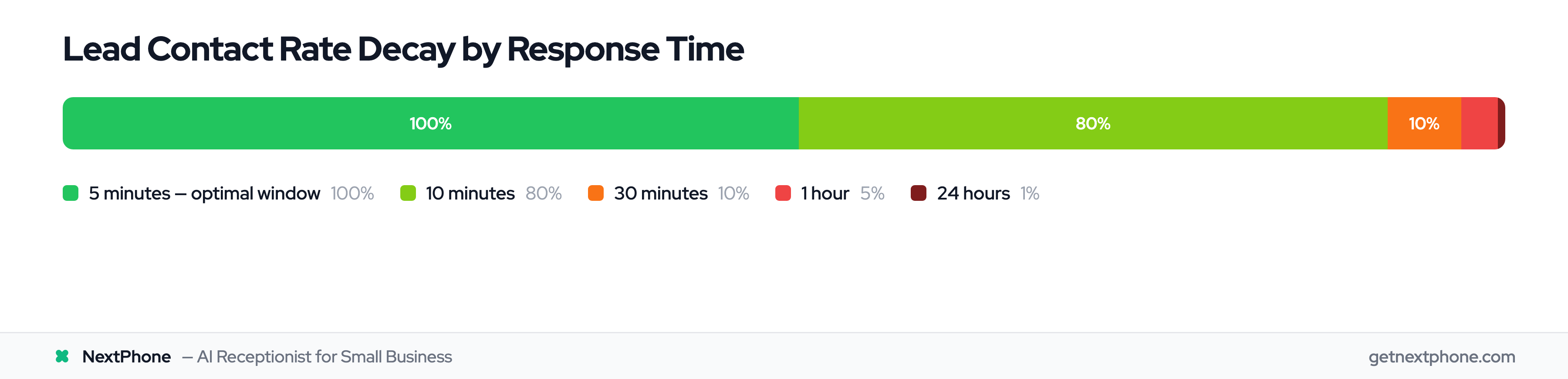
Lead quality doesn't decline gradually. It falls off a cliff.
Here's what the research shows:
- 5 minutes: Optimal window - 100% contact potential
- 10 minutes: Contact rate drops to roughly 80%
- 30 minutes: Contact rate plummets to about 10% (a 10x drop from 5 minutes)
- 1 hour: Down to approximately 5%
- 24 hours: Less than 1% - you're 60x less likely to qualify that lead
Waiting 30 minutes costs you the same as if 9 out of 10 leads never existed. That's not a gradual decline. That's a collapse.
The First Responder Advantage
Here's the stat that reframes everything: 78% of customers buy from the first business that responds. Not the cheapest. Not the one with the best reviews. Not the most experienced. The first one to pick up the phone — the one that converts the call to a booking.
For home services - where the customer has a leaking pipe, a dead AC unit, or flickering lights - this makes intuitive sense. They're not comparison shopping at 10 PM with water on their floor. They're calling until someone answers.
Research from Chili Piper's 2025 benchmark study of 4 million form submissions found that instant response achieved a 66.7% meeting booking rate, compared to 30% for standard follow-up. Speed didn't just help - it more than doubled the call booking conversion rate.
After 30 Minutes: You've Probably Lost
The Velocify research puts it starkly: responding within 1 minute delivers 391% better conversion than waiting longer. Every additional minute after that chips away at your odds.
By the time most businesses get around to returning a call - often hours or days later - the lead has already spoken to competitors, forgotten the details of their problem, or decided to "wait and see." Your callback feels cold. Their urgency has passed.
What's Happening in Your Customer's Head
The data is clear. But WHY does speed matter so much? Understanding the psychology helps you take it seriously.
The Research Moment
When someone picks up the phone or fills out a form, they're at their absolute peak of buying intent. They have:
- The problem fresh in their mind
- Mental budget allocated ("I need to spend money on this")
- Time carved out right now to deal with it
- Emotional motivation (frustration, urgency, excitement)
This is the moment of maximum receptivity. Every minute you wait, these factors decay.
The Multi-Tab Problem
Your lead isn't sitting by the phone waiting for you to call back. They're calling other companies. Opening other browser tabs. Reading reviews of your competitors. By the time you respond 30 minutes later, they may have already had a live conversation with someone else who answered immediately.
For home services, the dynamic is even faster. A homeowner with a burst pipe doesn't call one plumber and wait. They call three simultaneously and go with whoever answers first.
Memory and Context Fade
After 30 minutes, callers start forgetting details. What exactly did the AI say? What was the company name? What service area? By an hour, the emotional urgency has faded. By 24 hours, they've moved on to other problems.
This is why callbacks from "yesterday's leads" feel awkward. The customer barely remembers reaching out.
Competitor Contact
This is the real killer. While you're finishing a job, driving home, or waiting until morning to return calls, your competitors might be answering their phones. The first business to have a real conversation with the lead captures 78% of the business.
It's not that your competitor is better. They were just faster.
The Lead Sources Where Speed Wins (or Loses) the Job
Speed to lead applies differently depending on where the lead comes from. Some channels are more time-sensitive than others.
Inbound Phone Calls: The Ultimate Speed Test
Phone calls are the most time-critical lead source because the customer is ON THE LINE right now. There is no "response window." Either you answer or you don't.
Industry research puts the missed-call rate for home services at 74.1% — calls that go completely unanswered. And 85% of callers who don't reach someone won't call back. The speed-to-lead window for inbound calls is measured in seconds, not minutes.
Lead Aggregators: You're Racing 3-5 Competitors
Platforms like Thumbtack, Angi, and HomeAdvisor send the same lead to multiple businesses simultaneously. Everyone gets the notification at the same time. The company that calls first wins.
This is speed to lead in its purest form - a literal race. Your response time isn't just about converting the lead, it's about beating competitors to the punch.
Paid Ad Leads: You Paid $75 for This Call
When someone clicks your Google Ad or taps your Facebook call button, you've already paid $50-$75 (or more) for that lead. If the call goes unanswered, your paid lead response time balloons and that ad spend is pure waste.
Do the math: if 62% of calls go unanswered at $75 per call, that's $4,650 per month in wasted ad spend. And that's before counting the lost revenue from the customer who hired your competitor instead.
After-Hours: The Forgotten Speed Gap
Here's what most speed-to-lead content ignores: leads don't stop at 5 PM. A large share of home services calls come outside standard business hours. Evenings, weekends, holidays.
These after-hours callers often have the HIGHEST intent. They're dealing with emergencies. They've been thinking about the project all day at work. They're finally free to make the call.
And almost nobody is answering. Which means the businesses that DO respond after hours - even via AI - have virtually zero competition for those leads.
Web Form Submissions: The 5-Minute Cliff
When a prospect fills out a contact form — requesting a quote, booking a demo, or asking for more info — your speed-to-lead clock starts the moment they hit submit. Chili Piper's benchmark study of 4 million form submissions found instant response achieved a 66.7% meeting booking rate vs 30% for standard follow-up. The average B2B company takes 42 hours to respond to a form fill. By then the prospect has submitted the same form to three competitors.
This is where SaaS companies, real estate agencies, and insurance brokers lose the most leads. The form creates an illusion of patience — "they submitted a form, they'll wait." They won't. They're already on your competitor's site filling out the same form.
Live Chat and Chatbots: Instant or Invisible
Website chat has the tightest speed-to-lead window of any channel. Visitors expect a response within 10 seconds. After 30 seconds of no reply, most close the chat widget and leave. If you offer live chat but can't staff it, you're actively creating a bad experience — worse than not having chat at all.
AI chatbots solve the staffing problem for chat the same way AI receptionists solve it for phone. The key metric: time-to-first-meaningful-reply, not time-to-canned-response. "Hi, how can I help?" doesn't count. Asking a qualifying question does.
CRM and Lead Routing: The Internal Speed Gap
Even when you capture the lead fast, internal routing can kill your speed to lead. A form submission that lands in a shared inbox, waits for manual assignment, then sits in a rep's queue for 3 hours has a 5-second capture time and a 3-hour response time. The capture means nothing — the response is what the customer experiences.
Auto-routing rules in your CRM (round-robin assignment, territory-based routing, priority queuing by lead score) eliminate the internal delay. The best-performing teams route leads to a specific owner within 60 seconds of capture.
How to Measure Speed to Lead
You can't improve what you don't measure. Here's how to benchmark and track your speed to lead.
The formula: Speed to Lead = Time of First Meaningful Response − Time of Lead Creation
"Meaningful response" means a live conversation, a qualified reply, or an appointment booking — not an auto-acknowledgment email. If your auto-responder says "we'll get back to you within 24 hours," your speed to lead is 24 hours, not 0 seconds.
How to measure it:
- Phone calls: Your call tracking software (CallRail, CallTrackingMetrics) logs ring-to-answer time. If you use an AI receptionist, this is typically under 5 seconds.
- Form submissions: Compare form submission timestamp against first outbound call or email timestamp in your CRM.
- Chat: Most chat platforms report average first-response time natively.
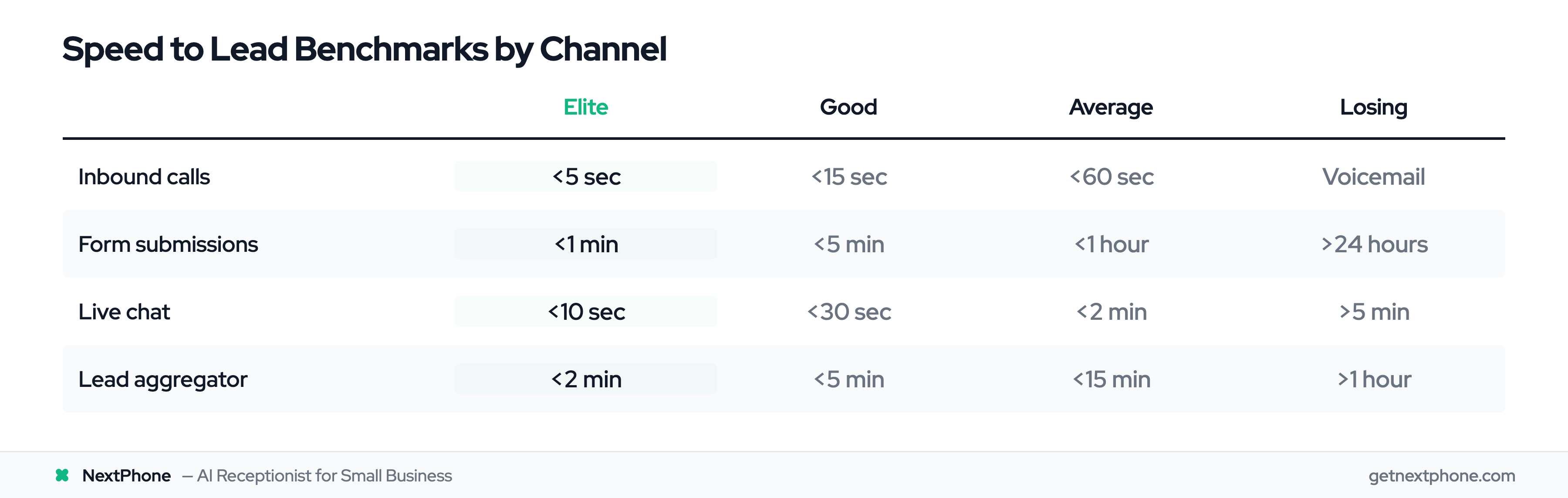
Benchmarks by channel:
| Channel | Elite | Good | Average | Losing |
|---|
| Inbound calls | <5 sec | <15 sec | <60 sec | Voicemail |
| Form submissions | <1 min | <5 min | <1 hour | >24 hours |
| Live chat | <10 sec | <30 sec | <2 min | >5 min |
| Lead aggregator | <2 min | <5 min | <15 min | >1 hour |
If you're in the "Average" column, you're losing to the "Elite" column every single time. The research is unambiguous: the gap between 5 minutes and 1 hour isn't 12x the time — it's 10x the lost leads.
How Much Money You're Losing Right Now
Let's turn the speed-to-lead research into actual dollars for a typical home services contractor.
The Basic Missed-Call Math
Run the industry benchmarks against a typical home services contractor:
- Average monthly calls: 42
- Missed call rate: 74.1% = 31 missed calls per month
- If 20% would have converted at $3,500 average job value
- $21,700 per month in lost revenue
- $260,400 per year
That's not theoretical. Those are industry-standard rates applied to an ordinary month of calls at a real contractor — and there's a straightforward missed call solution for it.
The Speed Multiplier Effect
Even the calls you DO answer can be lost to speed issues. If a caller reaches voicemail, calls your competitor, and your competitor answers live - you've lost despite technically getting the lead.
The 8x conversion advantage at 5 minutes means: if you currently convert 10% of your leads, responding within 5 minutes could push that to 80%. Same leads, dramatically different results.
Emergency and Urgent Call Premium Lost
Across our 1,446,980+ call corpus, urgency language and emergency requests rank among the most common reasons people call — and those calls command the highest job values. Emergency callers have zero patience. They call until someone answers.
These are the highest-value leads in your business, and they're the most time-sensitive. Speed to lead isn't just a concept for them — it's the entire decision. First to answer wins. Period.
Annual Impact Summary
| Metric | Monthly | Annual |
|---|
| Missed calls (74.1%) | 31 | 372 |
| Potential revenue lost | $21,700 | $260,400 |
| Wasted ad spend (62% missed) | $4,650 | $55,800 |
These numbers overlap somewhat — calculate your own ROI — but the directional message is clear: slow response is the most expensive operational failure in your business.
5 Ways to Respond Faster (Starting Today)
Understanding the problem is step one. Here's how to actually achieve response time improvement, from basic to advanced.
1. Answer Every Call Live
The ideal: someone picks up every ring. For many contractors, this means hiring office staff ($35,000-$45,000/year) or having a partner handle calls. It works great during business hours but doesn't solve after-hours, weekends, or overflow during peak season.
2. Set Up Instant Push Notifications
If you can't answer live, at least know immediately when a lead comes in. Most CRMs and lead platforms offer mobile push notifications. The gap: you still have to manually call back, and if you're on a ladder or in a meeting, that delay costs you.
3. Use Dedicated After-Hours Coverage
Traditional answering services ($500-$800/month) can pick up your phone after hours. The trade-off: they're reading scripts, can't answer detailed questions about your services, and they're taking messages rather than booking jobs. Better than voicemail, but still slow on the actual booking.
4. Automate First-Touch Response
Missed call text-back systems send an instant acknowledgment when a call is missed: "Thanks for calling, we'll get back to you shortly." This buys you time but doesn't qualify the lead or book the appointment. The customer knows you exist, but they're still calling competitors.
You can set up basic lead capture automation and callback tracking to make sure no lead falls through the cracks.
5. Deploy an AI Receptionist
This is where speed to lead gets solved permanently. An AI receptionist answers every call in under 5 seconds — faster than any human receptionist can physically reach a ringing phone. It doesn't just acknowledge the lead. It qualifies them, collects their information, answers their questions about your services, and handles live booking during calls.
The speed-to-lead clock never starts ticking because there's no gap between "lead calls" and "lead is engaged."
Zero-Second Response Time, 24/7
NextPhone approaches speed to lead as an engineering problem, not a staffing problem. You'll never be Contractor B again.
Instant Answer: AI picks up in under 5 seconds, every time. No rings. No hold music. No "all representatives are busy." The caller is immediately in a conversation with something that knows your business.
24/7 Coverage: Leads at 6 AM, 10 PM, 2 AM, Christmas morning - all answered identically. No after-hours gap. No "we'll return your call on Monday."
Live Qualification: The AI doesn't just answer - it runs custom lead qualification in real time. What service do you need? What's the address? Is this an emergency? When are you available? By the time the call ends, the lead is fully qualified and ready for dispatch or scheduling.
Immediate Data Push: Caller info goes straight to your CRM, field service software, or inbox via webhook. No manual data entry. No lost sticky notes.
Unlimited Capacity: Peak season call surge? AI handles it all. Five calls at the same time? No problem. Speed to lead doesn't degrade under volume.
The result? Most callers can't tell they're talking to AI — they just know someone finally answered the phone. Your speed to lead goes from minutes (or hours) to under 5 seconds, permanently.
One electrician in central Florida was getting 15-20 Angi and Thumbtack leads per week — all landing in his database, but half going cold before he could call back between jobs. After setting up NextPhone, every lead gets answered live, qualified (service needed, address, urgency), and logged to his CRM automatically. He calls back with full context and books the appointment. His words: "I went from chasing leads at 9 PM to just confirming appointments."
Setup takes a few minutes. $199/month flat, unlimited calls. A full-time receptionist costs $35,000+ per year and still only covers 40 hours per week.
The AI receptionist ROI math: capture one extra $3,500 job per month and you've paid for the service 17 times over.
Frequently Asked Questions
What is a good speed to lead benchmark?
Under 5 minutes is the research-backed target for optimal conversion. Under 1 minute is ideal - the Velocify research shows 391% better conversion at the 1-minute mark. Most businesses average 42+ hours for their first response attempt, so any improvement from your current baseline moves the needle significantly. For inbound phone calls specifically, the benchmark is even tighter: answer live or risk losing the lead entirely.
Does speed to lead apply to phone calls or just forms?
Both - but phone calls are actually the more critical channel. With form submissions, you have a small window (5 minutes ideal) to follow up. With inbound phone calls, the window is literally zero: the customer is on the line right now. Either you answer or they call your competitor. Our data shows 85% of callers who reach voicemail won't call back.
How do I respond fast when I'm on a job site?
You can't - at least not personally. That's the fundamental challenge for contractors and tradespeople. Your hands are dirty, you're on a ladder, or safety regulations prevent you from touching your phone. Solutions range from hiring office staff ($35K/year) to traditional answering services ($500-800/month) to AI receptionists ($199/month) that answer every call instantly without any human intervention.
Is the first responder advantage real?
Yes. Multiple studies confirm it. The most-cited finding: 78% of customers buy from whichever business responds first. In home services, this effect is even stronger because many calls involve urgent problems (burst pipes, dead AC, power outages) where the customer will literally hire whoever picks up the phone. Being first isn't just an advantage - for emergency calls, it's the only thing that matters.
What's the ROI of improving response time?
For a home services contractor averaging $3,500 per job, capturing just one additional lead per week through faster response adds $14,000/month in new revenue. An AI receptionist at $199/month delivers instant response 24/7, making the ROI roughly 70x. Even if you only captured one extra job per month (extremely conservative), that's still a 17x return on the $199 investment.
Does AI response count as speed to lead?
Yes. Speed to lead measures time-to-first-meaningful-contact. An AI receptionist that answers the call, asks qualifying questions, captures the caller's information, answers their questions about your services, and books an appointment counts as a legitimate and complete first response. The lead is engaged, qualified, and scheduled - which is actually MORE than most human receptionists accomplish on a first call.
The Race Is Already Happening
Every lead that reaches your business has an invisible countdown timer. The research says you have about 5 minutes before your odds start collapsing. For phone calls, you have seconds.
Right now, while you're reading this, someone in your service area is calling about a job. If you can't answer, they're calling your competitor. That's not a hypothetical - that's the $260,000 per year the data says you're leaving on the table.
Here's what's frustrating: speed to lead doesn't require being cheaper. It doesn't require better reviews or more experience. It just requires being there when the customer calls.
Your competitor who answers at 10 PM isn't better than you. They just picked up the phone.
The question is simple: Do you want to keep being Contractor B - finishing jobs while your leads book with someone else? Or do you want to be the one who answers first, every time?
