Quick answer: Missed call text back is an automatic SMS that fires within 30–60 seconds of a call you didn't pick up. Pair text-back with an AI receptionist that actually answers and you cover both gaps with one number.
Missed call text back is one of the smartest moves a small business can make. When someone calls and you can't pick up, the system fires off an automatic text within seconds -- acknowledging the call, keeping the lead warm, and giving the caller a clear next step. With 85% of missed callers never calling back, that instant text is often the difference between winning and losing the job. If you're looking at broader strategies to reduce missed calls, text-back is one of the most effective tools in the stack.
This guide covers how missed call text back works, how to set it up step-by-step, ready-to-use templates, what our own call data says about when text-back wins (and when it doesn't), and when you should layer it with something that actually answers the phone.
What Is Missed Call Text Back?
Missed call text back automatically sends an SMS to anyone who calls your business and doesn't get an answer. Instead of the caller hitting voicemail (which almost nobody checks), they get a text in their pocket within 30-60 seconds.
Here's the basic flow:
A customer calls your business number
The call goes unanswered (you're on a job, in a meeting, after hours)
The system detects the missed call within seconds
An automated SMS sends to the caller's phone
The caller receives a personalized message acknowledging their call
They can text back, starting a two-way conversation
Text messages have a 98% open rate and 90% get read within three minutes. Compare that to voicemail, where most people see "missed call" and move on to the next contractor in their search results. A missed call auto reply text puts you on the screen they check dozens of times per day -- that's a fundamentally different interaction than a blinking voicemail icon.
Missed Call Text Back in Practice: The Booking Flow
Here's what it looks like for a typical small business — say, a plumbing company getting calls during a job:
The call comes in at 11:43 AM. Owner is under a house fixing a leak.
The AI or trigger fires within 30–60 seconds: "Hi, this is Rivera Plumbing. Sorry we missed you — we're with a customer. Text us what you need or we'll call you back within the hour."
The caller texts back: "My water heater is making a banging sound. Need someone ASAP."
The owner sees the message between jobs — already knows the job type, urgency, and has the lead's number. Calls back in 20 minutes.
Books a same-day visit. Without text-back, that caller would have Googled the next plumber.
The same flow works for law firms (missed consult inquiry → text acknowledgment → scheduled callback), accounting firms (tax season inquiry → text with booking link), and any service business where calls come in faster than one person can answer them.
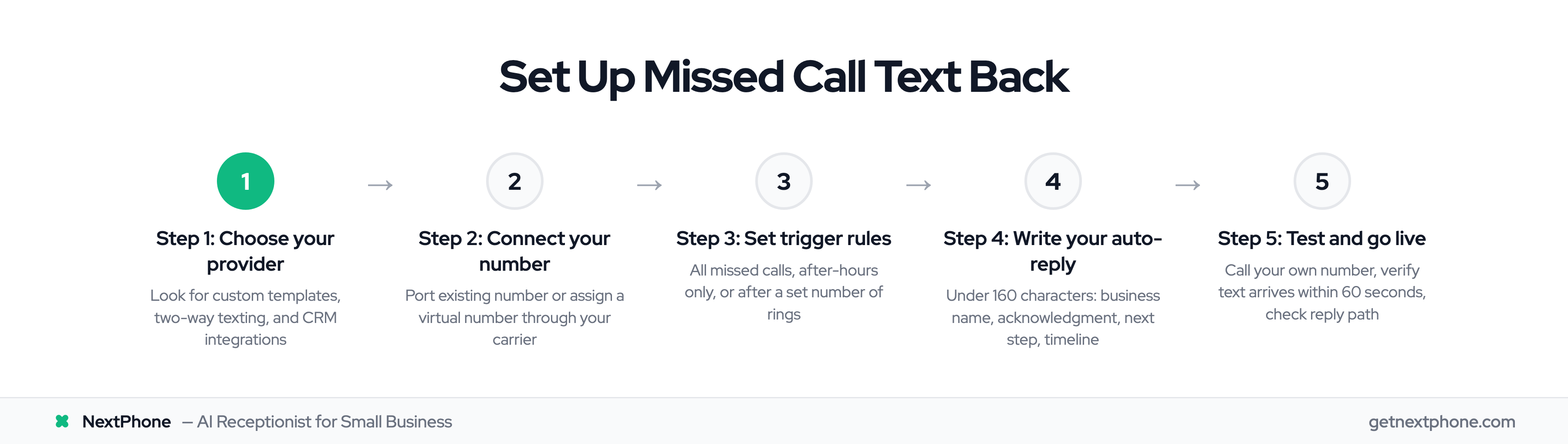
How to Set Up Missed Call Text Back (Step-by-Step)
Most providers follow a similar setup flow. Here's a provider-agnostic walkthrough you can follow with any text-back service.
Step 1: Choose Your Text-Back Provider
Options range from standalone text-back tools ($99-300/month) to full phone systems with built-in auto-reply. Key features to look for:
Step 2: Connect Your Business Phone Number
Most services let you either port your existing number or assign a virtual number that routes through your current line. If you use a VoIP system, check that the provider supports your carrier. The goal: callers see your primary business number, not a random 10-digit number.
Step 3: Set Trigger Rules
Configure when text-back activates:
All missed calls -- text every unanswered call regardless of time
After a set number of rings -- e.g., text only if unanswered after 4 rings
After hours only -- text when calls come in outside business hours
Specific caller types -- some systems let you filter by new vs. returning callers
Most contractors start with "all missed calls" and refine from there.
Step 4: Write Your Auto-Reply Message
Keep it under 160 characters so it sends as a single SMS. Include your business name, acknowledgment of the call, a clear next step, and a timeline. See the template section below for ready-to-use examples.
Step 5: Test and Go Live
Call your own business number and let it ring. Verify the text arrives within 60 seconds, reads correctly, and the reply path works. Test during business hours and after hours if you have different messages for each.
Auto Missed Call Text Back: Set It Once, Recover Leads on Autopilot
The "auto" in auto missed call text back is what makes it practical. Once you configure the trigger rules in Step 3 above, the text fires without any action on your part — whether you're on a job, in a meeting, or offline at 2 AM.
Most systems default to firing on every missed call, but you can narrow it:
All missed calls — the broadest capture; recovers leads around the clock
After hours only — text-back fires exclusively outside business hours; during-hours calls get handled live
After N rings — fires only when the call goes unanswered past a set ring count, useful if you pick up most calls but want a fallback for the overflow
The auto-trigger is what makes text-back scale. A service business handling 300 calls a month can't manually send texts to every caller who hit voicemail. The automation closes that gap in seconds — no staff, no overtime, no missed window.
For businesses where the phone tree itself creates drop-off before callers even reach you, see the guide to phone tree alternatives — pairing the right phone system with auto text-back reduces lead loss at the answer layer and the voicemail layer simultaneously.
Ready-to-Use Text-Back Templates
A generic "we missed your call" text won't cut it. Your auto-reply needs four things: your business name, acknowledgment of the call, a clear next step, and a timeline.
During Business Hours
"Hi, this is [Business Name]. Sorry we missed your call -- we're with another customer right now. Text us what you need or we'll call you back within 30 min."
After Hours
"Thanks for calling [Business Name]! We're closed for the day but got your call. We'll reach out first thing tomorrow morning. Need emergency service? Reply URGENT."
"Thanks for calling [Business Name]. For same-day emergencies (leaks, no power, no heat/AC), reply URGENT and we'll contact you within 10 minutes. For everything else, we'll follow up by [time]."
You can also pair these templates with an SMS follow-up automation workflow to handle the conversation that happens after the initial text.
Why Missed Call Text Back Matters for Small Businesses
The Speed-to-Lead Advantage
The InsideSales Lead Response Study found that conversion rates are 8x greater when you respond within 5 minutes. When you're on a roof, under a house, or driving between jobs, five minutes might as well be five hours. An auto-reply text buys you time by telling the caller you're on it.
Research shows 78% of customers buy from whichever company responds first. A text arriving 30 seconds after the missed call puts you in that "first responder" position even when you can't physically pick up. For more on why response time matters, see our breakdown of speed to lead data.
98% Open Rate vs. Voicemail
The numbers on SMS are hard to argue with:
98% open rate (compared to ~20% for email)
45% response rate (compared to 6% for email)
90% of texts read within 3 minutes
Average response time: 90 seconds
When you auto text missed calls, you're choosing the channel that almost guarantees the message gets seen. Voicemail can't compete with that.
24/7 Coverage Without Hiring
An automatic text when you miss a call works at midnight just as well as noon. No overtime pay. No answering service fees. Just a consistent acknowledgment whenever your phone rings and nobody picks up.
For contractors whose emergency calls spike at 2 AM (burst pipes, power outages, AC failures), this is especially valuable. If you're evaluating broader after-hours handling options, text-back is a strong starting point.
Cost-Effective Lead Recovery
Most missed call text back services run between $99 and $300 per month. Compared to losing even one $3,500 job to a missed call, the ROI is obvious. Industry research puts the missed-call rate for home services at 74.1% -- three out of every four potential customers calling someone else. Even recovering a fraction of those through text-back pays for itself many times over.
If you want to see how missed calls are affecting your business specifically, a click-to-call missed call analysis can give you the numbers.
Missed Call Text Back Pricing: GoHighLevel vs. Flat-Rate Plans
GoHighLevel's Missed Call Text Back ranks #1 for this search — and for good reason. It's well-built, easy to configure, and popular with agencies managing multiple locations. But the billing structure is worth understanding before you commit: GoHighLevel charges a platform subscription fee on top of per-segment SMS costs. Every outbound text adds to your monthly bill based on volume.
At low call volume, the per-SMS charges are manageable. At scale — a contractor running Google Local Services Ads with 300+ missed calls a month — SMS overage becomes a real budget line.
The flat-rate alternative: missed call text-back platforms like NextPhone include automated text-back as part of a fixed monthly plan from $199. No per-message fees. No per-minute charges. Whether you miss 20 calls a month or 200, the bill doesn't change.
One more difference: GoHighLevel texts after a call is already missed. NextPhone answers first — picking up in under 2 seconds, capturing the lead live — then sends a reinforcing text after the call. You're not choosing between answering and texting; you get both, at a predictable flat rate.
For a full side-by-side of what AI receptionist and text-back plans actually cost — NextPhone, Smith.ai, Ruby, and standalone tools — the AI receptionist pricing guide breaks down where the math tips.
Missed Call Text Back Software: How to Choose the Right Tool
Missed call text back software falls into three categories, and the differences matter at scale:
1. Standalone text-back tools (e.g., SlickText, SimpleTexting, Podium's SMS module)
Built for text messaging, not phone systems. Per-message pricing is typical: every outbound SMS adds to your monthly bill based on volume. Good for low-volume businesses; cost climbs meaningfully past 200 missed calls per month.
2. CRM-bundled text-back (e.g., GoHighLevel Missed Call Text Back, HubSpot workflows)
Included in the platform subscription, but SMS is still charged per segment on top. Best fit if you're already paying for the CRM and call volume is moderate. The configuration and trigger customization are solid, but the call itself still goes to voicemail — text-back runs after the missed call, not instead of it.
3. AI receptionist platforms with built-in text-back (e.g., NextPhone)
Answers the call first — picking up in under 2 seconds, 24/7 — then sends a follow-up text after the call for reinforcement. Flat monthly plan from $199 with no per-message charges regardless of volume. The distinction that matters: categories 1 and 2 respond to a missed call; category 3 prevents one.
For businesses where a single missed appointment, estimate request, or intake call translates to $500–$5,000 in lost revenue, the answering-first model has a materially different ROI profile than a pure text-back subscription. The AI receptionist pricing guide puts the per-tool math side by side.
Compliance and Best Practices
A few rules to keep you out of trouble:
Include your business name in the first text
Keep messages transactional (don't start selling in a missed call text)
Offer an opt-out option ("Reply STOP to opt out")
Don't send repeated texts to the same caller for the same missed call
Follow FCC/TCPA guidelines for all SMS communications
The good news: responding to someone who initiated contact by calling you is generally considered compliant. You're replying to their action, not cold-texting them. For a deeper look at phone answering best practices, including how texting fits into the bigger picture, we've written a full guide.
Text-back vs. AI answering: the real tradeoff
Text-back is a fallback. It runs after the call is already lost. AI answering replaces the missed call entirely — the phone rings, an AI receptionist picks up in under 3 seconds, asks the right qualifying questions, and either books / transfers / captures the lead before the caller has a chance to hang up.
A static text-back says "we'll get back to you." An AI receptionist asks "what kind of job is it, when do you need it, and what's the best number?" — captures the answers in plain English, drops them into your inbox, and then sends a follow-up text for reinforcement. You get both the acknowledgment and the qualified lead.
Hear it: NextPhone qualifying an inbound lead end-to-end
0:00
0:00
What replaces voicemail (and out-performs a text-back template) for service businesses — the AI captures contact info, urgency, and scope before the caller has a chance to hang up.
What the AI actually sounds like
If you're going to put a receptionist between your phone number and your callers, you should know what it sounds like before you ship it. Two representative voices from the production library:
Emma — warm, professional
0:00
0:00
Default pick for client-facing service businesses. Friendly, organized, trustworthy.
Chris — direct, confident
0:00
0:00
Default male pick. Direct without being stiff — works for trades, B2B, anywhere you want no fluff.
There are 28+ more voices in the production library if you want to match a specific brand tone. Whichever voice you pick, the script and the qualifying logic are the same.
When Text-Back Isn't Enough (and What to Add)
Missed call text back handles acknowledgment well, but there are scenarios where texting alone leaves gaps.
In our corpus of over 1,446,980 real inbound calls, urgency language like "emergency," "urgent," or "ASAP" shows up in a meaningful share of home services calls. A text promising a callback in 30 minutes doesn't solve a burst pipe flooding someone's basement. And even with a 45% SMS response rate, that means 55% of missed callers who receive your text still don't engage -- they saw it, read it, and called someone else.
These callers want a conversation, not a text thread.
The solution isn't to drop text-back. It's to layer it. AI phone answering picks up every call in real time, handles the conversation, captures caller info, and routes emergencies -- then sends a follow-up text after the call as reinforcement. This is the AI virtual receptionist approach: handle the conversation first, reinforce with text. The text becomes a value-add instead of a last resort. You can set up an AI answering service in 15 minutes alongside your existing text-back, or explore how an AI receptionist handles missed calls as a complement.
At $199/month with unlimited calls, a system like NextPhone that answers AND texts costs roughly the same as a mid-tier missed call solution for businesses that only covers texting. A callback tracking system helps you follow up on both channels.
Frequently Asked Questions
How fast does missed call text back respond?
Most systems send the text within 30-60 seconds of detecting a missed call. That's faster than you could call back manually. Some AI receptionists like NextPhone answer calls in under 3 seconds, eliminating the missed call entirely and making text-back a follow-up rather than a first response.
Is missed call text back legal?
Yes. Responding via text to someone who called you is generally compliant since they initiated contact. Keep your messages transactional (not promotional), include your business name, and offer an opt-out option like "Reply STOP to unsubscribe." Follow TCPA guidelines and avoid sending marketing content in these automated texts.
What should a missed call text back message say?
Include four things: your business name, acknowledgment of the call, a clear next step, and a timeline for follow-up. Keep it under 160 characters. Example: "Hi, this is Smith Plumbing. Sorry we missed you! Text us what you need or we'll call back within 30 min. Reply STOP to opt out."
Does missed call text back work for emergency calls?
Text-back acknowledges the call but doesn't solve urgent needs. Across our corpus of 1,446,980+ real business calls, urgency language like "emergency" or "ASAP" appears in a significant share of home services calls. For burst pipes, power outages, or AC failures, callers need an immediate voice response -- not a text promising a callback.
How much does missed call text back software cost?
Standalone text-back tools range from free (very limited) to $99-300/month for business-grade solutions with customizable templates and integrations. AI receptionists that answer calls AND send follow-up texts run $199-500/month. NextPhone offers both capabilities at $199/month with unlimited calls and 24/7 coverage — flat rate, no per-minute or per-message rounding.
Can missed call text back replace an answering service?
Text-back handles one piece of the puzzle -- acknowledgment. But it can't answer questions, capture detailed information, qualify leads, or route emergencies to your phone. AI receptionists cover all of this plus send follow-up texts, making them a more complete replacement for traditional answering services at a fraction of the cost.
Will callers get annoyed by automated texts?
Most callers appreciate the acknowledgment. It signals professionalism and responsiveness. The key is keeping messages personal (use your business name), limiting texts to one per missed call (don't spam repeat callers), and making the next step clear. Research shows 90% of consumers prefer texting with businesses, so the channel itself isn't the issue -- it's the content that matters.
What is a missed call auto-reply, and how is it different from text-back?
A missed call auto-reply is an automated SMS triggered by a missed call — functionally the same thing as text-back, just framed from the system's perspective. The terms are interchangeable in most contexts. The technical distinction: text-back describes the action (you text back a caller who rang), while auto-reply describes the mechanism (the system automatically replies without any manual step). Both refer to the same technology. What matters is the configuration: auto-reply rules let you fire different messages based on time of day, caller type, or whether it's a repeat caller — so your after-hours auto-reply can be different from your mid-day one. If you're comparing tools, look for per-trigger customization, not just whether they send a text at all.
Which apps can automatically text back missed calls?
Dedicated missed call text-back apps include tools built into CRM platforms (e.g., Go High Level's Missed Call Text Back), standalone SMS tools like Podium, SimpleTexting, and SlickText — these typically run $99–$300/month for text-only plans. Most VoIP systems (RingCentral, OpenPhone, Google Voice) include basic auto-reply as an add-on. The category to know: AI receptionists. Instead of texting after the call is already lost, an AI receptionist answers in under 3 seconds and captures the lead live — then sends a follow-up text for reinforcement. NextPhone ($199/month flat, unlimited calls) does both: answers calls 24/7 and sends a follow-up SMS after every call. For law firms and contractors where a single missed call can mean a $3,500–$10,000 lost case or job, the text back missed call app that works best is one that catches the call before it's missed.
Get Started with Missed Call Text Back
With 85% of missed callers never trying again, an instant auto-reply text is the simplest way to hold leads until you can follow up. For most small businesses, it pays for itself within the first week.
Set it up using the steps above, customize your templates for your business, and start recovering leads you're currently losing to silence. See how professional voicemail greetings stack up against what callers actually respond to, or read the best AI receptionist comparison.
Try NextPhone AI answering service
AI answering service that answers, qualifies, and books — 24/7.