Key Takeaways
- The average small business misses 74% of incoming calls - that's nearly 3 out of every 4 potential customers never getting through
- Each missed call costs between $200-$3,500 depending on your industry, adding up to $100,000+ in lost revenue annually
- Voicemail isn't the solution - 80% of callers hang up without leaving a message and call your competitor instead
- The most effective strategies combine technology (call forwarding, AI) with process changes (designated answer times, callback windows)
- You can reduce missed calls by 90%+ with the right combination of solutions, without hiring additional staff
Introduction
Here's a number that should keep every small business owner up at night: 74.1%.
That's the percentage of incoming calls that go completely unanswered for the average contractor. Not sent to voicemail. Not forwarded to a cell phone. Just... missed.
If you're reading this, you probably already know your business misses calls. What you might not realize is just how many opportunities walk away every time your phone rings and nobody answers. That customer needed a plumber today. They needed a roofer this week. They had budget approved and were ready to hire.
Now they're calling someone else.
This guide breaks down exactly why businesses miss so many calls, what it's actually costing you, and nine proven strategies to fix the problem - ranked by effectiveness. Whether you're a solo operator who can't answer while on a job site or a small team spread too thin, there's a solution here that fits your situation.
Let's stop the bleeding.
The Missed Call Problem - Worse Than You Think

If you asked most business owners how many calls they miss, they'd guess maybe 20-30%. A test of top 74 real estate brokerages found 41% didn't respond to leads at all. The reality is dramatically worse.
The Numbers Don't Lie
Industry research from Invoca reveals a sobering statistic: 74.1% of calls to home services contractors go completely unanswered, costing significant revenue. Industry data shows SMBs answer only 37.8% of inbound calls—62% go unanswered. That's not an outlier. That's not the worst performers. That's the average.
Think about what that means. If your business gets 40 calls per month - a typical volume for a small contractor - you're missing roughly 30 of them. Thirty potential customers who wanted to hire you, had money to spend, and never got to talk to anyone.
Industry research backs this up: 85% of customers whose calls aren't answered won't call back. They don't leave voicemails and wait patiently. They call the next number on their list.
It's Not Just You
Here's the uncomfortable truth: this problem is nearly universal among small service businesses.
Contractors get hit hardest because of the nature of the work. You can't answer a phone call while you're on a roof, in an attic, under a sink, or working with electrical panels. Your hands are busy. Your focus is on the job. And while you're doing the work that pays the bills, potential new work is calling and hanging up.
But it's not limited to trades. Any business where the owner or key staff are busy serving existing customers faces the same challenge. You're damned if you don't answer (lose new business) and damned if you do (interrupt current business).
The average contractor receives about 42 calls per month. At a 74% miss rate, that's 31 missed opportunities - month after month.
Why Businesses Miss So Many Calls
Understanding why calls get missed is the first step to fixing the problem. The causes aren't complicated, but they're persistent.
You're Busy Actually Working
This is the core issue for contractors and tradespeople. You can't answer a phone while you're running a circular saw, soldering pipes, or installing a ceiling fan. The phone rings. You hear it (maybe). You can't answer it. By the time you get to a stopping point, the caller has moved on.
The irony isn't lost on anyone: the harder you work, the more calls you miss. Success creates its own constraints.
Limited Staff, Unlimited Calls
Solo operators have nobody else to answer. Small teams are usually all occupied with existing customers or jobs. Unlike big companies with dedicated receptionists, small businesses don't have the luxury of someone whose only job is answering phones. American Bar Association research shows law firms now answer only 40% of phone calls (down from 56% in 2019), and only 33% respond to emails.
When everyone is "doing the work," the phone goes unanswered.
The After-Hours Gap
About 30% of business calls come outside traditional business hours - early mornings, evenings, weekends. Hiya's research shows ~30% of calls to mobile phones are spam, but the remaining 70% are potential business. These are often the most motivated callers: people dealing with emergencies, researching after their own workday ends, or trying to catch you before heading to their own jobs.
But if your business "closes" at 5 PM, those calls hit voicemail. And we know how that ends.
Voicemail Doesn't Count as Answering
This is where most business owners are fooling themselves. They think, "Well, the call went to voicemail - they can leave a message."
Here's the reality: over 80% of callers hang up when they reach voicemail. They don't leave messages anymore. Voicemail statistics show an average response rate of just 4.8%—meaning most voicemails simply don't lead to business. Customer expectations have fundamentally changed. People want immediate answers or they move on to someone who picks up.
Voicemail isn't a safety net. It's a polite way to lose customers.
The Real Cost of Every Missed Call
Let's talk about money. This isn't just an inconvenience issue - it's a revenue hemorrhage. Research shows a single missed call costs an average of $12.15, and SMBs lose $26,000+ per year from missed calls.
The Math That Matters
Here's the formula every business owner should know:
Monthly missed calls x Your close rate x Average job value = Lost revenue
Let's run some examples:
Plumber:
- 50 calls/month, 74% missed = 37 missed calls
- 30% close rate = 11 would-have-been-jobs
- $500 average service call
- Lost revenue: $5,500/month or $66,000/year
General Contractor:
- 42 calls/month, 74% missed = 31 missed calls
- 20% close rate = 6 would-have-been-jobs
- $3,500 average project
- Lost revenue: $21,000/month or $252,000/year
- 60 calls/month, 74% missed = 44 missed calls
- 25% close rate = 11 would-have-been-jobs
- $1,200 average emergency job
- Lost revenue: $13,200/month or $158,400/year
These aren't theoretical numbers. This is real money walking out the door every month. The problem affects every industry: 35% of law firm calls go unanswered, costing the legal industry an estimated $109 billion annually.
Missed phone calls are dental offices' largest revenue loss/blog-articles/2025/Why_missed_phone_calls_are_dental_offices_largest_revenue_loss). Healthcare practices face similar challenges, with 15-24% revenue reduction from missed and delayed inquiries.
Speed Wins: Why First Responder Closes the Deal
Here's a stat that should terrify you: 78% of customers buy from whoever responds first.
Not the cheapest. Not the most experienced. Not the one with the best reviews. The first one to actually talk to them. HBR's foundational study on online sales leads found companies that respond within 1 hour are 7x more likely to qualify leads—and audited 2,241 US firms with an average response time of 42 hours.
That customer who called at 10:15 AM? They've already called two other contractors by 10:20. The one who picks up first gets the job. The others don't even get a chance to quote.
When you miss a call, you're not just losing that one opportunity. You're actively handing it to your competitor. 90% of customers rate immediate response as critical, with 60% defining immediate as less than 10 minutes. 52% stop purchasing due to slow response times.
The Annual Impact
Analysis of contractor call patterns shows average losses of $189,068 per contractor per year due to missed calls. That's not a typo. Nearly $200,000 in annual revenue - gone - because phones ring unanswered. Accenture surveyed 7,000 customers and found customer service is on the brink—businesses that don't answer are losing customers permanently.
Even if your business is smaller or your job values lower, the principle holds. Every missed call has a dollar value. And those dollars add up fast.
9 Proven Strategies to Reduce Missed Calls
Now for the solutions. These strategies are ranked roughly by effectiveness and complexity. Start with the quick wins, then work your way up as needed.
Strategy 1: Set Up Proper Call Forwarding (Quick Win)
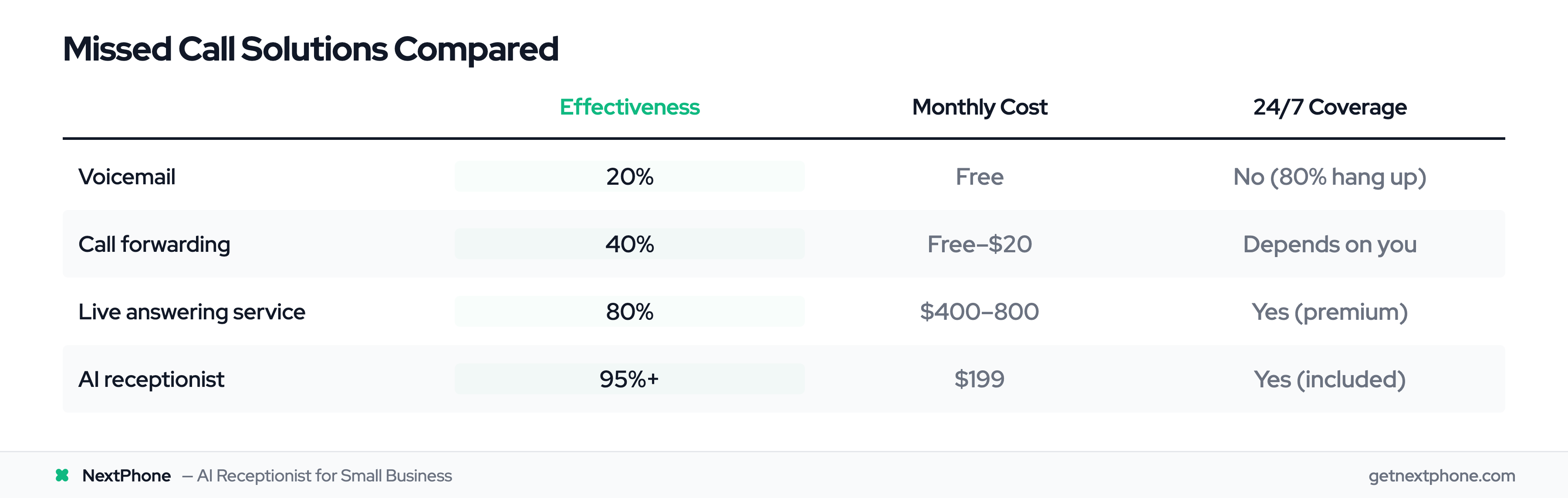
Effectiveness: 40% improvement Cost: Free - $20/month Best for: Everyone (do this today)
The simplest fix: make sure calls can reach your cell phone when you're away from the office line. Most phone systems and carriers offer basic call forwarding. Set it up to ring your mobile after 2-3 rings on the main line.
This doesn't solve the "I can't answer while working" problem, but it eliminates the "I missed it because I wasn't at my desk" problem.
Strategy 2: Optimize Your Voicemail (Better Than Nothing)
Effectiveness: 20% improvement Cost: Free Best for: Everyone (but don't rely on it)
Since voicemail catches the 20% who will leave messages, make it work:
- Keep the message under 15 seconds
- State your callback timeframe ("I'll return calls within 2 hours")
- Actually return calls within that timeframe
- Consider offering a text option ("Text me at this number for faster response")
Just understand that 80% of callers will still hang up. Voicemail is a backup, not a solution.
Strategy 3: Designate "Phone Time" Windows (Free)
Effectiveness: 30% improvement Cost: Free Best for: Solo operators, flexible schedules
Block two or three 15-minute windows throughout the day specifically for phone duties. Return missed calls, check voicemails, respond to texts. Protect these windows like appointments.
Common windows: 8:00-8:15 AM, 12:00-12:15 PM, 4:45-5:00 PM. Structure beats willpower.
Strategy 4: Use a Business Phone App (Low Cost)
Effectiveness: 50% improvement Cost: $20-50/month Best for: Mobile workers
Apps like Grasshopper, OpenPhone, or Google Voice give you a dedicated business number that rings on your personal phone. You can answer from anywhere, and the caller sees your business number, not your personal cell.
Some apps include basic features like auto-reply texts when you can't answer: "Thanks for calling [Business]. I'm with a customer right now but will return your call within 30 minutes."
Strategy 5: Hire Part-Time Phone Help (Moderate Cost)
Effectiveness: 60% improvement Cost: $500-1,500/month Best for: Growing businesses with call volume
A part-time employee or family member who handles phones during peak hours (typically 9 AM - 2 PM) can make a significant dent. They don't need trade expertise - just the ability to take messages, schedule appointments, and route urgent calls.
The challenge: finding reliable part-time help, training them, and managing when they're sick or unavailable.
Strategy 6: Use a Live Answering Service (Higher Cost)
Effectiveness: 80% improvement Cost: $400-800/month Best for: Businesses needing human touch, complex calls
Professional answering services employ trained receptionists who answer in your business name 24/7. They can take messages, schedule basic appointments, and route urgent calls.
The downsides: per-minute or per-call pricing adds up fast, and you're dependent on their staff's availability and quality. Expect the base price to be 50-100% higher in reality due to overages. Healthcare Contact Center Survey 2024 shows even dedicated call centers struggle with volume fluctuations.
Strategy 7: Implement Callback Protocols (Free)
Effectiveness: 40% improvement Cost: Free Best for: Teams with any flexibility
Create a formal policy: all missed calls returned within 5 minutes when possible, 30 minutes maximum. Assign accountability. Track results.
The 78% first-responder stat means speed is everything. Even if you can't answer live, beating your competitor to the callback wins jobs -- speed to lead is everything.
Strategy 8: Extend Your "Hours" (Process Change)
Effectiveness: 30% improvement Cost: Your time Best for: Businesses missing after-hours calls
If you're losing calls at 7 AM and 6 PM, consider shifting your availability. Answer phones starting at 7 AM instead of 9 AM. Be available until 7 PM instead of 5 PM. Weekend availability - even just a few hours Saturday morning - can capture calls competitors miss.
This isn't sustainable long-term, but it highlights why 24/7 coverage matters. AI-powered solutions are increasingly used for lead qualification across industries—providing the 24/7 coverage businesses need without the burnout.
Strategy 9: Use AI-Powered Call Answering (Best Value)
Effectiveness: 95%+ improvement Cost: $199/month Best for: Most small businesses
AI virtual receptionists represent the modern solution to this age-old problem. Unlike voicemail (which people ignore) or call forwarding (which still requires you to answer), AI actually answers and engages with callers.
How it works: The AI answers in your business name, understands what the caller needs, collects their information, determines urgency, and sends you a detailed message. Emergency calls get forwarded immediately. Spam gets filtered out.
The result: Every call answered, 24/7, without you lifting a finger.
NextPhone offers this at $199/month flat - unlimited calls, no per-minute charges, no setup fees. Compare that to live answering services at $500-800/month or part-time help at $1,000+ per month, and the value is clear.
For a business missing 30+ calls per month, capturing even a few additional jobs more than covers the cost.