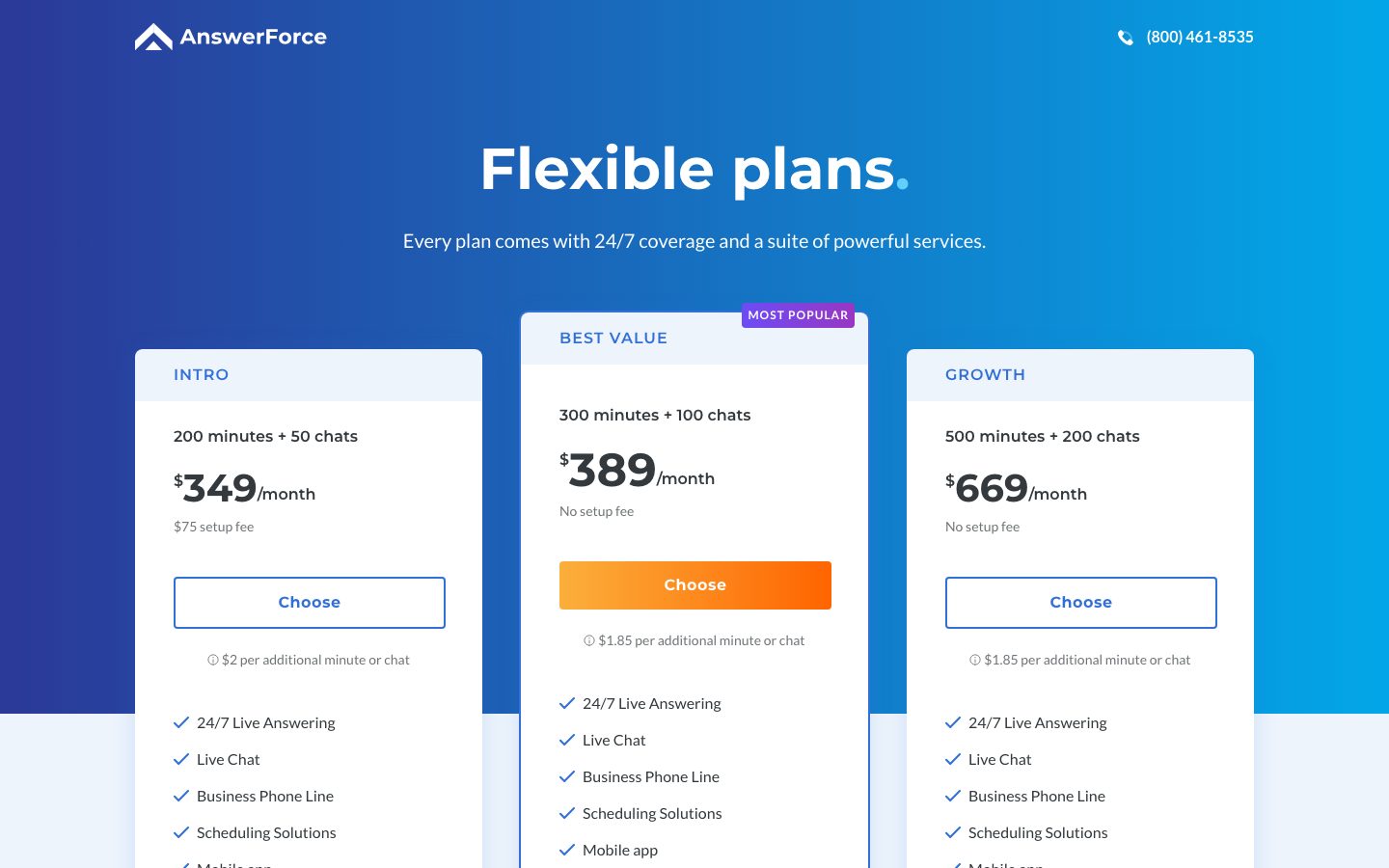
If you're comparing AnswerForce, the number you want is the overage rate, and it's $2.00 per additional minute on the entry plan.
NextPhone runs flat monthly plans from $199 with no per-minute charge at any volume, which is the short answer for most businesses leaving a minutes-bucket plan. The rest of this covers what AnswerForce actually costs, where they publish it, and five other options.
Last updated: August 2026. US pricing from AnswerForce's own published price sheet. Confirm current pricing before signing.
AnswerForce pricing
Prices checked against each provider's own pricing page on October 5, 2026.
| Plan | Included | Monthly | Setup | Per extra minute |
|---|---|---|---|---|
| Intro | 200 min + 50 chats | $349/month for 200 minutes | $75 | $2.00 |
| Best Value | 300 min + 100 chats | $389/month for 300 minutes | None | $1.85 |
| Growth | 500 min + 200 chats | $669/month for 500 minutes | None | $1.85 |
The ladder continues at $1.85 a minute past the allowance behind "View larger plans": 800 minutes for $1,069, then $1,339/month for 1,000 minutes, 1,500 minutes for $1,999 and 2,000 for $2,599, and upward (read October 7, 2026).
Two billing details from the same page, worth knowing before you model anything:
"No charge for the first 30 interactions under 30 seconds per billing cycle. All interactions are billed per-minute and rounded up to the nearest minute."
The free short-call allowance is genuinely useful: 30 wrong numbers or hang-ups a month cost nothing. Rounding up to whole minutes cuts the other way: a 61-second call bills as two minutes.
Credit where it's due, and the odd part
AnswerForce publishes a complete price sheet with no form and no login. In an industry where most competitors make you book a call to learn a number, that's better than the norm and worth saying.
The odd part is where it lives. The price sheet is at answerforce.com/plans-direct, and nothing on the site links to it. /pricing redirects to the homepage. /plans is a lead capture form. The footer's "Plans & pricing" link goes to the form. Every "See Prices" button goes to the form.
So the real numbers are public and reachable only if you already know the URL. Whether that's deliberate or a leftover from a redesign, the practical effect is the same: most people who try to find AnswerForce's pricing end up filling in a form.
The 90-day minimum
AnswerForce and AnswerConnect are both AnywhereWorks, Inc., and share terms of service. That agreement says:
"This Agreement will be in effect for a minimum period of 90 calendar days... either you or AW may terminate this Agreement at any time, for any or no reason, upon written notice."
Meanwhile AnswerConnect's own pricing PDF, page 4, says:
"We keep it simple. No hidden fees, no contracts, no notice period."
A 90-day minimum with a written-notice requirement is a contract with a notice period. Both documents are published by the same company.
The same PDF also disagrees with itself on setup fees: the Growth plan card on page 4 says "No setup fee," while a footnote on page 5 says every plan includes a one-time setup fee. (AnswerConnect has since stopped publishing prices: as of October 5, 2026 its pricing page is a quote form.)
None of this is unusual for the category. It matters because you're comparing plans, and the sticker price is not the thing you'll pay.
What AnswerForce is genuinely good at
They answer with trained humans, around the clock, and they've been doing it a long time. The receptionists handle live call answering, appointment scheduling, order taking and lead capture, and the platform behind them is mature: the mobile app is properly built, with real-time message access and an availability status you control from your phone.
They also integrate widely, including with the field service tools their customer base actually uses. For a business that wants a human voice and has predictable call volume that fits inside a plan, they do the job well.
One thing most comparisons miss
AnswerForce is one of seven answering-service brands run by AnywhereWorks: AnswerConnect (general business), AnswerForce (trades and general), LEX Reception (legal), WellReceived (medical), SignMore (real estate), ServiceForge (contractors) and HelloSells (lead qualification).
They're not seven products so much as seven front doors. The app store listings describe near-identical feature sets, and the terms of service are shared. What varies between them is the brand, the vertical vocabulary and the price sheet.
That's not a criticism; it's efficient, and the shared platform is why the app is as good as it is. But if you're comparing AnswerForce against AnswerConnect or LEX Reception to find the best fit, you're mostly comparing marketing. The service underneath is the same company, and so are the terms.