
Your phone rings while you're installing a new HVAC system in a Lake Oswego home. By the time you pull off your gloves and wipe the sweat from your eyes, the caller has hung up. They've already dialed the next contractor on their list - one with a local 503 number who answered on the first ring.
This happens more often than most Portland business owners realize. The Portland metro area faces unique economic pressures right now. According to the Portland Metro Chamber's 2025 State of the Economy report, Portland region employment declined 0.59% while national employment grew 1.34%. When every customer counts, missing calls isn't just inconvenient - it's potentially devastating.
The good news? You don't need to hire a full-time receptionist or pay hundreds for traditional answering services. This guide shows you how to get a professional Portland 503 number with AI-powered answering for a fraction of what your competitors pay.
What the 503 Area Code Covers (And Why It Matters)
503 Area Code Coverage
The 503 area code is Portland's original telephone code, established back in 1947. It covers a substantial portion of northwestern Oregon, including:
- Portland and its surrounding neighborhoods
- Beaverton, Hillsboro, and the Silicon Forest corridor
- Lake Oswego, Tigard, and Tualatin
- Salem (Oregon's capital)
- Oregon City, Milwaukie, and Clackamas
- The northern Oregon coast
That's roughly 2.5 million people in the Portland metropolitan area who recognize 503 as their local code.
503 vs 971: What's the Difference?
In 1999, Oregon added the 971 overlay code to the same geographic area. Both codes cover identical territory - the only difference is when they were assigned. A 503 number isn't "better" than 971, but many long-established Portland businesses use 503, and it remains the code most associated with the Portland area.
When choosing a business number, either works fine. Pick based on what's available and memorable.
Why Local Numbers Build Trust
Here's something that directly affects your bottom line: local phone numbers get answered more often than toll-free or out-of-state numbers.
According to caller ID research from Hiya, local numbers see 60-70% answer rates compared to just 40-50% for toll-free numbers. That 20-30 percentage point difference matters when you're trying to reach customers.
When a homeowner in Beaverton sees a 503 number calling back about their quote request, they pick up. When they see an 800 number or an area code from another state, many assume it's a sales call or spam and let it ring.
A local Portland number signals something simple but powerful: "We're here. We're local. We're part of this community."
Why Portland Businesses Can't Afford to Miss Calls
The Missed Call Epidemic

Most business owners drastically underestimate how many calls they're missing.
Industry research puts the missed-call rate for home services contractors at 74.1%, with those calls going completely unanswered. That's nearly three out of every four potential customers reaching voicemail instead of a person (or an AI that can actually help them).
For a typical Portland contractor receiving around 42 calls per month, that means 31 missed opportunities every single month.
What Happens When Callers Reach Voicemail
Here's where the economics get brutal. Industry research found that 85% of callers who don't reach someone will never call back.
They don't leave a message. They don't wait. They call the next business on their list.
One Portland plumber we spoke with put it this way: "I didn't even know I was missing that many calls until I saw the data. I just thought business was slow."
Portland's Economic Reality
Portland's small businesses face tougher conditions than most of the country right now. With regional employment lagging the national average, every customer interaction matters more than usual.
Consider this calculation for a typical home services contractor:
- 42 calls per month average
- 74.1% go unanswered = 31 missed calls
- If just 20% would have converted at $3,500 average job value
- That's $21,700 per month in lost revenue
Over a year, that adds up to $260,400 walking out the door. And emergency calls - the ones with urgency in the caller's voice - average $4,200 per job, even higher than routine work.
Missing one emergency call per week could mean $16,800 per month in lost revenue.
Answering Service Options for Portland Businesses
Portland businesses have several options for ensuring their phones get answered. The choice comes down to cost, capability, and what fits your business.
Traditional Live Answering Services
Traditional answering services employ human operators who answer calls on your behalf. They've been around for decades and work well for certain situations.
What you get:
- Real people answering calls
- Message taking and basic call routing
- Some services offer appointment scheduling
- Typically 24/7 coverage available (at higher cost)
What you pay:
- Base plans: $350-500+ per month
- Per-minute charges: $0.75-1.25 per minute of talk time
- Setup fees: Often $50-100
- Holiday and after-hours premiums
The per-minute charges add up fast. A busy Portland HVAC company taking 200+ calls during a summer heat wave could see bills exceeding $500-600 for the month, well beyond the base price.
AI-Powered Answering Services
AI answering services use conversational artificial intelligence to handle incoming calls. The technology has improved dramatically - modern AI can carry on natural conversations, understand context, and handle most routine inquiries without human intervention.
What you get:
- Instant call answering (under 5 seconds)
- 24/7/365 coverage without overtime charges
- Unlimited concurrent calls
- Consistent quality on every call
- Appointment scheduling, FAQ handling, call routing
What you pay:
- Flat monthly fee: $99-299 depending on provider
- Usually unlimited calls included
- No per-minute charges
- No setup fees with most providers
Pricing Comparison: What Portland Businesses Pay
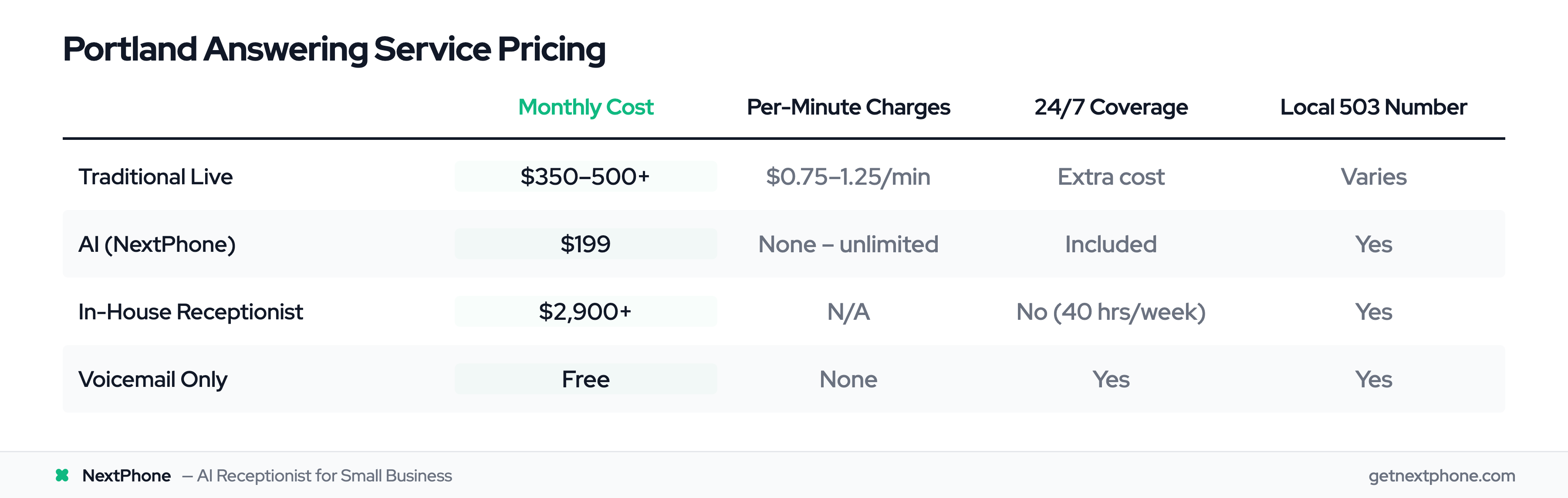
| Service Type | Monthly Cost | Per-Minute Charges | 24/7 Coverage | Local 503 Number |
|---|---|---|---|---|
| Traditional Live | $350-500+ | $0.75-1.25/min | Extra cost | Varies |
| AI (NextPhone) | $199 | None - unlimited | Included | Yes |
| In-House Receptionist | $2,900+ | N/A | No (40 hrs/week) | Yes |
| Voicemail Only | Free | None | Yes | Yes |
The math favors AI for most small businesses. A detailed pricing comparison shows that AI answering typically costs 40-60% less than traditional live services while delivering faster, more consistent performance.
AI vs Live Answering: Which Is Right for Your Portland Business?
This isn't about which is "better" in absolute terms. It's about which fits your specific situation.
Where AI Answering Excels
AI answering services shine in several areas:
Speed: AI answers calls in under 5 seconds. Traditional services often take 15-30 seconds or longer as operators finish other calls.
Consistency: Every call gets the same quality of service. No off days, no training issues, no turnover problems.
Availability: True 24/7/365 coverage without overtime, holiday premiums, or scheduling challenges.
Scalability: Whether you get 1 call or 100 calls simultaneously, AI handles them all. No busy signals, no "please hold."
Cost: Flat-rate pricing means predictable monthly costs. Busy months don't blow up your budget.
For routine inquiries - "What are your hours?" "Do you service my area?" "Can I schedule an appointment?" - AI handles these efficiently and accurately.
When You Might Need Live Agents
Some situations still call for human touch:
Complex complaints: When someone is genuinely upset, human empathy matters.
Unusual situations: Creative problem-solving for edge cases that don't fit standard scripts.
Sensitive industries: Certain legal or medical situations may require human judgment.
Personal preference: Some business owners simply prefer knowing a human answers.
The Hybrid Approach
The most effective strategy for most small businesses combines both.
AI serves as your first line of defense, handling the 60-80% of calls that are routine: hours, pricing, scheduling, basic questions. When a call requires human attention - complex issues, VIP customers, emergencies - it transfers directly to you or your team.
You get 24/7 coverage without paying for live operators to answer "What time do you close?" at 2 AM.
According to Gartner research, 60-70% of customers are now comfortable interacting with AI for simple tasks. That number keeps climbing as the technology improves.