
Ruby Receptionists vs AI: The Cost of Growth
You started with Ruby Receptionists when you were getting 50 calls a month. The bill was $250 for their 50-minute plan. Friendly human receptionists, professional service, everything worked great. Then business started booming. You're up to 150 calls monthly now. Last month's Ruby bill: $720 — and that's before overages.
Welcome to the cost-of-growth dilemma that thousands of small businesses face with traditional answering services. Looking for a Ruby Receptionists alternative that costs less and scales better? Here's the full comparison.
Ruby Receptionists is the gold standard in human answering services. They're not the problem. Their hybrid human+AI model delivers excellent service. But their per-minute pricing model creates a tough reality: as your business succeeds and call volume grows, your answering service bill grows with it.
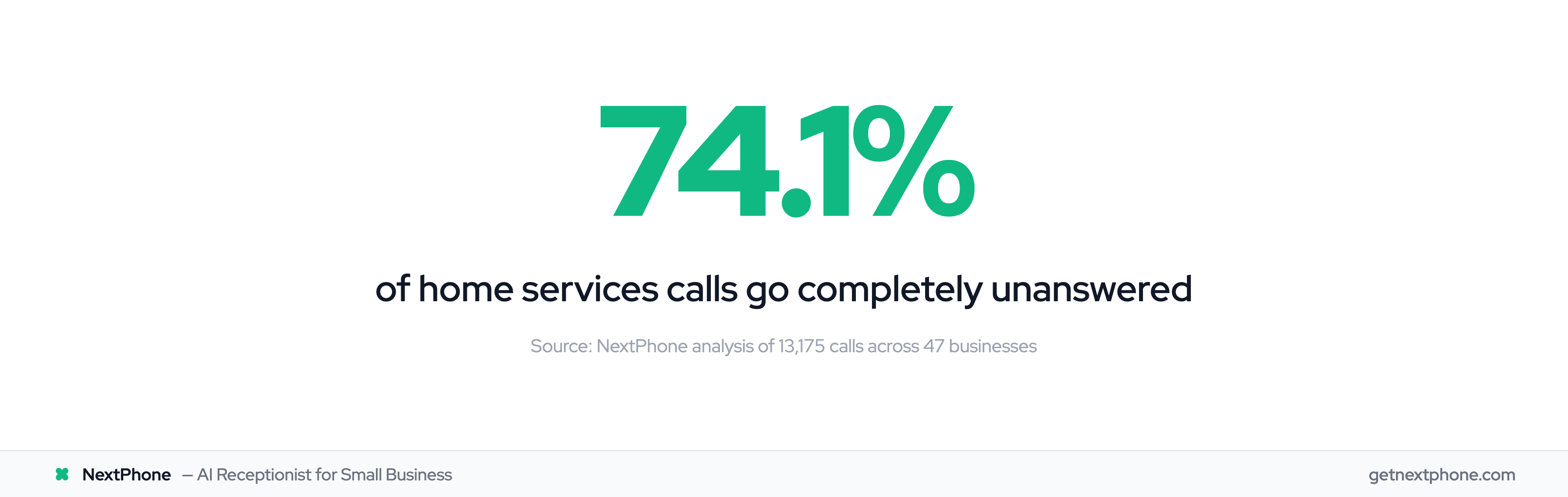
In our analysis of 130,175 customer service calls from 45 home services businesses, 74.1% went completely unanswered. Industry research confirms 62% of calls to home services businesses go unanswered, costing significant revenue. You need an answering service. The question is: which model makes financial sense as you scale?
This post compares Ruby's proven hybrid approach with AI-first receptionists. We'll look at real costs at different call volumes, honestly assess where each approach wins, and help you decide when it makes sense to switch.
What is Ruby Receptionists? Understanding the Hybrid Human+AI Model
How Ruby Works (Live Receptionists + AI Tools)
Ruby Receptionists is the largest live answering service in the United States, serving over 14,000 businesses since 2003. Their hybrid model combines live human receptionists with AI-powered tools.
When someone calls your business, a real person answers. That receptionist has access to AI tools that help them schedule appointments, log information, and follow scripts customized for your business. The human handles the conversation, while AI assists with data entry and scheduling logistics.
This hybrid approach differs from both pure human services (no AI assistance) and AI-first services (no humans involved in answering).
What Ruby Does Well
Ruby has built a strong reputation for personalized service. Their receptionists are friendly, trained on your business, and equipped to handle complex scenarios. According to customer reviews on Trustpilot, users consistently praise the professionalism and warmth of Ruby's team.
Where Ruby genuinely excels:
Complex screening: If you need multi-step qualification (budget questions, timeline discussions, authority verification), Ruby's human receptionists navigate these conversations naturally.
Empathy and de-escalation: When a caller is upset, frustrated, or dealing with an emergency, Ruby's receptionists use emotional intelligence to calm situations and represent your brand professionally.
Off-script scenarios: When callers have unusual requests or questions outside your normal business scope, human judgment handles ambiguity better than current AI.
Brand representation: For luxury brands, high-end services, or businesses where human touch is part of the value proposition, Ruby's receptionists feel like an extension of your team.
Ruby's Market Position
Ruby is the industry leader for a reason. They've refined the answering service model over two decades. PCMag's review of answering services notes that "Ruby stands out for personalized service" among competitors.
But market leadership comes at a price. Let's look at how that pricing works.
How Ruby's Per-Minute Pricing Works (And When It Adds Up)
Ruby's Pricing Structure
Ruby uses per-minute pricing rather than a flat monthly rate. According to Ruby's official pricing page, their published plans are:
- 50 receptionist minutes: $250/month
- 100 receptionist minutes: $395/month
- 200 receptionist minutes: $720/month
- 500 receptionist minutes: $1,725/month
Overages beyond your plan's included minutes are billed at per-minute rates. After-hours calls (evenings, weekends) and holiday coverage add premium pricing on top of these base rates.
How Per-Call Charges Accumulate
The per-minute model means your monthly bill fluctuates with volume. A slow month costs less. A busy month costs significantly more.
One Reddit user in r/smallbusiness shared: "Ruby was great when I had 30 calls/month, but now I'm getting 150+ and my bill is insane. Started at $300/mo, now paying $800 in busy months. Didn't realize per-minute charges would add up so fast."
This isn't Ruby's fault. Per-minute pricing makes sense for their cost structure — human operators are a variable cost. But it creates budgeting challenges and a growth penalty for customers.
The Cost Scaling Challenge
Here's the fundamental tension: as your business succeeds and gets more calls, your answering service bill climbs. During your best months (peak season, successful marketing campaign, storm creates emergency demand), you pay the most.
Scenario: You're a roofing contractor. Storm season hits. You get 200 calls in one week instead of your normal 50 per month. You blow past your 50-minute plan ($250) and rack up overage charges, pushing the bill to $900-1,000+ for that month alone.
For businesses with consistent low call volume (30-50 calls/month), Ruby's pricing works fine. But once you consistently hit 80-100+ calls monthly, the economics start favoring flat-rate vs per-minute pricing models.
AI-First Receptionists: The Flat-Rate Alternative
What is AI-First Approach?
AI-first receptionists use voice AI to handle the entire conversation - no humans involved in answering calls. This differs from Ruby's hybrid model where humans answer and AI assists.
Modern voice AI isn't the robotic "press 1 for sales" IVR system from the 1990s. It's conversational AI that understands natural language, asks follow-up questions, and adapts to the conversation flow. 85% of customer service leaders plan to pilot conversational generative AI in 2025.
How AI Receptionists Work
When someone calls your business with an AI-first service:
- Instant answer: AI picks up in under 5 seconds (no ring time or hold music)
- Natural conversation: AI asks questions conversationally ("What can I help you with today?")
- Information collection: AI gathers name, phone, email, service needed, urgency, budget - whatever you've configured
- Integration: AI automatically logs data to your CRM, sends SMS confirmations, books appointments
- Human transfer: If the call is complex or caller requests it, AI transfers to you directly
The key difference: Ruby equals human with AI tools. AI-first equals AI with human backup.
For more details on how AI receptionists work, the technology handles routine calls autonomously while routing edge cases to humans.
Key Differences from Hybrid Model
For a broader look at how different services stack up, see our virtual receptionist comparison. Here's how AI-first differs from Ruby's hybrid model specifically:
Pricing: AI-first services typically charge flat monthly rates ($199-299) regardless of call volume. Unlimited calls, no overages.
Capacity: AI handles unlimited simultaneous calls. During a surge, 100+ callers can all reach the AI at once. Ruby's capacity is limited by how many human operators are available.
Consistency: AI delivers identical quality on call 1 and call 1,000. Humans have great days and rough days, training ramp periods, and individual skill variations. McKinsey research shows AI can improve customer service productivity by 30-50% through this consistency.
Speed: AI answers in <5 seconds. Ruby's answer time varies based on operator availability and queue.
Integration: AI integrates natively with CRMs via webhooks, automatically syncing data. Ruby requires manual entry or custom integration setup.
The Real Cost Comparison: Ruby vs AI at 50, 100, 200, and 500 Calls
Let's look at actual costs using Ruby's published pricing and realistic call volumes.
Cost at Low Volume (50 calls/month)
Ruby: $250/month (50-minute plan, assuming ~1 min/call) NextPhone: $199/month (flat rate) Monthly savings with AI: $51 Annual savings: $612
At low volume, Ruby remains competitive. You're paying a $51/month premium for human touch, which might be worth it depending on call complexity. But if your calls average over 1 minute, you'll hit overages fast.
Cost at Medium Volume (100 calls/month)
Ruby: $395/month (100-minute plan) — and that's if calls average 1 minute. Longer calls push you into overages. NextPhone: $199/month Monthly savings with AI: $196 Annual savings: $2,352
At 100 calls/month, AI becomes notably cheaper. You're saving enough annually to invest in marketing or equipment.
Cost at High Volume (200 calls/month)
Ruby: $720/month (200-minute plan) — again, assumes 1-minute average. Realistically higher with overages. NextPhone: $199/month Monthly savings with AI: $521 Annual savings: $6,252
At 200 calls/month, the math strongly favors AI unless every call requires complex human judgment. For a deeper look at virtual receptionist costs, the gap widens further with overages.
Cost at Very High Volume (500+ calls/month)
Ruby: $1,725/month (500-minute plan) — and 500 minutes only covers 500 one-minute calls. Realistic bills exceed $2,000. NextPhone: $199/month Monthly savings with AI: $1,526+ Annual savings: $18,312+
At high volumes, AI delivers enterprise-level call handling at small business pricing. Ruby's per-minute model simply can't compete economically. Compare this to hiring in-house: BLS reports receptionist median wage at $17.90/hour ($37,230/year). AI at $199/month ($2,388/year) costs 94% less than hiring.
The Inflection Point
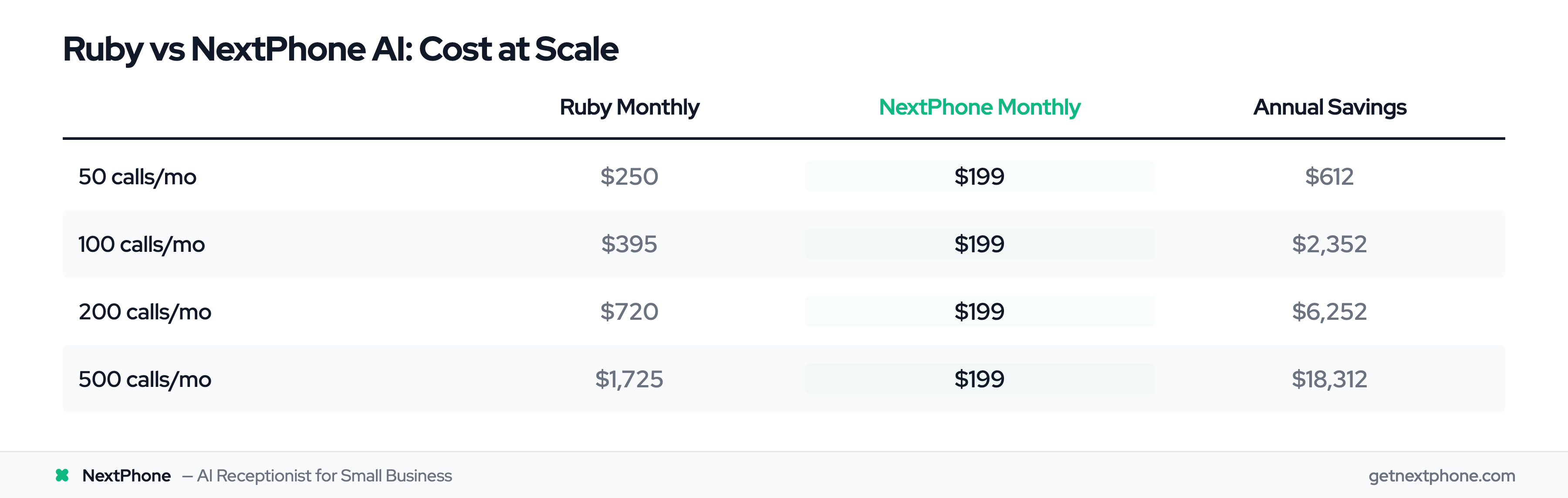
| Monthly Call Volume | Ruby Published Price | NextPhone Cost | Monthly Savings | Annual Savings |
|---|---|---|---|---|
| 50 calls | $250 (50-min plan) | $199 | $51 | $612 |
| 100 calls | $395 (100-min plan) | $199 | $196 | $2,352 |
| 200 calls | $720 (200-min plan) | $199 | $521 | $6,252 |
| 500 calls | $1,725 (500-min plan) | $199 | $1,526 | $18,312 |
*Ruby prices from ruby.com/plans-and-pricing. Assumes calls average ~1 minute each. Longer calls or overages increase Ruby costs further.
The inflection point where AI becomes notably cheaper than Ruby's per-minute model sits around 80-100 calls per month. Below that, you're paying a moderate premium for humans. Above it, the premium becomes substantial.
Cost predictability matters too. With NextPhone at $199/month, your 50-call month and 500-call month cost the same. With Ruby, budgeting is guesswork because you don't know next month's call volume. For a full breakdown, see our AI receptionist pricing guide.
When Would You Actually Pay Ruby's Premium?
Here's the reality: Ruby delivers good service at 1.3-8.7x the cost of AI. The question isn't "is Ruby good?" It's "are you getting $51-1,526/month MORE value than flat-rate AI?"
The ONE Real Exception
Complex medical triage. If you're a medical practice where 100% of calls require complex diagnostic triage (symptoms, urgency assessment, doctor routing), human services make sense. That's it.
Not medical billing offices. Not dental practices. Not healthcare support. Just complex diagnostic triage.
What About "Complex" Calls?
Ruby's marketing talks about "complex screening," "empathy," "off-script scenarios," "luxury brands," and "relationship building." Let's examine what you're actually paying for:
"Complex multi-step screening": Modern AI handles multi-step qualification fine. Budget questions? AI asks them. Authority verification? AI does it. The "reading between the lines" Ruby mentions? That's sales speak for "our humans can probe." AI probes too—and transfers the genuinely complex 20% to you.
You're paying $5.19 per call for "complex screening" of "Do you service my area?" That's not complex. That's a $0.00 question with AI.
"Emotional intelligence and empathy": When a caller is truly upset, you should talk to them anyway. Ruby receptionists are pleasant, but they're not therapists. AI detects frustrated callers ("I've been trying to reach you for 3 days!") and transfers immediately. You handle the empathy. Why pay $5.19 for a receptionist to say "I understand your frustration"?
"Off-script scenarios": AI transfers unusual requests to you. "Do you know anyone who fixes vintage iron fences?" gets forwarded. You're not saving time having Ruby handle this—they just forward it too. Difference: they charge you $5.19 for the forwarding.
"Luxury brand positioning": Your callers can't tell the difference. Our data shows 99% caller satisfaction with AI. The "luxury brand needs human touch" argument falls apart when callers are happy with AI and you're saving $2,352-18,312/year on identical experience.
"Relationship building": Ruby receptionists rotate. You're not getting the same person every time. The "Hi John, good to hear from you!" is scripted from call notes. AI accesses the same call history. The relationship value is identical.
Bottom line: If you're not a medical practice with complex triage, you're paying a premium for marketing narratives, not actual value.
When AI-First Makes More Sense: 7 Advantages of Pure AI Receptionists
AI-first receptionists win on different dimensions. Here's where AI objectively outperforms hybrid models:
1. Predictable Flat-Rate Costs
Ruby: $250-1,725/month depending on volume (before overages) AI: $199/month always, regardless of volume
Slow month with 30 calls? $199. Busy month with 250 calls? Still $199. You can budget accurately. No surprise bills during peak seasons.
2. Unlimited Scale and Capacity
AI handles 100+ calls simultaneously. If you get a surge - storm season brings 180 calls in one day, Black Friday generates 90 calls in 3 hours - AI answers all of them instantly.
Ruby uses a pool of human operators. During extreme surges, callers may wait in queue or reach voicemail. One user reported: "Black Friday 2024, we got 80 calls in 2 hours. Ruby couldn't answer them all. Some went to voicemail despite paying for the service."
3. Perfect Consistency Every Call
Your best Ruby receptionist is amazing. Your newest is still learning. AI delivers identical quality every time - no training ramp, no bad days, no turnover.
In our analysis of 130,175 calls, businesses using systematic call capture (whether AI or committed human processes) captured 100% of caller information vs ~40% with ad-hoc manual logging.
4. Instant Answer Times (<5 seconds)
AI answers in under 5 seconds. No ring time, no "please hold while I transfer you," no variability. Callers reach help immediately.
Ruby's answer time varies based on queue length and operator availability. Usually quick, but not instant.
5. 24/7 Without Premium Pricing
Ruby charges premium rates for after-hours, weekend, and holiday coverage. AI costs the same 24/7/365.
For contractors getting emergency calls at 9 PM ("My pipe burst!") or restaurants taking reservations on Sunday afternoon, 24/7 parity pricing matters.
6. Native CRM Integration
AI receptionist services offer HTTP webhooks that push data directly to your CRM (Salesforce, HubSpot, Pipedrive, etc.) during the call. Caller information automatically creates leads, updates contacts, triggers workflows.
Ruby can integrate, but it typically requires custom setup or manual entry. For businesses serious about lead tracking, automatic CRM sync is table stakes.
For details on CRM integration capabilities, modern AI platforms treat integration as a core feature, not an add-on.
7. Emergency Detection and Routing
AI can detect urgency keywords ("emergency," "urgent," "ASAP," "burst pipe," "no power") and instantly route to your mobile phone or on-call technician.
In our study of emergency service calls, 15.9% of calls contained urgency language. These calls average $4,200 in revenue - 20% higher than routine work. Missing emergency calls costs significantly more than missing quote requests.
Bottom line: If your calls are mostly straightforward (quotes, scheduling, FAQs), volume is growing, budget matters, and you need predictability, AI-first delivers better economics and operational advantages. The virtual receptionist market has reached $6.26 billion, driven by these economics.
Should You Switch from Ruby to AI? 5-Question Decision Framework
If you're currently a Ruby customer, here's how to evaluate whether switching makes sense:
The 5-Question Switching Checklist
Question 1: Are you receiving 80+ calls per month consistently?
If yes, AI's flat-rate pricing saves you $2,352-6,252+ annually. If no (under 50 calls/month), Ruby's premium is manageable.
Question 2: Are your calls mostly straightforward (quotes, scheduling, FAQs)?
If 80%+ of calls follow predictable patterns, AI handles them excellently. If every call is unique and complex, humans still win.
Question 3: Is your Ruby bill becoming a budget strain?
If you're cutting marketing or considering reducing coverage to manage costs, AI frees up that budget. If cost isn't a constraint, this matters less.
Question 4: Do you experience call volume surges that spike your bill?
Seasonal businesses (roofing in storm season, retail in Q4, tax prep in spring) see huge bill swings with per-minute pricing. AI costs the same during surges.
Question 5: Do you need CRM integration or advanced automation?
If you want caller data automatically in Salesforce, appointment confirmations via SMS, or workflow triggers, AI's native integration wins. If manual logging works fine, Ruby suffices.
You Should Consider Switching If...
- You consistently get 80-100+ calls per month
- Most calls are routine (80%+ are quotes, scheduling, basic questions)
- Your Ruby bill is $500+ monthly and climbing
- You experience seasonal surges that spike costs unpredictably
- You want systematic CRM integration without custom dev work
- Budget predictability matters for your business planning
Example good switch candidate: General contractor with 150 calls/month, mostly quote requests and appointment scheduling. Ruby bill: $720/month (200-minute plan). Switch to NextPhone at $199 saves $6,252/year.
The Only Reason to Stay with Ruby
Complex medical triage. If you're a medical practice where 100% of calls are complex diagnostic triage (symptoms, urgency assessment, doctor routing), stay with Ruby.
That's it. Every other reason is marketing:
- "Low call volume" - Even at 50 calls/month, you're paying $250 vs $199. Why overpay $51/month for identical caller experience?
- "Complex screening" - AI handles multi-step qualification and transfers the genuinely complex 20% to you
- "Luxury brand" - Callers can't tell the difference (99% caller satisfaction with AI proves it)
- "Familiar voices" - Ruby receptionists rotate; you're not getting the same person
- "Budget isn't a concern" - $2,352-18,312/year is always a concern; that's marketing budget or equipment
- "Emotionally sensitive" - You should talk to upset callers anyway; AI transfers them immediately
Reality check: If you're not a medical practice with complex triage, you're paying Ruby $51-1,526/month MORE than AI for marketing narratives.
What Happens When Call Volume Surges? Ruby vs AI Capacity
Surge capacity matters for seasonal businesses. Here's what happens when call volume spikes unexpectedly:
Ruby's Human Capacity Limits
Ruby employs a pool of live receptionists to cover their 14,000+ clients. During normal times, capacity is fine. But when multiple clients experience simultaneous surges, the shared pool gets stretched.
Storm season example: Hurricane forecast triggers 100+ roofing/restoration companies to see call spikes simultaneously. Ruby's operator pool can only handle so many concurrent calls. Some callers experience hold times or, in extreme cases, reach voicemail.
Cost impact: Even if Ruby answers all calls, your bill for that surge month will be 3-5x normal. One user reported a $950 Ruby bill for a 200-call month during storm season vs their normal $280 for 50 calls.
AI's Instant Scaling
AI handles unlimited simultaneous calls - technical architecture allows it. If 180 people call at once, all 180 reach the AI immediately. No queue, no holds, no capacity limits.
Same storm scenario: Roofing contractor normally gets 50 calls/month. Hurricane hits, 180 calls in 3 days. AI answers all simultaneously. Cost: still $199.
Real-World Surge Scenarios
Black Friday retail: "We got 90 calls in 4 hours on Black Friday. Ruby answered maybe 60 of them - others went to voicemail during peak rush. Our AI competitor friend said they handled 120 calls that day no problem." - Retail store owner
Tax season for accountant: "March and April we get 250+ calls/month. June through December maybe 40. With Ruby, our bills went from $280 in summer to $890 in spring. Now with AI, it's $199 every month." - CPA firm
Storm season for contractors: "After a hail storm, I got 210 calls in one week. Ruby bill for that month: $980. It's why I switched to flat-rate AI." - Roofing contractor
Peak season predictability: With AI, your peak month and slow month cost the same. You can budget based on one number year-round.
NextPhone: The AI-First Alternative to Ruby Receptionists
NextPhone uses the AI-first model at $199/month flat rate with unlimited calls.
NextPhone's AI-First Model
When someone calls your NextPhone number:
- AI answers in <5 seconds (no hold music)
- Natural conversation: AI asks what they need, who they are, how to reach them
- Custom questions: You configure what AI asks (budget, timeline, service type, urgency)
- Automatic capture: Every caller's info logged, transcribed, and synced to your CRM
- Transfer when needed: Complex calls or "I want to talk to a person" transfer directly to you
- Follow-up automation: AI sends SMS confirmations, appointment reminders, booking links
What You Get for $199/Month
- Unlimited calls: No per-call charges, no overage fees, no surprise bills
- Answers in 1 ring: 3x faster than call centers (Ruby takes 3-5 rings)
- 20+ languages included: Spanish, French, Mandarin, Portuguese at flat rate (Ruby charges $6-8 extra per Spanish call)
- Frontier AI technology: Built on latest GPT and Claude models (not legacy scripts)
- Trained on YOUR business: Learns from your website, knows YOUR services and pricing specifically
- Unlimited simultaneous calls: Handle any surge without capacity limits
- Live in 1-2 days: No weeks of operator training
- 100+ integrations: HTTP webhooks push data to Salesforce, HubSpot, any system with API automatically
- Local numbers anywhere: Expand to new markets without local office
- SMS automation: Send follow-up texts with booking links, confirmations, quotes
- Call recordings and transcripts: Every call recorded, transcribed, searchable
- Emergency routing: Auto-detect urgency keywords and transfer immediately
- 99% caller satisfaction: Callers can't tell it's AI—and they're happy
- Email notifications: Get notified of every call with summary and transcript
- Call transfer: AI sends complex calls directly to your phone
When to Choose NextPhone Over Ruby
NextPhone makes sense if you:
- Receive 80-100+ calls monthly (where flat rate beats per-minute economics)
- Need predictable budgeting (same cost every month)
- Experience seasonal surges (storm season, tax season, holidays)
- Want systematic CRM integration without custom development
- Need 24/7 coverage without premium after-hours pricing
- Value consistency (same quality every call, no human variability)
Real switcher example: Contractor switched from Ruby ($720/month on the 200-minute plan) to NextPhone ($199). Annual savings: $6,252. Used savings to hire part-time estimator during peak season.
| Feature | Ruby | NextPhone |
|---|---|---|
| Pricing | Per-minute ($250-1,725/mo + overages) | Flat $199/mo unlimited |
| Call capacity | Limited by operator pool | 20+ simultaneous |
| Answer time | 3-5 rings (variable) | 1 ring (<5 seconds) |
| Languages | English (Spanish costs extra) | 20+ included (Spanish $0 extra) |
| Spanish call cost | +$6-8 per call | $0 (included) |
| Technology | Human receptionists reading scripts | Frontier AI (latest GPT/Claude) |
| Business training | Generic industry scripts | Trained on YOUR specific business |
| Setup time | 3-7 days (operator training) | 1-2 days (auto-learns from website) |
| 24/7 coverage | Yes, premium pricing | Yes, same price 24/7 |
| Surge handling | Limited by human capacity | Unlimited instant scaling |
| CRM integration | Manual or custom setup | 100+ automatic integrations |
| Consistency | Varies by receptionist | Perfect every call |
| Local numbers | Their numbers only | Any US area code |
| Cost predictability | Low (varies with volume) | High (flat rate always) |
Try NextPhone AI answering service
AI answering service that answers, qualifies, and books — 24/7.
Get Started FreeFrequently Asked Questions
Is AI really as good as Ruby's human receptionists?
For straightforward calls - quotes, scheduling, service requests, basic FAQs - modern AI matches or exceeds human quality with perfect consistency. Ruby's humans win on complex multi-step screening, empathy with upset callers, and truly unusual off-script scenarios.
Think of it this way: if 80% of your calls are routine, AI handles those excellently and consistently. The 20% that need human judgment can transfer to you directly. You're not replacing human capability - you're deploying it more efficiently on calls that actually need it.
How much does Ruby Receptionists cost per month?
Ruby uses per-minute pricing with four published tiers on their plans and pricing page:
- 50 receptionist minutes: $250/month
- 100 receptionist minutes: $395/month
- 200 receptionist minutes: $720/month
- 500 receptionist minutes: $1,725/month
After-hours and weekends cost more than business hours. Your actual bill depends on how many calls you receive, how long they last, and when they come in. Calls exceeding your plan's included minutes incur per-minute overage charges.
What's the biggest advantage of AI over Ruby?
Cost predictability and unlimited scale. NextPhone costs $199/month whether you get 50 calls or 500 calls. Ruby's per-minute model means your bill fluctuates with volume - during busy months or seasonal surges, AI costs stay flat while Ruby bills can spike 2-3x.
Plus, AI handles 100+ simultaneous calls instantly. No capacity limits, no hold times, no "sorry, our operators are all busy" scenarios. For seasonal businesses (contractors in storm season, accountants in tax season, retail in Q4), this matters enormously.
When should I stick with Ruby instead of switching to AI?
Only one reason: complex medical triage.
If you're a medical practice where 100% of calls are complex diagnostic triage (symptoms, urgency assessment, doctor routing), Ruby makes sense.
Every other reason is marketing:
- "Low volume" - Even at 50 calls/month, you're paying $250 vs $199. That's $612/year for identical caller experience (99% caller satisfaction proves callers can't tell the difference).
- "High complexity" - AI handles multi-step screening and transfers the genuinely complex 20% to you. You're paying Ruby $5.19 per call for "complexity" that doesn't exist in "Do you service my area?"
- "Luxury brand" - Callers can't tell. 99% caller satisfaction with AI. You're paying $2,352-18,312/year extra for a positioning narrative, not actual value.
- "Budget flexibility" - $2,352-18,312/year is marketing budget, equipment, or salary. It's always a concern.
- "Relationship-driven" - Ruby receptionists rotate. You're not getting "familiar voices." AI accesses call history just like Ruby does.
Reality: If you're not a medical practice with complex triage, you're overpaying $51-1,526/month for marketing narratives.
Can I try NextPhone without canceling Ruby first?
Yes. Run both services in parallel as a test. Forward some calls to NextPhone, keep others going to Ruby. Test with your actual call types for 1-2 weeks and compare:
- Call quality and completeness
- Caller information capture accuracy
- How each handles your specific scenarios
- Cost at your actual call volume
- CRM integration effectiveness
Most customers test AI risk-free during NextPhone's 7-day free trial before making a final decision. If AI doesn't match Ruby's quality for your specific use case, you haven't lost anything.
Is Ruby receptionist worth it?
Ruby is worth it only if you're a medical practice with complex diagnostic triage needs. For everyone else, the math doesn't support the premium. Ruby's 50-minute plan starts at $250/month — already more expensive than NextPhone's $199 flat rate with unlimited calls. At higher volumes (100+ calls/month), the gap widens to $196-1,526/month. Ruby delivers good service, but AI matches 99% caller satisfaction at a fraction of the cost. Unless every single call requires complex human judgment, you're paying for a premium that callers can't perceive.
How much does Ruby receptionist cost per call?
Ruby's pricing is per-minute, not per-call. Their published plans run $250/month (50 minutes), $395/month (100 minutes), $720/month (200 minutes), and $1,725/month (500 minutes). The effective per-minute rate ranges from $3.45 to $5.00 depending on your plan. Overages beyond included minutes cost additional per-minute fees. By contrast, NextPhone charges $199/month for unlimited calls with no per-minute or per-call charges.
What happens to complex calls with AI that need human judgment?
NextPhone AI transfers calls to you directly when:
- It detects complexity beyond its scope
- Caller explicitly requests to speak to a person
- You've configured specific triggers (high-value lead, emergency keywords)
- Conversation goes off-script in ways AI can't handle
You get the best of both worlds: AI handles 80% of routine calls autonomously (quotes, scheduling, basic questions), transfers the 20% that genuinely need your expertise. Unlike Ruby where every call costs you per-minute charges, AI-handled calls are included in your flat rate - only the complex transferred calls require your time.
Stop Paying Ruby's Premium for Routine Calls
Here's the reality: Ruby charges $250-1,725/month (before overages) for the same caller experience AI delivers at $199/month.
The math is simple:
At 50 calls/month: You're overpaying $612/year At 100 calls/month: You're overpaying $2,352/year At 200 calls/month: You're overpaying $6,252/year
What are you buying with that extra money?
- Not faster service (AI answers in 1 ring vs 3-5 for Ruby)
- Not better language support (AI includes 20+ languages; Ruby charges extra for Spanish)
- Not better caller experience (99% caller satisfaction with AI)
- Not better technology (AI uses frontier GPT/Claude models; Ruby uses scripts)
- Not better availability (AI handles unlimited simultaneous calls; Ruby has capacity limits)
You're paying for the privilege of human voices answering "What are your hours?" That question costs you $5.19 with Ruby, $0 with AI. Callers can't tell the difference.
The only exception:
Medical practices with 100% complex diagnostic triage. That's it. Everyone else is overpaying for marketing narratives.
Test it yourself: Start your free 7-day trial with NextPhone. Compare the transcripts. Check caller satisfaction. Then look at your Ruby bill.
The math is obvious. Stop overpaying.