Key Takeaways
- 68+ million Hispanic Americans represent 20% of the U.S. population and contribute $3.6 trillion to the economy annually
- 42% of consumers refuse to purchase products or services unavailable in their preferred language
- Spanish answering services provide 24/7 bilingual support across phone, chat, and text channels
- Cultural competency matters as much as language fluency when building trust with Spanish-speaking customers
- AI-powered solutions deliver scalable, cost-effective bilingual support for businesses of any size
Introduction
The Hispanic population in the United States has grown to more than 68 million people, representing roughly one in five Americans. If U.S. Latinos were their own country, their economic output of $3.6 trillion would rank as the fifth largest economy in the world, larger than the United Kingdom, India, or France.
Yet many businesses continue to operate without Spanish answering service capabilities, effectively closing their doors to this massive and growing market. Research shows that 42% of consumers will not purchase products or services that are not available in their preferred language. For the 44.9 million Americans who speak Spanish at home, encountering an English-only phone system creates an immediate barrier to doing business.
A Spanish answering service provides businesses with bilingual phone support that serves Spanish-speaking customers with the same quality and professionalism as English-speaking callers. Whether through live agents, AI-powered systems, or a combination of both, these services ensure that language never becomes a reason for a customer to hang up and call a competitor.
This guide explores why Spanish answering service has become essential for growth-focused businesses, which industries benefit most, and how to implement bilingual phone support that builds lasting customer relationships.
Why Spanish Answering Service Matters
The Scale of the Hispanic Market

The numbers tell a compelling story about why businesses can no longer afford to ignore Spanish-speaking customers.
According to the U.S. Census Bureau, the Hispanic population reached 68.1 million in 2024, accounting for approximately 20% of the total U.S. population. This represents a 23% increase from 2010, when the Hispanic population stood at 50.5 million. Between 2010 and 2023, Latinos accounted for 56.7% of total U.S. population growth.
The American Community Survey reports that 41+ million people aged five and older speak Spanish at home, more than double the number from 1990. Spanish dominates as the most common non-English language spoken in American homes, representing 62% of all non-English language usage.
Among Hispanic immigrants, 94% speak Spanish at home. And while English proficiency has increased among U.S.-born Latinos, approximately one-third of all Hispanic Americans report they are not proficient in English.
Economic Power That Demands Attention
Hispanic economic influence extends far beyond population numbers. The Latino Donor Collaborative, in partnership with Arizona State University, reports that U.S. Latino GDP reached $3.6 trillion in 2024. This figure is projected to surpass Japan by the end of 2024 and Germany by 2027, making it the world's fourth largest economy by 2029.
Latino consumer spending reached $2.7 trillion in 2023, with projections showing continued growth. Hispanic household wealth has tripled over the past decade, and Hispanic buying power exceeded $1.9 trillion in 2023.
Perhaps most striking is the outsized contribution Latinos make to national economic growth. Between 2017 and 2022, despite comprising less than 20% of the population, Latinos were responsible for 28.3% of additions to national GDP.
The Cost of Language Barriers
When Spanish-speaking customers call a business and encounter English-only service, the consequences are immediate and measurable. PATLive reports that 42% of consumers say they will not purchase products or services that are not available in their preferred language.
This statistic reveals a fundamental truth about customer service: speaking a customer's language is not just a courtesy but a business necessity. Every unanswered Spanish call represents potential revenue walking out the door and straight to a competitor who offers bilingual support.
Cultural Competency Beyond Translation
Understanding Language Nuances
Effective Spanish answering service requires more than translating English scripts word-for-word. The Spanish language contains nuances that directly impact customer perception and satisfaction.
The most fundamental distinction is the difference between formal and informal address. Spanish has two forms of "you": the formal "usted" and the informal "tu." In customer service contexts, using "usted" demonstrates respect and professionalism. Agents who default to informal address risk coming across as unprofessional or even disrespectful.
Regional variations also matter. Spanish spoken in Mexico differs from Spanish spoken in Puerto Rico, which differs from Spanish spoken in Spain. Vocabulary, pronunciation, and even common phrases vary significantly. A Spanish answering service should understand these regional differences and adapt accordingly.
Professional vocabulary presents another consideration. Medical terminology, legal language, and technical jargon require specialized knowledge beyond conversational Spanish fluency. Agents need training in industry-specific terminology to communicate clearly and accurately.
Building Trust Through Language
Research consistently shows that customers feel more confident when speaking in their native language. When Spanish-speaking customers can express concerns clearly and understand responses without translation barriers, interactions become smoother and more productive.
Speaking a customer's mother tongue creates an emotional connection that strengthens retention. Language carries cultural meaning beyond words, and communicating in someone's native language demonstrates respect and understanding for their background.
This emotional resonance translates directly to business outcomes. Spanish-speaking agents reduce confusion, shorten handling times, and increase first-contact resolution rates. These improvements lead to stronger satisfaction scores and higher customer retention. The demand for this talent is reflected in the 438,521 bilingual customer service workers currently employed in the US.
Common Customer Service Scenarios
Spanish answering services handle the same range of inquiries as English-language support, including:
- Appointment scheduling: Medical appointments, legal consultations, service calls
- Product inquiries: Questions about features, availability, and pricing
- Billing support: Payment questions, account issues, and billing disputes
- Emergency calls: After-hours urgent matters requiring immediate response
- Complaint resolution: Addressing concerns and resolving issues with empathy
Each scenario requires cultural awareness beyond language proficiency. Understanding communication styles, expectations around formality, and cultural norms helps agents provide service that resonates with Spanish-speaking customers.
Industries with High Spanish-Speaking Customer Bases
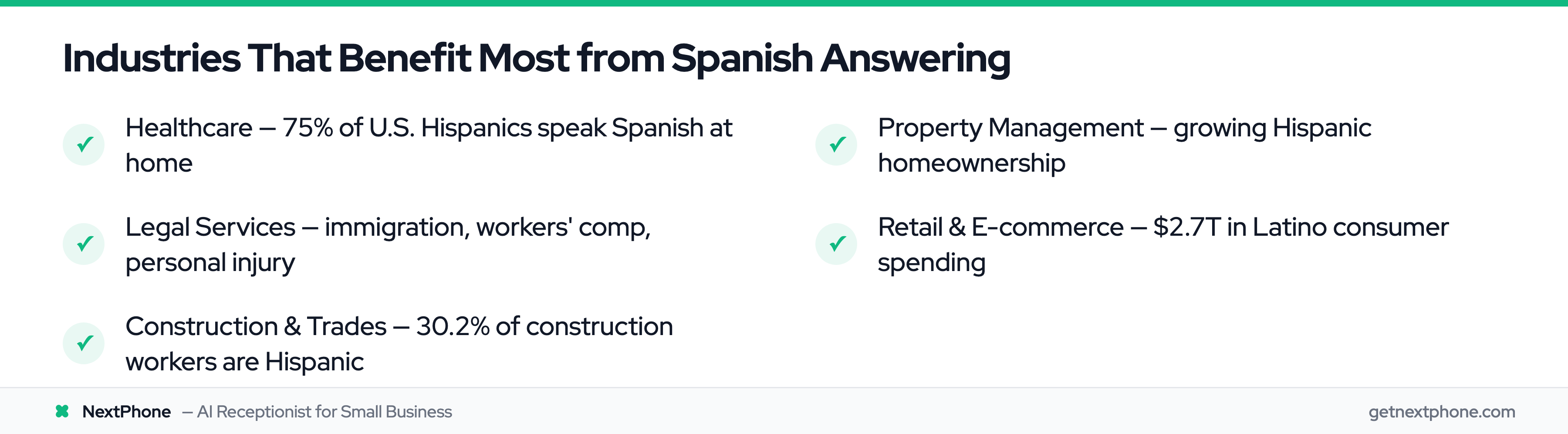
Healthcare
The healthcare industry faces particular urgency in providing Spanish-language support. Approximately 75% of U.S. Hispanics speak Spanish at home, and language barriers in healthcare settings can have serious consequences for patient outcomes.
Hispanic Americans spend an estimated $10 billion annually on health, wellness, prescription drugs, and over-the-counter products. When patients cannot communicate effectively with healthcare providers, they may misunderstand medication instructions, miss follow-up appointments, or fail to report symptoms accurately.
A Spanish answering service in healthcare settings handles appointment scheduling, prescription refill requests, nurse triage support, and general inquiries. Compliant bilingual services ensure that Spanish-speaking patients receive the same quality of care and communication as English-speaking patients.
Legal Services
The legal profession faces a significant gap between the Hispanic population and Spanish-speaking legal representation. Hispanic Americans are underrepresented in the legal profession compared to their share of the population, creating a shortage of attorneys with the language skills and cultural context to serve this community effectively.
Research shows that 65% of Spanish speakers conduct web searches on mobile devices when researching attorneys, higher than the average for all consumers. Workers' compensation claims are particularly prevalent in Hispanic-heavy industries, and immigration law, personal injury, and family law all see substantial demand from Spanish-speaking clients.
A Spanish answering service helps law firms capture leads from Spanish-speaking callers, schedule consultations, and provide basic information about services. For many potential clients, the initial phone call determines whether they choose to work with a particular firm.
Construction and Trades
The construction industry has the highest concentration of Hispanic workers of any major sector. According to Bureau of Labor Statistics data, 30.2% of the nation's 11.2 million construction workers identify as Hispanic or Latino.
Research has found that 62% of Hispanic construction workers do not speak English well or at all. This creates significant demand for Spanish-language support not only for the workforce but also for Hispanic homeowners seeking construction, HVAC, plumbing, electrical, and home repair services.
Spanish answering services help contractors and trade businesses schedule service calls, provide estimates, and respond to emergency repair requests from Spanish-speaking customers. In markets with large Hispanic populations, bilingual phone support can differentiate a business from English-only competitors.
Property Management and Real Estate
Hispanic homeownership continues to grow, and property management companies increasingly serve Spanish-speaking tenants. Maintenance requests, lease inquiries, rent payments, and emergency calls all require clear communication to ensure tenant satisfaction and property upkeep.
Real estate agents working in markets with significant Hispanic populations benefit from Spanish answering services that can handle initial inquiries, schedule showings, and provide property information to Spanish-speaking buyers and sellers.
Retail and E-commerce
Hispanic purchasing power continues to grow, and retailers who provide Spanish-language customer service gain a competitive advantage. Major retailers like Walmart recognized this trend years ago and implemented bilingual support through staff training, hiring, and translated materials.
Spanish answering services for retail businesses handle order status inquiries, returns and exchanges, product questions, and general customer support. In competitive retail markets, providing service in the customer's preferred language builds loyalty and encourages repeat purchases.
What to Look for in a Spanish Answering Service
Core Capabilities
Not all Spanish answering services deliver the same quality or range of features. When evaluating options, businesses should consider several essential capabilities.
Native Spanish-speaking agents provide the most natural and effective communication. Native speakers understand cultural nuances, regional variations, and conversational patterns that non-native speakers may miss. With 438,521 bilingual customer service workers in the US, the talent pool for Spanish-speaking support is significant.
24/7 availability ensures that Spanish-speaking customers receive support at any hour. Many Hispanic-owned businesses and Spanish-speaking consumers operate on schedules that extend beyond traditional business hours.
Multichannel support extends bilingual service beyond phone calls to include SMS, chat, and other communication channels. Some customers prefer text-based communication, and a comprehensive service addresses all preferences.
Call routing and transfer protocols determine how calls move between the answering service and internal staff. Seamless handoffs ensure that customers receive appropriate assistance without unnecessary delays or confusion.
Quality Considerations
Quality assurance separates excellent Spanish answering services from mediocre ones. Key quality factors include:
Agent training and certification demonstrates a commitment to professional standards. Agents should receive ongoing training in customer service techniques, industry knowledge, and cultural competency.
Quality monitoring through call recording and review helps identify areas for improvement and ensures consistent service delivery.
Cultural competency training goes beyond language fluency to address communication styles, customer expectations, and regional differences within the Spanish-speaking community.
Industry-specific knowledge enables agents to handle specialized inquiries accurately. Healthcare, legal, and technical industries require vocabulary and process knowledge beyond general customer service skills.
How AI Transforms Spanish Answering Services
Modern AI Capabilities
Artificial intelligence has revolutionized Spanish answering services, making bilingual support more accessible and affordable than ever before. Modern AI phone agents can conduct natural conversations in Spanish, understanding context, intent, and nuance.
Natural language processing technology has advanced dramatically, enabling AI systems to comprehend Spanish across various accents and dialects. Voice recognition handles the variations in pronunciation and speech patterns found across the Spanish-speaking world.
Real-time language switching allows AI agents to seamlessly transition between English and Spanish based on caller preference. This capability proves valuable for bilingual households where family members may have different language preferences.
Benefits of AI-Powered Solutions
AI-powered Spanish answering services offer several advantages over traditional staffing models.
Consistent 24/7 availability eliminates the staffing challenges of overnight and weekend coverage. AI agents never call in sick, never need breaks, and maintain the same quality at 3 AM as at 3 PM.
Scalability during peak periods allows businesses to handle high call volumes without hiring additional staff. Whether during seasonal rushes or marketing campaigns, AI systems scale instantly to meet demand.
Cost efficiency makes bilingual support accessible to small and medium businesses that cannot afford to staff dedicated Spanish-speaking agents. AI solutions typically cost a fraction of equivalent human staffing.
Consistent experience ensures that every caller receives the same quality of service. AI agents follow scripts precisely and never have off days that affect customer interactions.
NextPhone's Spanish Language Features
NextPhone provides AI phone agents with native-level Spanish fluency designed for business communication. The system handles natural conversations, schedules appointments, answers questions, and captures leads in both English and Spanish.
Language detection happens automatically based on the caller's speech, eliminating the need for "press 2 for Spanish" menus that add friction to the customer experience. Callers simply speak, and the AI responds in the appropriate language.
Custom scripts and industry-specific training ensure that NextPhone's Spanish answering capabilities address the unique needs of each business. Whether handling medical appointment scheduling, legal intake, or service requests, the AI adapts to industry requirements.
Integration with existing business systems means that information captured during Spanish calls flows directly into CRM platforms, scheduling software, and other tools. Businesses maintain a single source of truth for all customer interactions regardless of language.
Implementing Spanish Answering Service for Your Business
Assessment Phase
Successful implementation begins with understanding your current situation and needs.
Analyze call volume and language needs by reviewing call logs or implementing tracking to identify how many Spanish-speaking customers currently call your business. If you do not currently offer Spanish support, survey your customer base or analyze demographic data for your service area.
Identify peak Spanish-speaking customer times to ensure adequate coverage during high-demand periods. Regional patterns and industry norms influence when Spanish-speaking customers are most likely to call.
Review customer demographics by location if you serve multiple markets. Some locations may have significantly higher Spanish-speaking populations than others.
Evaluate existing service gaps by considering complaints, missed calls, or lost opportunities related to language barriers. Staff observations often reveal pain points that data alone may miss.
Setup and Configuration
Script development in Spanish should go beyond translation to create natural, culturally appropriate dialogue. Work with native Spanish speakers to develop scripts that sound natural rather than translated.
Greeting and call flow customization ensures that Spanish-speaking callers receive a welcoming experience from the first moment. Consider whether to offer Spanish as a menu option or implement automatic language detection.
Integration with existing phone systems requires technical coordination to ensure seamless call handling. Cloud-based solutions typically offer easier integration than on-premises systems.
Staff training on handoff procedures prepares internal teams to receive calls transferred from the answering service. Clear protocols prevent confusion and ensure smooth customer experiences.
Launch and Optimization
Pilot testing with sample calls helps identify issues before full deployment. Involve native Spanish speakers in testing to catch cultural or linguistic problems.
Quality monitoring through call recording and review enables continuous improvement. Regular quality assessments ensure that service meets expectations.
Customer feedback collection provides direct insight into the Spanish-speaking customer experience. Surveys in Spanish, follow-up calls, and review monitoring all contribute valuable information.
Performance metrics tracking quantifies the impact of your Spanish answering service. Compare key metrics before and after implementation to measure ROI.
Calculating the Business Impact
Key Metrics to Track
Measuring the return on investment from Spanish answering service requires tracking specific metrics.
Call answer rates reveal whether Spanish-speaking customers can reach your business. Compare answer rates before and after implementing Spanish support.
Customer satisfaction scores (CSAT) from Spanish-speaking customers indicate service quality. Survey customers in Spanish to gather accurate feedback.
First-contact resolution rates measure how effectively issues are resolved during the initial call. Language barriers often require multiple contacts to resolve issues.
Conversion rates from Spanish inquiries show how effectively phone calls turn into customers. Track leads and sales generated from Spanish-language calls.
Customer retention among Hispanic customers indicates long-term relationship building. Compare retention rates between customers served in English versus Spanish.
Building the Business Case
The business case for Spanish answering service combines revenue opportunity with cost avoidance.
Revenue from new customers represents the most direct benefit. If language barriers have prevented you from serving Spanish-speaking customers, bilingual support opens access to this market.
Reduced customer churn preserves existing revenue. Customers who receive service in their preferred language are more likely to remain loyal.
Competitive differentiation provides market advantage in areas with large Hispanic populations. Being the business that welcomes Spanish-speaking customers builds reputation and referrals.
Operational efficiency improves when language barriers are removed. Faster resolution times and fewer miscommunications reduce cost per interaction.
Best Practices for Spanish Customer Service
Organizations that excel at Spanish-language customer service follow consistent principles.
Hold Spanish teams to the same standards as English teams. Quality expectations, response time targets, and performance metrics should not differ based on language.
Provide ongoing training on regional dialects and cultural differences. The Spanish-speaking world encompasses many cultures, and effective service acknowledges this diversity.
Offer Spanish support across all channels. Customers expect consistent experience whether they call, text, chat, or email. Omnichannel Spanish support demonstrates comprehensive commitment.
Collect feedback in Spanish. Surveys and feedback forms should be available in Spanish to ensure honest, detailed responses from Spanish-speaking customers.
Monitor quality consistently. Regular call reviews and quality assessments maintain service standards over time.
Update scripts and training for cultural relevance. Language evolves, and what works today may feel dated in a few years. Periodic updates keep service fresh and appropriate.
Conclusion
The Hispanic market represents a massive opportunity that continues to grow. With 68 million Hispanic Americans contributing $3.6 trillion to the economy, businesses that fail to serve Spanish-speaking customers leave significant revenue on the table.
A Spanish answering service transforms potential barriers into competitive advantages. By providing bilingual support that combines language fluency with cultural competency, businesses build trust and loyalty with Spanish-speaking customers.
Whether through AI-powered solutions like NextPhone or traditional staffing approaches, implementing Spanish answering service has become a business necessity rather than a luxury. The 42% of consumers who refuse to purchase without preferred language support will spend their money somewhere, and businesses with Spanish capabilities will capture their share.
Evaluate your current Spanish language capabilities today. Consider the demographics of your service area, the languages your customers speak, and the opportunities you may be missing. The investment in Spanish answering service pays dividends through new customers, improved retention, and stronger relationships with the Spanish-speaking community.
Frequently Asked Questions
What is a Spanish answering service?
A Spanish answering service provides businesses with bilingual phone support that handles calls from Spanish-speaking customers. These services employ native Spanish-speaking agents or AI-powered systems that can conduct natural conversations in Spanish, taking messages, answering questions, scheduling appointments, and capturing leads. Spanish answering services operate on behalf of the business, providing a seamless extension of the company's customer service capabilities.
How much does a Spanish answering service cost?
Pricing varies based on call volume, hours of coverage, and service features. Traditional live agent services typically charge per minute or per call, with monthly minimums ranging from $100 to $500 for small businesses. AI-powered solutions like NextPhone often provide more predictable pricing with monthly subscriptions that include unlimited calls. When evaluating cost, consider the revenue potential from serving Spanish-speaking customers and the cost of lost business from language barriers.
Do I need bilingual staff if I use a Spanish answering service?
Not necessarily. A Spanish answering service can handle all Spanish-language calls independently, taking messages, scheduling appointments, and answering common questions. However, some situations may require transferring calls to internal staff, such as complex technical issues or sales negotiations. Many businesses use Spanish answering services as their primary bilingual support without employing in-house Spanish-speaking staff.
Can a Spanish answering service handle different dialects?
Quality Spanish answering services train agents to understand and communicate with Spanish speakers from various regions, including Mexico, Central America, the Caribbean, South America, and Spain. While vocabulary and pronunciation vary across regions, professional agents learn to adapt their communication style based on caller needs. AI-powered services like NextPhone use advanced language models trained on diverse Spanish language data to handle regional variations naturally.
What industries benefit most from Spanish answering services?
Industries with high Hispanic customer or workforce representation see the greatest benefits. Healthcare practices serving Hispanic patients, law firms handling immigration or workers' compensation cases, construction and home service contractors, property management companies, and retail businesses all benefit significantly. Any business in a market with substantial Hispanic population can gain competitive advantage through Spanish-language support.
How do AI-powered Spanish answering services work?
AI-powered Spanish answering services use natural language processing and machine learning to conduct phone conversations in Spanish. When a caller speaks Spanish, the AI recognizes the language and responds naturally in Spanish. These systems can understand context, answer questions, schedule appointments, and capture information just like human agents. Advanced AI virtual receptionist technology like NextPhone uses voice technology that sounds natural rather than robotic, creating positive customer experiences while operating 24/7 without staffing limitations.
How quickly can I implement a Spanish answering service?
Implementation timelines vary based on complexity. Basic setup with standard scripts can launch within days. More customized implementations with industry-specific training, system integrations, and detailed call protocols may require several weeks. AI-powered solutions typically implement faster than traditional services because they do not require hiring and training human agents. Many businesses begin with standard configurations and customize over time based on experience.
Ready to capture your share of the Hispanic market? NextPhone's AI phone agents provide native-level Spanish support 24/7, ensuring that every Spanish-speaking caller receives the service they deserve. [Learn more about our bilingual capabilities.]
