Why Seattle Businesses Are Missing Calls (And Revenue)
It's 2 PM on a Tuesday in Capitol Hill. You're a plumber crawling under a 1920s Craftsman home, fixing a corroded pipe. Your phone buzzes in the truck outside. Then again. And again.
By the time you climb out, brush off the cobwebs, and check your phone, you've missed three calls. Two went to voicemail. One didn't leave a message at all.
This scenario plays out thousands of times daily across Seattle. And the numbers are worse than you think.
Industry research shows that 74.1% of calls to home services businesses go completely unanswered. That's nearly three out of every four potential customers who called and got nothing but a voicemail prompt.
Here's what makes that statistic brutal: 85% of callers who don't reach someone won't call back. They don't leave a message. They don't try again later. They call the next business on their list. This is the core of the missed calls problem that plagues small businesses everywhere.
For Seattle contractors, that means every missed call during a busy season could be a $3,500 job walking out the door. Multiply that across a year, and you're looking at six figures in lost revenue.
But here's the good news: a Seattle answering service with a local 206 number can capture those calls 24/7, whether you're under a house, on a roof, or at dinner with your family.
Why Your Seattle Business Needs a 206 Number
When someone in Ballard sees a 206 number on their caller ID, they think "local business." When they see an 800 number, they think "telemarketer" and let it go to voicemail.
That instinct isn't irrational. It's backed by data.
The History of Seattle's 206 Area Code
The 206 area code is one of the original area codes established in 1947 when the North American Numbering Plan was created. For decades, it covered the entire state of Washington.
As the population grew, 206 was split multiple times:
- 1995: Area code 360 was created for Western Washington outside Seattle
- 1997: Area codes 253 (Tacoma) and 425 (Eastside) were carved out
Today, 206 covers only the Seattle urban core: downtown, Capitol Hill, Queen Anne, West Seattle, Beacon Hill, and nearby communities like Shoreline and SeaTac. It's become synonymous with Seattle itself.
For businesses, having a 206 number signals that you're a genuine Seattle company, not a call center in another state pretending to be local.
Local Numbers Build Trust
Studies show that customers prefer doing business with local companies. A 206 number acts as an immediate trust signal. It bypasses the skepticism that comes with toll-free or out-of-state area codes.
The Seattle metro area has more than 100,000 small businesses and about 2.55 small businesses per 100 residents, making it the 7th highest concentration in the country. In a market that competitive, every trust signal matters.
Answer Rates: Local vs Toll-Free
Here's where the numbers get interesting. According to industry research from Hiya and Truecaller, local numbers see answer rates of 60-70%, while toll-free numbers hover around 40-50%.
That's a significant gap. If you're making outbound calls or sending texts to confirm appointments, having a 206 number means more people will actually pick up.
Even for inbound calls, caller ID reputation matters. Customers who see a local number are more likely to call back if they missed you, because they recognize it as a legitimate local business rather than spam.
Seattle Answering Service Options: Which One Fits Your Business?
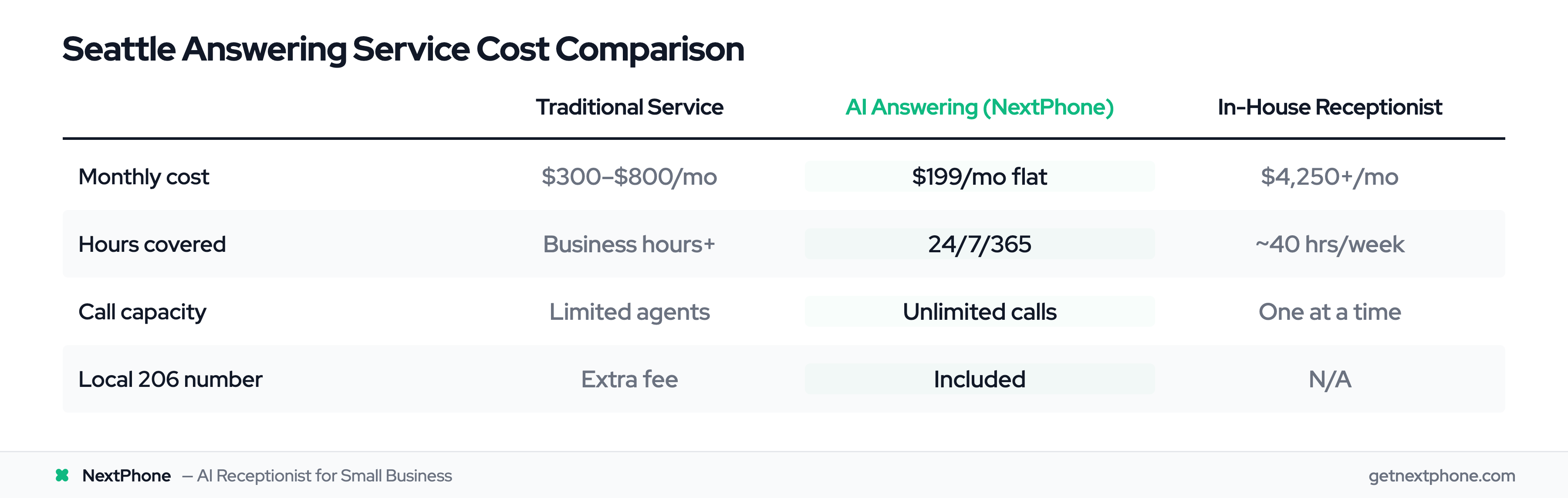
Not all answering services work the same way. Here's a breakdown of what's available to Seattle businesses and what each option costs.
Traditional Live Answering Services
Traditional live answering services like AnswerConnect, MAP Communications, and Cascade Answering Solutions employ real human operators who answer your calls according to scripts you provide.
How it works: Calls forward to their call center. A live operator answers with your business name, takes a message, and either emails it to you or patches the caller through.
Pricing: Typically $0.80-$1.25 per minute of talk time, with monthly minimums of $100-300. High call volumes can push costs to $500-800/month or more.
Best for: Businesses that need a personal touch for every call, complex intake processes, or clients who specifically want to speak to a human.
Cascade Answering, a Seattle-area company, advertises effective rates as low as $0.13-$0.45 per hour depending on call volume, which can be cost-effective for lower-volume businesses.
AI-Powered Answering Services
AI answering services use conversational artificial intelligence to handle calls. The technology has improved dramatically in recent years, and modern AI can understand context, answer questions, and have natural-sounding conversations.
How it works: Calls are answered instantly by an AI trained on your business information. It can answer common questions (hours, pricing, service areas), book appointments, and take messages.
Pricing: Flat monthly rates, typically $199-$300/month with unlimited calls.
Best for: Businesses with high call volumes, after-hours coverage needs, or routine inquiries that don't require human judgment.
Hybrid Solutions (AI + Human Backup)
The hybrid model combines AI efficiency with human availability. AI handles routine calls (which make up 60-80% of most business calls), while complex situations get transferred to a live person.
How it works: AI answers immediately, handles what it can, and transfers calls when needed. You can set rules like "transfer all calls mentioning 'emergency'" or "transfer if the caller asks to speak to a person."
Pricing: Varies by provider. NextPhone offers this at $199/month flat.
Best for: Most small businesses. You get 24/7 instant coverage without paying per-minute rates, plus smart forwarding to you when needed.
Virtual Receptionist Services
Virtual receptionists are dedicated staff (usually remote) who work specifically for your business. They're more personalized than call centers but less expensive than hiring in-house.
How it works: A trained receptionist learns your business and handles calls as if they were sitting in your office. They can schedule appointments, answer questions, and make outbound calls.
Pricing: $300-800/month depending on hours and call volume. Smith.ai, which serves the Seattle market, starts at around $300/month.
Best for: Businesses that need a high-touch experience, handle sensitive client matters (like law firms), or want someone who can do more than just answer calls.
Which Seattle Businesses Need an Answering Service?
Some industries benefit more from answering services than others. Here's how different Seattle businesses use them.
Home Services Contractors
Seattle's climate creates year-round demand for home services contractors. The rainy winters mean plumbing emergencies. The freeze-thaw cycles stress pipes. And when the heat goes out in January, customers need help immediately.
In our call data, urgent calls using language like "emergency," "urgent," or "ASAP" rank among the top reasons people call. True emergencies are a recurring reason too: burst pipes, no power, furnace failures in freezing weather.
December through February sees the highest volume of emergency heating repair calls in Seattle. Companies like Greenwood Heating and Allred note that heating emergencies don't follow business hours, and many of these calls come at night or on weekends.
For contractors, missing these calls means losing to whoever answers first. One plumber running a two-truck shop racked up 76 missed calls in a single month. He told us, "I didn't even know I was missing that many calls until I saw the data. I just thought business was slow."
Medical and Dental Practices
Medical offices face a different challenge: high call volumes during business hours when staff are also checking in patients, processing paperwork, and handling questions in person.
After-hours, patients still need to schedule appointments, request prescription refills, and ask about symptoms. Without an answering service, those calls go to voicemail, and patients may book with a competitor instead.
AI answering services can handle appointment scheduling, collect patient information, and route urgent medical questions to an on-call provider.
Legal Firms
For law firms, first impressions matter. Potential clients calling about a car accident or divorce are often stressed and emotional. Getting voicemail can feel impersonal and may send them to another firm.
Legal intake is also complex. The right questions need to be asked to qualify leads and gather case information. This is where virtual receptionists or hybrid AI solutions shine, as they can follow detailed scripts while maintaining a professional tone.
Property Management and Real Estate
Property managers deal with tenant emergencies at all hours. A burst pipe at 2 AM needs immediate attention. A lockout on a Sunday morning can't wait until Monday.
Real estate agents face intense competition. When a buyer calls about a listing, the first agent to respond often wins the client. An answering service ensures you never miss that initial inquiry.
How Much Does a Seattle Answering Service Cost?
Let's talk numbers. Understanding the true cost requires comparing apples to apples.
Traditional Answering Service Pricing
Most traditional services charge per minute of talk time:
- Budget tier: $0.80-$1.00/minute with monthly minimums around $100
- Mid-range: $1.00-$1.25/minute with additional features like appointment scheduling
- Premium: Custom pricing for high-volume or specialized needs
For a business receiving 50 calls per month averaging 3 minutes each (150 minutes), expect to pay $200-$400/month at realistic volumes.
Some services advertise low starting prices, but that's for very low call volumes. Realistic costs for active businesses run $300-800/month with overages.
AI Answering Service Pricing
AI services typically charge flat monthly rates regardless of call volume:
- Standard plans: $199-$250/month (full features, unlimited calls)
- Premium plans: $300+/month (advanced integrations, priority support)
NextPhone, for example, offers unlimited calls at $199/month with a 206 Seattle number included. There are no per-minute charges, no overage fees, and no surprises. For a complete breakdown, see our AI receptionist pricing guide.
Hiring a Seattle Receptionist: The Alternative
Let's compare to hiring someone in-house.
According to local wage data, the average receptionist in Seattle earns $20.54 per hour. BLS data shows the national median at $17.90/hour, but Seattle's higher cost of living pushes wages up.
At $20.54/hour for a full-time position:
- Annual salary: $42,723
- Plus benefits: Add 20-30% for health insurance, PTO, payroll taxes
- True cost: $51,000-$55,000/year
And here's the catch: that receptionist only works 40 hours per week, roughly 9-5. They take lunch breaks. They get sick. They take vacation.
Your phone doesn't stop ringing at 5 PM. Our data shows that a significant portion of calls to home services businesses happen outside traditional business hours, precisely when your in-house receptionist has gone home.
The Real Cost: Missed Calls
Here's where the math gets interesting.
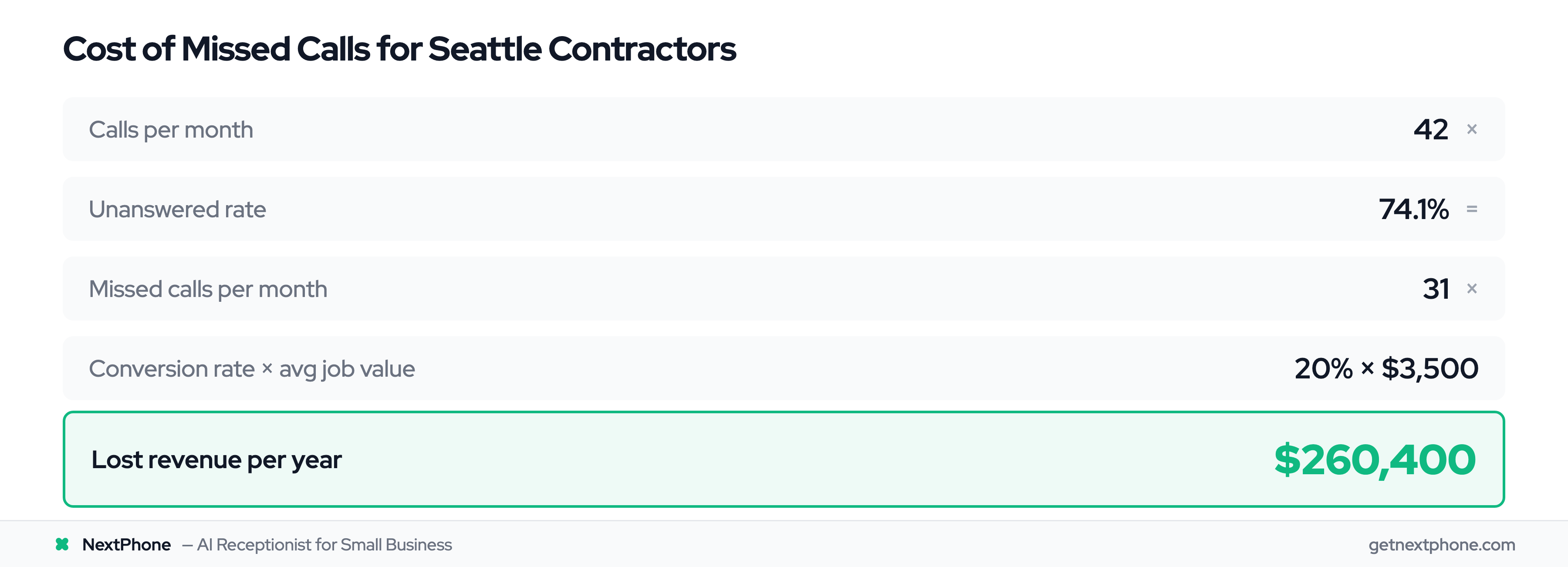
For a typical Seattle contractor receiving 42 calls per month:
- 74.1% go unanswered = 31 missed calls
- If 20% would have converted at $3,500 average job value
- Lost revenue: $21,700 per month, or $260,400 per year
Compare that to $199/month for an AI answering service, and the ROI becomes obvious. Even capturing just one extra job per month pays for the service many times over.
AI Answering Service vs Live Agents: Seattle Business Guide
Should you go with AI or stick with human operators? The honest answer: it depends on your business. Here's how to think through the AI vs human receptionist decision.
When AI Works Best
AI answering services excel at handling routine inquiries that make up the bulk of most business calls:
- Hours and location questions: "Are you open on Saturdays?"
- Pricing inquiries: "How much do you charge for a service call?"
- Appointment scheduling: "Can I book someone for next Tuesday?"
- Service area questions: "Do you serve Kirkland?"
- Basic FAQs: "Do you offer financing?"
AI answers these calls instantly, in under 5 seconds. There's no hold time, no waiting for the next available operator. At 3 AM, the AI sounds exactly as professional and alert as it does at 3 PM.
For Seattle businesses dealing with high call volumes or lots of routine inquiries, AI handles 60-80% of calls without any human intervention.
When You Need Human Agents
Some situations still call for a human touch:
- Emotionally charged calls: A customer upset about a bill or a client going through a difficult situation
- Complex negotiations: Detailed project scoping or custom quotes
- VIP relationships: Long-standing clients who expect personal attention
- Unusual requests: Anything that falls outside normal parameters
The good news is that good AI systems recognize these situations. When a caller asks to speak to a person or uses language suggesting frustration, the AI can transfer the call immediately.
The Hybrid Advantage
The best approach for most businesses is hybrid: AI for the routine stuff, humans for the complex stuff.
Here's how it works in practice:
- AI answers every call instantly
- Handles routine questions, books appointments, takes messages
- Detects urgency keywords like "emergency" or "burst pipe"
- Routes urgent calls to your phone immediately
- Transfers to a human when the caller requests it
This gives you 24/7 coverage at a flat monthly rate, while ensuring no caller ever feels trapped talking to a machine that can't help them.
How NextPhone Gives You a 206 Number + 24/7 AI Answering
NextPhone combines everything Seattle businesses need: a local 206 number, AI-powered answering, and the flexibility to route calls based on your rules.
Get a Local 206 Seattle Number
When you sign up, you can choose a 206 area code number that becomes your business line. Alternatively, you can keep your existing number and forward calls to NextPhone.
Either way, callers experience the same thing: instant pickup, professional greeting, and intelligent conversation that represents your business well.
AI Answers Every Call in Under 5 Seconds
NextPhone's AI is trained on your specific business. You tell it your services, pricing, hours, and service area. You give it answers to common questions. It learns how you want calls handled.
When someone calls, the AI greets them by name (if they're a returning caller), asks how it can help, and has a natural conversation. It can answer questions, book appointments, take messages, and send follow-up texts with booking links.
Emergency Routing for Urgent Calls
This is where NextPhone shines for Seattle's home services businesses.
The AI listens for urgency signals: words like "emergency," "flooding," "no heat," "burst pipe." When it detects these, it immediately offers to connect the caller to you.
You set the rules. Maybe you want all emergency calls forwarded to your cell. Maybe you want them during certain hours only. Maybe you have an on-call rotation. NextPhone handles it.
At $199/month with unlimited calls, it costs less than 5% of what you'd pay a Seattle receptionist, and it works 24/7/365, including during the January cold snaps when your phone rings off the hook.
Frequently Asked Questions
How much does a Seattle answering service cost?
Traditional per-minute services typically run $300-500/month for active businesses, with premium virtual receptionist coverage reaching $800+/month. AI answering services like NextPhone offer flat-rate pricing at $199/month with unlimited calls, which provides the best value for most small businesses.
Can I get a local 206 Seattle phone number?
Yes. Most answering services offer 206 area code numbers, either as your primary business line or as a forwarding number. NextPhone includes a 206 number with your subscription at no extra charge. You can also port your existing number or keep it and forward calls.
What's the difference between an answering service and a virtual receptionist?
An answering service handles incoming calls based on scripts: taking messages, providing basic information, and forwarding calls. A virtual receptionist is more like a remote employee, handling calls with greater personalization, scheduling appointments, making outbound calls, and learning the details of your business. AI receptionists combine elements of both with 24/7 availability.
Do Seattle answering services offer after-hours coverage?
Most do. In fact, after-hours coverage is the primary reason businesses use answering services. This is especially important in Seattle, where emergency heating calls peak during winter months and plumbing emergencies don't wait for business hours. AI services provide the same quality at 3 AM as they do at 3 PM.
Can an answering service handle emergency calls?
Good services detect urgency and route accordingly. NextPhone, for example, listens for keywords like "emergency," "flooding," or "no heat" and immediately offers to connect the caller to you or your on-call staff. In our data, urgent calls rank among the top reasons people call, so this feature matters for Seattle home services businesses.
Is an AI answering service as good as a live person?
For routine calls, AI often performs better: faster pickup, consistent responses, no hold time, 24/7 availability. For complex or emotional situations, humans still excel. The best approach is hybrid: AI handles the 60-80% of calls that are routine, and transfers to humans when needed. Customers increasingly prefer this, with research showing 60-70% are comfortable with AI for simple tasks as long as they can reach a human if needed.
Start Answering Every Seattle Call Today
Seattle's competitive business environment doesn't forgive missed calls. When 74% of calls go unanswered and 85% of those callers never try again, every ring is an opportunity that expires in seconds.
A 206 area code signals that you're a real Seattle business. An AI answering service ensures that every caller reaches someone, any time of day or night. Together, they give you the local presence and availability that wins customers.
At $199/month, NextPhone costs 93% less than hiring a Seattle receptionist and works around the clock. Setup takes minutes. You can get a 206 number or forward your existing line.
The businesses winning in Seattle aren't necessarily the biggest or the cheapest. They're the ones answering every call.
